Cybersecurity Standards for Generative AI: NIST, ISO, and SOC 2 Controls
You just deployed a generative AI chatbot to handle customer support. It’s fast, it’s helpful, and it’s terrified your legal team. Why? Because you’re asking a probabilistic engine to make deterministic promises about data privacy and security. If you think slapping an ISO 27001 certificate on your server rack covers you, you’re missing the point entirely.
The landscape of Cybersecurity Standards for Generative AI is shifting under our feet. In 2026, we aren’t just talking about firewalls; we’re talking about prompt injection, model poisoning, and hallucinations that leak proprietary data. Three major frameworks dominate the conversation: NIST AI RMF, ISO/IEC 27001, and SOC 2. But here’s the kicker: only one of them was built specifically for the chaos of generative AI.
Why Traditional Security Fails GenAI
Traditional cybersecurity assumes data sits in a database and moves through defined pipes. Generative AI breaks that assumption. Your data enters a "black box" model, gets transformed by weights and biases you can’t fully see, and exits as new text or images. This creates risks that standard controls don’t touch.
Consider Prompt Injection. A hacker doesn’t need to break your SQL database; they just need to trick your AI into ignoring its instructions. Standard WAFs (Web Application Firewalls) often miss this because the input looks like normal user traffic. Or take Data Poisoning. If someone feeds malicious data into your training pipeline, your model learns bad habits. You won’t know until the model starts giving confidently wrong answers to every user.
This is why generic standards feel inadequate. They protect the container, not the content. To secure GenAI, you need controls that address the lifecycle of the model itself-from training data integrity to output validation.
NIST AI RMF: The Gold Standard for Risk
If you want a roadmap that actually speaks the language of AI, look at the National Institute of Standards and Technology (NIST) AI Risk Management Framework (AI RMF). Released in 2023 and expanded with the Generative AI Profile in July 2024, this framework is currently the most relevant tool for US-based organizations.
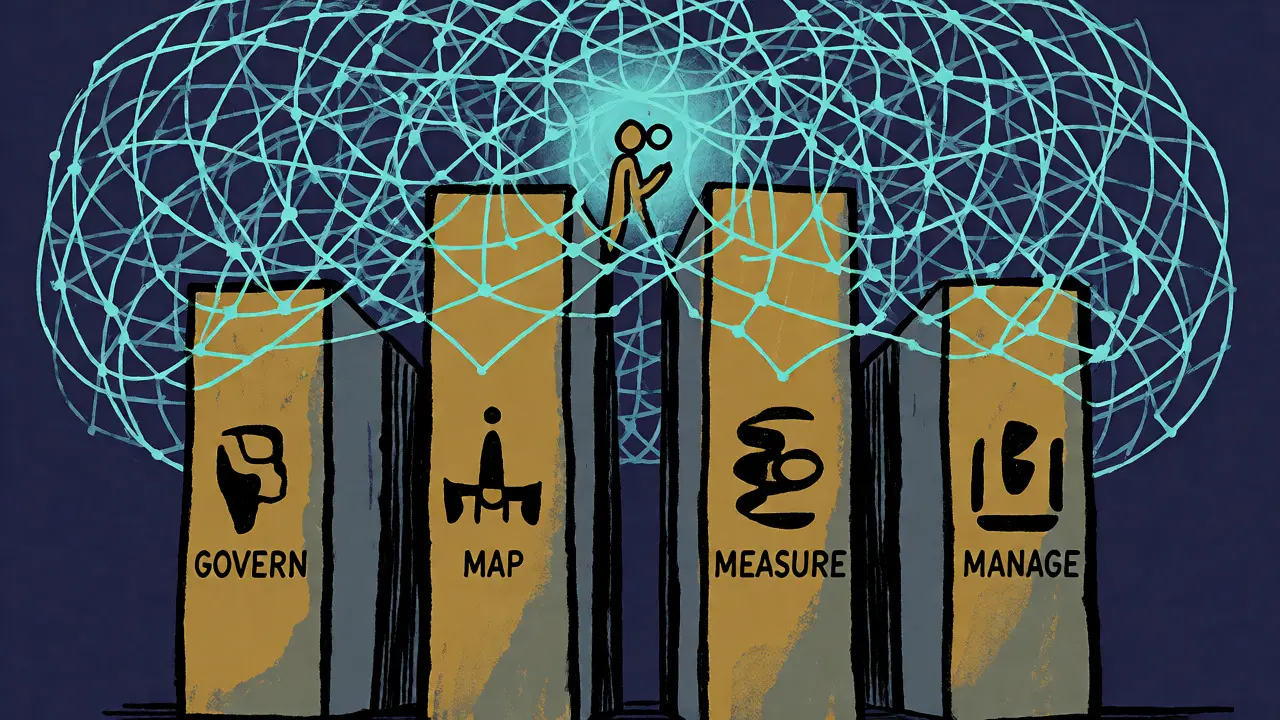
The AI RMF isn’t a checklist; it’s a mindset shift built on four functions: Govern, Map, Measure, Manage.
- Govern: Establishes accountability. Who owns the AI? Who is liable if it hallucinates a contract term?
- Map: Identifies context. Where does the data come from? What are the known biases?
- Measure: Uses metrics to test trustworthiness. Is the model accurate? Is it fair?
- Manage: Prioritizes and acts on risks. How do you patch a model?
The Generative AI Profile adds specific layers for LLMs (Large Language Models). It highlights 12 unique risks, including information integrity (fake news generation) and intellectual property leakage. For example, NIST recommends strict TEVV (Test, Evaluation, Validation, Verification) processes before deployment. You can’t just ship an LLM update; you have to prove it didn’t regress in safety benchmarks.
| Feature | NIST AI RMF / GenAI Profile | ISO/IEC 27001:2022 | SOC 2 Type II |
|---|---|---|---|
| Primary Focus | AI-specific risk management and trustworthiness | Information Security Management System (ISMS) | Service organization controls (Security, Availability, etc.) |
| GenAI Specificity | High (Explicitly addresses LLM risks) | Low (General IT security, requires custom mapping) | Low (No native AI controls, relies on interpretation) |
| Adoption Driver | US Federal mandates, enterprise best practice | Global trade requirements, EU alignment | B2B sales requirement, client trust |
| Key Control Example | Content provenance tracking, TEVV testing | Access control, encryption, incident response | Logical access, change management, backup recovery |
| Implementation Effort | Moderate-High (Requires cross-functional teams) | Moderate (Well-documented path) | Moderate (Audit-heavy process) |
ISO/IEC 27001: The Global Baseline
ISO/IEC 27001 remains the international benchmark for information security. If you sell software to Europe or Asia, you likely need this certification. However, ISO 27001 is silent on generative AI.
So, how do companies use it? They map AI risks to existing Annex A controls. For instance, protecting the confidentiality of training data falls under A.5.12 Classification of Information. Ensuring the availability of the AI service falls under A.8.14 Redundancy of Information Processing Facilities.
The problem is ambiguity. When auditors ask, "How do you ensure the integrity of the AI model?", there is no specific ISO clause for "model drift." You end up writing custom statements of applicability. While ISO is working on ISO/IEC 42001 (an AI management system standard), widespread adoption hasn’t hit yet. For now, ISO 27001 is a necessary foundation, but it’s not sufficient for GenAI security on its own.
SOC 2: The Sales Enabler
If you’re a B2B SaaS company, SOC 2 is probably already on your radar. Clients demand it to prove you handle their data safely. SOC 2 focuses on five Trust Service Criteria: Security, Availability, Processing Integrity, Confidentiality, and Privacy.
Here’s where it gets tricky for AI. SOC 2 doesn’t care if your AI is "trustworthy" in a philosophical sense; it cares if you have controls to prevent unauthorized access. Did you log who prompted the AI? Yes? Good. Did you restrict which employees can fine-tune the model? Yes? Good.
However, SOC 2 lacks guidance on things like Prompt Leakage. If a user asks the AI to repeat its system prompt, and the AI spits out internal instructions containing API keys, is that a security breach? Under traditional SOC 2 definitions, maybe not, unless you explicitly define it as a confidential asset. Many CISOs report building hybrid frameworks-using SOC 2 for the infrastructure and NIST for the AI logic-to satisfy both auditors and engineers.

Implementing Controls: What Actually Works
Reading frameworks is easy; implementing them is hard. Based on recent industry surveys, here is what successful organizations are doing right now in late 2026.
1. Data Provenance and Lineage
You must track where every byte of training data came from. If you scraped copyrighted books, can you prove it wasn’t used for commercial inference without license? NIST emphasizes Content Provenance. Implement metadata tagging for all AI-generated outputs so you can trace back to the source model version and input parameters.
2. Pre-Deployment Testing (TEVV)
Don’t rely on manual spot checks. Automate your Test, Evaluation, Validation, and Verification pipelines. Use adversarial testing tools to throw edge-case prompts at your model before it goes live. If your model fails a red-team attack simulation, it doesn’t deploy. Period.
3. Third-Party Vendor Management
Most companies don’t train their own base models; they use APIs from OpenAI, Anthropic, or Meta. Your security posture depends on theirs. Ensure your contracts include clauses for model updates. If the provider changes the underlying model silently, your performance and safety profiles might shift overnight. Monitor for these changes actively.
4. Human-in-the-Loop Workflows
For high-stakes applications (like healthcare or finance), automation alone is risky. Implement workflows where human experts review AI outputs before they reach the end-user. This satisfies the "Govern" function of NIST by establishing clear accountability chains.
Regulatory Pressure and Future Outlook
The days of voluntary adoption are ending. In the US, federal contractors are facing pressure to adopt NIST frameworks. California’s proposed SB 1047 aims to mandate NIST-aligned controls for large generative AI developers. Meanwhile, the EU’s AI Act pushes for transparency that aligns closely with NIST’s "Map" and "Measure" functions.
Looking ahead, expect NIST to release Control Overlays for Securing AI Systems (COSAIS) soon. These will provide more prescriptive technical controls, bridging the gap between high-level risk management and specific firewall rules. Gartner predicts that by 2027, 60% of large enterprises will use NIST-derived frameworks for AI security, up from 25% today.
Don’t wait for the law to force your hand. Start with NIST AI RMF to understand your risks, layer ISO 27001 for global credibility, and maintain SOC 2 to keep your customers happy. It’s not about choosing one; it’s about orchestrating them to cover the blind spots each leaves behind.
Is NIST AI RMF mandatory for private companies?
Currently, NIST AI RMF is voluntary for most private sector entities in the US. However, it is becoming a de facto standard for enterprise procurement. Additionally, federal contractors may face mandatory requirements, and state laws like those proposed in California could make compliance legally binding for specific sectors.
Can SOC 2 replace NIST for AI security?
No, SOC 2 is not designed to replace NIST for AI-specific risks. SOC 2 focuses on general service organization controls like access management and uptime. It lacks specific guidance on AI-centric threats such as model poisoning, prompt injection, or bias mitigation. Most mature organizations use SOC 2 alongside NIST frameworks.
What is the biggest challenge in implementing ISO 27001 for GenAI?
The main challenge is mapping non-deterministic AI behaviors to static security controls. ISO 27001 assumes predictable system behavior, whereas generative AI produces variable outputs. Organizations struggle to define "integrity" for an AI model and often have to create custom control objectives to satisfy auditors regarding model drift and data leakage.
How long does it take to implement NIST AI RMF?
Initial assessment typically takes 6-12 weeks. Full implementation varies by size; small businesses might complete core governance structures in 3 months, while large enterprises often require 6-12 months to integrate the framework across all departments, establish measurement metrics, and automate validation pipelines.
Does ISO/IEC 42001 replace ISO 27001 for AI?
No, ISO/IEC 42001 is an AI Management System standard that complements ISO 27001. While 27001 handles information security broadly, 42001 provides specific guidelines for managing AI systems, including ethical considerations and impact assessments. Companies often implement both to cover security and AI governance comprehensively.