
Evaluation Benchmarks for Generative AI Models: From MMLU to Image Fidelity Metrics
When you hear that a new AI model scored 90% on MMLU-Pro, what does that really mean? It sounds impressive-until you realize that number tells you almost nothing about how well the model writes a poem, draws a realistic landscape, or explains a medical diagnosis in plain language. The truth is, we’ve been measuring generative AI the wrong way for years. We focus on multiple-choice tests that don’t require generation at all. And while benchmarks like MMLU and MMLU-Pro became the gold standard, they left out half the picture: how well AI creates, not just selects.
Why MMLU and MMLU-Pro Dominated AI Evaluation
MMLU, short for Massive Multitask Language Understanding, was designed in 2020 as a way to test how much an AI model actually knows. It wasn’t about memorizing facts-it was about applying knowledge across 57 subjects, from law to microbiology to moral philosophy. Each question had four choices. Human experts, on average, got about 90% right. That became the target.
By 2024, models like GPT-4 and Claude 3 were hitting 88% or higher. It looked like AI was catching up to humans. But something was off. The same models that scored 89% on MMLU would spit out nonsense when asked to write a coherent essay or answer an open-ended question. Why? Because MMLU didn’t ask them to generate anything. It asked them to pick from a list. You could score perfectly by recognizing patterns, not by understanding.
That’s where MMLU-Pro came in. Released in late 2025, it was built to fix the flaws. Instead of four choices, it had ten. Instead of undergraduate-level questions, it used graduate-level ones-12,000 of them, reviewed by PhDs and AI researchers. The goal? To make guessing impossible. To force reasoning.
The results were eye-opening. GPT-4, which scored 90.2% on MMLU, dropped to 72.6% on MMLU-Pro. Llama 3 70B Instruct fell from 82% to 56.2%. That 25-point drop wasn’t a bug-it was a feature. It meant the original MMLU scores were inflated by surface-level tricks. MMLU-Pro exposed how little many models truly understood.
And here’s the kicker: MMLU-Pro is stable. Change the wording of the question? The model’s score barely moves. That’s because it’s not about phrasing-it’s about logic. Chain-of-thought prompting, where the model explains its reasoning step-by-step, actually helps on MMLU-Pro. On the old MMLU? It often made things worse.
The Hidden Flaw: No Generation, No Real Evaluation
Here’s the uncomfortable truth: MMLU and MMLU-Pro don’t evaluate generative AI. They evaluate selection AI. You can build a model that scores 90% on MMLU-Pro and still be terrible at generating text, code, or images. It’s like judging a chef based on their ability to pick the right ingredient from a menu-not on how they cook it.
This gap has real consequences. Companies use MMLU scores to justify funding, research grants, and product launches. But if the benchmark doesn’t reflect actual performance, then progress is an illusion. A model might dominate MMLU-Pro, yet fail to produce a single coherent paragraph when asked to explain quantum entanglement to a 10-year-old.
Some labs are trying to fix this. Google’s GenEval and Anthropic’s OpenResponse are new benchmarks that require models to generate full answers, not just pick one. These are harder to score, slower to run, and more expensive. But they’re honest. They measure what matters: the ability to create.
What About Images? The Missing Half of Generative AI
So far, we’ve only talked about language. But generative AI isn’t just about words. It’s about images, audio, video, even 3D models. And here, the problem is even worse. There’s no MMLU for images.
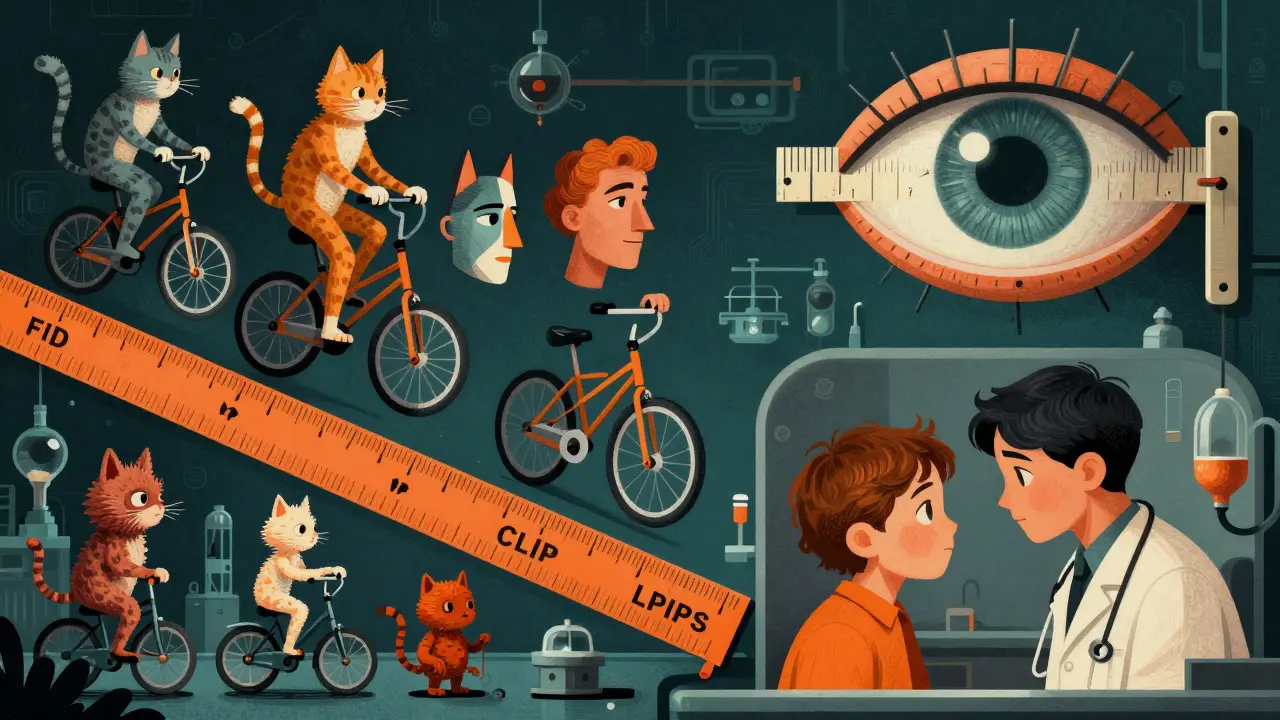
How do you measure if an AI-generated photo of a cat riding a unicycle on Mars is realistic? You can’t just ask it to pick from four options. You need to evaluate realism, composition, lighting, anatomy, and consistency with the prompt. That’s where image fidelity metrics come in.
Metrics like FID (Fréchet Inception Distance), CLIP Score, and LPIPS (Learned Perceptual Image Patch Similarity) are now used to judge image generators like DALL·E 4, Stable Diffusion 3, and Adobe Firefly 2. FID compares the statistical distribution of generated images against real ones. Lower scores mean better fidelity. CLIP Score measures how well the image matches the text prompt using a vision-language model. LPIPS looks at perceptual differences-how similar two images look to a human, not just pixel-by-pixel.
But even these have limits. A model might score high on FID but still generate creepy, unnatural faces. Or it might perfectly match the prompt but violate physics-like showing a floating car with no wheels. We’re still far from a single, reliable metric that captures realism, creativity, and correctness together.

Why We Need a New Framework
We’re stuck in a world where AI progress is measured by a single number on a leaderboard. But real-world performance doesn’t work that way. A model that scores 89% on MMLU-Pro might be great at answering trivia, but useless for customer service. A photo generator with a low FID might look perfect in a lab, but fail to render a person’s glasses correctly in a real ad campaign.
What we need is a layered evaluation system:
- Knowledge & Reasoning: Use MMLU-Pro to test broad understanding.
- Generative Quality: Use open-ended prompts to test coherence, creativity, and accuracy in text, code, or dialogue.
- Image Fidelity: Use FID, CLIP, and LPIPS to judge visual realism and prompt alignment.
- Real-World Robustness: Test how models handle edge cases, bias, safety, and unexpected inputs.
Right now, most companies only report one metric-the one that makes them look best. That’s not progress. That’s gaming the system.
The Future: Benchmarks That Reflect Reality
The next big leap in AI evaluation won’t come from adding more multiple-choice questions. It’ll come from creating benchmarks that mirror real tasks.
Imagine a test where a model has to:
- Read a patient’s medical history.
- Generate a clear, accurate summary for a doctor.
- Draw a labeled diagram of the affected organ.
- Explain the diagnosis in simple terms for the patient.
That’s not just a benchmark. That’s a job. And if AI can do that well, then we’ll know it’s ready.
Until then, treat MMLU-Pro scores like a GPA-not a guarantee of ability. A high score means the model studied hard. It doesn’t mean it can think.
Is MMLU-Pro the best benchmark for AI models?
MMLU-Pro is the most rigorous benchmark for testing broad knowledge and reasoning in language models-but it’s not the best overall. It doesn’t measure generation, creativity, or safety. For a full picture, you need to combine it with open-ended tests and multimodal evaluations like image fidelity metrics. Think of MMLU-Pro as one tool in a toolkit, not the whole toolbox.
What’s the difference between MMLU and MMLU-Pro?
MMLU has 57 subjects with four answer choices per question. MMLU-Pro expands to 12,000 graduate-level questions with ten answer choices. The extra options make guessing nearly impossible. MMLU-Pro also requires deeper reasoning, is more stable across different prompt styles, and better separates top-performing models. Most models score 15-30% lower on MMLU-Pro than on MMLU, revealing how inflated earlier scores were.
Why don’t image benchmarks like FID tell the whole story?
FID measures how statistically similar generated images are to real ones, but it doesn’t care if the image makes sense. A photo of a cat with six legs might have a low FID if it looks realistic-but it’s wrong. CLIP Score checks if the image matches the text, but it can’t catch subtle errors like floating objects or distorted anatomy. We need metrics that combine realism, correctness, and creativity-not just one number.
Can a model score high on MMLU-Pro but still be unreliable in practice?
Absolutely. A model can ace MMLU-Pro by memorizing patterns or exploiting biases in the question design, yet fail to generate a coherent paragraph when asked to explain something new. MMLU-Pro tests knowledge and reasoning in a controlled setting-but real-world use involves ambiguity, emotion, and unpredictability. Benchmarks are useful, but they’re not a substitute for real-world testing.
Are there any benchmarks that test generative ability directly?
Yes. Benchmarks like GenEval (by Google), OpenResponse (by Anthropic), and HELM (Holistic Evaluation of Language Models) require models to generate full responses instead of selecting answers. These are harder to automate, slower to run, and more expensive-but they give a much clearer picture of how well a model actually performs in real tasks like writing, coding, or explaining.






MMLU-Pro is just the latest fad to make researchers feel smart while ignoring the real problem: AI can't write a damn email without sounding like a robot that ate a thesaurus. We're so obsessed with numbers we forgot to ask if it can actually do anything useful. I asked one to explain why my cat hates the vacuum and it gave me a 12-paragraph lecture on feline behavior theory. Meanwhile my 7-year-old niece just said 'because it's loud' and was 100% right. We're not building intelligence. We're building very expensive parrots.
You know what's wild? We treat AI like it's supposed to be human but then we test it like it's a multiple-choice exam for undergrads. That's like judging a painter by how well they can identify colors in a flashcard game. The real test should be: can it make you feel something? Can it write a letter that makes your grandma cry? Can it draw a sunset that makes you pause and just... breathe? Metrics don't capture wonder. They capture compliance. And we're running out of time to build something that actually matters not something that just ticks boxes on a leaderboard.
I think there's a deeper issue here that nobody's talking about. We're not just measuring AI-we're measuring our own expectations. We want AI to be perfect at everything: logical, creative, empathetic, accurate, fast, safe. But humans aren't like that. We're messy. We make mistakes. We improvise. We get emotional. Maybe the problem isn't that AI is failing benchmarks-it's that we're asking it to be something it never was meant to be. A tool, not a person. A helper, not a replacement. Maybe instead of building a model that scores 90% on MMLU-Pro, we should build one that knows when to stay quiet. That might be the hardest benchmark of all.
FID scores are garbage. I ran a test last week where a model generated a perfect image of a dog wearing a top hat. Low FID. High CLIP. Looks great. But the dog had six legs. And the top hat was floating 2 inches above its head. The metrics didn't care. Humans did. We care about physics. We care about logic. We care about whether something makes sense. Not just whether it looks pretty. We need benchmarks that include error detection. Not just beauty contests.
I appreciate the effort to critique current benchmarks, but let's not throw the baby out with the bathwater. MMLU-Pro isn't perfect-but it's a step forward. The fact that models are now being forced to reason rather than guess is meaningful. And yes, image metrics are flawed-but they're the best we've got. Maybe the solution isn't abandoning metrics altogether, but layering them. Use MMLU-Pro for reasoning, GenEval for generation, FID for visuals, and add a real-world task test where the model has to complete an actual job-like drafting a legal email or labeling a medical scan. One number doesn't define capability. A portfolio does.