
Generative AI Target Architecture: Designing Data, Models, and Orchestration
When you move from a demo to a production-grade system, you aren't just "using an AI"; you are building a multi-layered machine. According to industry data from Snowflake, companies that actually nail this architectural approach see efficiency gains of 40-60% in their content workflows. But those who wing it often find that 70% of their failures aren't because the model was "too small," but because their data architecture was a mess. To get this right, you need to stop thinking about the AI as a single tool and start thinking about it as a pipeline of data, models, and orchestration.
The Foundation: Data Processing and Vectorization
You cannot feed a raw PDF or a messy SQL table directly into a foundation model and expect magic. The data layer is where the real work happens. In a modern setup, this starts with a Data Integration Layer is the system responsible for collecting, cleaning, and transforming raw enterprise data into a format AI can actually use . If your data is dirty, your AI will be confidently wrong.
One of the biggest breakthroughs in recent years is the move toward Vector Embeddings is the process of converting text or images into numerical arrays that represent semantic meaning . Instead of searching for keywords, vectorization allows the system to understand concepts. For example, if a user asks about "winter clothing," a vector-based system knows to look for "coats" and "scarves" even if those exact words aren't in the query.
To store these embeddings, you need a Vector Database is a specialized storage system designed to index and retrieve high-dimensional vectors with high speed and accuracy , such as Pinecone or Azure Cosmos DB. Gartner research shows that using these specialized databases improves retrieval accuracy by about 22% compared to traditional relational databases. However, be warned: this adds complexity. You'll spend more time configuring how you "chunk" your data-breaking long documents into smaller, meaningful pieces-than you will picking the model.
The Brain: Model Selection and Fine-Tuning
Now we get to the part everyone talks about: the models. Most enterprise architectures today use a hybrid approach. You don't just pick one model; you pick the right tool for the specific job. You might use a massive model like Gemini Ultra is a highly capable multimodal foundation model from Google with up to 1.8 trillion parameters for complex reasoning, but a smaller 7B parameter model for simple classification tasks to save on costs and latency.
There are two main ways to make a model "smart" about your specific business: fine-tuning and RAG. Fine-tuning is like sending the AI to graduate school-you retrain it on your specific dataset. It's great for teaching the AI a specific style or a niche medical language. However, it's expensive and the data gets outdated the moment you finish training.
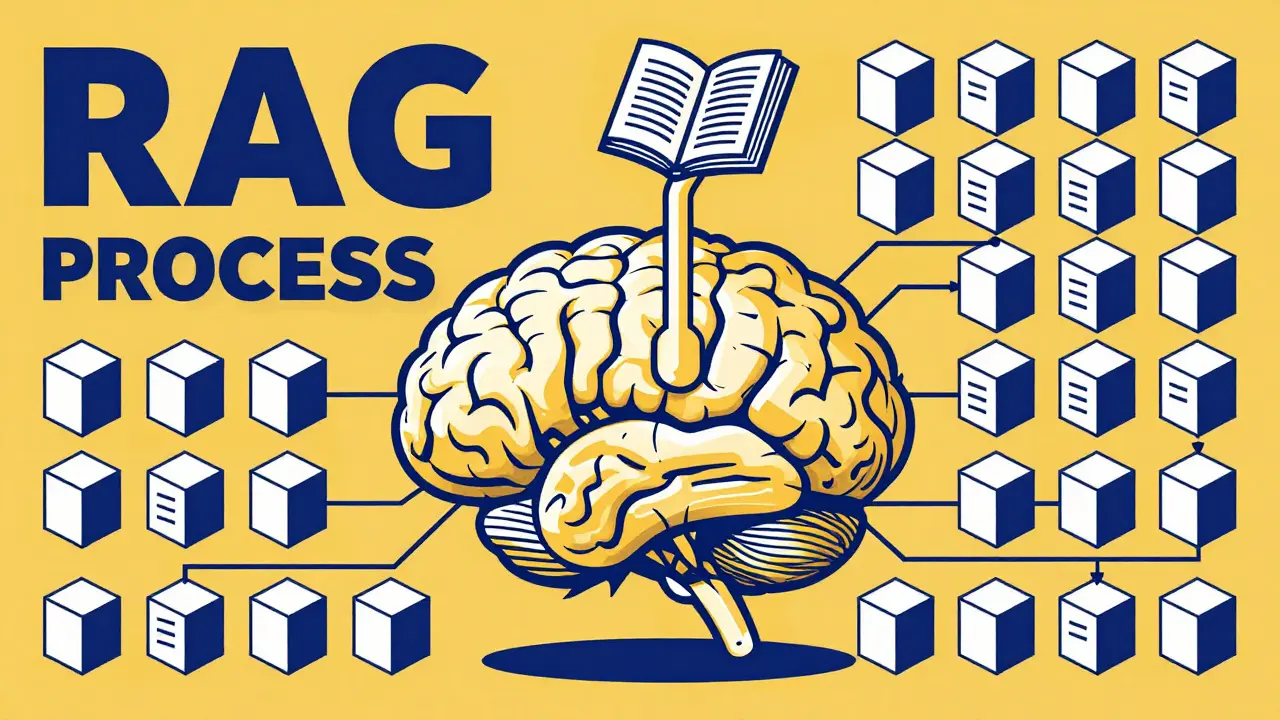
That's why Retrieval-Augmented Generation (RAG) is an architectural pattern that retrieves relevant documents from an external knowledge base and provides them to the LLM as context for generating a response has become the industry standard. RAG doesn't change the model; it gives the model an "open book" to look at. AWS reports that RAG can drop hallucination rates from 27% down to 9% in enterprise settings because the AI is citing actual documents rather than guessing from its training data.
| Feature | Fine-Tuning | RAG (Retrieval-Augmented Generation) |
|---|---|---|
| Knowledge Update | Requires retraining (Slow) | Real-time via database updates (Fast) |
| Factual Accuracy | Prone to hallucinations | High (citations provided) |
| Compute Cost | High (GPU intensive training) | Medium (Vector search + Inference) |
| Best Use Case | Learning a specific tone or jargon | Knowledge bases, FAQs, Technical docs |
The Glue: Orchestration Frameworks
If data is the foundation and the model is the brain, Orchestration Frameworks are software layers that manage the flow of data between the user, the vector database, and the AI model are the nervous system. Without orchestration, you just have a bunch of disconnected parts. These frameworks handle the "chain" of events: taking a user's question, rewriting it for better search, fetching the right data from the vector store, and then formatting the final prompt for the LLM.
Dr. Andrew Ng has pointed out that these frameworks are the unsung heroes of production AI. They turn a brittle demo into a robust system. A key part of this layer is the "Guardrail." Since LLMs can be tricked into ignoring their rules (prompt injection), you need a security layer that filters both the input and the output. OWASP has reported that over 50% of implementations are vulnerable to these attacks if they don't have a dedicated orchestration layer for security.
Modern orchestration also involves managing "Agents." Instead of one long prompt, the system breaks a task into smaller steps. For example, if a customer asks to "Compare my last three invoices and summarize the price increase," an agent-based architecture will: 1) Search for the invoices, 2) Extract the totals, 3) Calculate the difference, and 4) Write the summary. This modular approach is far more reliable than asking a model to do it all in one go.
The Infrastructure: Powering the Machine
You can't run a target architecture like this on a standard laptop. The infrastructure layer is where the rubber meets the road. For training and heavy fine-tuning, you're looking at high-performance hardware like NVIDIA A100 GPUs is industry-standard hardware accelerators designed specifically for deep learning and AI training . According to Snowflake, a typical enterprise setup requires at least 8-16 of these GPUs for training and 2-4 for inference.
Latency is the silent killer of AI adoption. If your system takes 45 seconds to respond because your vector database is poorly configured, users will abandon it. Most enterprise benchmarks aim for a response time between 200ms and 500ms. To achieve this, architects are moving toward "composable AI," where they can swap out a slow model for a faster one (like moving from GPT-4 to a distilled version) without rewriting the entire data pipeline.
Closing the Loop: Feedback and Evaluation
The most dangerous mistake you can make is deploying an AI and assuming it's "done." AI models drift. The way people ask questions changes, and the data they need evolves. This is why a Feedback Layer is a mechanism for collecting human-in-the-loop ratings and automated metrics to improve model performance over time is mandatory.
Look at the Mayo Clinic's diagnostic support system. They didn't just launch a model; they built a tight loop where clinicians could flag incorrect suggestions. This simple feedback mechanism improved their diagnostic accuracy by 29%. Without this, you're flying blind. MIT research shows that systems with human feedback loops have 41% higher user satisfaction, even though they take about 30% longer to build. The extra time spent on the feedback layer pays off in the long run by preventing a total system failure after 18 months of use.
What is the difference between a standard LLM and a RAG architecture?
A standard LLM relies entirely on the data it was trained on, which means it has a knowledge cutoff date and can hallucinate facts. A RAG (Retrieval-Augmented Generation) architecture allows the LLM to look up real-time, private, or specific information from a vector database before answering, which significantly increases factual accuracy and allows the AI to cite its sources.
How much compute power do I actually need for enterprise AI?
It depends on whether you are training or just running inference. For training a custom model, you typically need a cluster of 8-16 NVIDIA A100s or Google Cloud TPUs. For inference (running the model for users), 2-4 high-performance GPUs are usually sufficient for mid-sized enterprise applications, though cloud-managed services like Azure AI Studio or Vertex AI abstract much of this away.
Why is "chunking" important in a data architecture?
Chunking is the process of breaking large documents into smaller, semantic pieces. If you upload a 50-page PDF as one chunk, the vector embedding becomes too generic. If you chunk it too small, you lose context. Proper semantic chunking ensures that the retrieval system finds the exact paragraph needed to answer a question, which can be the difference between 52% and 85% accuracy in a RAG system.
Is a vector database always better than a traditional database?
For AI retrieval, yes. Traditional RDBMS (Relational Database Management Systems) search for exact matches or keywords. Vector databases search for mathematical similarity in meaning. While they are more complex to configure, they typically offer a 22% improvement in retrieval accuracy for knowledge-heavy applications.
How do I protect my AI architecture from prompt injections?
You need a dedicated orchestration layer that acts as a firewall. This involves implementing input sanitization (checking the user's prompt for malicious instructions) and output filtering (ensuring the AI's response doesn't violate company policy). Using specialized tools like AWS Guardrails can automate much of this security hardening.
Next Steps for Implementation
If you're just starting, don't try to build the whole seven-layer cake at once. Start with a phased approach. Spend your first two months focusing exclusively on the data architecture-cleaning your docs and testing your chunking strategies. Once your retrieval is accurate, spend the next few months selecting the right model and building the orchestration layer. Finally, deploy a small pilot with a heavy focus on the feedback loop. This gradual rollout prevents the "45-second response time" disasters seen in rushed implementations and ensures your system is actually usable before you scale it to the whole company.








rly love how this breaks down the whole mess.. most people just throw a prompt at a bot and wonder why its broken lol
The sheer audacity of suggesting that a handful of A100s is "sufficient" for a truly robust enterprise scale!!! It is positively quaint, almost adorable, how this simplifies the gargantuan struggle of GPU orchestration... an absolute travesty of nuance!!!
I think it's so cool how the data part is like the roots of a tree... if the roots are bad, the leaves won't grow right!! :) :)
Actually, everyone knows that Pinecone is way too expensive for most of these startups. Most of them are just using pgvector and pretending it's a "specialized" solution because they want to look fancy :) :)
rag is just a fancy way of sayin the model is too stupid to remember things 🙄 lol. just fine tune the damn thing properly instead of using these crutches 🤡
It is "saying," not "sayin." Get some basic education before you try to criticize architectural patterns you clearly don't understand! Your lack of linguistic precision is as embarrassing as your technical take!
Now now, lets just focus on the great points here!! I think the bit about chunking is really helpfull and most of us struggle with that part anyway so its okay to make mistakes while learning
keep it positive everyone!
Oh please, as if most companies even have "clean" data to begin with. It's an absolute joke. We're talking about spending months on data cleaning only for a manager to change the requirements in a single Tuesday meeting and blow the whole pipeline apart. It's practically a tragedy in three acts: hope, implementation, and total systemic collapse. I've seen a dozen projects fail exactly like this and it's always the same delusional optimism about the "foundation" that kills it. Give me a break.
This is the energy we need!!! Just imagine the scale of a system where agents actually handle the logic flow without human intervention... the efficiency would be insane! Just go for it!
I'm just sitting here staring at my flickering monitor feeling the crushing weight of a thousand misconfigured embeddings... it's a digital purgatory and this post just reminds me that my career is essentially a slow-motion train wreck in a sea of vector space. I can practically feel the heat from the GPUs melting my remaining will to live. It's honestly poetic how a "target architecture" just describes the exact shape of my professional failure.