Human-in-the-Loop Operations for Generative AI: A Practical Guide to Review, Approval, and Exceptions
You’ve deployed a large language model. It’s fast, it’s cheap, and it’s generating content by the thousands. But then you spot a hallucinated statistic in a customer email or a tone-deaf response in a support ticket. That single error can cost more than the efficiency gains from the last hundred perfect outputs. This is where Human-in-the-Loop (HITL) operations become critical. It’s not just about catching errors; it’s about building a structured workflow where humans actively review, approve, and manage exceptions before AI-generated content hits the real world.
If you’re an operations leader or an AI engineer, you know that "set it and forget it" doesn’t work with generative AI yet. The gap between an 85% accurate model and a business-ready system is filled by human judgment. This guide breaks down how to build that bridge without turning your team into a bottleneck.
Why You Can’t Just Trust the Model
Let’s be honest: generative AI is probabilistic, not deterministic. It predicts the next token based on patterns, not truth. Dr. Andrew Ng pointed out in his March 2024 newsletter that without oversight, these systems risk propagating harmful content at scale. In one case study of unreviewed customer service bots, toxic content generation spiked by 27%. That’s not a minor glitch; that’s a brand crisis waiting to happen.
Enterprises aren’t adopting HITL because they love manual work. They do it because the stakes are high. According to Forrester’s Q2 2024 AI Governance Report, 78% of enterprises now implement some form of human oversight. In regulated sectors like financial services and healthcare, that number jumps to nearly 90%. Why? Because regulations like SEC Regulation AI-2023 mandate human oversight for customer-facing outputs. If you skip this step, you’re not just risking quality; you’re risking compliance fines.
The Core Workflow: Review, Approve, Exception
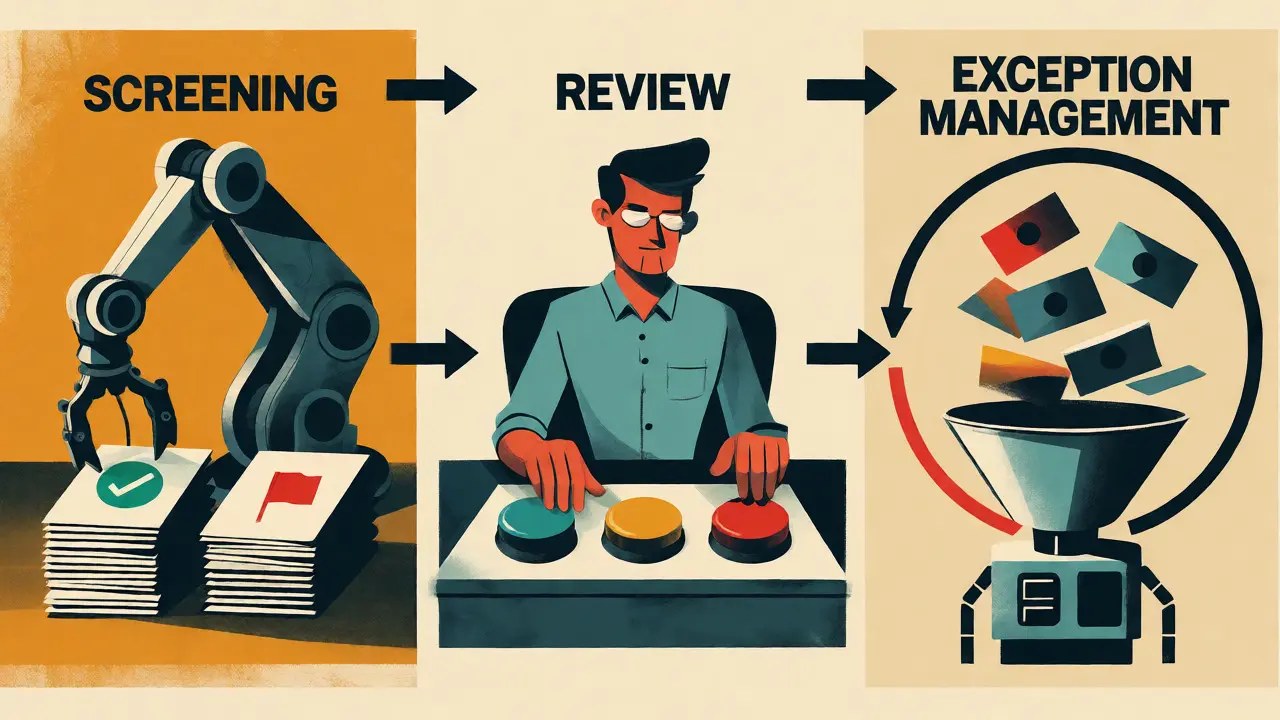
A robust HITL operation isn’t just "a person looks at it." It’s a three-stage pipeline designed to filter noise and focus human attention where it matters most. Here is how successful teams structure it:
- Automated Screening (The Filter): Before a human ever sees the output, the AI scores its own confidence. Most systems use a threshold-typically between 85% and 90%. If the model says, "I’m 95% sure this is correct," it auto-publishes. If it says, "I’m only 60% sure," it gets flagged. AWS reports that properly tuned confidence thresholds can correctly identify content needing review with 92.7% precision.
- Structured Human Review (The Judge): The flagged item goes to a reviewer. Crucially, this shouldn’t be a blank text box. Reviewers need predefined options: "Approve," "Edit," "Reject," or "Escalate." This standardizes decisions and makes data collection easier. KPMG found that training their staff on specific "Trusted AI" policies reduced review errors by 31%, though it initially slowed things down by 18% until the process normalized.
- Exception Management (The Loop): What happens when a reviewer rejects an output? It doesn’t just disappear. It becomes an exception log entry. These exceptions feed back into the system. Did the AI fail because of a lack of context? Or was it a prompt issue? Tracking these exceptions allows you to retrain models or tweak prompts, creating a feedback loop that improves accuracy over time.
HITL vs. HOTL: Know the Difference
People often confuse Human-in-the-Loop (HITL) with Human-on-the-Loop (HOTL). They sound similar, but they operate very differently, and picking the wrong one can break your workflow.
| Feature | Human-in-the-Loop (HITL) | Human-on-the-Loop (HOTL) |
|---|---|---|
| Role of Human | Active participant in decision-making before deployment. | Monitor who intervenes only when necessary. |
| Timing | Pre-production or pre-deployment gate. | Post-deployment monitoring. |
| Best For | High-stakes, regulated, or customer-facing content. | Low-risk internal tools or highly mature models. |
| Risk Level | Low (errors caught before exposure). | Medium (errors may reach users first). |
Think of HITL as a bouncer at the club checking IDs before entry. HOTL is security walking around inside the club, watching for trouble after people are already dancing. For generative AI in its current state, especially for external communications, you usually want the bouncer. Conductor’s Academy notes that HOTL is viable only when AI reliability is extremely high, which remains rare for complex generative tasks.
Technical Architecture: Making It Scale
You can’t run this on spreadsheets. Once you hit hundreds of reviews a day, you need orchestration. Tools like AWS Step Functions workflow orchestration service have become the gold standard for managing these states. They handle the logic: "If confidence < 85%, send to Queue A. Wait for human input. If approved, publish. If rejected, log exception."">
Here’s what a solid technical stack looks like:
- State Management: Use a serverless orchestrator to track each document or response through its lifecycle. This ensures no item gets lost in limbo.
- Identity & Access: Integrate with your existing identity provider (like Okta or Azure AD). You need to know exactly who approved what for audit trails.
- Notification Triggers: Don’t make reviewers refresh a page. Use webhooks to push low-confidence items to Slack, Teams, or email immediately.
- API Endpoints: When a human clicks "Approve," the system must call an API (like `SendTaskSuccess` in AWS) to resume the automated workflow. Latency here should be minimal.
Tredence’s 2024 case studies show that well-architected HITL systems reduce AI error rates by 63-78% while still maintaining 40-60% efficiency gains compared to fully manual processes. The key is automation surrounding the human touch, not replacing it.
Common Pitfalls and How to Fix Them
Even with good tech, implementations fail if you ignore the human element. Professor Fei-Fei Li’s Stanford HAI report identified three major failure modes in 127 enterprise deployments. Let’s tackle them head-on.
1. Inconsistent Review Standards
This happened in 68% of failed implementations. One reviewer approves a joke in a marketing email; another rejects it. To fix this, you need Standard Operating Procedures (SOPs). Spend 30-40% of your project time defining exactly what "good" looks like. Create rubrics. Show examples of approved vs. rejected content. Without this, your data will be noisy, and your model won’t learn effectively.
2. Reviewer Fatigue and Bottlenecks
KPMG reported a 22% increase in review times during peak usage before they added AI-powered pre-filtering. Humans get tired. After reviewing 50 items, quality drops. Mitigate this by rotating reviewers, limiting daily quotas, and using AI to highlight specific issues (like potential toxicity) so humans don’t have to scan every word. Reddit users in r/MachineLearning frequently cite "dramatically reduced review fatigue" as a win when pre-filtering works well.
3. Poor Feedback Integration
57% of failures stem from bad feedback loops. If a reviewer edits a sentence, does that edit go anywhere? If not, the AI never learns. You need to tag *why* an edit was made. Was it factual? Tone? Grammar? Tagged data is fuel for fine-tuning. Unstructured comments are just noise.

Implementing Your First Pilot
Don’t try to boil the ocean. Start small. AWS recommends a focused pilot project measuring three KPIs: accuracy improvement, turnaround time, and human effort. Here’s a quick checklist for your first 90 days:
- Select a Low-Risk, High-Volume Use Case: Internal summaries or draft emails are better starting points than legal contracts.
- Set Initial Thresholds Conservatively: Start with a high confidence threshold (e.g., 90%) so most items go to humans. As you gather data, you can lower it.
- Train Your Team: Budget 16-24 hours per professional for specialized training. Teach them how to critique AI, not just write content.
- Measure Baseline Performance: You can’t prove ROI if you don’t know your starting error rate.
- Iterate on Thresholds: Expect to adjust your confidence cutoffs 2-3 times in the first quarter. Tredence found that 63% of organizations need multiple iterations to optimize this balance.
Remember, the goal isn’t to eliminate humans. It’s to make their time count. By automating the routine and flagging the exceptions, you turn your team from proofreaders into strategic editors.
Frequently Asked Questions
What is the ideal confidence threshold for triggering human review?
There is no one-size-fits-all number, but industry standards typically start between 85% and 90%. This range balances the cost of human review against the risk of AI errors. For high-stakes environments like healthcare or finance, lean toward 90%+. For internal drafts, 80% might suffice. You should monitor false positives (unnecessary reviews) and false negatives (missed errors) to tune this number over time.
How much faster is HITL compared to fully manual workflows?
Properly implemented HITL systems maintain 40-60% efficiency gains compared to fully manual processes, according to Tredence’s 2024 benchmarks. While adding human review adds time compared to fully automated AI, it drastically reduces the time spent correcting errors downstream. Average review times per item range from 22 to 37 seconds depending on complexity, which is significantly faster than writing from scratch.
Do we need custom software for HITL, or can we use off-the-shelf tools?
For most enterprises, cloud-native orchestration tools like AWS Step Functions, Azure Logic Apps, or GCP Workflows are sufficient. They handle state management and integrations natively. Custom-built solutions often struggle with scalability and maintenance, with Forrester noting that custom solutions had a 84.7% success rate in handling workflow exceptions versus 98.2% for established enterprise platforms.
How do we prevent reviewer bias or inconsistency?
Inconsistency is a top failure mode, affecting 68% of implementations. Combat this by creating clear Standard Operating Procedures (SOPs) with visual examples of approved and rejected content. Implement double-blind reviews for controversial cases and conduct regular calibration sessions where reviewers discuss edge cases together to align their standards.
Will AI eventually replace the need for human-in-the-loop?
Not entirely, especially in regulated industries. Gartner predicts that by 2026, 90% of enterprise generative AI applications will require formal HITL processes. While MIT forecasts a shift toward "context-aware HITL" where humans only handle domain-specific exceptions by 2028, high-stakes decisions will likely always require human accountability due to regulatory and ethical requirements.