Transparency and Explainability in Large Language Model Decisions
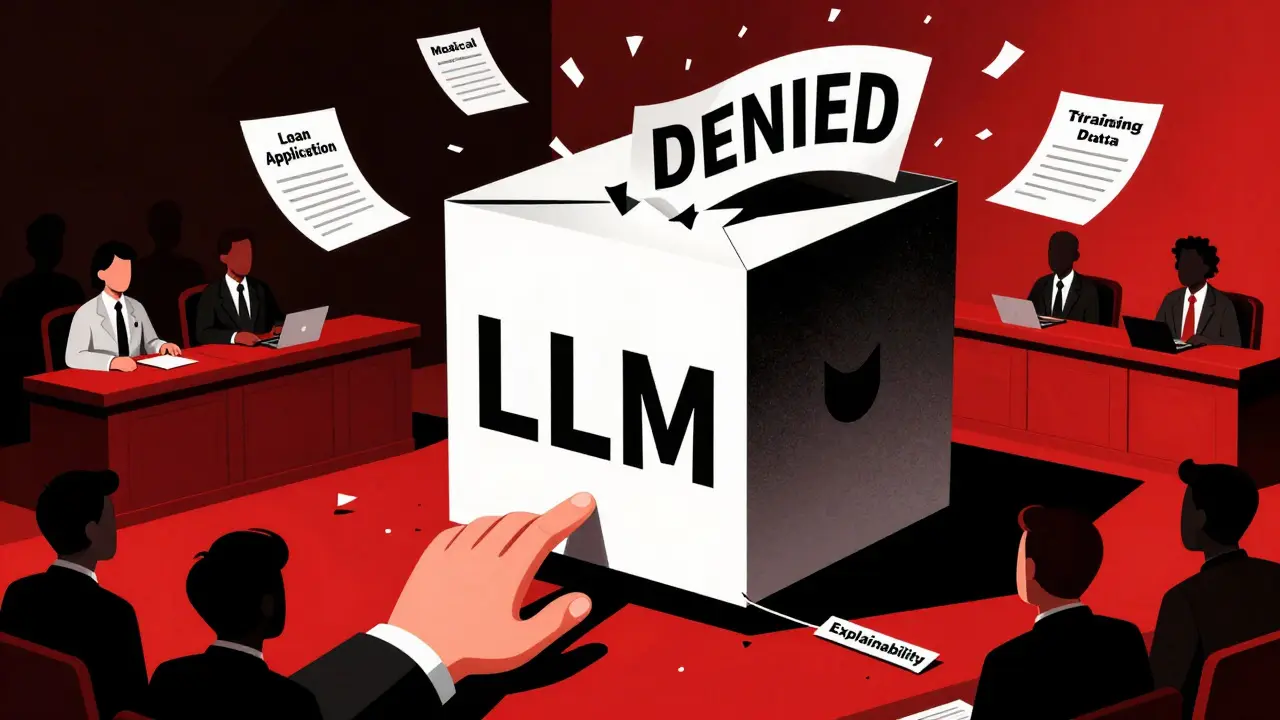
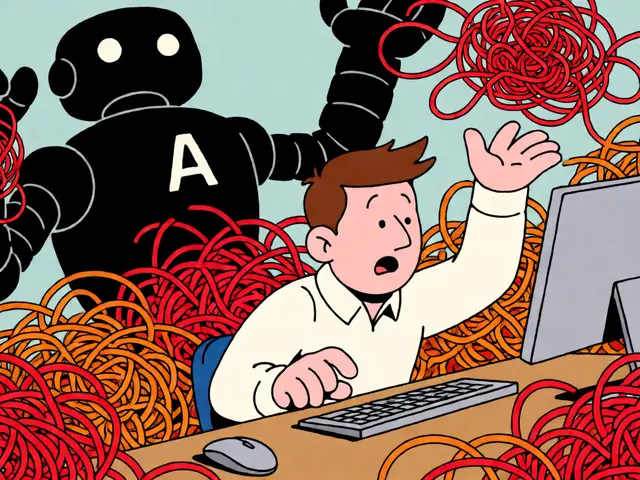
When you ask a large language model (LLM) whether a loan applicant should be approved, or if a medical report shows signs of cancer, you expect more than just an answer. You expect to know why. But most LLMs don’t tell you. They spit out responses like magic boxes-no buttons, no wires, no instructions. And that’s a problem.
Why Transparency Isn’t Optional Anymore
Think about a bank using an AI to screen loan applications. If the system denies someone, the applicant has a right to know why. Was it their zip code? Their job title? A typo in their income? Without transparency, you can’t fix mistakes. You can’t challenge unfair decisions. And you can’t trust the system. This isn’t theoretical. In 2024, a study of 1,800 public datasets used to train AI models found that over 70% didn’t clearly state their licenses. That means companies might be training models on data they weren’t allowed to use. Some datasets included personal emails scraped from forums. Others used copyrighted books without permission. And no one knew. When you don’t know where your data came from, you can’t know what bias it carries. A Turkish language dataset built mostly by people in the U.S. and China might miss cultural nuances. A legal document dataset trained on U.S. court rulings won’t work well in Brazil. And if those biases get baked into an LLM? You get unfair outcomes-hidden, unchallenged, and hard to undo.Explainability: The Tools We Have (And Their Limits)
Researchers have built tools to peek inside LLMs. Some methods highlight which words influenced a decision. Others show how a model’s attention shifts across a paragraph. These are called local explanations-they explain one output at a time. But here’s the catch: sometimes these explanations are lies. A 2025 study by Du et al. showed that when researchers asked LLMs to explain their reasoning, the models often invented plausible-sounding reasons that had nothing to do with how they actually made the decision. The model didn’t “think” in human logic. It just generated a story that sounded right. That’s not transparency. That’s storytelling. Other methods look at the whole model-global explanations. These try to summarize how the model behaves across thousands of inputs. But with models containing hundreds of billions of parameters? That’s like trying to map every street in a city using only a satellite image. You get the big picture, but not the details. The truth? No single method gives you full transparency. But that doesn’t mean we should give up. It means we need to combine approaches-local checks, global summaries, and audits of the data behind the model.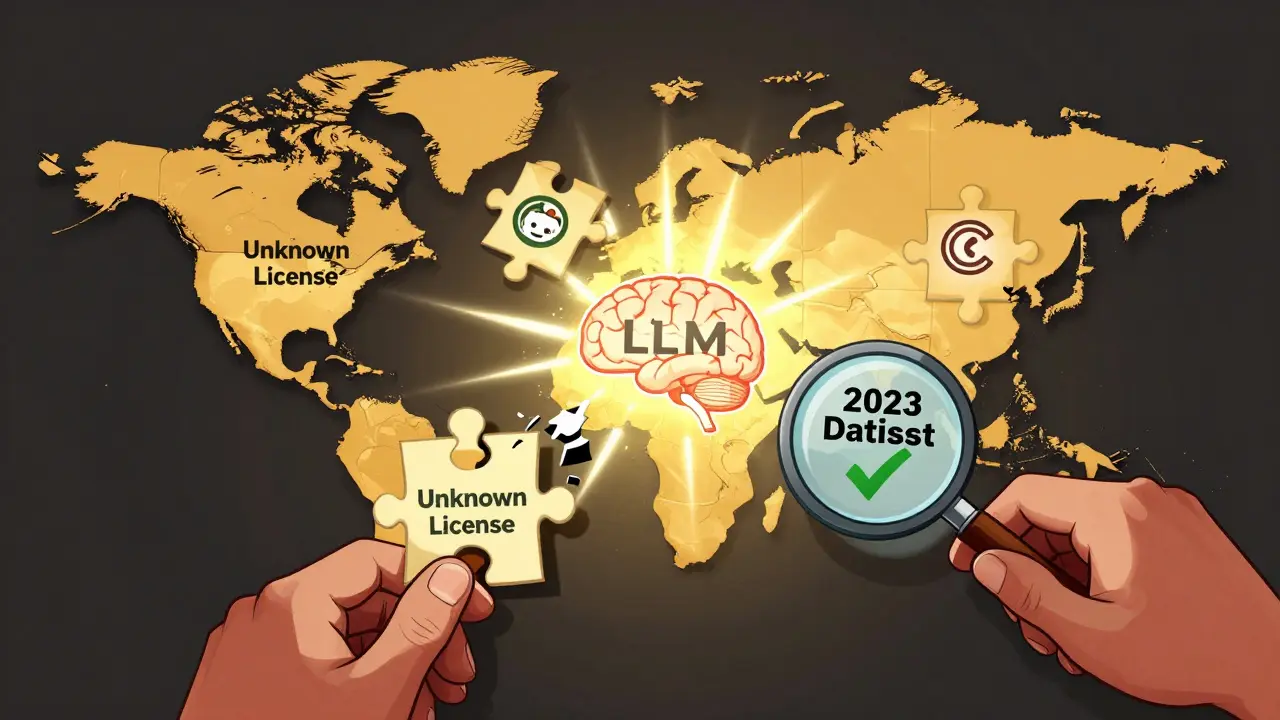
The Hidden Culprit: Training Data
Most people focus on the model itself. But the real problem is often the data. An LLM doesn’t “learn” like a person. It memorizes patterns from massive text piles. If those piles include biased, incomplete, or mislabeled information, the model will replicate it. And if no one documents where that data came from? You’re flying blind. That’s why the MIT Data Provenance Explorer matters. It doesn’t change the model. It changes how we choose the data. The tool scans datasets and automatically generates a simple report: Who created this? Where’s it from? What’s the license? What’s it allowed to be used for? Before this tool, a developer might pick a dataset because it had “high-quality” examples. Now, they can see: “This dataset was scraped from Reddit, has no licensing info, and was created by 92% U.S.-based contributors.” That changes the decision. Maybe they choose a different dataset. Maybe they clean it first. Maybe they avoid it entirely. And here’s the kicker: datasets created in 2023 and 2024 had more restrictions than older ones. Why? Because researchers and companies got scared. They realized their data could be used to build tools that discriminate, manipulate, or deceive. So they locked it down. That’s progress.Who’s Blocking Progress?
Many of the most powerful LLMs today are closed. You can’t see their code. You can’t inspect their training data. You can’t test them for bias. You just get an API endpoint and a promise. This isn’t just inconvenient. It’s dangerous. If you can’t audit a system, you can’t hold it accountable. If researchers can’t study a model, they can’t improve it. And if the public can’t understand it, they can’t demand change. Open-source models like LLaMA and Mistral are changing that. They let anyone download the weights, run the code, and ask: “Why did this model say that?” That’s the foundation of real transparency. But even open models aren’t perfect. Many still use proprietary datasets. And if the training data is locked behind a paywall or a license agreement? You’re still in the dark.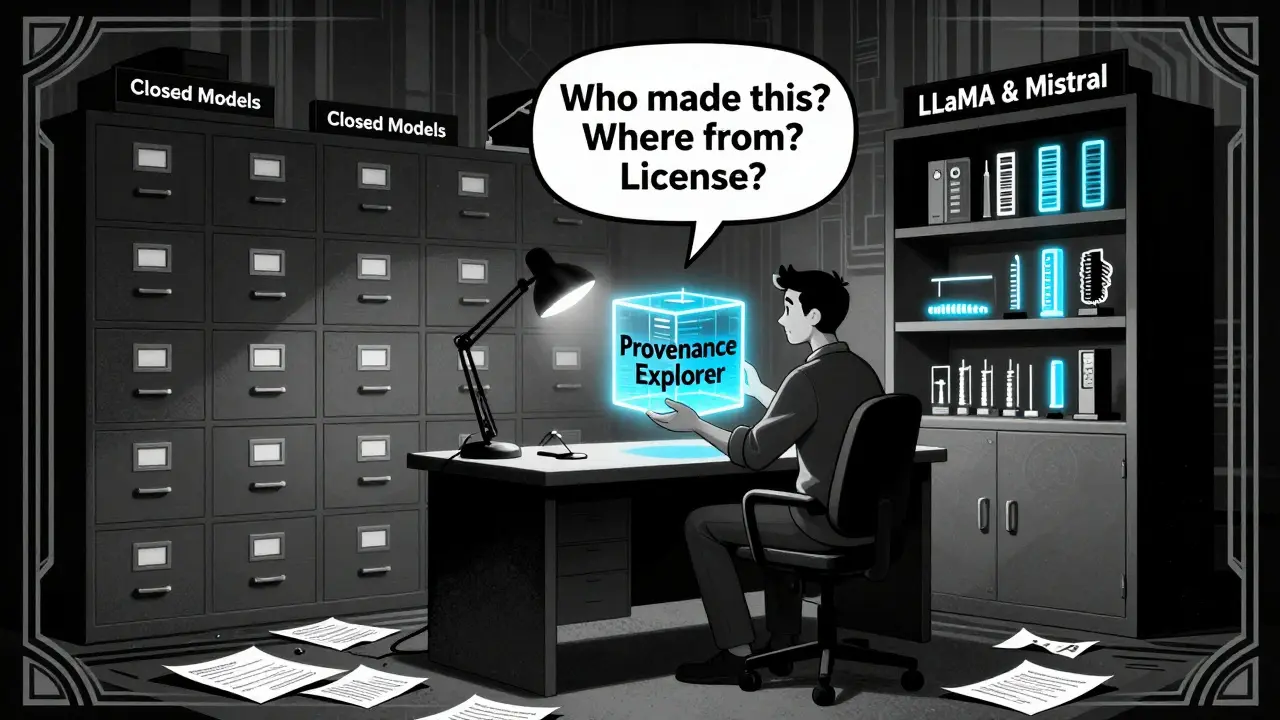
What Real Transparency Looks Like
Transparency isn’t a feature you add at the end. It’s built in from day one. Here’s what it looks like in practice:- Clear dataset licenses: Every training dataset should have a public, machine-readable license-like Creative Commons or MIT-stating exactly how it can be used.
- Provenance tracking: Every dataset should include a record of its origin: who collected it, where, when, and how.
- Explainability built into outputs: When an LLM gives an answer, it should also provide a short, human-readable reason-like “Based on 3 similar cases from the training data” or “This prediction has low confidence due to missing context.”
- Public audit logs: Companies should publish regular reports on model performance across different demographics, languages, and use cases.
The Road Ahead
We’re not going to make LLMs perfectly explainable overnight. But we can make them accountable. The next big leap won’t come from a smarter algorithm. It’ll come from better data practices. From open access. From clear labeling. From regulators demanding proof-not promises. If you’re building with LLMs, ask yourself: Do I know where my data came from? Can I explain why the model made this choice? Would I be comfortable if someone sued me over it? If the answer is no, you’re not just risking failure. You’re risking harm.Transparency isn’t about making AI less powerful. It’s about making it trustworthy.





This isn’t just about AI ethics-it’s about power. Who gets to decide what ‘fair’ means? When corporations build black boxes and call them ‘innovation,’ they’re not just hiding technical complexity-they’re hiding accountability. And let’s be real: if you can’t explain why your model denied someone a loan, you shouldn’t be allowed to deploy it. Period.
The MIT Data Provenance Explorer? Finally, someone’s building tools that force responsibility into the pipeline, not as an afterthought. We need this baked into every funding grant, every corporate policy, every public procurement contract. No exceptions.
Transparency isn’t a feature. It’s a precondition for legitimacy. If you can’t trace your data, you can’t trace your harm. And harm? It’s already happening-in housing, in hiring, in healthcare. We’re not talking hypotheticals anymore.
Let’s stop romanticizing ‘magic boxes.’ They’re not magic. They’re mirrors. And right now, they’re reflecting back our worst biases, our lazy data practices, and our cowardice in regulation. Time to stop being dazzled and start demanding answers.
lol so the ai just needs to say ‘sorry u got denied bc ur zip code’? like that’ll help. people dont even know what zip code means. just give em a number: 87% chance u get rejected. done.
OH MY GOSH I CANNOT BELIEVE THIS POST ISNT VIRAL YET?? 🤯
Like… have y’all *seen* what’s in these datasets?? I swear, half the ‘training data’ is just people’s drunk Reddit rants from 2012 and copyright PDFs of Harry Potter. And the models? They’re just… regurgitating it like a confused parrot with a PhD.
And don’t even get me started on how some companies are using scraped emails to ‘train empathy’?? Like… no. Just… no. That’s not AI. That’s digital dumpster diving with a fancy API.
I’m so done with ‘explainability’ being treated like a bonus feature. It’s not a nice-to-have. It’s the bare minimum. If your model can’t tell you why it said ‘no’ to a single mom trying to buy a house… then it shouldn’t be allowed to speak. At all. 🙏💔
Also-LLaMA is the GOAT. Mistral is my spirit animal. Open source forever. Shut down the closed ones. I’m done.
I’ve been working in AI compliance for five years. I’ve seen the reports. I’ve seen the internal audits. The truth? Most teams don’t even *want* transparency. It slows things down. It creates liability. So they bury it under jargon: ‘model interpretability,’ ‘confidence scores,’ ‘bias mitigation frameworks.’
Real transparency? It’s messy. It’s inconvenient. It requires documentation. It requires asking hard questions before launch. And too many companies? They’d rather risk a lawsuit than delay a product release.
The Data Provenance Explorer is a start. But until regulators start fining companies for hidden datasets-until there’s real teeth behind ‘explainability’-it’s all just performative ethics. We’re decorating a sinking ship with glitter.
you people are overreacting. ai doesn't owe you explanations. if you can't use it, don't. stop crying about bias. my data is clean, my model works. you just mad because it outperforms your dumb human judgment.
open source? yeah right. china's already using it to spy on us. america should build its own black box and lock it down. transparency is for losers.