Search-Augmented Large Language Models: RAG Patterns That Improve Accuracy
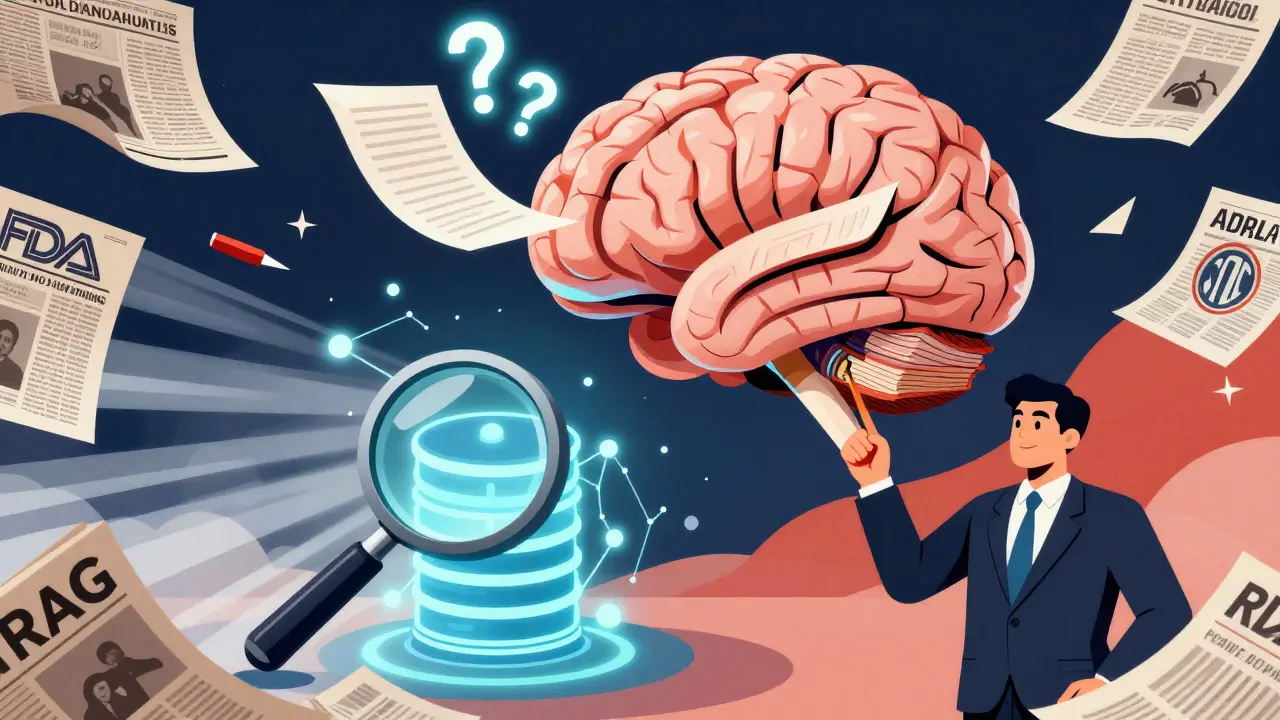
Large language models (LLMs) can sound incredibly smart-until they make up facts. You ask about last quarter’s earnings, and it cites a report that doesn’t exist. You ask for the latest FDA guidelines, and it quotes a version from two years ago. This isn’t just annoying-it’s dangerous in healthcare, finance, or legal settings. The problem isn’t the model’s intelligence. It’s that its knowledge is frozen in time, locked inside its training data. That’s where RAG comes in. Retrieval-Augmented Generation isn’t just another buzzword. It’s the most practical way to make LLMs accurate, reliable, and useful in real-world applications.
How RAG Fixes the Hallucination Problem
Traditional LLMs don’t know what’s happening right now. They were trained on data up to a certain cutoff date-sometimes years ago. No matter how much you prompt them, they can’t access new documents, updated policies, or internal company records. That’s why they hallucinate. RAG changes that by giving the model a live connection to your data. Here’s how it works in simple terms: When you ask a question, RAG doesn’t just guess from memory. First, it searches through your company’s documents-emails, PDFs, knowledge bases, chat logs-using semantic search. It finds the most relevant pieces, pulls them in, and feeds them to the LLM along with your original question. The model then generates an answer based on that fresh, verified context. The result? Answers grounded in reality, not imagination. Studies show this isn’t theoretical. Google Cloud’s case studies found RAG improved factual accuracy by 35-60% in enterprise use cases. Microsoft’s benchmarks show RAG systems hitting 82-94% accuracy on factual queries, while base LLMs without retrieval struggle at 45-68%. That’s not a small improvement. That’s the difference between a chatbot you can trust and one that gets you fired.The Three Core Pieces of RAG
RAG isn’t magic. It’s a pipeline with three essential parts, and if any one breaks, the whole system fails. First is document preparation. Your data isn’t clean. PDFs are scanned images. Emails have signatures and threads. Contracts have footnotes. You need to break them into manageable chunks-usually 256 to 512 tokens long. Too big, and you lose precision. Too small, and you lose context. A legal document split in the middle of a clause? The model won’t understand the ruling. A customer support log with 10 back-and-forths mashed into one chunk? You’ll get a confused answer. Smart chunking uses sentence boundaries and semantic meaning, not just word counts. Second is retrieval. This is where vector databases like Pinecone, Milvus, or Azure AI Search come in. They turn your text into numerical vectors-mathematical representations of meaning. When you ask a question, it’s turned into a vector too. The system finds the closest matches using cosine similarity, usually with a threshold between 0.7 and 0.85. But here’s the catch: pure vector search isn’t enough. The best systems use hybrid search, combining vector search (60-70% weight) with keyword matching (30-40%) using BM25. Why? Because sometimes you need the exact phrase “HIPAA compliance” to appear, not just semantically similar words. Third is grounded generation. The LLM doesn’t just regurgitate the retrieved text. It synthesizes it. It answers your question using the context you gave it. But if the retrieved info is noisy, irrelevant, or contradictory, the answer will be too. That’s why advanced systems use re-rankers like Cohere Rerank, which sort the top 10 retrieved chunks and boost the most relevant ones. This can improve top-3 relevance by 22%.Why RAG Beats Fine-Tuning
You might think: Why not just fine-tune the model on our data? That way, it learns the answers directly. Fine-tuning sounds appealing, but it’s expensive and inflexible. Retraining a large model on your internal documents costs $75,000-$100,000. It takes weeks. And once you update your policy manual? You have to retrain again. RAG? You just upload the new PDF. No retraining needed. A November 2023 study in the Journal of Artificial Intelligence Research found RAG outperformed fine-tuning by 41.7% on time-sensitive queries. For companies that update compliance docs quarterly-or hourly-RAG is the only viable option. Plus, RAG is transparent. You can see exactly which documents the model used to generate its answer. That’s huge for audits, legal compliance, and user trust. Fine-tuning? It’s a black box. You have no idea what it learned-or if it learned something wrong.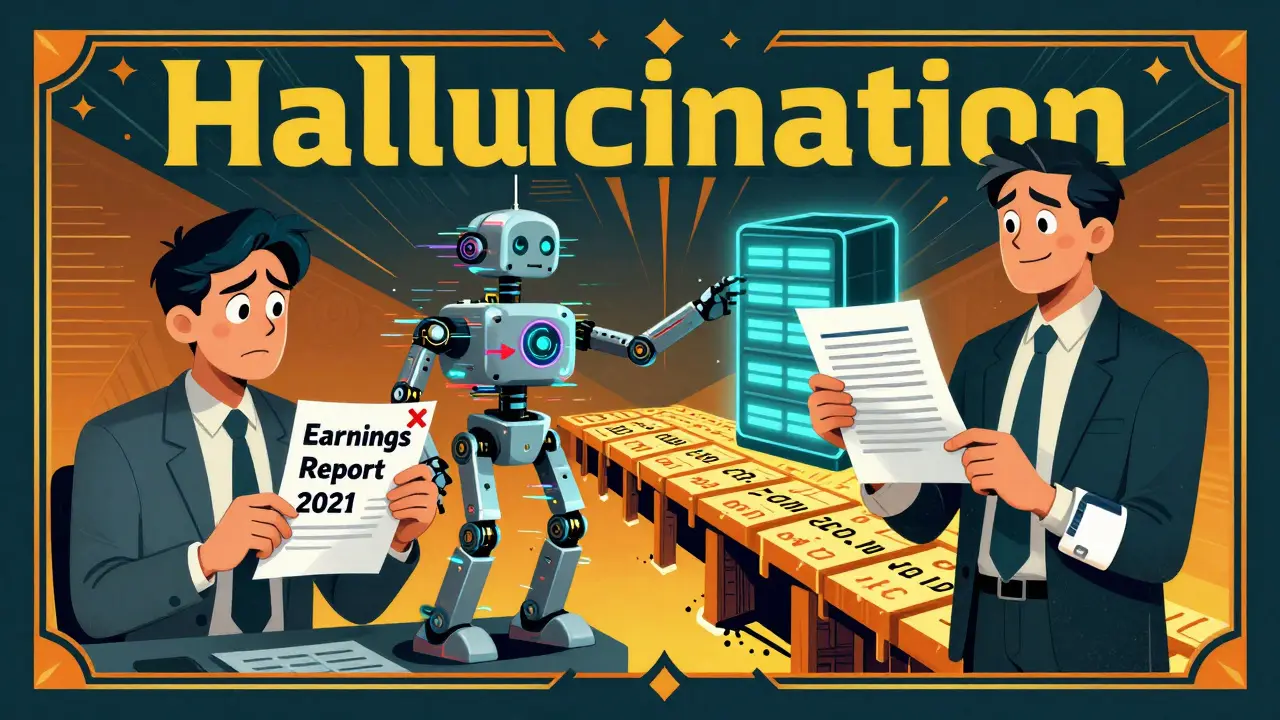
Advanced RAG Patterns That Actually Work
Basic RAG helps. But the best systems use smarter patterns to handle complex questions. One is query expansion. Users don’t ask perfect questions. “What’s our policy on remote work?” might be too vague. Advanced RAG systems rewrite that into: “What are the current guidelines for remote work approvals, including equipment reimbursement and time zone flexibility?” This improves retrieval recall by 27%. Another is recursive retrieval. For multi-hop questions-like “What was the outcome of the 2023 merger, and how did it affect Q4 compliance?”-a single retrieval isn’t enough. The system first retrieves info about the merger. Then it uses that answer to generate a second, more precise query to find compliance impacts. Microsoft’s January 2024 update to Azure AI Search showed this boosts accuracy on complex queries by 28%. Then there’s Self-RAG. Developed by Stanford in late 2023, this version lets the LLM decide for itself whether to retrieve information. Instead of retrieving every time, it learns to say, “I already know this,” or “I need to look it up.” This cuts unnecessary retrievals by 38% and improves accuracy by 21%. And Tree of Thoughts RAG? That’s the next level. Instead of one path, it explores multiple reasoning paths at once-like a human brainstorming. It’s especially good for legal or medical reasoning tasks. Stanford’s research showed it hits 79% accuracy on complex multi-step questions, while standard RAG only manages 54%.The Hidden Costs and Common Mistakes
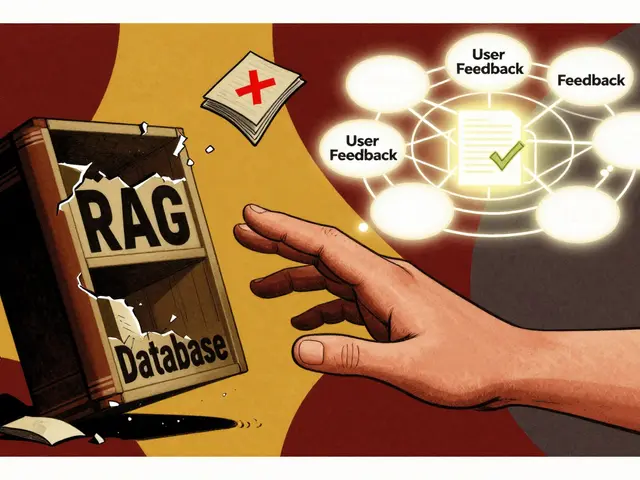
RAG isn’t plug-and-play. Most teams underestimate how hard it is to get right. The biggest mistake? Bad chunking. One Reddit user shared how their legal team’s RAG bot kept giving wrong answers because it split contract clauses across chunks. Fixing it took six months of manual tuning. Another common error: ignoring query transformation. If users type “Tell me about the new policy,” and you don’t expand it, you’ll miss 15-20% of relevant documents, according to MIT Technology Review. Then there’s latency. Retrieval adds 200-800ms to response times. That’s fine for internal tools. Not fine for customer-facing chatbots. Companies are now optimizing with GPU-accelerated vector databases and caching frequently asked queries. And let’s not forget the data problem. If your knowledge base is messy-duplicate files, outdated versions, broken links-RAG will just retrieve garbage. You need data hygiene before you even start.Who’s Using RAG-and Why
RAG isn’t just for tech companies. It’s everywhere. In healthcare, hospitals use it to answer clinical questions with the latest treatment guidelines. One system reduced incorrect medication advice by 52%. In finance, banks use it to answer compliance questions based on real-time regulatory updates. A Fortune 500 bank cut loan policy errors from 32% to 9% after deploying RAG. In legal firms, associates use RAG to find case law references in seconds instead of hours. Gartner reports that 78% of enterprises using generative AI now use RAG. IDC says 68% of the $32.8 billion generative AI market in 2023 was RAG-powered. By 2027, that number is projected to hit $112.7 billion. The top adopters? Financial services (82%), healthcare (76%), and government (68%). Why? Because those industries can’t afford hallucinations. A wrong answer in a loan application or a patient record isn’t a joke-it’s a lawsuit.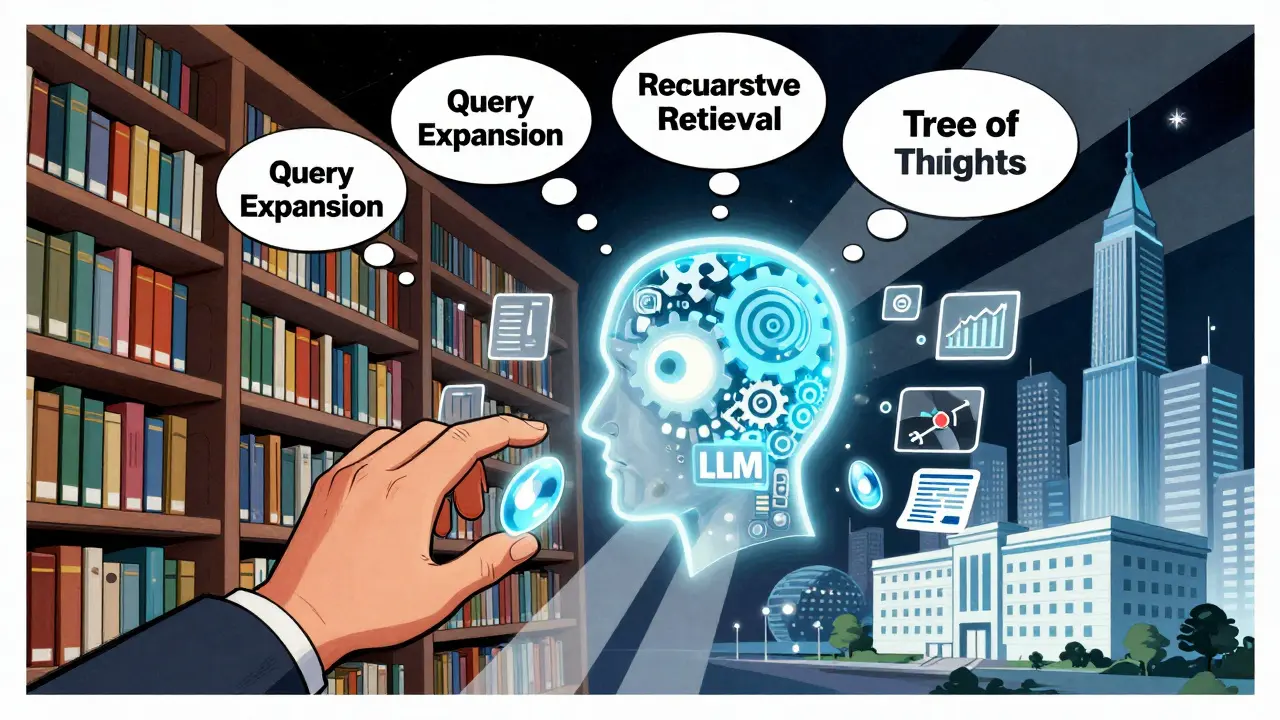
What Comes Next
RAG is evolving fast. Google and Microsoft are building retrieval directly into their LLM APIs. By 2025, most enterprise AI tools will have RAG built-in-no extra setup needed. Future versions will handle more than text. Imagine asking, “Show me the product defect trends from last quarter,” and the system pulls up charts, images of faulty parts, and repair logs-all in one answer. That’s multi-modal RAG, and it’s already being tested. The real goal? Making retrieval so seamless that users don’t even notice it’s there. No more “I checked the manual” or “Let me look that up.” Just answers-fast, accurate, and always current.Frequently Asked Questions
What’s the difference between RAG and fine-tuning?
Fine-tuning changes the model’s internal weights by retraining it on your data-it’s expensive, slow, and static. RAG keeps the model unchanged and pulls in live data from your documents when needed. RAG is cheaper, faster to update, and lets you see exactly where answers come from.
Do I need a vector database for RAG?
Yes, for anything beyond a simple prototype. Vector databases like Pinecone, Milvus, or Azure AI Search are designed to find similar text fast using semantic search. You can’t do this reliably with regular search engines or simple keyword matching.
How long does it take to implement RAG?
A basic RAG system can be set up in 4-6 weeks. But enterprise-grade systems with hybrid search, re-ranking, and query expansion typically take 8-12 weeks. The biggest time sink is cleaning and chunking your data-not building the pipeline.
Can RAG handle complex reasoning?
Standard RAG struggles with multi-step questions. But advanced patterns like Tree of Thoughts and recursive retrieval fix this. These let the system break down complex questions, retrieve info step-by-step, and combine results-boosting accuracy from 54% to 79% on hard reasoning tasks.
Is RAG secure and compliant with GDPR?
RAG can be compliant, but it requires extra work. You need to mask personal data before indexing, audit what’s retrieved, and ensure documents aren’t exposed in responses. GDPR-compliant RAG adds 23-37% to development time, but it’s non-negotiable for EU or healthcare data.





Man, I’ve seen so many teams try to slap RAG on their chatbot and call it a day. Then the thing starts giving out fake policy docs like it’s reading tea leaves. This post? Spot on. Real talk-RAG ain’t magic, but it’s the closest thing we got to making AI stop bullshitting.
It’s fascinating how the real bottleneck isn’t the model architecture or even the vector database-it’s the data hygiene. I’ve worked on three RAG pipelines, and every single one failed initially because someone dumped 2000 PDFs from 2017 into the system without cleaning them. One legal firm had a clause split across two chunks, and the AI kept saying ‘the contract is void’ when it was actually enforceable. Took six months of manual chunk tuning and sentence-boundary-aware splitting to fix it. The tech is good, but garbage in, garbage out still applies harder than ever.
Oh wow. Another ‘RAG is the future’ blog post from someone who thinks ‘semantic search’ is a Netflix algorithm. You people act like this is groundbreaking. I’ve been using retrieval systems since 2019. This is just rebranded TF-IDF with fancy embeddings. And don’t even get me started on ‘Tree of Thoughts’-it’s just prompt engineering with extra steps. If you need this much complexity to make an LLM not hallucinate, you’re using the wrong tool entirely.
Sibusiso, you’re missing the point. RAG isn’t about whether it’s ‘new’-it’s about whether it works in production. You can rant about TF-IDF all day, but when your compliance officer needs to know if the latest SEC rule applies to Q3 disclosures, and your AI pulls the right paragraph from the 2024 filing with a link to the source? That’s not ‘extra steps.’ That’s risk mitigation. The fact that you think this is ‘overcomplicated’ tells me you’ve never had to explain to a lawyer why your AI invented a regulation that doesn’t exist.
bro i just tried ragg on my company’s help docs and it kept saying we have a ‘flexible work policy’ when we dont even have remote work. i think my pdfs were too messy. also why does it take 5 seconds to answer? my old chatbot was faster lol
There’s something deeply human about this whole thing. We’re not just building better tools-we’re trying to fix our own trust issues with technology. We built these models to sound smart, but they lie. And we keep pretending it’s okay until someone gets hurt. RAG doesn’t just improve accuracy-it rebuilds accountability. The fact that you can trace an answer back to a specific clause in a policy document? That’s not engineering. That’s ethics made visible. Maybe the real breakthrough isn’t in the vectors or the chunking-it’s in finally forcing AI to show its work.
One thing no one talks about: the mental shift needed for teams. Engineers think RAG is a tech problem. Product teams think it’s a feature. But the real win is cultural-you stop saying ‘the AI said’ and start saying ‘here’s what the docs say.’ That changes how people interact with the tool. I’ve seen teams go from ‘trust the bot’ to ‘check the sources’ in under two weeks. That’s the quiet revolution.