Why Large Language Models Hallucinate: Probabilistic Text Generation in Practice
You ask an Large Language Model is a type of artificial intelligence that generates human-like text by predicting the next word in a sequence based on statistical patterns learned from vast amounts of data. for a specific fact, and it gives you a confident, detailed answer. You trust it because it sounds right. Then you check the source, and it doesn't exist. The date is wrong. The name is made up. This isn't a glitch; it's how these models are built to work.
Hallucination-the act of generating plausible but false information-is the biggest hurdle standing between experimental AI and reliable enterprise tools. It’s not just a minor annoyance for casual users. In high-stakes fields like medicine or law, a fabricated citation or a wrong statistic can cost millions. Understanding why this happens requires looking past the "magic" of AI and into the math of probabilistic text generation is the core mechanism where language models calculate the likelihood of each possible next token (word fragment) based on previous inputs, rather than retrieving stored facts.. When you grasp that LLMs are essentially sophisticated autocomplete engines, the source of their errors becomes clear.
The Math Behind the Mistake
To understand hallucinations, you have to forget the idea that an LLM has a database of facts it looks up. Instead, think of it as a pattern-matching machine. When you input a question, the model breaks your text down into tokens-small chunks of characters. These tokens are converted into numbers, passed through layers of neural networks, and processed by something called self-attention mechanisms are components within transformer architectures that allow the model to weigh the importance of different words in a sentence relative to each other, determining context and relationships..
The goal of the model is simple: predict the next most likely token. It uses a softmax function to assign probabilities to thousands of potential next words. If the probability is high enough, it picks one. Here is the problem: "likely" does not mean "true." It means "statistically probable based on training data."
Research from AWS Builder Center in September 2024 identified three structural factors driving this issue:
- Data Quality Issues: If the training data contains errors, outdated info, or biases, the model learns those patterns as truth. About 42% of hallucinations stem from dirty data.
- Training Methodologies: Models are trained to maximize the likelihood of the correct next token. This rewards confident guessing. As noted in arXiv paper 2509.04664 (September 2025), models often achieve higher benchmark scores by hallucinating a plausible-sounding answer than by admitting uncertainty.
- Architectural Limitations: Context windows are finite. Most commercial models cap out around 32,768 tokens. When conversations get long, earlier details fade, leading to contradictions or invented details to fill gaps.
Tokenization itself introduces noise. Google Cloud’s April 2025 analysis showed that converting linguistic nuances into numerical vectors causes errors in 12-15% of cases. The model sees numbers, not meaning. It predicts the next number, not the next fact.
How Temperature and Settings Fuel Fabrication
You might think you have control over hallucinations through settings like temperature, but the relationship is more complex than many realize. Temperature controls randomness. A low temperature (e.g., 0.2) makes the model stick to the most probable answers, which feels safer but can lead to repetitive or overly conservative outputs. A high temperature (e.g., 0.8) encourages creativity but drastically increases the chance of fabrication.
Lakera.ai’s January 2025 benchmarking study across 15 major models found that increasing temperature from 0.2 to 0.8 raised hallucination probability by 37%. However, they also discovered that temperature adjustments alone only reduce hallucinations by about 8% when combined with other strategies. Why? Because even at low temperatures, the underlying statistical patterns may still favor a confident lie over a hesitant truth if the training data was biased toward authoritative-sounding falsehoods.
Another hidden factor is the autoregressive nature of generation. Each new token depends on all previous ones. If the model makes a small error early in a long response, that error cascades. According to arXiv paper 2509.04664, hallucinations amplify by 22% for every additional 100 tokens generated after an initial mistake. This is why long-form essays or code blocks are particularly risky-they compound errors over time.

Who Hallucinates More? A Model Comparison
Not all models hallucinate equally. Size, training methodology, and specialization play huge roles. Meta’s November 2024 technical report showed that models exceeding 100 billion parameters generally exhibit 18-22% lower hallucination rates in factual domains compared to smaller counterparts. But there’s a twist: larger models sometimes hallucinate *more* in creative tasks where factual accuracy matters less, because they’re optimized for fluency and variety.
| Model | Medical Queries | General Knowledge | Creative Writing |
|---|---|---|---|
| GPT-4o | 53% | 45% | 28% |
| Claude 3.5 Opus | 41% | 38% | 25% |
| Gemini 1.5 Pro | 47% | 42% | 30% |
| Med-PaLM 2 | 29% | 58% | N/A |
| Llama 3 70B | 52% | 50% | 32% |
Notice how Med-PaLM 2 excels in medical contexts (29% hallucination rate) but struggles elsewhere (58%). Specialized models trade general knowledge for domain accuracy. For enterprises, this means choosing a model isn’t just about raw power-it’s about matching the tool to the task. Legal applications suffer the most, with Stanford Law Review reporting a 67% error rate in contract interpretation. Financial predictions hover around 49%. Creative writing, however, remains relatively safe at 28%.
Real-World Impact: When Lies Cost Money
This isn’t theoretical. In October 2025, a Reddit thread titled “LLM Hallucinations That Cost Me My Job” documented 17 real cases. One software engineer deployed incorrect code suggested by GitHub Copilot, causing $250,000 in system downtime. Another academic published a paper with fabricated citations, damaging their reputation.
G2’s Q3 2025 survey of 1,247 business users revealed that 68% encounter hallucination-related errors weekly. Customer service bots and research assistants are the worst offenders. Users complain about inconsistent answers across sessions (76%) and overconfidence in wrong responses (89%). The pain point isn’t just wrong answers-it’s the lack of humility. Models rarely say, “I don’t know.” They invent instead.
Positive shifts are emerging. OpenAI’s October 2025 satisfaction survey showed 63% of users noticed better uncertainty signaling in GPT-5 compared to GPT-4. Enterprise teams using retrieval-augmented generation (RAG) reported a 44% reduction in hallucinations when integrating Watsonx with proprietary knowledge bases. The key insight? Trust must be engineered, not assumed.
Practical Strategies to Reduce Hallucinations
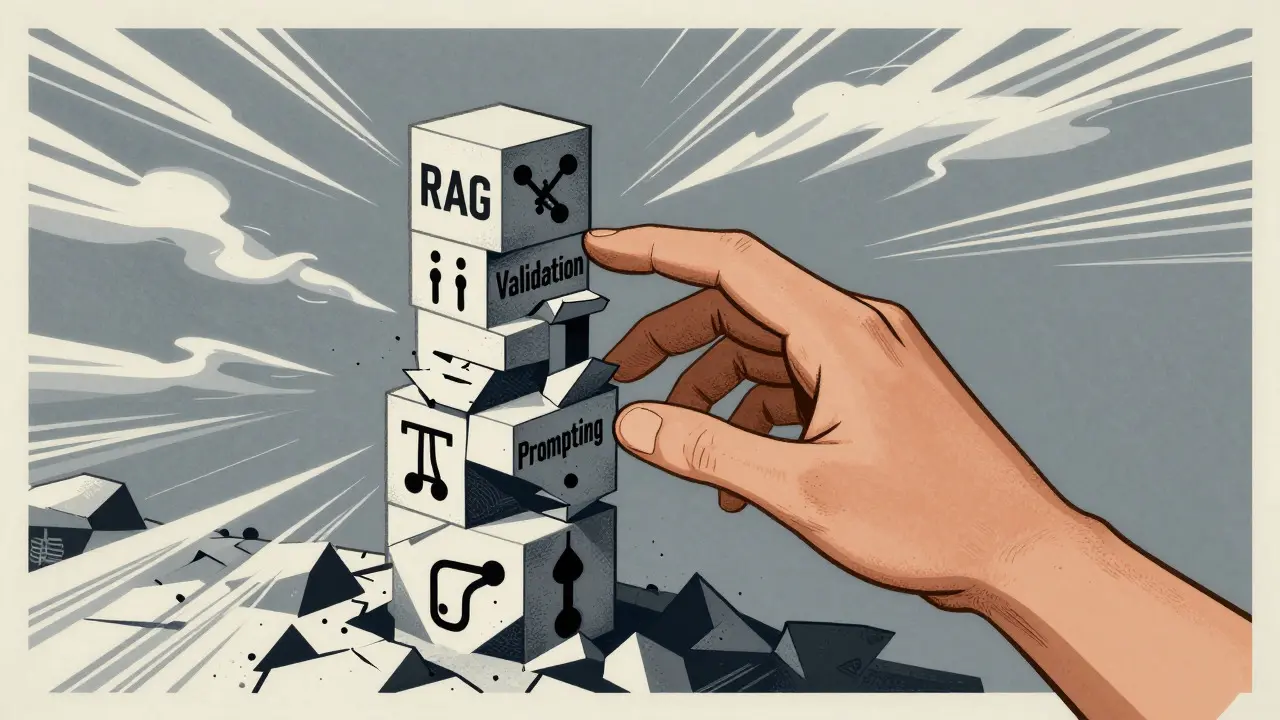
You can’t eliminate hallucinations entirely-not yet. But you can manage them. AWS’s November 2025 guide outlines a four-layer mitigation strategy that works in practice:
- Prompt Engineering: Simple changes like asking the model to cite sources, explain its reasoning, or admit uncertainty can cut hallucinations by 37-56%. Dr. Elena Rodriguez’s team at Lakera.ai found this more effective than temperature tweaks alone.
- Retrieval-Augmented Generation (RAG): Ground the model’s output in verified documents. By fetching relevant snippets from a trusted database before generating text, RAG reduces hallucinations by 42-48%. Implementation takes 6-8 weeks for most data science teams.
- Fine-Tuning with Anti-Hallucination Datasets: Train the model on examples of correct vs. incorrect responses. This yields a 28-35% reduction but requires significant computational resources.
- Human-in-the-Loop Validation: For critical decisions, always involve a person. This approach achieves the highest reduction (61-73%) but adds latency-each validation step costs 200-500ms per query.
Confidence scoring is another powerful tool. Bloomberg’s June 2025 case study showed that implementing confidence thresholds reduced financial application errors by 39%. If the model’s certainty score drops below a set level, flag the response for review. Don’t let the AI decide what’s important-you define the risk tolerance.
The Future: Can We Fix This?
The industry is moving fast. OpenAI’s December 2025 update introduced “uncertainty-aware generation” to GPT-5, cutting factual hallucinations by 29%. Google’s Gemini 1.5 Pro added “source grounding scores,” reducing citation fabrications by 34%. DeepMind’s AlphaGeometry 2 achieved near-zero hallucinations on geometry problems by combining neural networks with symbolic reasoning-a hybrid approach that may become standard.
Regulatory pressure is mounting too. The EU’s November 2025 AI Act amendment mandates hallucination risk assessments for high-stakes apps. US NIST guidelines propose strict thresholds: 0.5% for medical diagnosis, 2% for legal research. Companies ignoring these standards face liability. McKinsey’s October 2025 report confirms that firms with robust mitigation strategies see 3.2x higher ROI on AI investments. Reliability isn’t optional anymore-it’s profitable.
Hallucinations won’t disappear. They’re baked into the probabilistic foundation of language modeling. But with smarter prompts, grounded data, and human oversight, you can turn a risky experiment into a reliable tool. The goal isn’t perfection. It’s control.
What exactly causes an LLM to hallucinate?
Hallucinations occur because LLMs generate text by predicting the next most statistically likely token, not by retrieving verified facts. Errors stem from noisy training data, architectural limits like finite context windows, and training objectives that reward confident guesses over uncertainty admission.
Does lowering the temperature setting stop hallucinations?
Lowering temperature reduces randomness and can decrease hallucinations slightly, but it’s not a cure-all. Studies show temperature adjustments alone only reduce hallucinations by about 8%. Combined with prompt engineering and RAG, it becomes part of a broader mitigation strategy.
Which industries are most affected by LLM hallucinations?
Legal, medical, and financial sectors face the highest risks. Legal contract interpretation shows a 67% error rate, medical diagnosis support hits 53%, and financial market predictions reach 49%. Creative writing and non-critical coding assistance remain lower risk, around 28-31%.
How does Retrieval-Augmented Generation (RAG) help?
RAG grounds the model’s output in verified external documents. Before generating text, the system fetches relevant snippets from a trusted database. This approach reduces hallucinations by 42-48% and is considered essential for enterprise-grade reliability.
Can we ever completely eliminate hallucinations?
Probably not entirely, due to the inherent probabilistic nature of language modeling. However, experts believe hallucinations can be reduced to acceptable levels-under 3% in critical domains-through hybrid architectures, better evaluation metrics, and multi-layered mitigation strategies.