
Ethical Guidelines for Democratized Vibe Coding at Scale
Discover ethical guidelines for scaling vibe coding. Learn how to manage security risks, IP ambiguity, and skill erosion when democratizing software development with AI.

Data Extraction Prompts in Generative AI: Structuring Outputs into JSON and Tables
Learn how to use data extraction prompts in generative AI to convert unstructured documents into clean JSON and tables. Discover best practices for handling complex layouts, validation strategies, and platform comparisons.

Why Large Language Models Hallucinate: Probabilistic Text Generation in Practice
Explore why large language models hallucinate, focusing on probabilistic text generation flaws. Learn practical mitigation strategies like RAG and prompt engineering to improve AI reliability in enterprise applications.

Vibe Coding Retrospectives: How to Fix AI Code Failures
Learn how to conduct effective Vibe Coding retrospectives to analyze AI code failures. Discover structured frameworks, failure classification, and tips to improve prompt engineering and maintainability.

Prompting as Programming: How Natural Language Became the Interface for LLMs
Explore how prompt engineering has evolved into a programming paradigm. Learn core techniques, compare it with traditional coding, and discover tools shaping the future of LLM interfaces.

How to Capture Project Style Guides in System Prompts for Consistency
Learn how to embed project style guides into system prompts for consistent AI output. Discover best practices for structure, length, and testing to improve brand voice and formatting accuracy.

Few-Shot Prompting Strategies That Boost LLM Accuracy and Consistency
Discover how few-shot prompting boosts LLM accuracy by 15-40%. Learn strategies for example selection, ordering, and combining with Chain-of-Thought to avoid the few-shot dilemma.

Vibe Coding Glossary: Essential Terms for AI-Assisted Development
Explore the essential terms of vibe coding, the AI-assisted development method transforming software creation. Learn key concepts, tools, and risks to master this new workflow.
Stop Vibe Coding: How to Avoid Anti-Pattern Prompts for Secure AI Code
Learn why "vibe coding" leads to insecure software and how to replace dangerous anti-pattern prompts with secure, structured frameworks to stop AI-generated vulnerabilities.

Interactive Clarification Prompts in Generative AI: Asking Before Answering
Interactive clarification prompts help AI systems ask smart questions before answering, reducing hallucinations and improving accuracy. This approach turns vague requests into precise, useful outputs by uncovering hidden context.

Few-Shot Prompting Patterns That Improve Accuracy in Large Language Models
Few-shot prompting improves large language model accuracy by 15-40% using just 2-8 examples. Learn the top patterns, when to use them, and how they outperform zero-shot and fine-tuning in real-world applications.
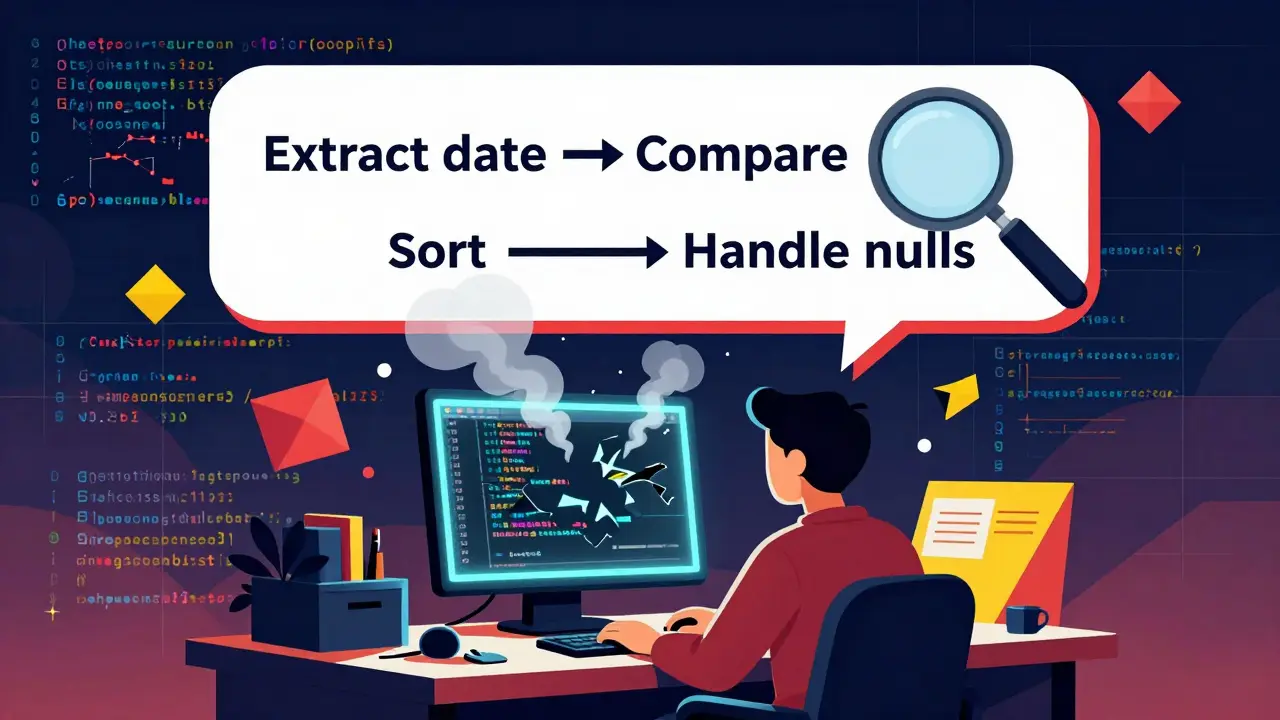
Chain-of-Thought in Vibe Coding: Why Explanations Before Code Work Better
Chain-of-Thought prompting improves AI coding by forcing explanations before code. Learn how asking for step-by-step reasoning cuts bugs, saves time, and is now the industry standard for complex tasks.