
Stop Vibe Coding: How to Avoid Anti-Pattern Prompts for Secure AI Code
You've probably felt the rush of "vibe coding." You type a loose description into an LLM-something like "make a quick login page that looks modern"-and seconds later, you have a working prototype. It feels like magic. But here is the cold truth: when you code by vibes, you aren't just outsourcing the typing; you're outsourcing your security thinking to a model that doesn't actually care if your app gets hacked. In fact, relying on these vague instructions is the fastest way to introduce critical vulnerabilities into your production environment.
What Exactly is Vibe Coding?
Before we get into what to avoid, we need to define the problem. Vibe Coding is a development practice where programmers request code from AI assistants based on general descriptions or "vibes" rather than precise technical specifications. It's a conversational approach that prioritizes speed and "feeling" over rigorous engineering. While it's great for rapid prototyping, it's dangerous for actual software builds. According to a Red Hat report from late 2024, this trend exploded as developers moved away from detailed requirements in favor of prompts like "make this look nice" or "fix this bug quickly."
The problem is that LLMs are pattern-matchers. They don't possess a moral or security mandate; they simply predict the next token based on their training data. Since a huge portion of public code repositories contains insecure implementations, the AI will often give you the most anti-pattern prompts-the path of least resistance-rather than the most secure one.
The Danger of Anti-Pattern Prompts
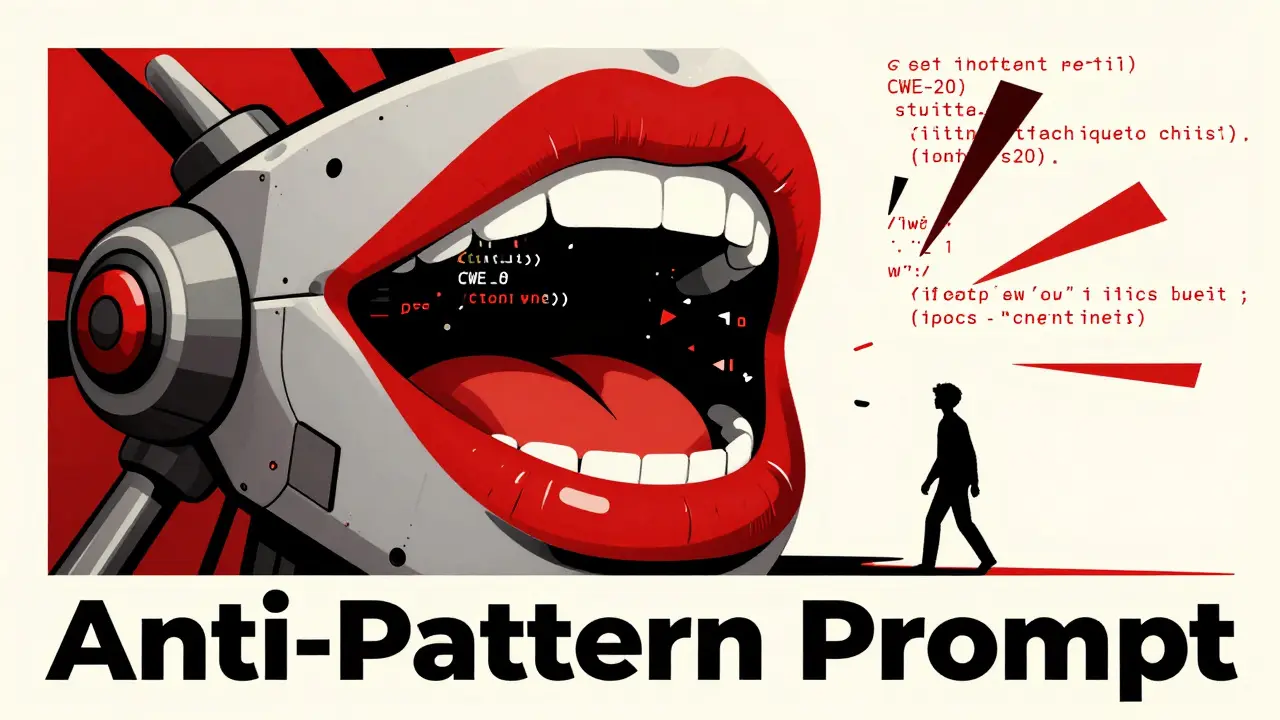
An Anti-Pattern Prompt is an instruction given to an LLM that is too vague, lacks security constraints, or omits critical technical specifications, leading to insecure or inefficient code. Think of it as a "bad habit" in prompt engineering. When you ask for functionality without specifying constraints, you are essentially inviting the AI to take shortcuts.
The data on this is sobering. Research from the DevGPT dataset analysis showed that simple "write code" prompts resulted in a 64% higher weakness density in GPT-3 outputs and a 59% higher density in GPT-4 compared to prompts that explicitly asked the model to avoid known security flaws. If you're just "vibing," you're significantly increasing the chance that your code contains a backdoor or a leak.
One of the most lethal anti-patterns is requesting code that processes user input without mentioning sanitization. Simon Willison's 2025 research highlighted that these prompts directly lead to CWE-20, which is the Common Weakness Enumeration for Improper Input Validation. If you ask for a "quick API endpoint" and don't specify how to handle the input, you're basically leaving the front door unlocked.
| Metric | Vibe Prompting ("Just do it") | Structured Prompting (Recipe Pattern) |
|---|---|---|
| Average Iterations to Success | 4.3 interactions | 1.2 interactions |
| First-Response Accuracy | Baseline | 4.1x Higher |
| Security Risk | High (89% vulnerable in some tests) | Significantly Lower |
| Initial Effort | Very Low | 15-20% more time spent drafting |
Common Anti-Patterns to Stop Using Today
If your prompts look like the examples below, you are practicing anti-pattern prompting. Here is what to stop doing and how to pivot.
- The "Quick and Dirty" Request: "Create a login system quickly."
Why it's bad: This almost always ignores password hashing, session management, and CSRF protection. It's a goldmine for attackers. - The Context-Free Request: "Write a function to upload files in PHP."
Why it's bad: Without specifying versioning or security constraints, you'll likely get code vulnerable to remote file inclusion. In one documented case, a developer using this approach faced an $85,000 incident response cost after a production hack. - The "Bypass" Request: "Write code that bypasses these security restrictions for testing."
Why it's bad: This teaches the AI to ignore security logic, and those "temporary" bypasses have a habit of making it into the final build. - The Vague UI Request: "Make this page look professional."
Why it's bad: While less dangerous than a security hole, it leads to bloated CSS and inaccessible HTML that is a nightmare to maintain.
The Solution: Anti-Pattern Avoidance Patterns
So, how do you actually get secure code without spending all day writing prompts? You need to move from "vibes" to "recipes." The most effective approach is the Anti-Pattern Avoidance Prompt Pattern, pioneered by researchers at Endor Labs. This is a zero-shot technique where you explicitly tell the AI what not to do.
Instead of a vibe, use this formula: "Generate secure [Language] code that: [Coding Task]. The code should avoid critical CWEs, including [List of specific CWEs]."
For example, if you're building a database query, don't just ask for the query. Ask for a secure Python function that uses parameterized queries to avoid SQL Injection (CWE-89). By naming the vulnerability, you trigger the LLM to prioritize security-centric patterns over the generic, often-insecure ones found in its training data.
Another powerful tool is the "step-by-step debugging approach." Instead of asking the AI to fix a bug in one go, prompt it to "walk through this function line by line and track variable values." Endor Labs found this reduces logic errors by 47% because it forces the model to simulate the execution rather than guessing the answer.
The Friction Trade-Off: Is it Worth It?
Some argue that over-engineering prompts creates too much friction for rapid prototyping. You'll hear CTOs say that security scanners should just catch these issues later in the CI/CD pipeline. But let's look at the math: a vibe prompt might save you two minutes of typing, but if it introduces a vulnerability, you might spend nearly four hours debugging a security incident later. That's a terrible trade-off.
Moreover, the mental load of fixing a vulnerability after the code is written is much higher than preventing it at the prompt stage. When you use structured prompts, you're performing a "security review" in real-time as the code is generated. This shifted-left approach is why organizations that implement prompt training see a 63% reduction in AI-generated security issues within just three months.

The Future of Secure Prompting
We are moving toward a world where "vibe coding" will be seen as a rookie mistake. The Prompt Engineering Standards Consortium (PESC) has already started categorizing 47 distinct anti-patterns to avoid. We're also seeing these guardrails being built directly into the tools. GitHub Copilot has already begun flagging vague prompts and suggesting secure alternatives, which has already cut insecure prompt usage by 43%.
By 2027, most enterprise AI tools will likely have built-in guardrails that prevent you from submitting high-risk, vague prompts. The goal is to make secure prompting as automatic as using a linter. Until then, the responsibility lies with you. Stop vibing and start specifying.
What is the difference between vibe coding and prompt engineering?
Vibe coding is an informal, descriptive approach to AI generation that relies on general "vibes" or intentions (e.g., "make this look cool"). Prompt engineering is a disciplined process of providing specific constraints, context, and security requirements (e.g., "Use TypeScript 5.0, implement a Rate Limiter, and avoid CWE-79") to ensure a predictable and secure output.
Why does the AI give me insecure code if I don't specify security?
LLMs are trained on massive amounts of public code. Unfortunately, a large portion of public code is insecure. Because insecure implementations are often more common and simpler, the AI pattern-matches to these prevalent but flawed examples unless you explicitly tell it to avoid them using specific security constraints or CWE identifiers.
What is a CWE and why should I put it in my prompt?
CWE stands for Common Weakness Enumeration. It is a community-developed list of software and hardware weakness types. By mentioning a specific CWE (like CWE-89 for SQL Injection) in your prompt, you provide the AI with a precise technical target to avoid, which significantly reduces the likelihood of the model generating code with that specific vulnerability.
Does secure prompting slow down the development process?
Initially, yes. It takes about 15-20% more time to craft a structured "Recipe" prompt than a vague "Vibe" prompt. However, this is offset by a massive reduction in the number of iterations needed to get the code right (1.2 interactions vs 4.3) and a drastic decrease in time spent fixing security bugs later.
Can't I just rely on my security scanners to find the bugs?
While scanners are essential, relying on them exclusively is a high-risk strategy. Many AI-generated logic errors or subtle security flaws can be missed by automated tools. Furthermore, fixing a bug at the prompt level is exponentially cheaper and faster than fixing it after it has been integrated into a larger codebase and passed through a CI/CD pipeline.
Next Steps for Developers
If you've been vibing, it's time to clean up your act. Start by auditing your recent AI prompts. If you see requests like "make this work" or "write a quick script," go back and rewrite them using the Anti-Pattern Avoidance Pattern.
For teams, the best move is to integrate prompt documentation into your code reviews. Require developers to submit the prompt they used alongside the AI-generated code. This not only creates a paper trail for security audits but also encourages the team to move away from dangerous anti-patterns and toward a culture of secure, intentional engineering.






The cognitive dissonance here is wild. We've spent decades teaching engineers to be precise, and now we're seeing a massive regression because the dopamine hit of a "working" prototype is too strong. It's not just about security holes; it's about the erosion of critical thinking. When you stop defining the boundaries of your problem, you stop actually solving it and start just guessing until the output looks right. This shift toward "vibes" is essentially a surrender of professional agency to a probability engine, and the long-term technical debt will be catastrophic for anyone who thinks they're "hacking" a faster workflow. We need to recognize that the friction in structured prompting isn't a bug, it's the actual work of engineering. If you're avoiding the effort of specification, you aren't coding, you're just gambling with your production environment. The apathetic approach to input validation is a symptom of a larger culture of immediacy over quality that is honestly terrifying for the future of the web. We're trading robustness for a facade of speed, and the bill will eventually come due in the form of massive data breaches and unmaintainable legacy code that no human actually understands because no human actually designed it. It is an ethical failure to deploy AI code that hasn't been constrained by rigorous technical requirements. We must demand a return to intentionality in development, or we'll just be managing a series of increasingly complex accidents.
I do this all the time lol
Omg actually so true!! Like, imagine being so basic that you just let the AI guess? 🙄 I've always felt that my approach to promptin is just... naturally more refined because I actually care about the laaaandscape of the code. Most ppl are just out here vibing and it's honestly a tragedy lol. It's like wearing socks with sandals-just wrong on every level! ✨
The phrasing in that table is absolute rubbish. "Baseline" isn't a metric, it's a lazy way to avoid providing actual data. And don't even get me started on the lack of consistency in the bullet points. Proper English is dead, much like the security of whoever is actually "vibe coding" their way into a layoff.
yeah honestly who cares about a few cwes when you can just ship it and hope for the best lol its not that deep
I think the point about shifted-left security is quite sound.