
Adapter Layers and LoRA for Efficient Large Language Model Customization
Customizing large language models used to mean retraining the entire thing-billions of parameters, days of GPU time, and racks of hardware. That’s no longer the case. Today, you can fine-tune a 7B-parameter model like Llama-2 on a single consumer GPU with less than 100MB of extra storage. The secret? Two techniques: LoRA and adapter layers. They’re not magic, but they’re close. And if you’re trying to make LLMs work for your business, product, or research without breaking the bank, you need to understand them.
Why Full Fine-Tuning Doesn’t Work Anymore
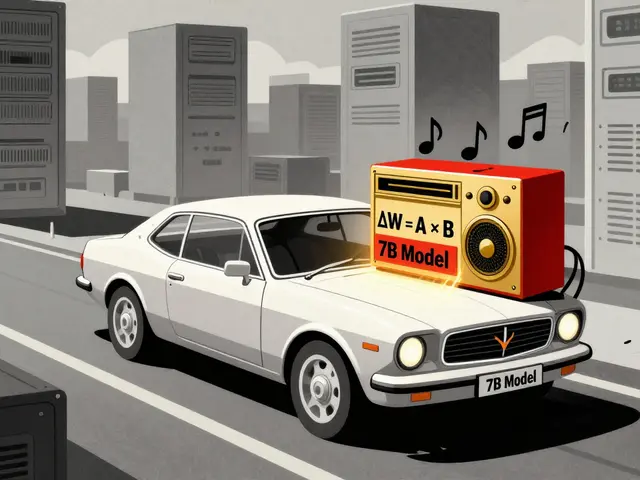
Let’s say you want to adapt GPT-3 (175B parameters) to answer questions about your company’s internal policies. The old way? You’d train every single weight in the model. That means storing 175 billion numbers in memory, just for one version of the model. Multiply that by ten tasks, and you’re talking about 1.75 trillion parameters. Even if you had the GPUs, the cost would be insane. Training one full fine-tune of a 7B model can take 72 hours and 24GB of VRAM. That’s not scalable. It’s not practical. It’s not even reasonable for startups or researchers without enterprise budgets. Enter parameter-efficient fine-tuning (PEFT). Instead of touching the whole model, you only update a tiny fraction of it. Think of it like upgrading your car’s stereo without rebuilding the engine. The core stays the same-fast, reliable, proven. But now it plays your playlist.What Is LoRA?
LoRA, or Low-Rank Adaptation, was introduced in 2021 by researchers at Microsoft and Carnegie Mellon. The idea is simple: when you fine-tune a model, most of the weight changes are redundant. They lie in a low-dimensional space. You don’t need to update 1024x1024 matrices. You can approximate those changes with two smaller matrices. Here’s how it works. Take a weight matrix W in a transformer’s attention layer-say, 1024x1024. That’s over a million parameters. LoRA freezes W and adds a small update: ΔW = A × B. Matrix A is 1024×r, and B is r×1024. The rank r? Often just 8. So instead of 1,048,576 parameters, you’re training only 2×1024×8 = 16,384. That’s 0.2% of the original. And guess what? Performance stays nearly identical on benchmarks like GLUE and SuperGLUE. LoRA targets the key linear layers in transformers: the query and value projections in attention blocks. You can extend it to all linear layers (called full LoRA), but that’s usually overkill. Most of the gain comes from the attention weights. And here’s the kicker: once training ends, you can merge A and B back into W. Your inference speed? Exactly the same as the original model. No slowdown. No extra steps.What Are Adapter Layers?
Adapter layers came first-in 2019, for BERT. They work differently. Instead of modifying weights, you stick a tiny neural network inside the transformer block. Typically, it’s a down-project layer (768 → 64), a ReLU or GELU activation, then an up-project layer (64 → 768). That’s about 3-4% extra parameters per block. The big advantage? Modularity. You can plug in a different adapter for each task. Need a medical version? Load adapter A. Legal version? Load adapter B. No reloading the whole model. Just swap the adapter. That’s perfect for multi-task systems or continual learning where the model needs to adapt over time without forgetting old skills. But there’s a trade-off. Each adapter adds a sequential step during inference. That means latency. Real-world tests show 15-25% slower response times. In a customer service chatbot? That’s noticeable. In a batch processing pipeline? Maybe not. But if speed matters, adapters are a harder sell.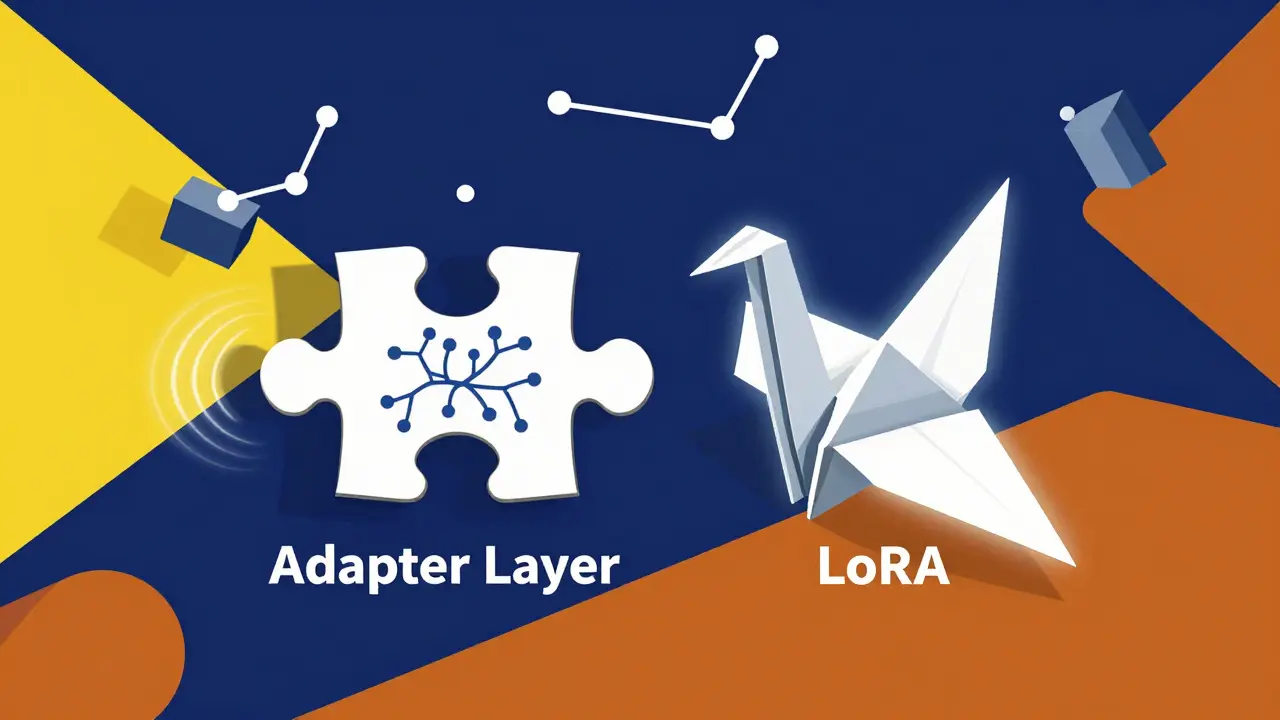
LoRA vs. Adapter Layers: The Real Differences
| Feature | LoRA | Adapter Layers |
|---|---|---|
| Parameter Efficiency | 0.1-0.7% of base model | 3-4% of base model |
| Inference Speed | Same as base model (weights merged) | 15-25% slower |
| Storage per Task | 8-16MB | 20-40MB |
| Multi-Task Support | Possible with batching (e.g., LoRAX) | Natural-swap adapters on the fly |
| Hardware Requirements | Works with QLoRA on 24GB GPU for 65B models | Works on standard GPUs, but slower |
| Best For | Single-task fine-tuning, cost-sensitive apps | Multi-task systems, continual learning |
LoRA wins on efficiency. It’s why 52% of enterprises using PEFT choose it, according to a 2023 McKinsey survey. But adapters still have their place. If you’re running a platform that serves 50 different customer segments with custom LLMs, adapters let you load them all into memory at once. LoRA can do this too-via Predibase’s LoRAX system-but it requires more engineering.
QLoRA: The Game Changer
In 2023, Tim Dettmers and his team released QLoRA. It combined LoRA with 4-bit quantization using NormalFloat (NF4). That means you can fine-tune a 65B-parameter model on a single RTX 4090 with 24GB of VRAM. Before QLoRA, that was impossible. Even GPT-3’s 175B model was out of reach for anyone without a data center. QLoRA doesn’t just save memory. It preserves performance. Benchmarks show it retains 99% of full fine-tuning accuracy on MMLU and other tests. And because it’s built on LoRA, inference stays fast. No latency penalty. No extra steps. Just a smaller, smarter model. This is why startups and researchers are switching to QLoRA. A Reddit user fine-tuned Llama-2-7B on an RTX 3090 in 8 hours. The full fine-tune took 72. The storage? 80MB instead of 14GB. That’s not an improvement-it’s a revolution.How to Get Started
You don’t need to be a PhD to use LoRA or adapters. The Hugging Face PEFT library (version 0.8.0 as of late 2023) makes it trivial. Here’s the basic flow:- Install the library:
pip install peft transformers - Load your base model (e.g., Mistral-7B or Llama-3-8B)
- Apply LoRA:
get_peft_model(model, lora_config) - Set rank (r=8 is a good start), alpha (usually 16), and target layers (query, value)
- Train like normal-same optimizer, same data, same loss
- Save the adapter weights (not the whole model)
That’s it. You’re now fine-tuning with 0.2% of the parameters. And you can load the adapter later without touching the base model.
For adapters, the process is nearly identical. Use AdapterConfig instead of LoraConfig. The library handles the rest.
Common Pitfalls and Fixes
Not everything goes smoothly. Here’s what goes wrong-and how to fix it.- Underfitting: Your model doesn’t learn. Solution: Increase the rank r. Start at 8. Try 16, then 32. Some domains (like medical or legal) need r=64.
- Overfitting: It performs well on training data but fails on new data. Solution: Use less data, add dropout, or lower alpha (try 8 instead of 16).
- Slow inference: You’re using adapters and it’s lagging. Solution: Switch to LoRA. Merge weights. Done.
- Quantization errors: You tried QLoRA and got weird outputs. Solution: Use the latest NF4 calibration from Hugging Face. It’s improved dramatically since November 2023.
One user on Hacker News tried LoRA on a financial dataset and got terrible results until they increased r to 64. That’s the rule: start small, scale up if needed. Don’t assume low rank always works.
What’s Next?
The field is moving fast. Google Research is testing dynamic LoRA-where the rank r changes during training based on gradient signals. Meta AI is combining LoRA with prompt tuning for low-resource languages. And OpenAI is exploring multimodal LoRA for image+text models. Enterprise tools like Predibase’s LoRAX are making it possible to deploy hundreds of custom models on one server. Each adapter adds just 2-3% more latency. That’s a game-changer for SaaS platforms. By 2025, Gartner predicts 85% of enterprise LLM use will rely on PEFT. LoRA will dominate single-task use cases. Adapters will live on in multi-task systems. QLoRA will be the default for anyone without a GPU cluster.Frequently Asked Questions
Can I use LoRA with any LLM?
Yes, as long as the model uses standard transformer layers with linear projections (query, key, value, and feedforward). LoRA works with Llama, Mistral, Phi, GPT-2, BERT, and most open models. It doesn’t work with models that use custom attention or non-linear layers without linear projections.
Do I need a powerful GPU to use LoRA?
Not anymore. With QLoRA, you can fine-tune 7B-13B models on a consumer GPU like the RTX 3090 or 4090. For 30B+ models, you still need a high-end card, but you no longer need multiple GPUs or cloud credits. LoRA reduces memory use by 3x compared to full fine-tuning.
How much storage do LoRA adapters take?
Typically 8-16MB per adapter, regardless of the base model size. A 70B model’s LoRA weights are still under 20MB. That’s because you’re only saving the low-rank matrices A and B-not the entire model. This makes it easy to version control and deploy.
Can I combine LoRA and adapters?
Technically yes, but it’s rarely useful. Both are PEFT methods designed to replace full fine-tuning. Combining them adds complexity without clear benefits. Stick to one. Use LoRA for efficiency, adapters for modularity.
Is LoRA better than prompt tuning?
LoRA usually outperforms prompt tuning on complex tasks. Prompt tuning only adjusts input embeddings, which limits how much the model can adapt. LoRA modifies internal weights, giving it more expressive power. For simple classification, prompts work fine. For reasoning, code generation, or domain-specific knowledge, LoRA wins.
What’s the biggest mistake people make with LoRA?
Using the default rank (r=8) for everything. That works for general tasks, but not for niche domains. Medical, legal, or financial data often need r=32 or r=64. Always test with increasing ranks. Don’t assume low-rank always means good performance.




Just used LoRA to fine-tune a Mistral model for customer support replies on my RTX 3060. Took 4 hours, used 12GB VRAM, and the adapter is only 14MB. I was skeptical but wow. This is how AI should be done.
LoRA? More like Lo-RA-ly-works. You people act like this is some breakthrough when it’s just gradient compression with extra steps. And QLoRA? You’re quantizing into NF4 like it’s gospel. The paper’s benchmarks are cherry-picked. Try it on real-world messy data and watch it crumble. Also, stop calling it ‘efficient’-you’re still training weights, just in a fancy way.
Bro. I fine-tuned a 13B model on my gaming rig. 8 hours. 16MB file. Now it writes my Slack replies better than my boss. I didn’t need a data center. I just needed coffee and a little faith. This isn’t AI anymore-it’s magic with math.
Adapters are kinda cool for switching between tasks but the lag kills me in chat apps. Went with LoRA after reading this and never looked back. Also, r=8 is fine for most stuff but yeah, if you’re doing legal docs, bump it to 32. Learned that the hard way.
Let’s be real-LoRA’s dominance isn’t just about efficiency. It’s because the Hugging Face ecosystem baked it in so seamlessly. The API is stupid simple. Adapter layers? Technically viable, but nobody wants to debug 25% latency spikes in prod. Also, QLoRA with NF4 calibration? That’s the real MVP. If you’re not using it, you’re doing it wrong.
The entire PEFT movement is a distraction from the real issue: we’re still training models on garbage data. LoRA doesn’t fix bad prompts. It doesn’t fix hallucinations. It doesn’t fix the fact that 90% of fine-tuned models are just memorizing training data and calling it ‘adaptation’. You’re optimizing the wrong layer. The model isn’t the problem. The data pipeline is. Fix that first.
And don’t get me started on ‘enterprise adoption’. Companies are buying this as a silver bullet because it’s cheaper than hiring actual domain experts. You don’t need a 64-rank LoRA to answer ‘what’s our PTO policy?’ You need a well-written FAQ and a human.
This isn’t innovation. It’s cost-cutting dressed up as progress. The paper says ‘performance is nearly identical’-but identical to what? A model trained on 100x more data? On clean, curated datasets? No. Identical to a model trained on scraped Reddit threads and Stack Overflow dumps. That’s the real benchmark.
LoRA is a band-aid. A very elegant, mathematically beautiful band-aid. But it’s still a band-aid.
Someone said QLoRA lets you train 65B on a 4090? That’s not possible. That’s like saying you can drive a Lamborghini on a bicycle tire. You’re lying. Or you’re delusional. Or both.