API vs Open-Source LLMs: The 2026 Decision Framework for Cost, Privacy, and Performance
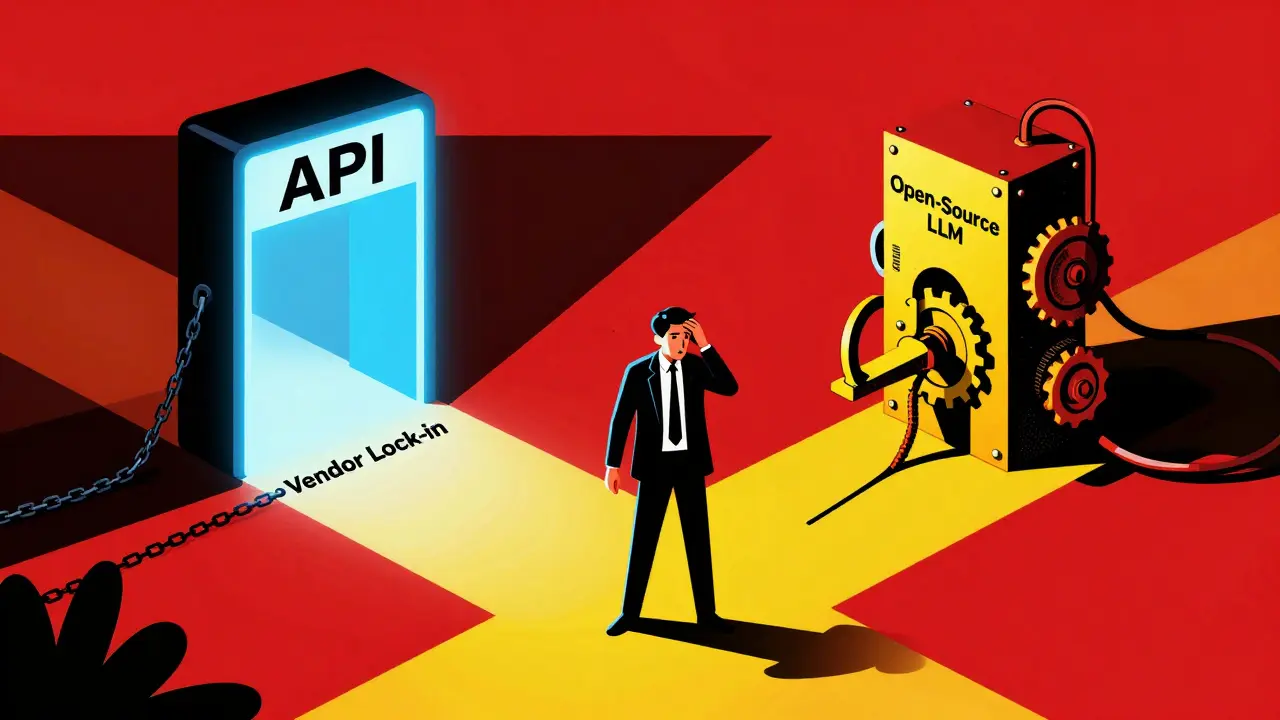
You’re staring at two very different paths. On one side, you have the polished, plug-and-play convenience of proprietary API-based LLMs, like cloud-hosted models from major tech companies that offer instant access via simple code calls. On the other, the rugged, customizable world of Open-Source LLMs, such as community-driven or company-released models you can download, modify, and run on your own servers.
In 2026, this isn’t just a technical debate anymore. It’s a business survival question. With the global LLM market hitting $28.7 billion in late 2025, the stakes are higher than ever. You aren’t just choosing a tool; you’re choosing your operational risk, your monthly burn rate, and your ability to innovate without permission.
The old advice was simple: use APIs if you want speed, use open-source if you want privacy. That binary is dead. Today, the performance gap has shrunk to a mere 3-5 percentage points on most benchmarks. But the cost structures, compliance hurdles, and engineering demands remain wildly different. This guide cuts through the noise to give you a practical framework for deciding which path fits your specific reality right now.
The Performance Reality Check: Is the Gap Worth Paying For?
Let’s start with the elephant in the room: capability. Three years ago, proprietary models were leagues ahead. Today, they’re merely slightly better at hard things.
According to Helicone’s comprehensive comparison data from November 2025, top-tier proprietary models like GPT-4.1 score an impressive 84.2% on MMLU (a benchmark for general knowledge) and 87.7% on GPQA (complex reasoning). Leading open-source contenders, like DeepSeek-V3, sit right behind them at 82.1% and 85.3% respectively. That sounds close, but here’s the catch: that 2-4% difference translates to a 15-22% higher error rate in real-world, high-stakes applications like medical diagnosis or legal contract analysis.
If you are building a customer support chatbot that needs to answer basic FAQs, that gap doesn’t matter. If you are building a diagnostic assistant for radiologists, it matters immensely. Dr. Sarah Chen, AI Research Director at Stanford HAI, noted in October 2025 that while proprietary models still lead by 4-6% on complex scientific reasoning, modern open-source models deliver "sufficient capability" for 80% of enterprise applications.
So, ask yourself: What is the cost of a wrong answer? If the answer is "a frustrated user who tries again," go open-source. If the answer is "a lawsuit" or "patient harm," stick with the proprietary API until the gap closes further.
The Cost Equation: Upfront Pain vs. Monthly Bleeding
This is where most teams get burned. Proprietary APIs feel cheap because the first month’s bill is low. But they scale exponentially. Open-source feels expensive because you need to buy hardware or rent GPUs upfront. But they stabilize quickly.
| Metric | Proprietary API (e.g., GPT-4.1) | Open-Source (e.g., Llama 3-70B) |
|---|---|---|
| Initial Setup Cost | $0 - $500 (Integration time only) | $2,000 - $10,000 (Hardware/Cloud Instances) |
| Monthly Cost (Low Volume) | d>$100 - $500 | $300 - $1,500 (Fixed infrastructure) |
| Monthly Cost (High Scale) | $5,000 - $20,000+ | $300 - $1,500 (Marginal cost near zero) |
| Pricing Model | Per-token (Input/Output) | Fixed Infrastructure + Electricity |
| Hidden Costs | Vendor lock-in, rate limits | ML Engineer salary ($120k-$180k/yr), maintenance |
Consider David Rodriguez, a software engineer who shared his experience on DeepLearning.AI in November 2025. He was paying $1,200/month for GPT-4 to handle 250,000 customer queries. After migrating to Llama 3-70B, his monthly cost dropped to $350. Yes, he spent three weeks setting it up. But after six months, he had saved over $5,000 and owned his infrastructure.
However, don’t ignore the human cost. n8n Blog’s 2025 analysis showed that 67% of organizations hiring for open-source deployment had to bring on at least one additional ML engineer. If you don’t have that budget or talent, the "cheap" open-source model might end up costing you more in salaries than the API ever would.

Data Privacy and Compliance: The Non-Negotiable Factor
If your industry is healthcare, finance, or government, this section makes the rest of the article irrelevant. You likely don’t have a choice.
In 2026, regulatory pressure is intensifying. The EU AI Act’s implementation requires full transparency for high-risk applications. McKinsey’s November 2025 compliance analysis found that proprietary APIs are non-compliant for 41% of financial and healthcare use cases simply because you cannot verify exactly how your data is processed or stored within a black-box system.
InclusionCloud reported that 78% of enterprises handling sensitive data now opt for self-hosted open-source solutions to maintain HIPAA or GDPR compliance. When you host a model like Mistral 8x22B or Llama 3 on your own private cloud or on-premise servers, your data never leaves your firewall. There is no third-party vendor reading your logs. There is no risk of your proprietary training data leaking into another client’s output.
If you send patient records or trade secrets to a public API, you are assuming a massive liability risk. Even if the provider promises encryption, you are trusting their security team, not your own. For regulated industries, open-source isn’t just a cost-saving measure; it’s an insurance policy.
Implementation Complexity: Speed vs. Control
Time-to-market is a killer. If you need to launch a prototype next week, proprietary APIs are the only rational choice. Integration takes 1-3 days. You need prompt engineering skills, but you don’t need to know Kubernetes.
Open-source deployment is a marathon. The same n8n Blog survey found that average setup times range from 2-4 weeks. You’ll be dealing with GPU optimization, CUDA compatibility issues, and model quantization. One developer on Trustpilot recounted spending 40 engineering hours just troubleshooting CUDA errors before reverting to the API.
But control comes with that complexity. With an API, you are stuck with what the provider gives you. If they change the model version, deprecate a feature, or spike prices overnight, you are helpless. With open-source, you can fine-tune the model on your specific domain data. You can tweak the temperature settings precisely. You can optimize the inference speed for your specific hardware. You own the stack.
Think about it like buying a car versus leasing one. Leasing (API) is easy, reliable, and includes maintenance. Buying (Open-Source) requires you to learn how to change the oil, but you can modify the engine however you want and keep it forever.
The Hybrid Strategy: Why Not Both?
Here’s the secret that most successful enterprises are using in 2026: they aren’t choosing one. They are using both.
Dr. Elena Rodriguez, writing in Harvard Business Review in November 2025, described this "layered strategy." Use proprietary APIs for customer-facing interfaces where performance and reliability are paramount. Users won’t tolerate slow or incorrect answers when they are trying to buy something or solve a critical problem. The marginal cost increase is worth the brand trust.
Then, use open-source models for internal data processing, document summarization, and backend tasks. These tasks are high-volume but lower-stakes. You can afford a slight drop in accuracy because the cost savings are massive, and the data stays private.
For example, a bank might use Claude Opus 4.1 to generate personalized investment advice for clients (high value, high compliance, high cost). Simultaneously, it uses a self-hosted Llama 3 instance to summarize thousands of internal transaction logs for fraud detection patterns (high volume, internal only, low cost).
This approach mitigates vendor lock-in risks. If OpenAI raises prices by 50% tomorrow, your internal operations don’t collapse because they run on your own hardware. Your external customers still get the best experience, but your margins are protected.
Decision Checklist: Which Path Fits You?
Still unsure? Run your project through this quick filter.
- Choose Proprietary API if:
- You need to launch in less than two weeks.
- Your application involves life-critical decisions (medical, legal, autonomous driving).
- You have no in-house ML engineers or DevOps team.
- Your data volume is low to medium (under 1 million tokens/month).
- You prioritize ease of integration over long-term cost control.
- Choose Open-Source LLM if:
- You handle highly sensitive data (PII, PHI, trade secrets).
- You expect high-volume usage (millions of tokens/month).
- You need to fine-tune the model on proprietary domain data.
- You have dedicated engineering resources for maintenance.
- You are subject to strict regulatory compliance (GDPR, HIPAA, EU AI Act).
Remember, the landscape shifts fast. Microsoft’s release of Phi-4 in November 2025 narrowed the performance gap even further, achieving 83.7% on MMLU. By Q4 2026, analysts predict the gap will shrink to 1-2%. If you are on the fence, starting with an API allows you to validate your product idea quickly. Once you hit scale, you can migrate to open-source to optimize costs. The reverse migration-from open-source back to API-is harder due to retraining costs, so plan your exit strategy early.
Is open-source LLM really free?
No. While the model weights themselves are often free to download, the infrastructure costs are significant. You must pay for GPU servers (either capital expenditure for hardware or operational expenditure for cloud instances like AWS g5.4xlarge), electricity, cooling, and the salaries of engineers to maintain the system. At high scale, these fixed costs are usually lower than API fees, but they are never zero.
Which open-source model is best for beginners in 2026?
Meta's Llama 3 series remains the gold standard for beginners due to its extensive documentation, community support, and availability on platforms like Hugging Face. Mistral AI's Mixtral 8x22B is also excellent for those needing high performance with efficient resource usage. Start with Llama 3-8B if you have limited hardware, scaling up to 70B as needed.
Can I switch from API to open-source later?
Yes, but it requires architectural planning. Design your application with an abstraction layer that separates your business logic from the LLM provider. This allows you to swap out the underlying model (from GPT-4 to Llama 3, for example) with minimal code changes. Without this layer, refactoring your entire codebase during a migration can take months.
Do open-source models violate copyright laws?
It depends on the license. Meta's Llama models use a custom license that restricts commercial use for large companies (those with over $700M in revenue) without approval. Mistral and many other models use permissive Apache 2.0 licenses. Always review the specific license agreement of the model weights before deploying them in a commercial product.
How much faster are proprietary APIs compared to self-hosted models?
Proprietary APIs generally offer lower latency because providers optimize their infrastructure globally. GPT-4.1 delivers around 85 tokens per second. A self-hosted Llama 3-70B on equivalent hardware typically achieves 45-60 tokens per second. However, with proper quantization and specialized hardware (like NVIDIA H100s), you can narrow this gap significantly for most conversational applications.