Architectural Standards for Vibe-Coded Systems: Reference Implementations and Governance
The Speed Trap of AI-Generated Code
By March 2026, the promise of Vibe Coding is an AI-native programming paradigm where developers specify high-level functional intent alongside qualitative descriptors of the desired tone or style has become a reality for many teams. You can type a prompt, and a system generates a working feature in minutes. But here is the hard truth: speed without structure creates technical debt faster than any manual coder ever could. In 2025, we saw projects fail not because the code didn't work initially, but because it couldn't be maintained. The difference between a successful AI-driven product and a messy codebase often comes down to one thing: Architectural Standards.
When you hand over the keyboard to an agent, you are no longer just writing logic; you are designing a system that learns from its own output. Without guardrails, the AI tends to optimize for immediate functionality rather than long-term resilience. This is why governance is no longer optional. It is the safety net that keeps your software from collapsing under its own weight as it scales.
Defining the Vibe Coding Paradigm
Before we talk about rules, we need to agree on what we are building. The concept was formally defined in the October 2025 arXiv paper (arXiv:2510.17842). It describes a shift where the developer acts more like a conductor, specifying the "vibe"-the tone, style, and emotional resonance-while an intelligent agent handles the syntax. Google Cloud documented this in December 2024 as a style of programming using natural language prompts to assist the coding process.
This isn't just autocomplete. It is a fundamental shift in how software is created. Current implementations rely on AI coding assistants like GitHub Copilot is an AI-powered code completion tool that integrates with development environments (version 4.3, updated October 2025) or Amazon CodeWhisperer (version 2.1). However, the core value proposition centers on accelerating development cycles. Drew Maring's November 2024 case study documented 186 completed tasks with 94% test coverage for a production application built using specification-first approaches. That is impressive speed. But Codecentric's March 2025 analysis of an AI-generated SPaaS platform revealed 37 critical security vulnerabilities and 21 architectural anti-patterns when those guardrails were missing.
Five Foundational Architectural Principles
To prevent the chaos of unstructured AI generation, you need to enforce specific design patterns. Technical specifications for vibe-coded systems require adherence to five foundational architectural principles with specific implementation patterns. These are not suggestions; they are requirements for stability.
- Composition Over Inheritance: You must implement this through capability interfaces that combine flexibly. In Synaptic Labs' May 2025 reference implementation, 87% of object behaviors were composed from 12 standardized capability interfaces rather than hierarchical inheritance. This makes the code easier for the AI to understand and modify without breaking existing logic.
- Dependency Injection: This requires strict interface-based contracts with constructor injection patterns. vFunction's January 2025 analysis showed properly implemented DI reduced coupling by 63% in AI-generated codebases. If the AI doesn't know where dependencies come from, it will hardcode them, creating a mess.
- Tell, Don't Ask: This principle mandates that objects receive commands rather than having state inspected. Case studies show 41% fewer conditional branches in refactored code. When you ask the AI to "tell" objects what to do, the resulting logic is cleaner and less prone to race conditions.
- Law of Demeter Compliance: You need to flatten object chains through well-defined service interfaces. This reduces method chain length from averages of 4.7 to 1.2 in compliant implementations. Short chains mean the AI can reason about the code more effectively.
- AI-Friendly Design: This requires consistent patterns across all components. This includes standardized REST interfaces (create, update, delete, get, list operations), uniform error handling (using 4 standardized error types), and predictable dependency structures. Synaptic Labs' June 2025 benchmark showed consistent pattern implementation improved AI extension success rates from 58% to 92%.
Structured vs. Unstructured Approaches
Not all vibe coding is created equal. Comparative analysis reveals stark differences between structured and unstructured approaches. Structured methods like Drew Maring's AI-spec driven development and the BMAD framework produce systems with 94% test coverage and 68% lower technical debt compared to unstructured approaches, according to Codecentric's March 2025 analysis of 12 production systems.
| Attribute | Structured Approach | Unstructured Approach |
|---|---|---|
| Test Coverage | 94% | Variable (often <60%) |
| Technical Debt | 68% Lower | High Accumulation |
| Security Vulnerabilities | 18% Gap Reduction | 37 Critical Issues per 1,000 lines |
| Coupling Issues | Low (63% Reduction) | 73% of Systems Affected |
| Maintainability | High | 42% Unused Code Fragments |
Unstructured vibe coding consistently generates strong coupling issues. You will find that 73% of analyzed systems suffer from this. Security vulnerabilities jump to 37 critical issues per 1,000 lines of code. Poor maintainability results in 42% unused code fragments. Structured approaches with architectural guardrails reduce these issues by 63-82%. The reference architecture proposed in the arXiv:2510.17842 paper comprises four components: an Intent Parser, a Semantic Embedding Engine, an Agentic Code Generator, and a Feedback Loop.

Governance and Onboarding Processes
Practical implementation of architectural standards for vibe-coded systems requires specific onboarding processes and continuous governance. You cannot just start typing prompts. Synaptic Labs' May 2025 guide recommends a 3-phase onboarding. First, establish an architectural constitution, which takes 4-8 hours for small teams. Second, create reference implementations for core patterns, taking 12-24 hours. Third, implement validation pipelines, requiring 8-16 hours.
Drew Maring's November 2024 documentation shows his team spent 112 hours establishing their constitutional framework before generating any production code. This upfront investment paid back through 73% fewer architectural remediation hours during development. Common challenges include prompt drift, where developers gradually abandon architectural constraints. This affected 68% of teams in Codecentric's study. Constitutional updates, like Maring's Principle VIII addition, required 42 hours of verification and template updates in his case study.
Required skills include traditional architectural knowledge. 87% of successful teams had architects with 10+ years experience plus prompt engineering expertise. Documentation quality varies dramatically. Google's vibe coding guides score 4.7/5 for clarity while independent frameworks average 3.2/5 based on developer surveys. Community resources remain limited but growing, with the newly formed Vibe Architecture Guild hosting weekly pattern reviews.
Regulatory and Future Standards
The market context shows rapid adoption despite architectural concerns. Gartner predicted 55% of enterprise development teams will use AI coding assistants by 2026. The architectural tooling segment is emerging as a critical differentiator. vFunction secured $42M Series B funding in March 2025 specifically for architectural observability for AI-generated code.
Regulatory considerations are intensifying. The EU's June 2025 AI Act requires architectural transparency documentation for AI-generated systems in critical sectors. This prompted 41 of the Fortune 100 to implement constitutional approaches by Q3 2025 according to Forrester's August 2025 report. The most significant near-term development is the IEEE P2874 standard, currently in draft phase as of December 2025. It specifies architectural requirements for AI-generated systems including mandatory separation of concerns metrics (minimum 85% adherence) and coupling thresholds (maximum 0.35 fan-out).
Long-term viability assessments vary. Gartner's October 2025 forecast predicts 90% of vibe-coded systems without architectural standards will require full rewrites within 3 years. Those with proper governance have 83% expected longevity beyond 5 years. The consensus across vFunction's February 2025 analysis, Synaptic Labs' May 2025 guide, and Codecentric's March 2025 review is clear: vibe coding's success depends entirely on architectural discipline.
What is the primary risk of unstructured vibe coding?
The primary risk is rapid technical debt accumulation. Systems built without explicit architectural standards accumulate 4.7x more technical debt per month than traditionally developed systems. This leads to security vulnerabilities and maintainability issues that often require full rewrites within three years.
Which tools support architectural governance for AI code?
Specialized platforms like Synaptic Labs target architectural governance, while enterprise tools like vFunction provide post-generation architectural validation. GitHub Copilot focuses on low-level code completion, but requires external governance layers for architecture.
How much time should be spent on the architectural constitution?
For small teams, establishing an architectural constitution takes 4-8 hours. However, complex projects like Drew Maring's MacroMetric project required 112 hours of framework establishment before generating production code, which significantly reduced remediation time later.
What is the IEEE P2874 standard?
The IEEE P2874 standard is a draft specification as of December 2025 that defines architectural requirements for AI-generated systems. It includes mandatory separation of concerns metrics and coupling thresholds to ensure code quality and safety.
Does vibe coding replace traditional software architecture?
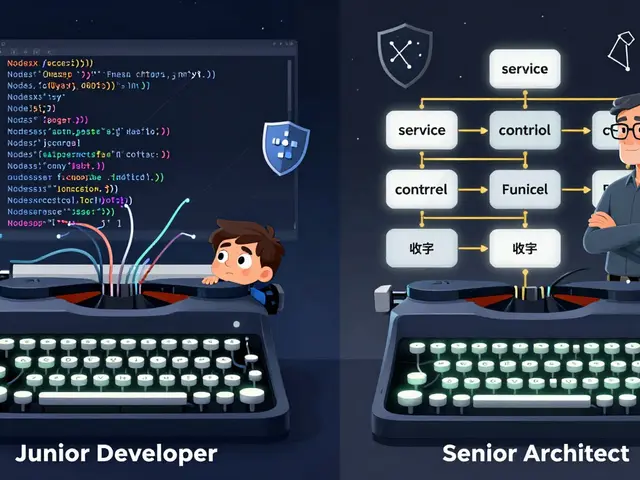
No. Vibe coding shifts the architect's role from writing code to defining constraints. 87% of successful teams had architects with 10+ years experience. The AI handles syntax, but humans must enforce principles like dependency injection and composition over inheritance.






It is really interesting how speed can actually slow you down in the long run. I have seen teams rush into AI coding without thinking about the structure. The part about technical debt accumulating faster than manual coding is scary. We need to treat these standards like actual laws in our projects. It is not just about getting features out quickly anymore. Quality has to be the main focus if we want longevity. I appreciate the detailed examples from Synaptic Labs too. It helps to see real numbers backing up the theory. Governance is definitely the missing piece in most conversations about this.
Most teams fail because they lack discipline not tools. The AI is only as good as the architect guiding it. Simple logic.
Many peolpe forget about the security side of things. The table showing the difference is really clear. We shoudl not ignore the governance part. It can save so much time in the future. I agree with the point on dependency injection. Hardcoding is a bad habit for sure.
I know what you mean about the security part. It is scary when you see the numbers. I hope everyone starts using the standards soon. It will make life easier for us all.
This is exactly what we needed to hear today.
The security vulnerabilities part really scared me a bit 😱. But I am glad there are standards being proposed. 💡 We need to keep our code clean for the future. 🛠️ The comparison table is super helpful for understanding the risks. 📊 I will definitely share this with my team. 🤝 Thanks for putting this together! ✨
People want fast code but they forget about fixing it later. The AI makes mistakes if you do not tell it what to do. I think the rules are good. We should follow them to stay safe. It is better to be slow and right than fast and wrong. Simple stuff like that.
We really need to talk about this more in our industry circles. The shift towards vibe coding is happening whether we like it or not. Ignoring the architectural standards is basically asking for trouble down the line. I have worked with teams that tried to skip the constitution phase and they regretted it. The upfront time investment is actually a huge savings in the long run. Think about how much time you waste fixing bugs from bad AI generation. It is not worth the risk to just let the AI run wild without constraints. The IEEE standard mentioned here is something we should all keep an eye on. It will likely become mandatory for bigger contracts soon anyway. We have to adapt our processes to fit these new tools properly. Collaboration between architects and prompt engineers is going to be key. You cannot just throw a prompt at a wall and expect a fortress to appear. The data from Drew Maring shows that preparation pays off significantly. We should encourage our junior devs to learn these patterns early on. It is about building sustainable systems not just quick prototypes. I hope this post gets the attention it deserves from leadership teams. Let us all commit to better practices moving forward.