How Generative AI Boosts Revenue Through Cross-Sell, Upsell, and Conversion Lifts
When companies start using generative AI for sales, they don’t just automate tasks-they unlock new ways to make more money. It’s not about replacing salespeople. It’s about giving them superpowers. Think of it like this: every time a customer visits your website, calls your support line, or replies to an email, they leave behind clues. Generative AI notices patterns no human could catch in real time. It spots when someone is ready to buy a second product, when they’re hesitating on a higher-tier option, or when they’re about to walk away. And it acts-fast, personalized, and at scale.
How Cross-Sell Works with Generative AI
Cross-selling isn’t new. You buy a phone, and they ask if you want a case. But traditional systems use simple rules: "If someone bought X, show them Y." That’s like guessing based on last year’s weather. Generative AI doesn’t guess. It learns.
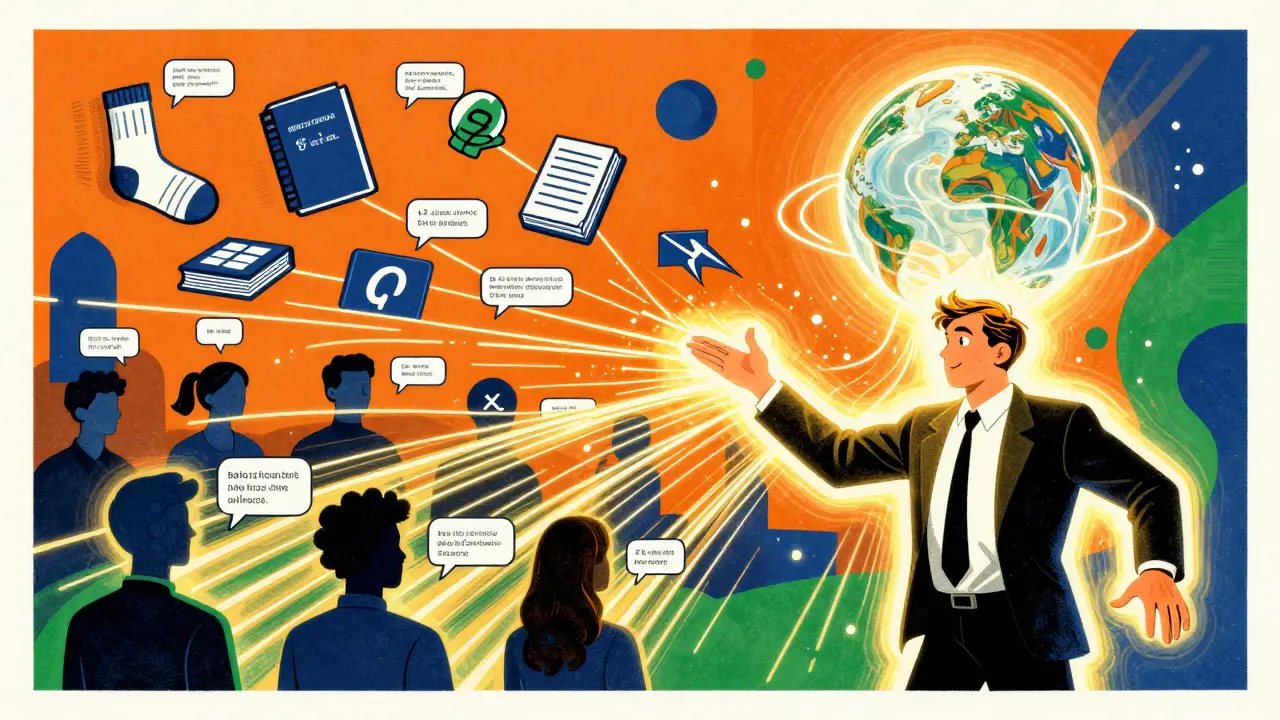
Take a Fortune 500 retailer. Before AI, their cross-sell rate hovered around 10%. After implementing a system trained on 18 months of purchase history, browsing behavior, and customer service logs, their average order value jumped 18.7% in six months. How? The AI noticed that customers who bought running shoes and searched for weather forecasts in the same session were 3.2x more likely to buy moisture-wicking socks. It didn’t just recommend socks. It recommended the right socks-the ones matching their location, weather, and past returns.
Real-time data is key. AI pulls from CRM systems, e-commerce platforms, and even chat logs. It doesn’t just look at what was bought. It looks at what was searched, what was abandoned, and what was complained about. That’s how it knows someone is dissatisfied with their current product and might be open to an upgrade.
Upsell That Actually Converts
Upselling is trickier than cross-selling. People don’t want to feel pushed. They want to feel understood. That’s where generative AI shines.
A financial services firm in Chicago started using AI to analyze customer interactions. Instead of pushing premium accounts to everyone, the system identified subtle signals: a customer who checked their investment balance three times in a week, asked about retirement options twice, and recently changed jobs. The AI generated a personalized message-not a sales pitch, but a question: "Based on your recent move, would you like to see how your new income could help you reach your goals faster?"
Conversion rates on those upsell offers jumped from 12.3% to 19.8%. Why? Because the message felt like advice, not a pitch. The AI didn’t just match products to profiles. It matched tone, timing, and context.
According to Master of Code’s January 2026 analysis, companies using generative AI for upsell see 26-34% ROI. That’s not magic. It’s precision. The system learns what language works for each segment, what timing feels natural, and what offers actually lead to long-term loyalty-not just one-time sales.
Why Conversion Rates Are Rising
Conversion rate improvements are the most visible result. But most companies don’t realize how much of it comes from small, invisible tweaks.
One e-commerce brand noticed their cart abandonment rate was high among users who viewed a product but didn’t click "Add to Cart." The AI analyzed those sessions and found a pattern: 72% of them looked at the product image for less than 1.5 seconds. That’s not interest. That’s confusion. The AI automatically replaced those product images with short videos showing the item in use. Conversion from that segment jumped 14%.
Another example: a SaaS company used AI to rewrite onboarding emails. Instead of generic templates, the system generated personalized subject lines based on how users interacted with their free trial. One user watched all the tutorial videos but never set up their profile. The AI sent: "You’ve seen how it works. Let’s get you started in 2 minutes." The reply rate? 47%. The industry average? 11%.
McKinsey estimates generative AI could add $4.4 trillion to the global economy by 2030. A big chunk of that comes from lifting conversions. And it’s not just tech companies. Retailers, banks, even healthcare providers are seeing 15-20% conversion lifts when they move beyond basic chatbots to true AI-driven personalization.
Who’s Winning-and Who’s Falling Behind
Not every company sees these results. The difference? Maturity.
High-maturity adopters-those who’ve had AI in production for over a year-see 3x higher ROI than companies just testing prototypes. Their conversion lifts? 15-20%. Basic implementations? 5-8%. Why? Because the high performers don’t just plug in a tool. They rebuild their processes around it.
Take Salesforce Einstein GPT. It doesn’t just suggest next products. It integrates with your entire sales workflow. If a rep opens a customer’s profile, the AI automatically surfaces: past complaints, recent engagement, and the best offer to close the deal. It doesn’t just give data-it gives context.
Meanwhile, companies with siloed data are stuck. One Reddit user in r/SalesTech shared: "We saw only a 3.2% lift because our CRM, marketing, and support data were in three different systems." No AI can fix that. Data has to flow.
Industry differences matter too. Consumer services, finance, and healthcare lead adoption. Construction? Just 1.4% of firms use it. Why? Because AI needs digital touchpoints. If your customer interaction is a phone call to a field rep, AI can’t help-yet.

What It Takes to Make It Work
You can’t just buy an AI tool and expect revenue to spike. It takes work.
- Data readiness: You need at least 12 months of clean customer interaction data. No historical data? Start collecting.
- Team alignment: 67% of successful implementations include data scientists. 58% need CRM specialists. Sales teams? They need training-not replacement.
- Executive buy-in: 84% of companies that launched AI within six months had direct executive sponsorship.
- Clear KPIs: Don’t measure "engagement." Measure "revenue per interaction."
And don’t forget incentives. One company found their sales team resisted AI recommendations because commissions were tied only to direct sales. They changed the structure: reps earned bonus points for AI-suggested cross-sells that converted. Within three months, adoption jumped from 30% to 89%.
What’s Next
The market is exploding. Global generative AI revenue is projected to hit $30-$40 billion in 2026. By 2030, it could be over $350 billion. But the low-hanging fruit is gone. The next wave won’t be about generic recommendations. It’ll be about context-aware interactions.
Imagine this: a customer opens your app at 10:37 p.m. They’ve been browsing for a week. The AI notices they’re on mobile, have a history of late-night purchases, and recently searched for "gift ideas for mom." Instead of showing the top-selling item, it offers: "A personalized journal with her name engraved. Ships tomorrow. 20% off if you order in the next 90 minutes."
That’s the future. And it’s already here for the companies that built the right foundation.
Can generative AI really increase sales revenue?
Yes. Companies using generative AI for sales see measurable lifts: 15-20% higher conversion rates, 10-18% increases in average order value, and 26-34% ROI on AI investments. Real-world examples include a Fortune 500 retailer that boosted average order value by 18.7% and a financial services firm that increased upsell conversions from 12.3% to 19.8%.
What data do I need to make AI work for cross-selling?
You need at least 12 months of clean, integrated customer data: purchase history, browsing behavior, support tickets, email opens, and chat logs. Siloed data from separate systems won’t work. The AI needs to see the full customer journey across channels to spot real patterns.
Which industries benefit the most from AI-driven upsell?
Consumer services, finance, and healthcare lead adoption. These industries have high digital touchpoints, recurring customer interactions, and clear upsell paths. Retailers see 5-20% revenue boosts from personalization. Banks report up to $3.5 million in additional revenue per front-office employee. Sectors like construction and agriculture lag due to low digital engagement.
How long does it take to see results from AI sales tools?
Most companies see initial results in 4-6 months. But that assumes data is ready and teams are aligned. If you’re starting from scratch with poor data, plan for 6-12 months of preparation before launching. The fastest results come from companies that focus on 3-5 high-impact use cases instead of trying to automate everything.
Is generative AI better than traditional recommendation engines?
Yes, significantly. Traditional engines use simple rules like "people who bought X also bought Y." Generative AI analyzes unstructured data-chat logs, social media, browsing time, emotional tone-and learns complex patterns. In e-commerce, it drives 22-35% higher conversion rates than rule-based systems. It’s not just smarter-it’s adaptive.
What are the biggest risks of using AI for sales?
The biggest risks are poor data quality, misaligned incentives, and privacy concerns. If your data is siloed or outdated, AI will make bad suggestions. If sales reps aren’t rewarded for following AI recommendations, adoption will fail. And if customers feel manipulated, trust drops. Transparency is key: let users know how recommendations are made, and give them control over their data.