Evaluating Drift After Fine-Tuning: Monitoring Large Language Model Stability
Imagine deploying a fine-tuned large language model (LLM) that performs flawlessly in testing. Three months later, users start complaining that the answers feel "off" or outdated. This is not a bug; it is drift. When you fine-tune an LLM, you are essentially freezing its behavior based on a specific snapshot of data and user preferences. But the world doesn't stop. Users ask new questions, frameworks update, and social norms shift. If you don't actively monitor for changes in how your model behaves compared to its baseline, you risk silent degradation that can cost your business millions in trust and compliance.
Drift after fine-tuning isn't just a theoretical concern. It is the primary reason why 85% of AI leaders report production issues related to changing data properties. Whether you are using Reinforcement Learning from Human Feedback (RLHF) or standard supervised fine-tuning, the gap between your training data and real-world inputs widens over time. The goal of this guide is to help you move from passive hope to active surveillance. We will look at how to detect when your model is drifting, what metrics actually matter, and how to set up a monitoring pipeline that catches problems before your users do.
Understanding the Types of Drift in LLMs
Before you can monitor drift, you need to know what kind of drift you are dealing with. In traditional machine learning, we often talk about input distribution changes. In LLMs, the situation is more complex because both the input (prompts) and the output (responses) are unstructured text. There are three main forms of drift you need to watch for:
- Covariate Shift: This happens when the statistical properties of the input prompts change. For example, if your model was trained on short coding questions but users start asking long, context-heavy architectural queries, the input distribution has shifted. Anthropic documented cases where models trained on general coding began failing when users switched to querying newer frameworks like Bun or Astro, simply because the prompt structure changed.
- Concept Drift: This is a shift in what constitutes a "good" response. A response that was helpful in 2023 might be outdated or insensitive in 2026. If user preferences evolve-say, they now prefer concise bullet points over long paragraphs-the concept of quality has drifted, even if the input prompts remain similar.
- Label Drift: This occurs when human annotation behavior changes. If the guidelines for rating responses become stricter or looser over time, the labels used to evaluate your model no longer align with the original training signal. This is particularly problematic in RLHF pipelines where reward models are sensitive to subtle shifts in human judgment.
The key takeaway here is that drift is not always bad. Sometimes, a shift in user behavior represents legitimate evolution. However, without monitoring, you cannot distinguish between beneficial adaptation and harmful degradation. According to Google Research, 25-30% of detected drift signals actually represent beneficial model evolution rather than performance loss. Your monitoring system needs to be smart enough to flag these distinctions.
Key Metrics for Detecting Instability
How do you measure something as intangible as "model stability"? You don't measure it directly; you measure the distributions of embeddings and scores. Here are the technical characteristics that form the backbone of effective drift monitoring:
- Jensen-Shannon (JS) Divergence: This is a statistical tool used to compare two probability distributions. In LLM monitoring, you calculate JS divergence between sentence embeddings of current outputs and historical baselines. A threshold of 0.15 to 0.25 is typically used to trigger alerts. If the divergence exceeds this range, it suggests the semantic content of your responses is shifting significantly.
- Reward Model Score Distribution: If you use RLHF, track the distribution of reward scores. Deviations exceeding 15-20% from the baseline distribution indicate potential drift. If average rewards drop, your model is likely producing lower-quality outputs relative to what it was trained on.
- Prompt Clustering Analysis: Use Latent Dirichlet Allocation (LDA) or K-means clustering on prompt embeddings. Anthropic reports that when 30-40% of prompts fall into novel clusters, it necessitates model retraining. This helps identify covariate shift early.
These metrics require computational resources. Enterprise-scale deployments typically need 8-16 NVIDIA A100 GPUs for embedding generation and real-time analytics pipelines capable of processing 10,000 to 100,000 requests per second. You also need to maintain historical data snapshots, usually covering 3-6 months of production data, to have a valid baseline for comparison.
Traditional vs. LLM-Specific Detection Methods
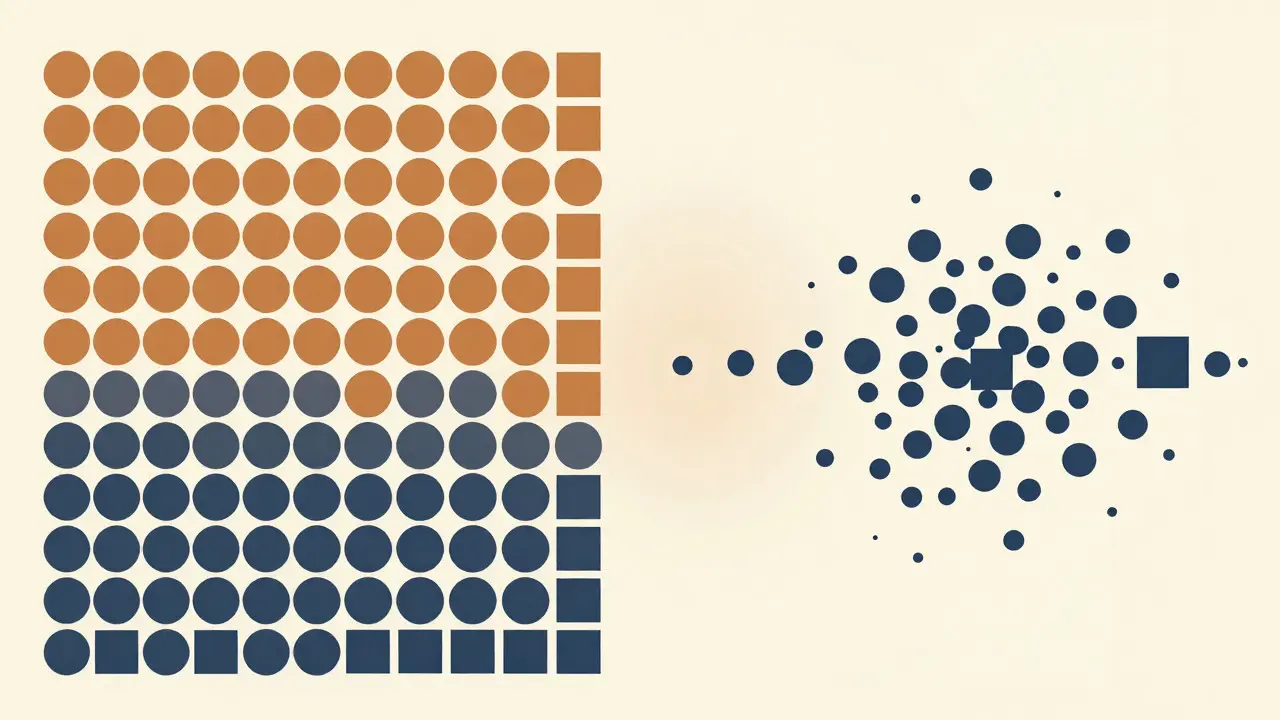
You might be tempted to reuse traditional MLOps drift detection tools like Page-Hinkley or EDDM. While these work well for structured tabular data, they struggle with the high-dimensional, unstructured nature of LLM outputs. A 2024 benchmark study by UCSC OSPO found that traditional methods achieve only 55-65% accuracy in detecting meaningful drift in LLMs.
In contrast, modern LLM-based detection systems perform significantly better. Systems leveraging smaller models like GPT-3.5-turbo for meta-evaluation demonstrated 82-89% accuracy in identifying meaningful drift while reducing false positives by 37% compared to traditional statistical methods. The key differentiator is the ability to track both input and output distributions simultaneously. Only 35% of available commercial tools fully support this dual-tracking capability, according to Forrester's Q4 2024 evaluation.
| Feature | Traditional Statistical Methods | LLM-Specific Approaches |
|---|---|---|
| Detection Accuracy | 55-65% | 82-89% |
| False Positive Rate | High | Reduced by ~37% |
| Data Type Handling | Structured/Tabular | Unstructured Text/Embeddings |
| Input/Output Tracking | Usually Input Only | Simultaneous Input & Output |
| Implementation Complexity | Low | High (Requires Embedding Pipelines) |
A critical weakness across most solutions, regardless of method, is the feedback delay. Meta’s 2024 research on Llama-3 monitoring documented a 2-4 week lag in identifying concept drift. By the time you catch it, users may have already noticed the quality drop. This is why real-time alerting capabilities are a top praise point in user reviews, mentioned in 63% of positive G2 ratings.
Building a Practical Monitoring Pipeline
Getting started with drift monitoring requires a structured approach. The learning curve is steep, with organizations typically requiring 3-6 months to achieve proficiency. Here is a practical roadmap to establish your baseline and set up alerts:
- Establish Baseline Distributions: Collect 10,000 to 50,000 representative samples from your initial deployment phase. These should cover a wide range of typical user interactions. Store these embeddings and reward scores as your "golden" baseline.
- Select Embedding Models: Use industry-standard embedding models like text-embedding-ada-002, which maintains an 85% adoption rate in 2025 benchmarks due to its balance of speed and semantic fidelity.
- Define Tiered Alerts: Don't alert on every minor fluctuation. Implement a tiered system:
- Critical Drift: Performance degradation >15%. Triggers immediate action and engineering review.
- Minor Drift: Degradation between 5-15%. Enters a review queue for weekly analysis.
- Integrate with MLOps Frameworks: Connect your monitoring solution to existing tools like MLflow or Weights & Biases. Most enterprise implementations require 8-12 weeks of integration effort, so plan accordingly.
One common pitfall is alert fatigue. If your thresholds are too sensitive, your team will ignore the alerts. Calibrate your sensitivity by reviewing past incidents. If you find yourself investigating false positives frequently, widen your JS divergence threshold slightly. Conversely, if you miss degradations, tighten it.
Cost, Tools, and Market Landscape
The global LLM monitoring market reached $1.2 billion in 2025, growing at 47% year-over-year. This growth is driven by regulatory pressure, including the EU AI Act's requirements for continuous model monitoring. But what does it cost to implement?
Commercial solutions vary widely in price. Specialized platforms like iMerit's Ango Hub offer RLHF-specific monitoring for $15,000-$50,000 annually. Enterprise-grade cloud solutions, such as Microsoft's Azure Monitor for LLMs, charge approximately $42 per 1,000 monitored requests. Open-source alternatives like NannyML have zero licensing costs but require significant engineering resources to maintain. On average, organizations dedicate 1.5-2.5 full-time engineers per deployed LLM for monitoring tasks.
When choosing a tool, look for features that address the specific weaknesses of drift monitoring. Does it track both prompt and response distributions? Can it handle the 2-4 week feedback delay issue? Recent developments, like OpenAI's 'DriftShield' framework released in December 2025, use contrastive learning to reduce false positives by 29%, setting a new standard for precision. Hugging Face also integrated automatic drift detection into their Inference Endpoints platform in January 2026, making implementation easier for developers.
Frequently Asked Questions
What is the most common cause of drift in fine-tuned LLMs?
The most common cause is covariate shift, where the distribution of user prompts changes over time. For example, users may start asking about new software frameworks or using different language patterns than those present in the original fine-tuning dataset. This causes the model to encounter inputs it hasn't seen during training, leading to unpredictable outputs.
How often should I check for drift in production?
For high-traffic applications, monitoring should be real-time or near-real-time, processing thousands of requests per second. For lower-volume deployments, daily batch processing is often sufficient. The key is to minimize the feedback delay, which currently averages 2-4 weeks in many systems. Aim to reduce this window as much as possible through automated alerting.
Can drift ever be a good thing?
Yes. Approximately 25-30% of detected drift signals represent beneficial model evolution rather than degradation. For instance, if users start preferring shorter, more direct answers, and the model adapts to this preference, the "drift" reflects improved user satisfaction. Your monitoring system must distinguish between harmful degradation and positive adaptation.
What is the difference between model drift and data drift?
Data drift refers to changes in the statistical properties of the input data (prompts). Model drift refers to the gradual degradation of the model's predictive power due to discrepancies between past training data and current real-world inputs. In practice, they are closely linked: data drift often triggers model drift if the model isn't robust to the new input distribution.
How much does it cost to monitor LLM drift?
Costs vary significantly. Commercial cloud solutions charge around $42 per 1,000 monitored requests. Specialized enterprise licenses can range from $15,000 to $50,000 annually. Open-source tools are free but require dedicated engineering time, typically 1.5-2.5 FTEs per model. Factor in infrastructure costs for GPU-accelerated embedding generation, which can be substantial for high-throughput applications.