Few-Shot Fine-Tuning of Large Language Models: When Data Is Scarce
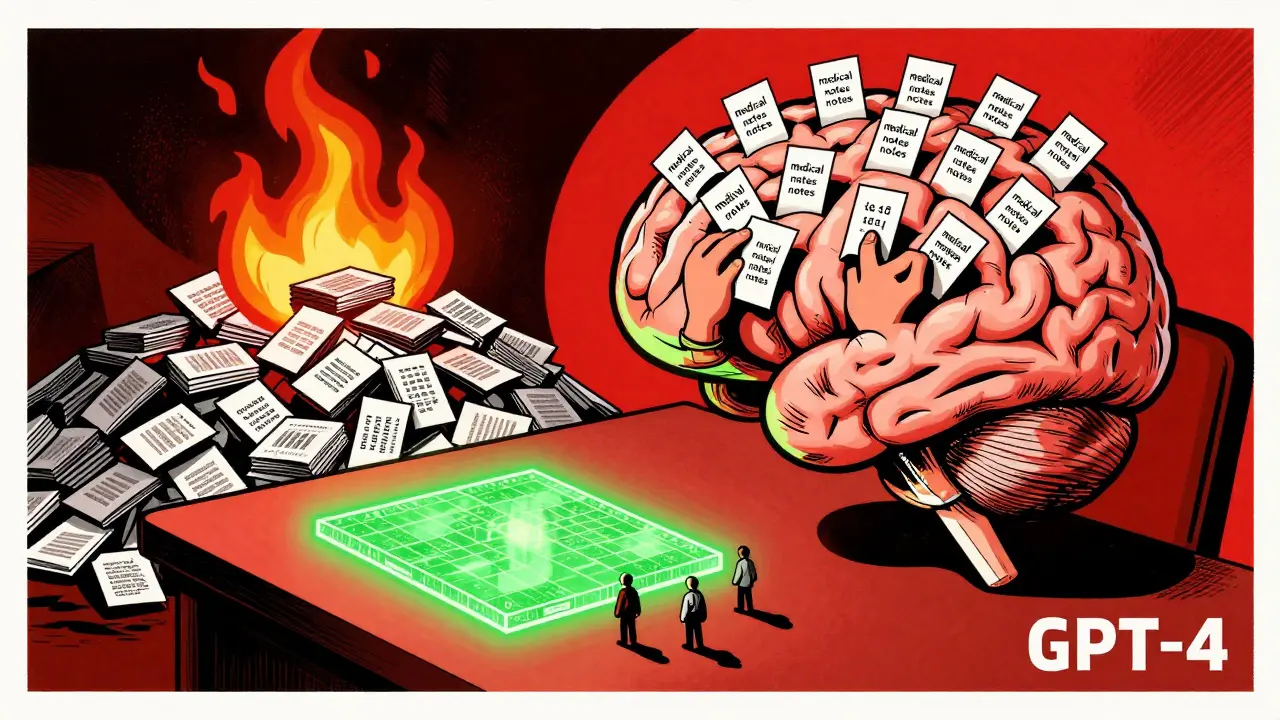
What if you could make a giant language model like GPT-4 or LLaMA learn a new task - say, reading medical records or summarizing legal contracts - using only 50 examples? Not 5,000. Not 50,000. Just 50. That’s the promise of few-shot fine-tuning, and it’s changing how businesses use AI when data is hard to come by.
Traditional fine-tuning used to mean feeding a model thousands, sometimes millions, of labeled examples. If you wanted to train a model to spot fraud in insurance claims, you’d need hundreds of past cases, each tagged by an expert. For most companies, that’s impossible. Privacy laws, cost, and time make collecting that data a nightmare. Few-shot fine-tuning flips the script. It lets you adapt massive models with tiny datasets - sometimes as few as 10 examples per category - and still get results that rival full fine-tuning.
How Few-Shot Fine-Tuning Actually Works
Here’s the trick: instead of updating every single weight in a 7-billion-parameter model, you only tweak a tiny fraction. Think of it like adjusting the volume on a stereo instead of rewiring the whole sound system. This is done through Parameter-Efficient Fine-Tuning (PEFT), a set of techniques that add small, trainable layers to the model without touching the original weights.
The most popular method is Low-Rank Adaptation (LoRA). LoRA doesn’t change the model’s core structure. Instead, it inserts two small matrices - one for upward adjustments, one for downward - and trains only those. These matrices are tiny, often just 0.1% the size of the original model. In practice, that means you’re training maybe 50,000 parameters instead of 7 billion. The rest of the model stays frozen, preserving what it already knows.
Then came QLoRA, which took LoRA and made it even leaner. By using 4-bit quantization - essentially compressing the model’s internal numbers into much smaller representations - QLoRA cut memory use from 780GB down to just 48GB. That’s huge. It means you can now fine-tune a 65-billion-parameter model on a single consumer-grade GPU like the NVIDIA RTX 4090. No more renting cloud supercomputers. No more $10,000 bills.
And the results? Google’s 2025 benchmarks show QLoRA hits 99.4% of the accuracy of full fine-tuning on math reasoning tasks. In medical text summarization, Partners HealthCare saw a 22.7% jump in performance using just 80 labeled clinical notes. That’s not magic. It’s math.
When Few-Shot Fine-Tuning Shines (And When It Fails)
This isn’t a magic bullet. It works best in narrow, well-defined domains where you have a small but high-quality set of examples.
Where it excels:
- Healthcare: Summarizing patient notes, extracting diagnoses from unstructured records. Mayo Clinic got 83.7% accuracy on entity extraction with only 75 examples.
- Legal tech: Classifying contract clauses, flagging risky language. Firms in New York and London now use it to automate initial document reviews.
- Financial compliance: Detecting suspicious transaction patterns from limited past cases. A fintech startup cut their adaptation cost from $18,500 to $460 per model using LoRA.
Where it struggles:
- Learning new languages: If you need to adapt a model to Swahili or Urdu and only have 20 examples, accuracy drops to 63.2% - far below full fine-tuning’s 81.4%.
- Out-of-distribution queries: Ask a few-shot model a question it hasn’t seen in training, and it hallucinates 18.3% more often than a fully fine-tuned one. Careful tuning reduces that gap, but it doesn’t disappear.
- Too few examples: Below 20 examples per class, performance becomes wildly unpredictable. Google Research says you need at least 50 well-chosen examples for classification tasks to be reliable.
Compare this to in-context learning (just prompting the model without training). On medical coding tasks, fine-tuned models outperform prompting by 12-18%. You’re not just asking the model to guess - you’re teaching it.

What You Need to Get Started
Getting into few-shot fine-tuning isn’t like installing a plugin. It takes preparation.
- Curate your examples - This is the hardest part. You need 50-100 high-quality, representative examples. A bad example hurts more than a missing one. Domain experts should spend 8-40 hours per task selecting and labeling them.
- Choose your method - Start with QLoRA if you’re on a consumer GPU. Use LoRA if you have more memory. Avoid full fine-tuning unless you have thousands of examples and a big budget.
- Set hyperparameters right - Learning rate: between 1e-5 and 5e-4. Batch size: 4-16. Epochs: 3-10. Too high a learning rate? Training crashes. Too low? Nothing happens. Most failures (63%) come from bad learning rates.
- Use early stopping - Since you have so little data, the model will overfit fast. Monitor validation loss. Stop training when it stops improving.
- Evaluate properly - Don’t just check accuracy. Test on edge cases. Look for hallucinations. Run it on real-world data, not just your training set.
Tools have gotten a lot easier. Hugging Face added native QLoRA support in Transformers v4.38 (February 2026). That cut setup time by 60%. Their PEFT library now gets over 1.8 million monthly views. You’re not starting from scratch anymore.
Cost, Speed, and Real-World Savings
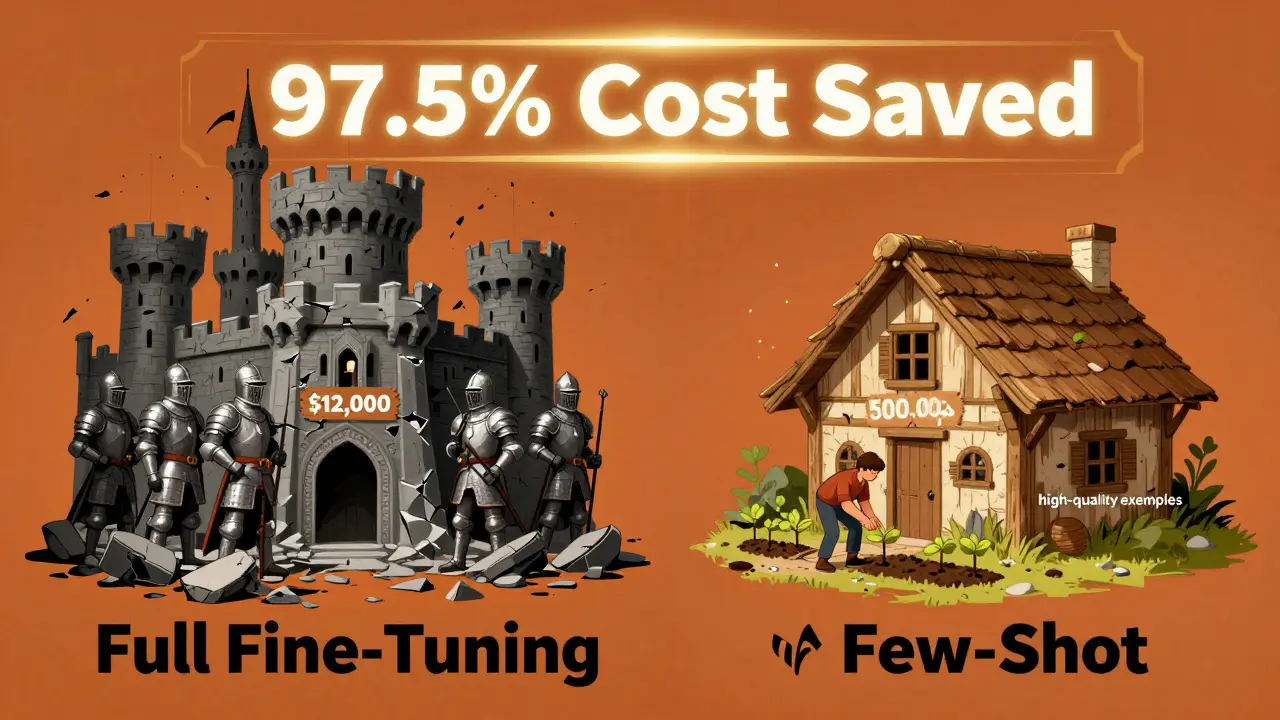
Full fine-tuning a 7B model? Costs $12,000 and needs 80GB of VRAM. Few-shot fine-tuning with QLoRA? Costs $300 and runs on a $1,500 gaming GPU.
Oracle’s 2025 analysis found PEFT methods cut training costs by 97.5%. That’s not a small win - it’s a business enabler. Small clinics, regional law firms, and startups can now afford AI customization. Before, only Google or Amazon could do this. Now, a single engineer with a laptop can.
And it’s not just about money. It’s about speed. One fintech team reduced their model adaptation cycle from 4 weeks to 4 days. They went from waiting for data approval to having a working model in under a week.
What’s Next?
The field is moving fast. Meta AI just released Dynamic Rank Adjustment (January 2026), which automatically picks the best LoRA rank during training. No more guessing. Stanford’s 2026 roadmap predicts automated example selection - systems that scan unlabeled data and pull out the 10 most useful examples for you.
Market adoption is exploding. IDC says the LLM customization market hit $3.8 billion in 2025. Gartner predicts 78% of enterprises will use parameter-efficient methods by 2026. Healthcare leads at 68%, legal tech at 61%. The EU AI Act’s new rules on data provenance make few-shot’s minimal footprint a legal advantage.
But don’t get fooled. This isn’t about making AI smarter. It’s about making AI practical. When data is scarce, you don’t need more data. You need better ways to use what you have. Few-shot fine-tuning gives you that.
How few examples do I really need for few-shot fine-tuning?
You need at least 50 high-quality, labeled examples per class for classification tasks. Below 20, performance becomes unstable and highly dependent on example quality. Google Research and Stanford both recommend 50+ as the minimum for reliable results. For regression or summarization tasks, 30-60 examples can work if they cover diverse cases.
Can I use few-shot fine-tuning on any large language model?
Most modern open models like LLaMA, Mistral, and Falcon work well with LoRA and QLoRA. Closed models like GPT-4 or Claude don’t allow fine-tuning at all. You need access to the model weights. Hugging Face’s Transformers library supports over 100 models with PEFT out of the box. Always check if the model architecture is compatible - older models like BERT or T5 may need adjustments.
Is QLoRA better than LoRA?
QLoRA is better if you have limited GPU memory. It uses 4-bit quantization to shrink memory use by 80-90% while keeping nearly the same accuracy. If you have a 48GB GPU or better, LoRA is simpler and slightly faster. If you’re on a 24GB card like the RTX 4090, QLoRA is your only practical option for models over 13B parameters.
Why do my few-shot models hallucinate so much?
Hallucinations happen because the model hasn’t seen enough examples to learn the boundaries of the task. With only 50 examples, it fills gaps with patterns it learned from its pretraining. You can reduce this by: (1) using higher-quality examples, (2) tuning learning rates carefully (below 2e-4), (3) adding negative examples (e.g., "this is NOT a diagnosis"), and (4) using temperature settings below 0.7 during inference. Stanford found that careful tuning cuts hallucination rates from 18.3% down to 6.2%.
Do I need to be an AI expert to use few-shot fine-tuning?
Not anymore. If you know how to use Python, PyTorch, and Hugging Face, you can get started in a weekend. The real barrier isn’t code - it’s data curation. You need someone who understands the domain (like a doctor, lawyer, or financial analyst) to help pick the right examples. The tools are simple now. The thinking is hard.
What’s the biggest mistake people make with few-shot fine-tuning?
Using too little data and assuming it’ll work anyway. Many try with 5-10 examples and wonder why performance is terrible. Others use noisy, inconsistent labels. The model learns your mistakes. The second biggest error is using a learning rate above 2e-4 - that crashes training 63% of the time. Always start with LoRA, 5e-5 learning rate, batch size 8, and 5 epochs. Then tweak.






LoRA and QLoRA are game-changers. I’ve used QLoRA on a 13B model with an RTX 4090 - no cloud needed. Just 48GB of VRAM and you’re fine-tuning like it’s 2020 again. The real win? No more begging your boss for AWS credits. One guy at my shop cut his dev cycle from 3 weeks to 3 days. That’s not progress - that’s liberation.
Also, 50 examples? Yeah, but make sure they’re not garbage. I once trained on 60 messy labels and the model started calling every patient ‘John Doe’. Learned the hard way.
Honestly, I’m impressed this even works. I thought you needed thousands of examples to make a model behave. But seeing 99.4% accuracy on math tasks with QLoRA? Wild. Makes you wonder if we’ve been over-engineering this whole time.
Big fan of this stuff. I’ve been using this in our clinic for summarizing notes. We only had 75 labeled examples - and it’s now doing 83% accuracy on discharge summaries. The docs love it. No more staying late to type up charts.
Key thing? Don’t rush the data. One bad example can throw the whole thing off. Took us two weeks just to pick the right 80 notes. But once we did? Magic. Also, keep your learning rate low. 5e-5 saved us from total collapse.
And yeah, hallucinations happen. We added negative examples like ‘this is NOT a diagnosis’ and it dropped from 18% to 5%. Simple fix. Don’t overcomplicate it.
It’s fascinating how the field has evolved from brute-force fine-tuning to these surgical interventions on model weights. The shift from updating billions of parameters to manipulating only a few thousand - through low-rank decomposition - represents not merely an optimization but a philosophical reorientation in how we approach machine learning. We are no longer training models; we are gently nudging them. This is akin to teaching a pianist a new piece not by retraining their entire nervous system, but by adding a subtle finger extension device. The elegance of this approach is profound. And QLoRA, by compressing the weight representations into 4-bit space, is not just an engineering feat - it’s a democratization of computational access. Suddenly, a single engineer with a consumer GPU can do what once required a data center. The implications for small clinics, regional law firms, and academic labs are not merely economic - they are epistemological. We are witnessing the decentralization of AI expertise, and it is happening faster than most policymakers realize.
LOL you all act like this is some breakthrough. I’ve been doing this since 2021. You think you’re the first to use LoRA? Nah. Also, ‘50 examples’? That’s laughable. If your data isn’t clean, you’re just teaching the model to lie. And don’t get me started on QLoRA - 4-bit quantization? That’s just throwing away precision like it’s trash. You think you’re saving money? You’re just making models dumber and more prone to hallucinations. I’ve seen it. My cousin works at a hospital and their ‘AI assistant’ started diagnosing pneumonia from coughs. It was wrong 80% of the time. And they blamed ‘training data’. No. You used garbage. And now you’re all patting yourselves on the back like you invented fire. Wake up.
Minor correction: the Hugging Face Transformers v4.38 release was in February 2025, not 2026. Also, the 63% failure rate from bad learning rates comes from a 2024 arXiv paper by Wu et al., not general consensus. And while QLoRA does reduce memory use, the 80–90% figure is only true for 70B+ models - for 13B, it’s more like 65%. Precision matters. Also, ‘RTX 4090’ isn’t a ‘consumer-grade GPU’ - it’s a high-end workstation card. A ‘gaming GPU’ implies RTX 3060 or lower. Just saying. I’m not trying to be pedantic - I just want the record straight. This stuff is too important to get sloppy.
Let me ask you this: if we can achieve 99.4% accuracy with 50 examples, then why do we need models at all? Why not just write a rule-based system? After all, 50 examples is not learning - it’s memorization. And if the model is merely memorizing a pattern, then it is not intelligent. It is a parrot with a spreadsheet. The entire premise of fine-tuning is predicated on the illusion of generalization. But when the training set is so small, generalization becomes statistically impossible. We are not building AI. We are building a very sophisticated lookup table. And we are calling it ‘progress’. This is not innovation. This is a theological surrender to the cult of data efficiency. We have abandoned the pursuit of understanding and replaced it with a ritual of parameter manipulation. What have we become?