
Observability and SRE Guide for Self-Hosted LLMs
Running your own large language model isn't like spinning up a standard web server. You aren't just managing CPU and RAM; you're dealing with volatile GPU memory, massive token throughput, and the inherent unpredictability of generative AI. When you move away from a managed API and go the self-hosted route, the burden of reliability shifts entirely to your shoulders. If the model starts hallucinating or the latency spikes to ten seconds per token, there's no cloud provider to blame-it's your SRE practices that will determine whether your service stays up or crashes under the weight of a few concurrent users.
The biggest myth in AI operations right now is that the models can manage themselves. You might think an LLM could act as an autonomous on-call engineer, but real-world data shows otherwise. Recent tests by ClickHouse involving GPT-5 and OpenTelemetry data proved that autonomous root cause analysis (RCA) just isn't there yet. Even the most advanced models struggle to consistently outperform a human engineer who knows the system. The goal isn't to replace the SRE, but to build an observability stack that makes the SRE's life easier.
The Core Metrics That Actually Matter
In a traditional app, you look at request rates and error codes. With self-hosted LLMs, those are secondary. You need to look at the GPU and the queue. If you're using vLLM is a high-throughput serving framework for LLMs that optimizes GPU memory through PagedAttention, you have a goldmine of Prometheus metrics available. Don't just track if the pod is "running"; track how the model is breathing.
Focus on these four critical signals to avoid production disasters:
- Request Queueing: Track
vllm_num_requests_waiting. If this number climbs, your users are staring at a loading spinner while their requests sit in a line. It's the first sign you need to scale. - Active Processing: Monitor
vllm_num_requests_runningto understand your actual concurrency limits. - GPU Cache Pressure: Watch
vllm_gpu_cache_usage_perc. LLMs use a KV cache to remember the context of a conversation. If this hits 100%, the system will either crash or slow down to a crawl. - Token Throughput: Use
vllm_avg_generation_throughput_toks_per_s. This is your real "speedometer." If throughput drops while GPU usage is high, you might have a bottleneck in your weights loading or a noisy neighbor on the node.
| Metric Type | Traditional SRE (Web App) | LLM SRE (Self-Hosted) | Why it Matters |
|---|---|---|---|
| Resource Focus | CPU / RAM | GPU VRAM / Cache | Model weights must fit entirely in VRAM. |
| Latency | TTFB (Time to First Byte) | Tokens per Second (TPS) | Generation speed impacts user experience. |
| Bottleneck | Database I/O / Network | KV Cache / Compute Bound | Memory bandwidth is usually the killer. |
| Scaling Trigger | Request Count / CPU Load | Queue Length / GPU Memory | Scaling on CPU is useless for LLMs. |
Integrating LLMs into the SRE Workflow
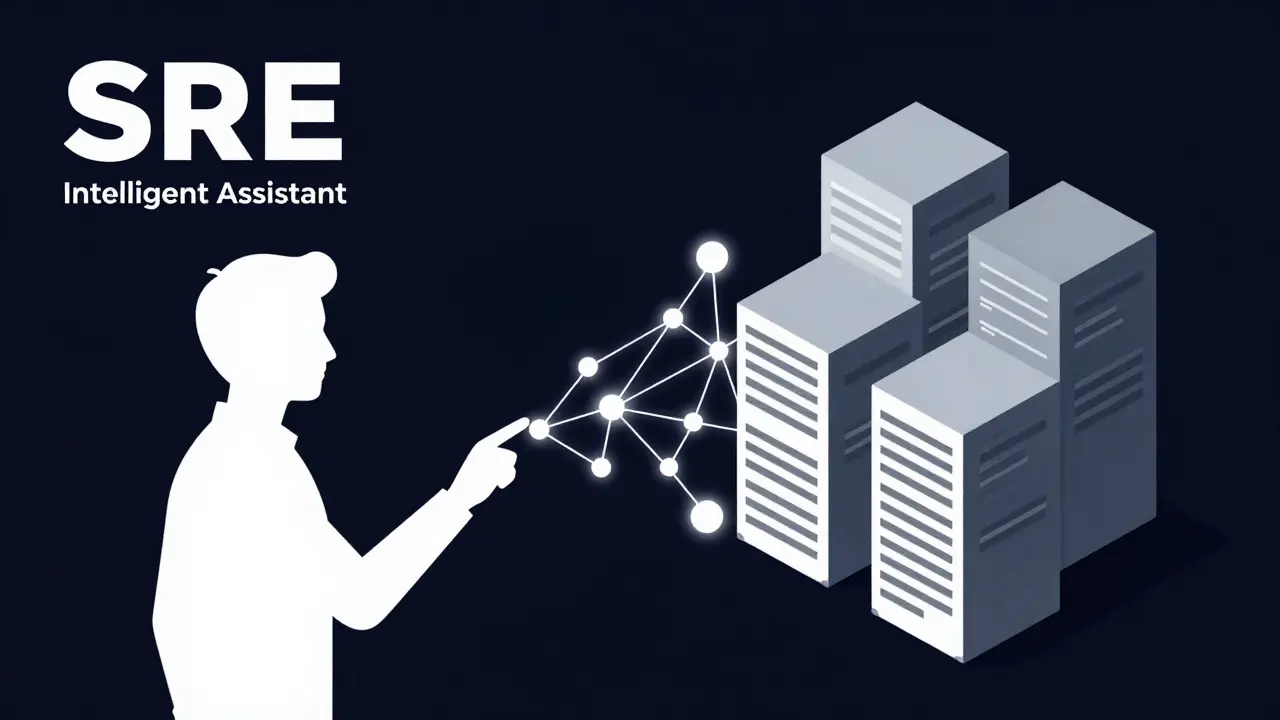
Since we know LLMs can't autonomously fix your cluster, how should you actually use them? The shift is from "Autonomous Agent" to "Intelligent Assistant." Instead of letting a bot restart pods, use it to parse the noise. SREs are often buried in logs from Kubernetes is an open-source container orchestration system for automating software deployment and scaling, and the sheer volume of container events can be overwhelming.
A practical workflow involves feeding the LLM specific slices of data. For example, when a pod enters a CrashLoopBackOff, don't ask the LLM "Why is the app broken?" Instead, pipe the last 50 lines of the pod log and the current resource limits into the model. Ask it to summarize the error pattern and suggest a specific change to the requests or limits in your YAML. This turns a 20-minute manual log dive into a 30-second review.
Beyond logs, you can use models to correlate signals. If you see a spike in 500 errors coinciding with a GPU memory leak, an LLM can quickly synthesize these two disparate alerts into a single narrative: "GPU OOM event causing API gateway timeouts." It's not doing the discovery; it's doing the synthesis.
Moving Toward AI-Native Automation
We are starting to see a transition from manual SRE work to what the CNCF calls AI-native automation. This isn't about a chatbot in the CLI; it's about integrating models directly into the control loop of your infrastructure. While some of these are still emerging, they represent the future of self-hosting.
Keep an eye on these three capabilities:
- Smart Sizing: Moving beyond static resource requests. Imagine a system that uses ML to analyze your LLM's memory usage patterns and automatically adjusts vertical scaling to optimize cost without risking an Out-Of-Memory (OOM) kill.
- Autopilot Scaling: Traditional horizontal pod autoscalers (HPAs) are often too slow or too blunt for LLMs. AI-driven scaling looks at workload patterns and predicts surges before they hit the queue, adjusting replicas in real-time.
- Pod Recovery AI: This goes a step beyond simple restarts. It analyzes the failure event, recognizes a known pattern (like a CUDA driver mismatch), and triggers a specific recovery action rather than just rebooting the container into the same error state.
The LLMOps vs. MLOps Divide
One of the biggest mistakes experienced SREs make is treating LLMOps is the operationalization of large language models, focusing on the deployment, monitoring, and maintenance of generative AI systems as if it were just a subset of MLOps is a set of practices that aims to deploy and maintain machine learning models in production reliably and efficiently. In traditional MLOps, you're often worried about data drift and retraining pipelines. In LLMOps, you're fighting a different battle.
The challenges are fundamentally different. You're dealing with Retrieval-Augmented Generation (RAG) pipelines, where the observability needs to extend into the vector database. You're managing context windows and prompt versions. If a model's output quality drops, it's not necessarily "drift" in the statistical sense-it could be a change in how the system retrieves documents or a subtle shift in the prompt template.
To succeed here, SREs need to expand their toolkit. You can't just be a Kubernetes expert; you need to understand the basics of tokenization, how KV caches work, and why GPU memory fragmentation happens. It's a fusion of systems engineering and AI internals.
Common Pitfalls in LLM Observability
Avoid the temptation to monitor everything with a "black box" approach. Many teams just track the API response time and call it a day. This is a recipe for failure. If your response time is slow, you won't know if it's because the GPU is throttled, the prompt is too long, or the vector DB is lagging.
Another common mistake is ignoring the "cost of observability." Running a separate LLM to monitor your production LLM can quickly double your compute costs. Be strategic. Use lightweight models or specialized tools like Openlit for tracing and quality tracking, and reserve the heavy-duty models for complex root cause synthesis during actual incidents.
Can I fully automate my LLM infrastructure with an AI agent?
Not yet. Current research, including tests by ClickHouse, shows that LLMs cannot consistently perform autonomous root cause analysis (RCA) better than experienced SREs. They are excellent assistants for summarizing logs and suggesting fixes, but a human should always be in the loop for final decision-making and execution.
What is the most critical metric for a self-hosted vLLM setup?
The vllm_gpu_cache_usage_perc is arguably the most critical. Because LLMs rely on a KV cache for context, hitting 100% utilization typically leads to severe performance degradation or system crashes. Monitoring this allows you to scale or optimize batch sizes before the service fails.
How does LLMOps differ from traditional MLOps?
Traditional MLOps focuses on model training, data pipelines, and statistical drift. LLMOps focuses on the operational complexities of generative AI, such as managing huge weights, optimizing token throughput, handling RAG pipelines, and monitoring the quality of non-deterministic outputs.
Is Prometheus sufficient for LLM monitoring?
Prometheus is great for infrastructure metrics (GPU usage, queue length, throughput), but it isn't enough for the full picture. You also need tracing and quality monitoring tools (like Openlit) to track the actual content of the responses and the latency of the RAG retrieval process.
What is "Smart Sizing" in the context of Kubernetes AI?
Smart Sizing is an emerging AI-native capability that uses machine learning to automatically adjust the CPU and memory requests/limits of a container. For LLMs, this means the system can learn the ideal memory overhead required for various model sizes and workloads, reducing wasted resources and preventing OOM kills.
Next Steps for Your Infrastructure
If you're just starting with self-hosted LLMs, don't try to build a fully autonomous system. Start by setting up a robust Prometheus scrape config for your serving framework. Get your alerts right-alert on queue growth and GPU cache saturation before you alert on generic pod restarts.
Once your metrics are stable, introduce an LLM-assisted log analysis workflow. Create a simple script or use a tool that pipes error logs to a model for synthesis. As your scale grows, look into the CNCF's roadmap for AI-native automation to see when Pod Recovery AI and Autopilot scaling become viable for your specific workload.









This is such a great breakdown!! I've seen so many teams struggle with KV cache issues because they just dont realize how it impacts the VRAM. Its honestly a lifesaver to have these specific vLLM metrics listed out here. Hope this helps anyone geting started with self-hosting!!
OH MY GOD!! The absolute nightmare of a 10-second per token latency is literally the stuff of horror movies!! I cannot even imagine the panic when that loading spinner just keeps spinning into eternity!! Absolutely wild!!
Point taken on the LLM as an assistant rather than a replacement. We need to stop pretending these things are magic and actually treat them like the tools they are.
One finds the distinction between LLMOps and MLOps to be quite elementary, yet it is fascinating that some still struggle to grasp the nuance of memory fragmentation in a production environment.
The author mentions "ClickHouse involving GPT-5," but they fail to mention who actually controls the data flow behind these "tests." It's obviously a coordinated effort to make us believe in the reliability of these models so we stop questioning the underlying hardware monopolies. Also, "SRE's life" should have a possessive apostrophe, but the overall structure is surprisingly coherent for a corporate-leaning piece.
Looking at this from a systems philosophy perspective, the shift from autonomous to assistive AI is really a move toward symbiotic computing. We aren't just offshoring the labor to a machine, but enhancing the human's cognitive reach.
From a practical standpoint, the KV cache usage is indeed the 'heartbeat' of the system. If you're seeing saturation, you're essentially hitting the physical limits of your hardware's ability to maintain state. I've found that implementing a more aggressive request-prioritization queue helps mitigate the 'noisy neighbor' effect mentioned in the post. It transforms the problem from a crash-risk into a manageable latency-tradeoff. The real challenge isn't just monitoring the metric, but deciding what the system should do when that metric hits 90%. Should you drop low-priority tokens? Or trigger a scale-up event that might take five minutes to initialize? That's where the real SRE art happens.
Imagine thinking that "Smart Sizing" is some revolutionary breakthrough and not just a rebranded version of basic autoscaling. Groundbreaking stuff, really. I'm sure the industry is shaking in its boots. Typical American obsession with slapping a "AI" label on things that have existed for a decade.
Complete rubbish!!! The whole thing is a plot by the cloud giants to make us think self-hosting is a nightmare so we keep paying their rip-off fees... total scam...!! Just use a simple script and stop overcomplicating it with "observability stacks" and other such nonsense!!!! Absolutely pathetic how we've lost the art of simple Linux admin!!
I find this information to be quite useful. It is very nice.
The audacity to suggest that a simple prompt-to-log pipeline constitutes a "workflow" is truly staggering, especially when one considers the profound lack of depth in the discussion regarding the actual architectural implications of asynchronous GPU memory allocation...!! It is clear the author has a surface-level understanding at best, ignoring the systemic failures that occur when one fails to account for the non-deterministic nature of token generation in a multi-tenant environment...!! Truly a pedestrian analysis...!!