How Training Duration and Token Counts Affect LLM Generalization
You can throw billions of dollars at a language model, feed it every book ever written, and still get a system that fails when you ask it to do something slightly different. It sounds counterintuitive, doesn't it? We assume that more data equals smarter models. But in the world of Large Language Models (LLMs), quantity is only half the equation. The real magic-or disaster-happens in how those tokens are processed over time.
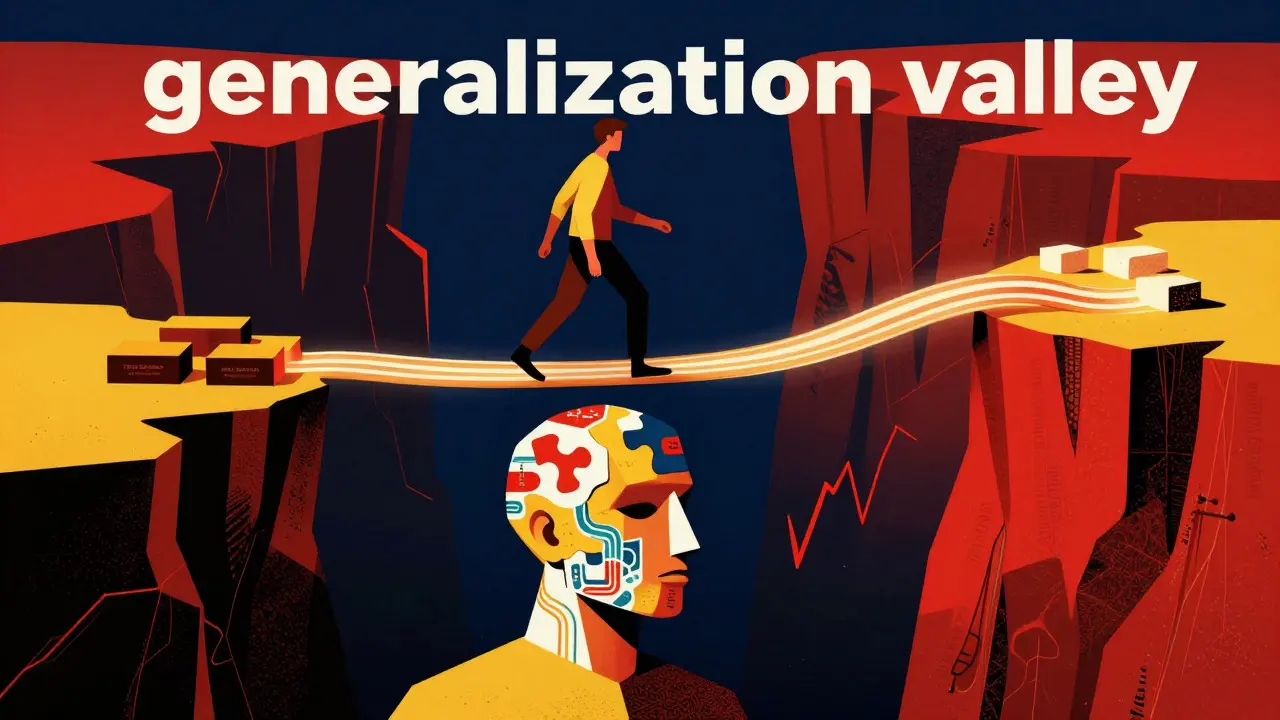
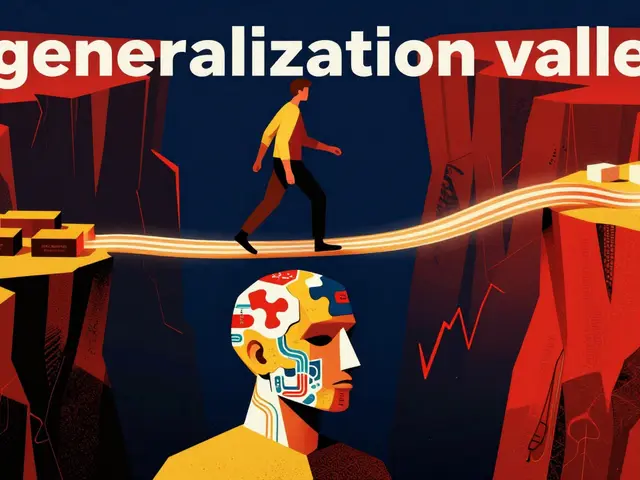
The relationship between training duration, token counts, and generalization is not linear. It’s messy, non-monotonic, and often deceptive. A model might look brilliant on your validation set but collapse completely when faced with a new, slightly longer, or structurally different problem. This phenomenon, known as the "generalization valley," is where many AI projects stall. Understanding why this happens requires looking past simple scaling laws and into the mechanics of how models learn to reason versus how they learn to memorize.
The Myth of Raw Scale: Why More Tokens Aren't Always Better
We’ve been told for years that bigger is better. If you double the parameters and double the data, performance goes up. That’s the classic scaling law. But recent research suggests we hit a wall if we ignore how that data is structured. The core issue isn’t just the number of tokens; it’s the distribution of sequence lengths within those tokens.
Consider the work from Apple’s Machine Learning Research team published in early 2025. They demonstrated that traditional training methods, which chop text into fixed chunks (like 2,048 tokens), create a blind spot. The model learns to process short sequences efficiently but struggles terribly when asked to handle context windows larger than what it saw during training. This is called poor length generalization.
By switching to a variable sequence length curriculum, Apple showed that an 8k context-length model could be trained at the same computational cost as a 2k model using old-school methods. More importantly, it achieved up to 6x faster training and significantly better performance on long-context benchmarks. The key insight? The distribution of sequence lengths during training matters just as much as the total token count. If you only train on short snippets, your model never learns the algorithmic logic required to hold together a long narrative or complex reasoning chain. It just memorizes patterns that don’t scale.
Memorization vs. Generalization: The Critical Complexity Threshold
There is a fine line between a model understanding a concept and a model reciting a similar example from its training data. Researchers call this the boundary between memorization and generalization. To measure this, the Scylla framework introduced in late 2024 uses a metric called "critical complexity." This is the threshold where a model stops relying on genuine reasoning and starts leaning heavily on non-generalizable behaviors-essentially, cheating by recalling surface-level similarities.
Here’s where it gets interesting. This relationship is non-monotonic. As task complexity increases, the gap between in-distribution (ID) and out-of-distribution (OOD) performance widens until it hits a peak-the generalization valley. After that point, if the model is large enough, it might recover some capability, but usually, it’s just guessing based on memorized fragments.
| Model Architecture | Critical Complexity Threshold | Primary Failure Mode | Length Generalization Efficiency |
|---|---|---|---|
| Llama-3.2-3B | Low (Baseline) | Surface-level memorization | Poor beyond 2k tokens |
| Llama-3-8B | Medium (+37% vs 3B) | Reasoning drift in OOD tasks | Moderate up to 4k tokens |
| Gemma-2-9B | High | Instability in long contexts | Good with variable curriculum |
| GPT-4o | Very High | Catastrophic forgetting on niche topics | Excellent up to 128k tokens |
Notice the shift in the table. Larger models like Llama-3-8B can handle approximately 37% more complex reasoning tasks before falling back on memorization compared to their smaller counterparts. However, size alone doesn’t fix the problem. Without proper training protocols, even massive models will fail at length generalization. They might retain information longer-GPT-4 retains memorized info 41% longer than GPT-3.5-but that persistence can actually exacerbate overfitting risks if the model is just holding onto noise instead of learning signal.
The Danger of Fixed Sequence Lengths
If you’re building an LLM today and you’re still using fixed sequence lengths for training, you’re likely leaving money on the table and capping your model’s potential. Traditional approaches suffer from what researchers call "poor length generalization capabilities." Even with increased scale, these models fail to learn the general algorithms needed for arbitrary-length problem solving.
A study presented at NeurIPS 2022 highlighted this starkly. Performance on mathematical calculations correlated strongly (r=0.87) with term frequency in the training data. What does that mean? It means the model wasn’t learning math. It was learning which numbers appeared next to each other in the books it read. That’s surface-level memorization. When you give it a novel equation structure, it breaks.
In contrast, combining pretrained LLMs with scratchpad prompting-where the model outputs solution steps before giving an answer-dramatically improves length generalization. This technique forces the model to engage in step-by-step reasoning rather than pattern matching. Interestingly, research shows that for certain skills like length generalization, agents can learn through in-context learning (ICL) rather than through fine-tuning, even with infinite data available. This challenges the conventional wisdom that you always need to fine-tune to improve specific capabilities. Sometimes, the prompt engineering is more powerful than the weight updates.
Training Duration and the Risk of Catastrophic Forgetting
So, should you train forever? Absolutely not. There is an optimal point, and passing it leads to degradation. This is where training duration becomes a critical variable. Extended training beyond this optimal point often results in "catastrophic forgetting," where the model loses its ability to generalize on out-of-distribution (OOD) benchmarks despite showing improved performance on in-distribution (ID) metrics.
GitHub issue #LLM-TRAIN-442 documents cases where continued training degraded generalization by 22-34% on OOD tests. The model became better at repeating what it knew but worse at applying that knowledge to new situations. This is why 78% of practitioners surveyed on Hugging Face forums now implement early stopping based on validation set generalization metrics rather than pure loss minimization. You stop training not when the error is lowest, but when the model starts losing its flexibility.
Dr. Sarah Chen from Apple’s ML division puts it simply: "The distribution of sequence lengths during training is as critical as total token count for achieving robust generalization." Professor David Kim from Stanford adds a warning: datasets containing few long instances fundamentally limit a model's ability to generalize across and beyond the lengths it learned from. If your training data is all short tweets, your model will struggle with long reports, no matter how many tokens you feed it.
Practical Implementation: Balancing Regularization and Curriculum
How do you apply this in practice? It requires a shift in how you design your training pipeline. First, move away from fixed chunking. Implement a variable sequence length curriculum. This means dynamically adjusting the length of input sequences during training, ensuring the model sees a diverse range of context sizes. This approach has been shown to reduce training costs by 38-52% while maintaining or improving generalization capabilities.
Second, tune your regularization techniques carefully. Nitor Infotech’s 2025 best practices guide specifies that L1 and L2 regularization coefficients should be kept between 0.001 and 0.01. These values penalize large parameter weights, encouraging the model to find simpler, more generalizable solutions. Dropout rates between 0.1 and 0.3 also significantly enhance generalization by preventing neurons from co-adapting too tightly to specific training examples.
Third, monitor your learning curves for the "generalization debt" trap. This occurs when a model is optimized for specific benchmark metrics but fails catastrophically on unexpected distribution shifts. Meta experienced this in November 2024 when a production Llama-3 variant exhibited 68% error rates on novel mathematical formulations despite strong benchmark scores. The model had learned the test, not the subject.
- Implement Early Stopping: Halt training when OOD performance deteriorates by more than 5%, even if ID loss continues to decrease.
- Use Variable Context Windows: Train with mixed sequence lengths to force the model to develop robust attention mechanisms.
- Apply Scratchpad Prompting: Encourage step-by-step reasoning during inference to bypass surface-level memorization.
- Diversify Data Sources: Ensure your corpus includes a significant proportion of long-form, complex reasoning tasks.
The Future of Token Efficiency
The market is shifting. The global LLM training market, valued at $14.7 billion in Q3 2025, increasingly prioritizes generalization efficiency over raw parameter count. Companies are realizing that a smaller, well-trained model that generalizes well is more valuable than a massive model that hallucinates on edge cases. Startups like LengthGenAI are emerging specifically to optimize sequence length distributions, securing millions in funding to solve this exact problem.
By 2027, industry analysts predict that "token efficiency" will become a primary benchmark alongside parameter count. Models that achieve 90%+ generalization on sequences four times longer than their training maximums will command premium adoption. The era of brute-force scaling is ending. The era of intelligent, efficient training is here. If you want your model to truly understand, not just repeat, you need to rethink how you count your tokens and manage your training time.
What is the generalization valley in LLMs?
The generalization valley is a non-monotonic relationship between task complexity and the performance gap between in-distribution (ID) and out-of-distribution (OOD) data. It represents the threshold where a model's reliance on memorization peaks before potentially recovering with increased size or better training, indicating the upper bound of its current generalization capabilities.
Why do fixed sequence lengths hurt model performance?
Fixed sequence lengths prevent models from learning algorithms for arbitrary-length problem solving. They lead to poor length generalization, causing sharp performance declines when the model encounters inputs longer than those seen during training. Variable sequence length curricula allow models to adapt to diverse context sizes efficiently.
How does training duration affect generalization?
Excessive training duration can lead to catastrophic forgetting, where the model loses its ability to generalize on novel tasks despite improved performance on familiar ones. Early stopping based on OOD validation metrics is crucial to halt training before the model begins overfitting to surface-level patterns in the training data.
What is critical complexity?
Critical complexity is a metric used to quantify the threshold at which an LLM shifts from genuine reasoning to relying on non-generalizable behaviors like memorization. It helps identify the upper limits of a model's ability to handle novel, complex tasks without falling back on rote recall.
Can in-context learning replace fine-tuning for generalization?
For certain skills like length generalization, yes. Research indicates that agents can learn through in-context learning (such as scratchpad prompting) rather than through fine-tuning, even with infinite data. This approach forces the model to demonstrate reasoning steps, reducing reliance on memorized patterns.







omg this is so deep 😭 why do we always think more data = better?? it’s like eating 100 burgers to get healthy lol. the generalization valley thing is wild, like when you study too much for a test and forget everything 🤯 i feel like my brain does that sometimes with memories... also typos r everywhere bc im typing fast but u get it right? ✨
It is truly fascinating how the distribution of sequence lengths impacts model performance. One might assume that sheer volume suffices, yet the structure remains paramount. This insight encourages us to look beyond raw metrics and consider the qualitative aspects of training data. A well-curated dataset often yields superior results compared to an unstructured deluge of information.
yeah totally agree with the variable length stuff. fixed chunks are so last season lol. if you want your model to actually reason not just regurgitate you gotta mix it up. early stopping is key too dont let it overfit or it becomes useless. keep pushing boundaries guys!
Most people miss the point entirely. It's not about the tokens. It's about the noise. You can have perfect curriculum and still fail if the data is garbage. The table shows size helps but only slightly. Real issue is garbage in garbage out. Stop obsessing over context windows and fix your datasets first.
i mean yeah but like the scratchpad prompting part is huge right? its basically forcing the model to show its work which makes sense for math problems. ive seen models fail hard on simple algebra if they just guess the answer. making them write steps helps a lot even if its slow. also typos sorry my phone autocorrect is broken today 😅
The concept of catastrophic forgetting is particularly alarming for enterprise applications. If a model degrades in out-of-distribution performance after extended training, the financial implications are severe. Companies must implement rigorous validation protocols. Relying solely on loss minimization is a strategic error that many organizations continue to make despite evidence to the contrary.
we tend to forget that intelligence isn't just scale. it's pattern recognition across varying contexts. the apple research is solid but underplayed. variable sequence length is the real breakthrough here not just bigger params. most folks ignore the mechanics of attention mechanisms and just throw money at it. sad really.
I've been experimenting with mixed sequence lengths lately. The difference in coherence for long-form outputs is noticeable. It seems the model learns to allocate attention resources more efficiently when exposed to diverse lengths during training rather than being constrained by rigid chunking strategies.