
Is AI Coding Green? The Real Energy, Cost, and Efficiency Trade-Offs in 2026
Here is a hard truth for developers in 2026: the convenience of AI-generated code often comes with a hidden environmental tax. While tools like GitHub Copilot and ChatGPT promise faster delivery times, recent data reveals that AI-assisted development can emit up to 19 times more CO2 than traditional human programming during the creation phase. This isn't just about saving trees; it’s about the massive energy grids powering these models and the long-term costs of inefficient code running on servers worldwide.
We are standing at a critical juncture. As AI adoption explodes, so does its carbon footprint. According to RISE (Research Institutes of Sweden), AI currently accounts for 0.1% of global greenhouse gas emissions-roughly equivalent to Sweden's entire annual output. That number might sound small, but it is growing exponentially. The question is no longer if AI impacts the environment, but how we can rewrite our workflows to make that impact net-positive rather than destructive.
The Hidden Carbon Cost of "Fast" Code
When you ask an LLM (Large Language Model) to write a function, you aren't just getting text. You are triggering a complex chain of computational events. A June 2025 study published in Nature Communications dropped a bombshell on the industry: AI models emit significantly more CO2eq than human programmers during the development process. Why? Because generating that code requires immense processing power, and the resulting code is often not optimized for energy efficiency.
Let’s break down the numbers. The same study found that 87% of AI-generated code samples failed to implement energy-efficient design patterns. Another 73% exhibited inefficient memory allocation. In simple terms, the AI gives you code that works, but it runs like a gas-guzzling SUV instead of a hybrid car. It consumes more RAM, uses more CPU cycles, and ultimately drains more electricity from your servers over its lifetime.
This creates a severe sustainability trade-off. You save time today by letting AI write the code, but you pay for it in energy consumption tomorrow. Dr. Kenji Tanaka, lead researcher on the Nature study, warned that "the environmental cost of AI-assisted development has been significantly underestimated." We have optimized for speed and features for decades without considering energy. Now, the bill is coming due.
Sustainable Green Coding: The Developer’s Solution
If AI tools are part of the problem, they can also be part of the solution-if used correctly. Enter Sustainable Green Coding (SGC). This is a language-agnostic strategy that embeds carbon-conscious practices into software development. Research from MCML in 2025 demonstrated that applying SGC principles can reduce energy consumption by up to 63% without sacrificing performance.
But what does this look like in practice? It’s not magic; it’s discipline. SGC relies on six key practices:
- Energy-hungry vs. efficient design patterns: Choosing algorithms that require fewer computational steps.
- Memory allocation optimization: Reducing the amount of RAM needed, which directly lowers server energy use.
- AI inference caching: Storing results of previous AI queries to avoid redundant calculations.
- Resource-aware programming: Writing code that scales down when full power isn’t needed.
- Algorithmic optimization: Refining logic to run faster and cooler.
- Structural code improvements: Cleaning up bloat that slows down execution.
Human developers following these principles achieved dramatic results in empirical evaluations. However, the challenge remains awareness. A 2019 report by Karita et al. noted that only 22% of developers consistently considered energy efficiency while coding. Even in 2026, this mindset shift is still catching up. On Reddit’s r/programming, while 68% of respondents acknowledged environmental concerns, only 29% actively modified their practices to address them.

Tools to Measure What Matters
You cannot manage what you do not measure. For years, developers lacked standardized metrics for code sustainability. That is changing rapidly. Tools like CodeCarbon and CarbonTracker allow developers to track the exact energy usage of their code during training and inference.
Consider this real-world example from GitHub discussions in April 2025. Developer @codegreen87 reported using CodeCarbon with ML projects and was shocked to see their model training emitted 156kg of CO2e. To put that in perspective, that’s equivalent to driving 600km in a gasoline car. Without the tool, that emission would have been invisible. With it, the developer could optimize the model, reducing future emissions.
These tools are becoming essential parts of the CI/CD pipeline. However, integration is not always smooth. A May 2025 survey by Hion Digital found that 61% of developers reported difficulty integrating energy measurement tools into existing workflows. The learning curve is steep, but the payoff is clear. Companies like Siemens Energy and Ørsted have already documented 30-40% energy reductions after implementing these frameworks.
The Big Picture: Net-Zero Potential
Despite the heavy energy cost of building AI, there is a silver lining. PwC’s 2025 analysis suggests that AI-driven improvements across broader economic sectors could compensate for AI’s own energy demands. If implemented strategically, AI could cut total greenhouse gas emissions by 0.1% to 1.1% between 2024 and 2035.
How? By optimizing energy grids, improving supply chain logistics, and enabling smarter manufacturing. Olof Mogren, research leader at RISE, emphasizes that "effective AI is about combining intelligent algorithms with optimal use of computing power." The goal is not to stop using AI, but to use it wisely. Right-sizing AI models for specific business needs, rather than defaulting to the largest available model, is a key step. PwC’s four-action framework encourages companies to track AI-related emissions and consider sustainability when choosing vendors.
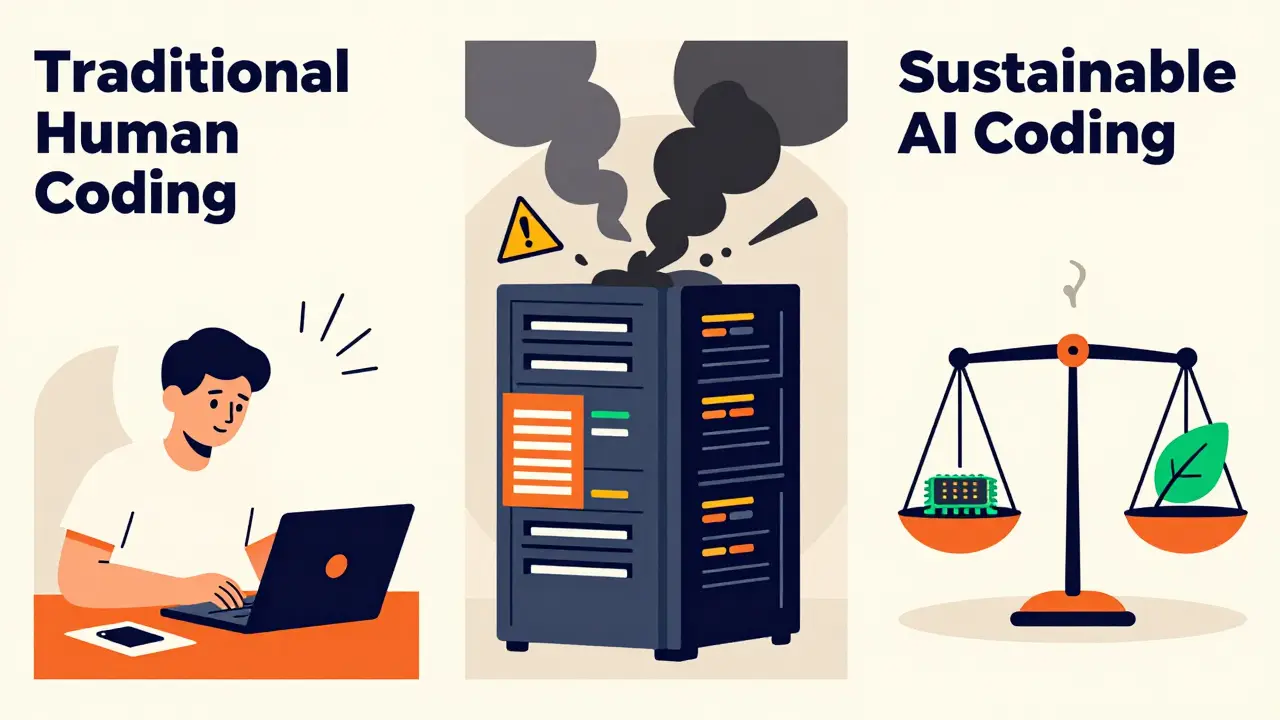
| Feature | Traditional Human Coding | Standard AI-Assisted Coding | Sustainable AI Coding (SGC) |
|---|---|---|---|
| Development Speed | Moderate | Very Fast | Fast (with initial setup) |
| Initial CO2 Emission | Low | High (up to 19x higher) | Moderate (optimized prompts) |
| Runtime Energy Efficiency | Variable (depends on skill) | Poor (often unoptimized) | High (up to 63% reduction) |
| Tooling Requirement | Minimal | LLM Access | Carbon Tracking Tools + Training |
Regulatory Pressure and Market Shifts
The conversation around sustainable AI is moving from voluntary best practices to mandatory compliance. The EU’s AI Act, effective August 2026, will require large AI model developers to disclose energy consumption metrics. Similarly, California’s proposed Digital Sustainability Act mandates carbon footprint reporting for data centers exceeding 5MW capacity.
This regulatory shift is driving market dynamics. The global market for sustainable software development tools was valued at $2.3 billion in Q1 2025 and is projected to grow at a 28.7% CAGR through 2030. Microsoft announced in May 2025 that GitHub Copilot will integrate energy efficiency scoring in its 2026 roadmap. Google is incorporating sustainability metrics into Vertex AI. These moves signal that sustainability is becoming a core feature, not an afterthought.
Enterprise adoption is accelerating. Gartner reports that 41 of the Fortune 100 companies were implementing some form of AI sustainability tracking as of Q2 2025. The primary driver? ESG (Environmental, Social, Governance) reporting requirements. 73% of large enterprises cite these needs as the main catalyst for sustainable AI initiatives. Financial services lead the pack with 38% implementation, followed by technology at 29%.
Practical Steps for Developers Today
You don’t need to wait for corporate policy changes to start making a difference. Here is how you can begin integrating sustainable practices into your workflow immediately:
- Install Carbon Tracking Tools: Add CodeCarbon or similar profilers to your local development environment. See the real-time impact of your code.
- Optimize Prompts for Efficiency: When using AI assistants, explicitly request "energy-efficient" or "low-complexity" solutions. Prompt engineering is now a sustainability lever.
- Right-Size Your Models: Don’t use a massive LLM for a simple task. Use smaller, specialized models where possible to reduce inference energy.
- Review Memory Allocation: Audit AI-generated code for memory leaks and excessive allocations. These are common inefficiencies in auto-generated snippets.
- Advocate for Green Metrics: Push your team to include energy efficiency in code reviews, alongside security and functionality.
The transition to sustainable AI coding is not just an ethical choice; it’s a technical necessity. As energy production becomes a limiting factor for AI development-as Meta CEO Mark Zuckerberg acknowledged in 2024-the ability to write efficient, low-carbon code will become a premium skill. The developers who master this balance will not only save the planet but also build more robust, cost-effective systems.
Does AI coding actually increase carbon emissions?
Yes, current studies indicate that AI-assisted development can emit up to 19 times more CO2 than human programming during the creation phase. This is due to the high energy demand of running Large Language Models and the tendency of AI to generate unoptimized code that consumes more resources at runtime.
What is Sustainable Green Coding (SGC)?
Sustainable Green Coding is a set of practices designed to minimize the energy consumption of software. It includes techniques like algorithmic optimization, memory management, and resource-aware programming. Empirical studies show SGC can reduce energy consumption by up to 63% without losing performance.
How can I measure the carbon footprint of my code?
You can use tools like CodeCarbon or CarbonTracker. These software profilers monitor hardware-level energy usage during code execution and training, providing specific metrics on CO2 emissions. Integrating these into your CI/CD pipeline helps track sustainability over time.
Are there regulations requiring AI sustainability reporting?
Yes. The EU’s AI Act (effective August 2026) requires large AI model developers to disclose energy consumption. Additionally, California’s proposed Digital Sustainability Act mandates carbon footprint reporting for large data centers. These regulations are driving enterprise adoption of sustainable AI practices.
Can AI help achieve net-zero emissions despite its own energy use?
Potentially, yes. PwC research suggests that if AI is used to optimize energy grids, supply chains, and manufacturing, the overall reduction in global emissions could outweigh the energy used to run AI itself. This requires strategic implementation and right-sizing of AI models for specific tasks.








The sheer audacity of claiming AI is 'green' when the data centers are basically nuclear reactors in disguise is laughable. We are burning through resources to generate code that leaks memory like a sieve, and then we expect the planet to thank us for it? It is an absolute tragedy of modern engineering that we prioritize speed over sanity. The environmental tax is not hidden; it is screaming at us from every server rack.
I have been integrating CodeCarbon into my daily workflow for the past six months, and the visibility alone has changed how I approach algorithmic design. It is not about stopping innovation but rather refining our methods to ensure that efficiency is treated with the same rigor as security or performance metrics in code reviews. When you see the real-time CO2e output of a simple inference call, it forces a immediate reevaluation of whether a large model is truly necessary for the task at hand. This shift in mindset is crucial for long-term sustainability.
It is really fascinating to consider how the definition of a skilled developer is shifting so dramatically in this new era where energy consumption becomes a primary metric alongside functionality and user experience. I think many of us are still struggling to wrap our heads around the idea that writing clean code now also means writing cool code, literally speaking, because the thermal output of inefficient algorithms has such a direct correlation to the carbon footprint of the entire infrastructure supporting that application. We need to mentor junior developers on these principles early on so that they do not inherit bad habits from legacy systems that were built without any regard for environmental impact, and perhaps we can create a culture where sustainable coding is seen as a mark of professionalism rather than an optional extra.
The statistical evidence presented regarding the 19x increase in CO2 emissions during the development phase is unequivocally accurate and reflects a systemic failure in current AI deployment strategies. It is imperative that engineers recognize that the computational complexity of Large Language Models necessitates a rigorous adherence to Sustainable Green Coding (SGC) protocols to mitigate the thermodynamic inefficiencies inherent in unoptimized neural network inference. The integration of tools such as CarbonTracker is not merely beneficial but mandatory for maintaining regulatory compliance under the impending EU AI Act directives.
yeah sure lets pretend the average dev cares about saving a few watts while their boss screams about shipping features by friday lol. i mean great advice for the elites who have time to optimize memory allocation but for the rest of us just trying to keep the lights on its all just noise. typical corporate greenwashing disguised as technical guidance