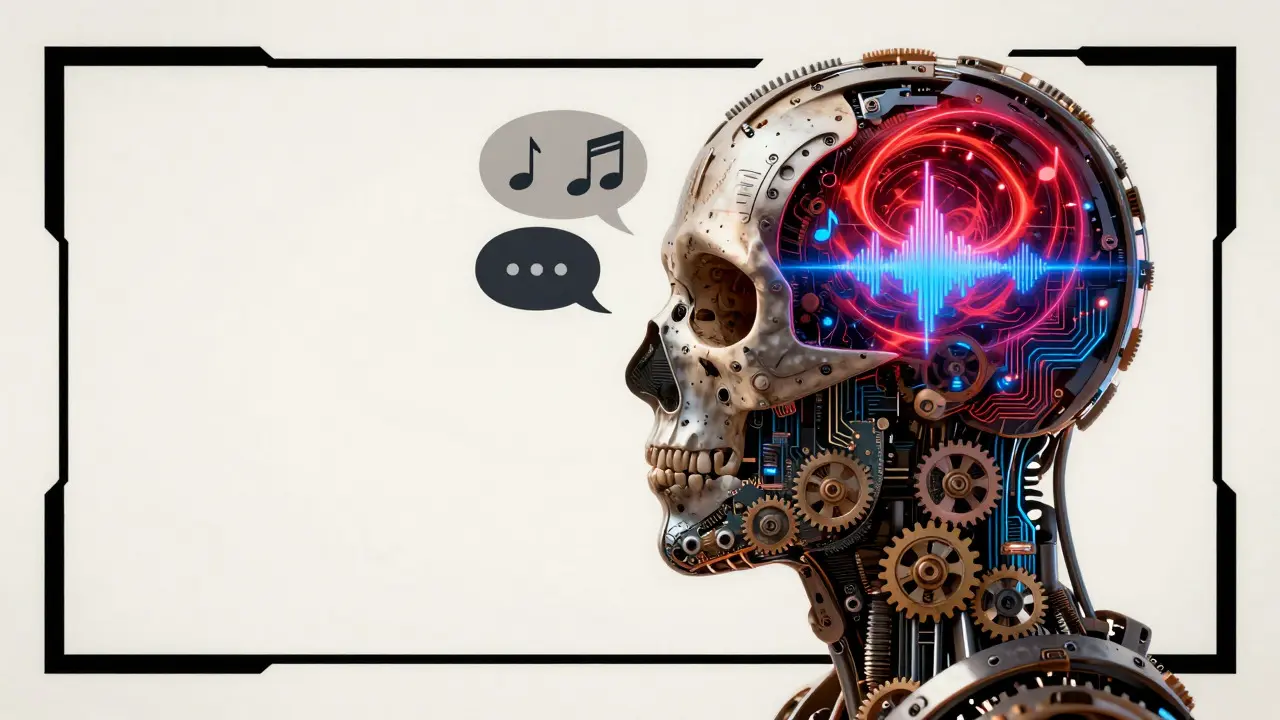
Audio Generation in Generative AI: Speech, Music, and Sound Effects Explained
Imagine hearing a voice that sounds exactly like your favorite actor reading your morning news, or listening to a full orchestral score composed by an algorithm in seconds. This isn't science fiction anymore. It is the reality of audio generation in generative artificial intelligence. Since around 2016, machine learning models have moved from simple beeps and boops to creating near-human quality speech, complex music, and realistic sound effects. Today, these tools are reshaping how we produce media, create games, and even communicate.
You might wonder how a computer understands the difference between a whisper and a shout, or a jazz riff and a classical symphony. The answer lies in deep neural networks-specifically transformers, diffusion models, and generative adversarial networks (GANs). These systems learn patterns from massive datasets of audio, allowing them to synthesize new content from text prompts or short audio samples. But what does this mean for you? Whether you are a developer, a content creator, or just curious about technology, understanding these three pillars-speech, music, and sound effects-is key to navigating the future of digital audio.
The Evolution of Speech Synthesis
Speech synthesis has come a long way since Homer Dudley’s Voder at the 1939 New York World’s Fair. Early systems relied on rule-based concatenation, stitching together recorded syllables. They sounded robotic and stiff. Then came the neural revolution. In 2016, DeepMind introduced WaveNet, which used deep convolutional networks to generate raw audio waveforms directly. This was followed by Google’s Tacotron 2 in 2017, which mapped text to mel spectrograms before passing them to a vocoder.
These breakthroughs pushed Mean Opinion Scores (MOS)-a standard metric for audio quality-to within 0.05 points of human recordings. By the early 2020s, cloud providers like Google, Amazon, and Microsoft offered dozens of voices in over 70 languages. Startups like ElevenLabs took it further with ultra-realistic voice cloning. Their platform allows users to clone a voice from just one to five minutes of audio, capturing unique timbre, pitch, and prosody. This capability is powerful for dubbing and accessibility but raises serious ethical questions about consent and deepfakes.
Modern text-to-speech (TTS) pipelines typically involve three stages: text analysis, acoustic modeling, and vocoding. The model converts text into linguistic features, predicts prosody and timbre via intermediate representations like mel spectrograms, and finally generates waveform samples using vocoders such as WaveNet or HiFi-GAN. Recent advances integrate large language models (LLMs) to improve emotional expressiveness and context-awareness, making synthetic voices more natural and engaging.
Music Generation: From Loops to Full Songs
While speech synthesis focuses on intelligibility and naturalness, music generation tackles creativity and structure. Early AI music models struggled with long-term coherence. However, Google’s Music Transformer changed the game in 2018 by using relative attention mechanisms to model polyphonic piano music over hundreds of timesteps. OpenAI’s Jukebox (2020) went further, generating multi-minute songs in specific styles using hierarchical VQ-VAEs and autoregressive transformers trained on 1.2 million songs.
In 2023, Google Research released MusicLM, capable of generating high-quality 24 kHz music conditioned on natural language prompts or hummed melodies. Meta’s AudioCraft suite introduced MusicGen, a transformer-based decoder that produces up to 12 seconds of music per forward pass, extendable via autoregressive continuation. Meanwhile, commercial platforms like Suno and Stable Audio have democratized access, allowing non-musicians to create complete songs with lyrics and vocals from simple text descriptions.
Despite these advances, limitations remain. Many AI-generated tracks suffer from harmonic incoherence, repetitive structures, or lack of dynamic development beyond 1-2 minutes. Producers often describe outputs as “generic library music with a twist.” Tools like Suno excel at generating verses and choruses but struggle with bridges, key changes, and novel progressions. For professional use, AI serves best as a brainstorming aid or placeholder rather than a replacement for human composition.
Sound Effects and Environmental Audio
Beyond speech and music, AI is transforming sound design. Meta’s AudioGen, part of the AudioCraft suite, generates diverse sound effects and environmental audio from text prompts. You can type “dogs barking in a park with traffic in the background,” and it will produce stereo 16-24 kHz audio several seconds long. This is invaluable for game developers and filmmakers who need quick Foley-like assets.
Stability AI’s Stable Audio also supports sound effect generation alongside music. Its latent diffusion model creates high-fidelity outputs with precise control over duration and tempo. Users can specify BPM, genre, and track length, making it suitable for both creative experimentation and production-ready assets. Unlike earlier GAN-based approaches, diffusion models offer better global coherence and fewer artifacts, though they require significant computational resources.
Practical applications include prototyping game audio, creating background ambience for videos, and generating interface sounds for apps. However, generated sound effects can sometimes feel “mushy” or lack high-frequency detail, requiring post-processing in digital audio workstations (DAWs) for professional results.
Technical Foundations and Architecture
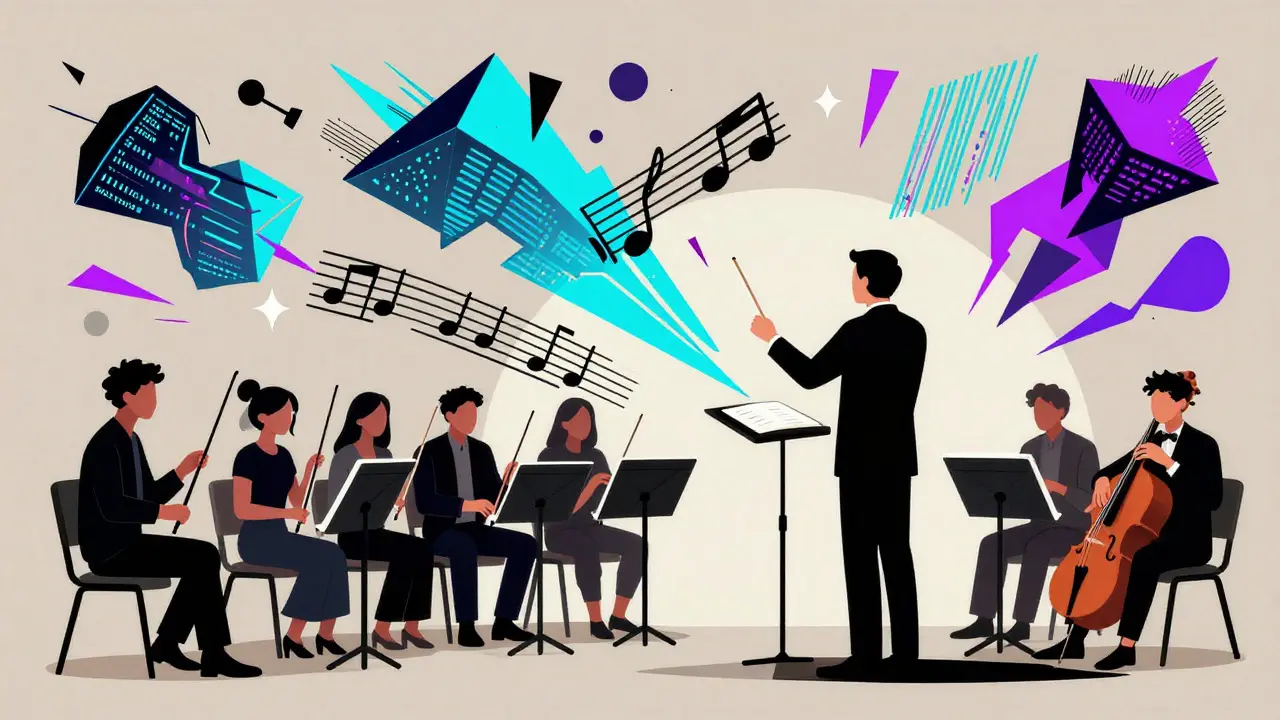
Under the hood, all these systems rely on similar technical ingredients: large-scale training datasets, powerful neural architectures, and efficient audio representations. Training data ranges from hundreds of hours for early TTS to millions of hours for modern multimodal models. Architectures vary based on the task:
- Transformers: Excel at modeling long-range dependencies in music and speech. Used in MusicLM, MusicGen, and Jukebox.
- Diffusion Models: Iteratively denoise latent representations to generate coherent audio. Preferred for Stable Audio and recent sound effect generators.
- GANs: Historically used for speech and music but largely superseded by transformers and diffusion due to training instability.
- Vocoders: Convert intermediate representations (like mel spectrograms) into waveforms. Examples include WaveNet, WaveRNN, and HiFi-GAN.
Audio representation is critical. Instead of working directly with raw waveforms, many models use compressed tokens. Meta’s EnCodec compresses waveforms into discrete tokens at bitrates as low as 1.5 kbps, enabling efficient conditioning for MusicGen and AudioGen. This approach balances quality and computational efficiency, allowing real-time inference on consumer-grade GPUs.
Ethical Challenges and Regulation
With great power comes great responsibility. Audio generation introduces significant ethical challenges, particularly around copyright, consent, and misinformation. Voice cloning can replicate identifiable individuals from short recordings, enabling fraud and impersonation scams. In 2023, the viral deepfake track “Heart on My Sleeve,” imitating Drake and The Weeknd, racked up millions of plays before being removed following complaints from Universal Music Group.
Regulators and platforms are responding. Policies on AI-generated music and synthetic voices have emerged since 2019, focusing on watermarking, detection, and transparency. Industry experts advocate for robust watermarking techniques, such as embedding inaudible signals or statistical signatures, to track AI-generated content. Consent-based data collection and opt-out mechanisms for artists and speakers are becoming standard practices.
Legal frameworks remain unsettled. Questions about whether training on copyrighted catalogs without explicit consent constitutes fair use are still being litigated. Until clear guidelines emerge, creators must navigate a gray area, balancing innovation with respect for intellectual property rights.
Comparing Top Audio Generation Tools
| Platform | Primary Focus | Key Technology | Best For | Limitations |
|---|---|---|---|---|
| ElevenLabs | Speech Synthesis & Cloning | Neural TTS, Voice Embeddings | Dubbing, Audiobooks, Virtual Assistants | Costly for high volume; ethical concerns |
| Suno | Music Generation | Proprietary Transformer/Diffusion | Non-musicians, Social Media Content | Limited structural control; generic output |
| Stable Audio | Music & Sound Effects | Latent Diffusion Model | Creative Experimentation, Game Assets | Requires GPU for local deployment |
| Meta AudioGen | Sound Effects | Transformer + EnCodec | Foley, Environmental Ambience | Short durations; needs post-processing |
Future Trends and What to Expect
The next five years will see rapid advancements in audio generation. We can expect longer and more coherent music compositions, extending beyond 3-5 minutes with finer-grained control over chord progressions and song sections. Speech synthesis will become richer in emotional nuance and conversational prosody, driven by integration with LLMs.
Multimodal agents like AudioGPT will converge audio and vision, enabling systems that can transcribe, analyze, and generate diverse audio types while interacting via talking heads. Spatial and environmental modeling will improve, supporting immersive audio for VR and AR applications.
However, long-term viability depends on resolving legal issues around training data and establishing business models that compensate rights holders. Trust will be built through transparency, user control, and robust detection tools. As these technologies mature, they will not replace human creativity but augment it, offering new tools for expression and collaboration.
What is the difference between speech synthesis and voice cloning?
Speech synthesis generates speech from text using pre-trained voices, while voice cloning replicates a specific individual's voice characteristics from a small sample of their audio. Cloning requires fine-tuning or zero-shot conditioning to capture unique timbre and prosody.
Can AI-generated music be copyrighted?
Currently, copyright law is unclear regarding AI-generated works. In many jurisdictions, human authorship is required for copyright protection. If a human significantly edits or arranges AI output, they may claim rights, but pure AI generation often lacks legal standing.
Which tool is best for creating sound effects?
Meta’s AudioGen and Stability AI’s Stable Audio are top choices for sound effects. AudioGen excels at environmental sounds and Foley, while Stable Audio offers precise control over duration and tempo, suitable for both music and SFX.
How do I avoid detecting AI-generated audio?
Detection tools look for statistical anomalies and watermarks. To reduce detectability, add noise, apply compression, or mix AI audio with live recordings. However, transparency is increasingly valued, so labeling AI content is often the best practice.
Is AI music replacing human composers?
Not yet. AI struggles with long-term structure, novelty, and emotional depth. Most professionals use AI as a brainstorming tool or for generating placeholders. Human creativity remains essential for nuanced, impactful compositions.




another day another algorithm stealing the soul out of art
i guess we should just thank the robots for doing our jobs for us while they sit in server farms eating electricity
it is not about stealing it is about shifting the paradigm of creation itself
when we look at the history of technology every new tool was met with fear and then eventually acceptance
the voder in 1939 sounded terrible but it laid the groundwork for what we have now
we must consider that the human element is not in the mechanics of sound production but in the intent behind it
if a machine can mimic the timbre does it lose the meaning
perhaps the meaning is transferred to the listener rather than the creator
this is a philosophical question that has no easy answer but one thing is certain the line between synthetic and organic is blurring faster than we can legislate it
we need to stop fighting the current and start learning how to swim in it
You are so naive, Alex. It is not a 'paradigm shift' it is theft. Plain and simple. The fact that you use such flowery language to excuse corporate greed is almost insulting. These companies scrape millions of hours of copyrighted work without asking, without paying, and without consent. And you call it 'swimming'? I call it drowning the artists who spent decades mastering their craft. We need strict regulations, not your passive acceptance of digital colonization.
i wonder if the legal system will ever catch up to the speed of these models
it feels like we are running a race where the finish line keeps moving further away
maybe the solution isn't banning it but finding a way to compensate the original creators automatically through smart contracts or something similar
just a thought really
I mostly just want my audiobooks to sound less robotic when I'm driving