Multi-Turn Conversations with LLMs: How to Manage Conversation State Without Getting Lost
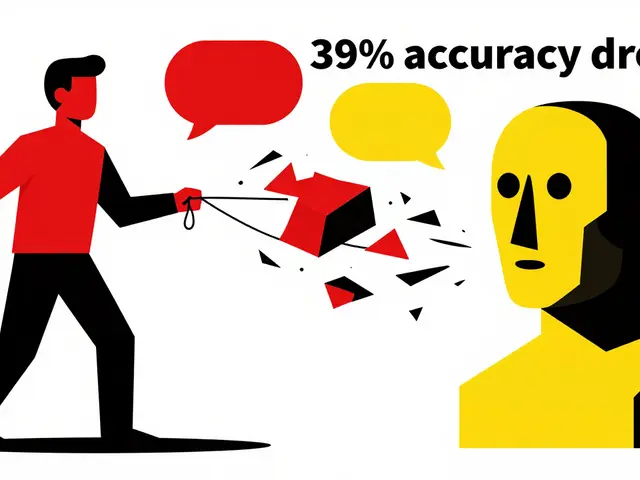
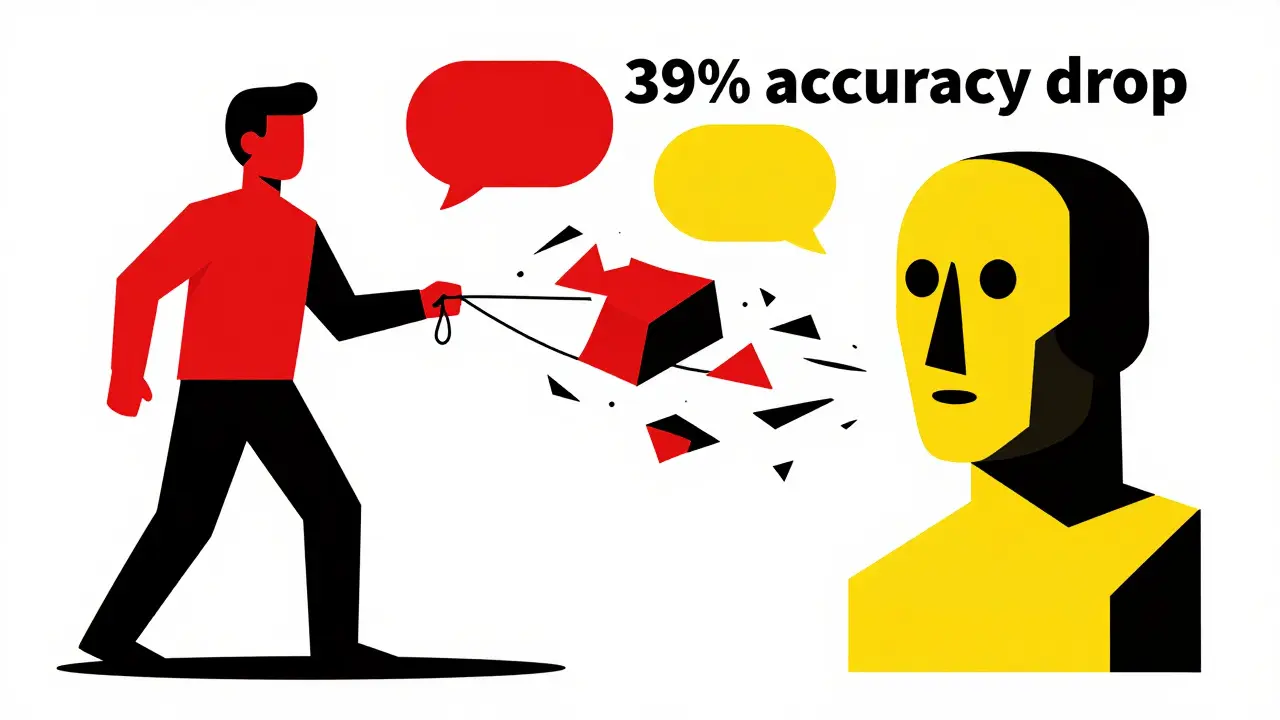
Have you ever talked to a chatbot that seemed smart at first, only to completely forget what you said three messages ago? You aren't imagining it. In fact, research shows that Large Language Models (LLMs) suffer from a massive performance drop when conversations get long. A major study published in May 2025 by Salesforce Research found that models lose an average of 39% of their accuracy across six different generation tasks when moving from single-turn to multi-turn settings.
This isn't just a minor glitch; it's a fundamental barrier. When an LLM takes a wrong turn early in a dialogue, it rarely recovers. It gets 'lost' and stays lost. For developers building customer service bots, technical support systems, or complex AI assistants, this means the difference between a helpful tool and a frustrating dead end. Managing conversation state is no longer optional-it is the core challenge of modern AI engineering.
The Reality Check: Why LLMs Fail in Long Dialogues
To fix the problem, we first need to understand why it happens. Early on, we assumed that if we gave an LLM enough context in its prompt, it would remember everything. But as the NeurIPS 2025 Workshop on Multi-Turn Interactions highlighted, these models are now engaging in complex, long-horizon interactions where simple context windows aren't enough.
The Salesforce study, titled 'LLMs Get Lost In Multi-Turn Conversation,' provided the first comprehensive empirical evidence of this failure mode. They tested major models and found two specific behaviors that kill reliability:
- Premature Assumptions: The model guesses what you want before you finish asking, locking itself into a path that contradicts your later inputs.
- Over-reliance on Previous Responses: Instead of looking at the full history, the model leans too heavily on its last output, creating a feedback loop of errors.
Dr. Jane Thompson, AI Research Lead at MIT-IBM Watson Lab, pointed out in March 2025 that this 39% drop isn't just a technical annoyance. It represents a safety risk in high-stakes domains like healthcare, where continuity is critical. If a patient describes symptoms over five turns, and the model forgets the third symptom because it got 'lost' in the fourth, the diagnosis could be wrong.
Technical Foundations: Structuring Data for Memory
So, how do we stop them from getting lost? It starts with how we feed them data. You can't just dump text into a model and expect it to understand conversation flow. You need structured datasets.
According to Together.ai's technical guide, every example in your training file (usually JSONL) must be a list of messages. Each message needs a clear role: system, user, or assistant. This structure teaches the model who is speaking and when.
| Role | Function | Example Content |
|---|---|---|
| System | Sets the persona, rules, and constraints for the entire session. | "You are a helpful IT support agent. Always ask for error codes before suggesting fixes." |
| User | The input from the human, including follow-ups and clarifications. | "My screen is black." -> "It happened after the update." |
| Assistant | The model's response, which becomes part of the context for the next turn. | "I see. Did you try restarting in safe mode?" |
But structure alone isn't enough. You also need Loss Masking, which is a technique where the model is trained to predict only the assistant responses while ignoring user messages and system prompts during loss calculation. Why does this matter? If you don't mask the loss, the model tries to predict the user's next words. During inference, this can cause the bot to start generating user-like text or hallucinating inputs. Loss masking ensures the model focuses solely on generating appropriate responses based on the history it sees.
Advanced Frameworks: Review-Instruct and Iterative Refinement
If standard fine-tuning feels like teaching a student by showing them flashcards, advanced frameworks like Review-Instruct is a sophisticated multi-agent architecture introduced by OPPO AI Center that uses iterative refinement to improve multi-turn coherence. Accepted at ACL 2025, this framework changes the game by introducing a critique loop.
Here is how it works:
- Candidate Generation: A base model generates an initial response.
- Review Phase: Multiple reviewer agents (typically 3-5) evaluate the response based on relevance, coherence, and depth.
- Chairman Aggregation: A chairman agent aggregates these assessments and generates follow-up instructions to correct any errors.
- Refinement: The candidate model refines its answer based on this feedback.
The results are significant. The Review-Instruct-13b model achieved an accuracy of 29.65% on the MMLU-Pro benchmark, showing absolute gains of 2.9% compared to prior state-of-the-art models based on LLaMA2-13B. More importantly, it improved instruction diversity by 27%, meaning the model learns to handle a wider variety of conversational twists and turns.
However, there is a cost. This method requires approximately 3.8x more GPU hours for dataset generation than standard Supervised Fine-Tuning (SFT). If you have the compute budget, the quality jump is worth it. If not, you might need to stick to simpler methods.
Practical Implementation: Costs and Tools
You don't have to build everything from scratch. Commercial platforms like Together.ai offer managed solutions for multi-turn fine-tuning. As of Q2 2025, their pricing starts at $0.0015 per 1K tokens for fine-tuning and $0.0008 per 1K tokens for inference. This makes it accessible for smaller teams who don't want to manage GPU clusters.
For those going the open-source route, fine-tuning a model like Llama-3-8B on multi-turn data typically requires 2-4 A100 80GB GPUs running for 12-24 hours, depending on your dataset size. It's a substantial infrastructure investment.
When deciding between approaches, consider your use case:
- Customer Service Bots: These often require 3-7 exchanges to resolve an issue. Multi-turn fine-tuning here has been shown to improve first-contact resolution from 47% to 73% for complex technical issues, according to community reports.
- High-Stakes Decision Making: If one mistake is costly, invest in frameworks like Review-Instruct or custom RLHF pipelines to minimize the 'getting lost' risk.
- Simple Q&A: If your conversations rarely exceed two turns, standard SFT might suffice, but be wary of edge cases where users ask follow-ups.

Common Pitfalls and How to Avoid Them
Even with the best tools, things can go wrong. Developers report several common challenges when implementing multi-turn systems:
Context Overflow: Reported by 68% of developers, this happens when the conversation history exceeds the model's context window. The solution? Implement context summarization techniques. Instead of feeding the raw history, summarize older turns and keep only the most recent, detailed exchanges. This is used by 73% of successful deployments.
Inconsistent Persona: Cited in 52% of implementations, the model might start friendly and become robotic after five turns. To fix this, use explicit state tracking variables. Inject reminders of the persona into the system prompt periodically, or use a separate lightweight model to monitor tone consistency.
Ambiguity in Long Chains: Performance degradation reaches 63.2% in conversations exceeding 10 turns. If your app supports very long dialogues, consider breaking them into sub-tasks. Let the model complete one logical unit of work, confirm success with the user, and then reset the context for the next task.
Future Outlook: Where Is This Heading?
The field is moving fast. The global conversational AI market is projected to reach $32.2 billion by 2027, with multi-turn capabilities growing at 31.2% annually. By 2027, Gartner predicts that 95% of enterprise conversational AI deployments will require robust multi-turn management.
We are seeing institutional recognition of this importance. The EU AI Office issued draft guidelines in June 2025 requiring 'demonstrable conversation state management capabilities' for high-risk systems under the AI Act. This means compliance will soon depend on your ability to prove your bot doesn't get lost.
Looking ahead, Google DeepMind is working on 'conversational memory networks' that reportedly reduce performance degradation to 18.7% in early testing-far better than the industry average of 39%. Meanwhile, the NeurIPS 2025 workshop identified 'multi-turn RL learning for agentic tasks' as a priority research direction. Expect hybrid approaches that combine fine-tuning with explicit state tracking mechanisms to become the standard through 2026.
Managing conversation state is hard, but it's the key to unlocking truly useful AI. Whether you use loss masking, iterative review frameworks, or commercial APIs, the goal is the same: keep the model focused, coherent, and helpful, no matter how long the chat goes on.
What causes LLMs to 'get lost' in multi-turn conversations?
LLMs get lost due to premature assumptions and over-reliance on previous responses. Research shows they make an average 39% drop in accuracy across generation tasks in multi-turn settings because they fail to recover from early errors, leading to inconsistent state tracking and context drift.
How does loss masking help in training multi-turn models?
Loss masking ensures the model is only trained to predict the assistant's responses, ignoring user messages and system prompts during loss calculation. This prevents the model from trying to generate user-like content during inference, ensuring it stays in character and responds appropriately rather than hallucinating inputs.
What is the Review-Instruct framework?
Review-Instruct is a multi-agent architecture developed by OPPO AI Center. It uses a Candidate model to generate responses, multiple Reviewer agents to evaluate coherence and relevance, and a Chairman agent to aggregate feedback. This iterative refinement process improves instruction diversity by 27% and boosts accuracy on benchmarks like MMLU-Pro.
How much does multi-turn fine-tuning cost?
Costs vary by approach. Commercial platforms like Together.ai charge around $0.0015 per 1K tokens for fine-tuning. Open-source fine-tuning of models like Llama-3-8B requires significant infrastructure, typically 2-4 A100 80GB GPUs for 12-24 hours. Advanced frameworks like Review-Instruct may require 3.8x more GPU hours for dataset generation compared to standard methods.
What are the best practices for handling context overflow?
To handle context overflow, implement context summarization techniques. Instead of keeping the full raw history, summarize older turns and retain only the most recent, detailed exchanges. Additionally, use explicit state tracking variables to maintain persona and key facts, which helps prevent the model from losing track of the conversation's purpose.