
Sinusoidal vs Learned Positional Encoding: Why Modern LLMs Use RoPE
Imagine reading a sentence where the words are shuffled randomly. You might recognize the individual terms, but the meaning vanishes instantly. This is the exact problem Transformers are born with. The self-attention mechanism at their core treats every word in a sequence as an independent entity, completely ignoring order. Without a way to tell the model which word came first and which came last, it cannot understand grammar, causality, or narrative flow.
To fix this, researchers introduced Positional Encoding is a technique that injects information about the position of each token into the model's input embeddings. It’s the invisible glue that holds sequence logic together. In the original "Attention Is All You Need" paper from 2017, the authors presented two main ways to do this: fixed sinusoidal patterns and learned embeddings. For years, these were the standard options. But if you look at today’s top-tier Large Language Models (LLMs) like Llama 3 or PaLM, you won’t find either of them. They’ve moved on to more advanced methods like Rotary Position Embedding (RoPE). Understanding why this shift happened-and when you might still stick to the old ways-is crucial for anyone building or fine-tuning AI models today.
The Original Contenders: Sinusoidal vs. Learned
When Vaswani et al. published the Transformer architecture in 2017, they experimented with two primary approaches to positional encoding. Both aimed to solve the same problem: giving the model a sense of sequence. However, their mechanics and limitations differ significantly.
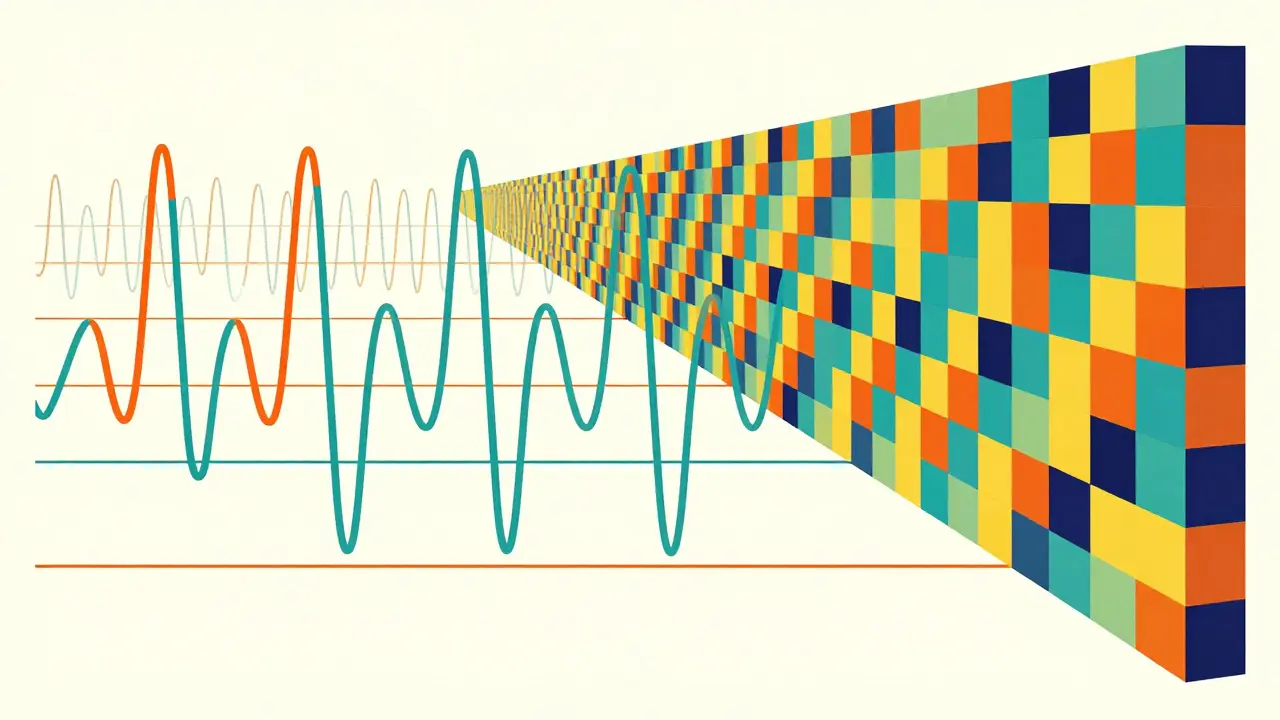
Sinusoidal Positional Encoding uses fixed mathematical functions-specifically sine and cosine waves of varying frequencies-to assign a unique vector to each position. The formula looks like this: PE(pos, 2i) = sin(pos / 10000^(2i/d_model)) and PE(pos, 2i+1) = cos(pos / 10000^(2i/d_model)). Because these values are calculated mathematically rather than stored, the model theoretically can handle sequences of any length, even ones longer than what it saw during training. The idea was that the model could learn to extrapolate these patterns. In practice, however, this theoretical advantage rarely held up. When GPT-2 tried to process sequences double its training length, its perplexity score jumped from 20.5 to 32.1, showing a sharp drop in understanding.
On the other side, Learned Positional Embeddings treat position as just another feature to be learned. Instead of calculating values, the model maintains a lookup table of vectors, one for each possible position index. If your maximum sequence length is 512, the model learns 512 distinct vectors. This approach is simpler to implement and often performs slightly better on short, fixed-length tasks because the model can memorize specific positional quirks. But it has a hard ceiling. If you want to increase the context window from 2048 to 4096 tokens, you can't just resize the table; you have to retrain the entire model. This rigidity made learned embeddings a poor fit for the rapidly expanding context windows of modern LLMs.
| Feature | Sinusoidal Encoding | Learned Embeddings |
|---|---|---|
| Flexibility | Theoretically infinite length | Limited by table size |
| Extrapolation | Poor (performance drops 30-40% beyond training length) | None (fails completely outside trained range) |
| Parameters | Zero additional parameters | High memory usage for large contexts |
| Best Use Case | Educational purposes, legacy systems | Fixed-length specialized tasks (e.g., molecular prediction) |
Why Modern LLMs Abandoned the Basics
If you’re working with state-of-the-art models in 2026, you’ll notice that neither sinusoidal nor learned embeddings are the default anymore. Why? Because both struggle with Sequence Length Extrapolation is the ability of a model to maintain performance when processing inputs longer than those seen during training. As LLMs grew from handling paragraphs to processing entire books, the need for robust long-context handling became critical.
The industry shifted toward relative positional representations. Instead of telling the model "this word is at position 5," these methods tell it "this word is 3 positions away from that word." This relative distance is far more useful for language understanding. Two leading techniques emerged: Rotary Position Embedding (RoPE) and ALiBi (Attention with Linear Biases).
RoPE, introduced in the RoFormer paper in 2021, applies rotation matrices to query and key vectors. Mathematically, it ensures that the inner product between tokens depends only on their relative distance. This elegant solution allows models like Llama 2 and Llama 3 to support context windows of 4096 tokens or more with minimal performance degradation. In benchmarks, RoPE maintained 90% of its optimal performance even when the sequence length was doubled, whereas sinusoidal encoding plummeted to 65%.
ALiBi takes a different approach by eliminating positional embeddings entirely. Instead, it adds a linear bias term to the attention scores based on the distance between tokens. This method is incredibly simple to implement-often requiring just a few lines of code change-and performs remarkably well. On the LM1B dataset, ALiBi showed a 2.1 perplexity improvement over sinusoidal encoding at 2048 tokens and maintained stability up to 8192 tokens without needing fine-tuning.
Implementation Realities: What Developers Face
Choosing the right positional encoding isn’t just about theoretical performance; it’s about engineering practicality. Based on community feedback from GitHub and developer forums, the experience varies widely depending on your choice.
Implementing RoPE requires modifying the attention computation layer to include rotation operations. While powerful, it introduces complexity. A Hugging Face issue from 2023 highlighted that integrating RoPE into custom transformers often took developers several days due to subtle dimension mismatches in rotation matrices. Additionally, RoPE increases computational overhead by approximately 15% due to the extra rotation calculations. However, the payoff is significant: users reported a 14% reduction in hallucination rates for long documents after switching from sinusoidal to RoPE.
In contrast, ALiBi is praised for its simplicity. Developers noted that adding ALiBi required only a single line change to the attention score calculation. It integrates seamlessly with existing architectures and adds negligible computational cost. For resource-constrained environments or teams looking for a quick upgrade from sinusoidal encoding, ALiBi is often the preferred starting point. One practitioner noted that ALiBi maintained 97% of RoPE’s performance on their 4096-token medical text corpus while being significantly easier to debug.
That said, there are pitfalls. RoPE can cause performance degradation with very small batch sizes (<4) during training, requiring careful learning rate adjustments. Meanwhile, ALiBi requires tuning the bias scalar (alpha) per attention head, which can be tricky if not initialized correctly. Neither method is a silver bullet, but both represent a massive leap forward from the static nature of sinusoidal and learned embeddings.
Market Trends and Future Directions
The industry has spoken loud and clear. According to the 2025 State of AI Report, 87% of new LLM architectures released in 2024-2025 employed RoPE or its variants. This dominance is reflected in the Hugging Face Open LLM Leaderboard, where 78% of top-performing models utilize RoPE. Legacy sinusoidal encoding now represents only about 28% of implementations, mostly confined to educational tools or older systems.
Even within RoPE, innovation continues. Meta’s Llama 3 introduced "RoPE Scaling," a technique that compresses position frequencies to support million-token contexts with only 15% performance degradation. Google’s PaLM 2 featured "Adaptive RoPE," which dynamically adjusts rotation frequencies based on input content. These advancements suggest that the future of positional encoding lies in dynamic, content-aware methods rather than static patterns.
However, experts warn of risks. A Stanford HAI study from late 2025 documented a "position hallucination" phenomenon in RoPE-based models, where error rates in numerical reasoning tasks involving position-sensitive calculations rose to 8.2% beyond trained context lengths. As we push models to handle ever-longer sequences, ensuring reliability remains a key challenge.
How to Choose for Your Project
So, which should you use? Here’s a practical decision guide:
- Use Sinusoidal Encoding if: You are building a prototype for educational purposes, working with a legacy codebase that cannot be easily modified, or dealing with extremely short, fixed-length sequences where extrapolation doesn’t matter.
- Use Learned Embeddings if: Your task involves highly specialized, fixed-length inputs (like molecular structures or financial time-series data with strict limits) and you have the compute resources to retrain whenever you need to change the length.
- Use RoPE if: You are building a production-grade LLM that needs to handle long contexts (4k+ tokens), require high accuracy in language generation, and have the engineering bandwidth to manage slightly more complex attention layers.
- Use ALiBi if: You need a quick, low-overhead upgrade to an existing transformer model, are working with limited computational resources, or prefer architectural simplicity without sacrificing much long-context performance.
The era of static positional encoding is over. As LLMs continue to scale, the ability to understand and generate coherent text across vast amounts of information will depend on how well we encode the relationships between tokens. Whether you choose RoPE for its precision or ALiBi for its elegance, moving beyond sinusoidal and learned embeddings is no longer optional-it’s essential.
What is the main difference between sinusoidal and learned positional encoding?
Sinusoidal encoding uses fixed mathematical formulas (sine/cosine waves) to generate position vectors, allowing theoretical support for infinite sequence lengths. Learned encoding uses a trainable lookup table where each position has a specific vector, limiting the model to the maximum sequence length defined during training.
Why do modern LLMs like Llama 3 use RoPE instead of sinusoidal encoding?
RoPE (Rotary Position Embedding) provides superior extrapolation capabilities, meaning it maintains performance when processing sequences longer than those seen during training. Sinusoidal encoding suffers significant performance drops (30-40%) when doubling sequence length, making it unsuitable for modern long-context applications.
Is ALiBi better than RoPE for all use cases?
Not necessarily. ALiBi is simpler to implement and has lower computational overhead, making it great for resource-constrained environments. However, RoPE generally offers higher accuracy and better performance on complex language tasks, especially in state-of-the-art models like Llama and PaLM.
Can I switch from sinusoidal to RoPE in my existing model?
Yes, but it requires modifying the attention computation layers to include rotation operations. It’s not a plug-and-play swap; you’ll need to adjust your code and potentially retrain or fine-tune the model to adapt to the new positional representation.
What is "position hallucination" in RoPE models?
Position hallucination refers to errors in numerical reasoning or position-sensitive tasks when the model processes sequences beyond its trained context length. Studies show RoPE models can exhibit up to 8.2% error rates in these specific scenarios, highlighting a risk in extreme extrapolation.