
Transformer Architecture in Generative AI: A Practical Guide for Engineers
Stop trying to force sequential logic onto parallel problems. If you are building modern generative systems, the Transformer architecture is the foundational neural network design that powers almost every state-of-the-art language and multimodal model today. It replaced Recurrent Neural Networks (RNNs) not because it was slightly better, but because it solved a fundamental bottleneck: the inability to process long-range dependencies efficiently. For engineers moving from theoretical knowledge to practical implementation, understanding the Transformer is no longer optional-it is the baseline requirement for working with Large Language Models (LLMs), computer vision systems, and audio generation tools.
Why Transformers Replaced RNNs and CNNs
To build effective systems, you first need to understand what broke before them. Traditional models like Recurrent Neural Networks (RNNs) are neural networks designed to process sequential data by maintaining a hidden state that updates with each time step. They read text word by word. This sounds intuitive, but it creates two massive problems for engineers. First, they cannot be easily parallelized. You must wait for step N to finish before starting step N+1. Second, they suffer from vanishing gradients over long sequences. By the time an RNN reaches the end of a paragraph, it has largely forgotten the beginning.
Convolutional Neural Networks (CNNs) tried to fix this by processing chunks of data simultaneously, but they struggled with global context. The Transformer, introduced by Vaswani et al. in 2017, eliminated the recurrence entirely. Instead of reading left-to-right, it looks at the entire input sequence at once. This shift enabled massive parallelization on GPUs, reducing training times from months to days. For a generative AI engineer, this means you can scale model size and dataset volume without hitting the same computational walls that limited previous architectures.
The Core Components: Anatomy of a Transformer Block
When you inspect a model like GPT-4 or BERT, you are looking at stacks of identical transformer blocks. Each block performs specific mathematical operations to refine the representation of your data. Understanding these components is critical for debugging performance issues or optimizing inference speed.
- Tokenization and Embedding: Raw text is useless to a neural network. Your tokenizer splits input into tokens (subwords or words). These tokens are mapped to high-dimensional vectors via an embedding layer. This vector captures semantic meaning; "king" and "queen" will have similar vector representations.
- Positional Encoding: Since the Transformer processes all tokens simultaneously, it loses information about order. Positional encodings are added to the embeddings to inject sequence position data. Without this, the model treats "dog bites man" and "man bites dog" as the same set of words.
- Multi-Head Self-Attention: This is the engine room. The mechanism calculates how much each token should "attend" to every other token in the sequence. Multi-head attention allows the model to focus on different types of relationships simultaneously-such as grammatical structure in one head and semantic meaning in another.
- Feed-Forward Networks (FFN): After attention, each position passes through a fully connected neural network independently. This adds non-linearity and complexity to the representations.
- Layer Normalization and Residual Connections: These stabilize training. Residual connections add the input of a layer to its output, preventing degradation in deep networks. Layer normalization ensures that the values remain within a manageable range, speeding up convergence.
Encoder vs. Decoder Architectures
Not all transformers are built the same. As an engineer, you must choose the right variant for your job. The original paper proposed an encoder-decoder structure, but modern applications often use only half of it.
| Architecture Type | Primary Function | Key Mechanism | Example Models | Best Use Case |
|---|---|---|---|---|
| Encoder-Only | Understanding and Representation | Bidirectional Attention | BERT, RoBERTa | Sentiment analysis, classification, search |
| Decoder-Only | Generation | Causal (Masked) Attention | GPT-3, LLaMA, Mistral | Text generation, chatbots, code completion |
| Encoder-Decoder | Translation and Summarization | Cross-Attention | T5, BART | Machine translation, abstractive summarization |
In decoder-only models used for generative AI, we apply a causal mask. This prevents the model from seeing future tokens during training. When generating text, the model predicts the next token based only on what has already been generated. Encoder-only models, like BERT, see the entire context bidirectionally, making them superior for tasks requiring deep understanding rather than creation.
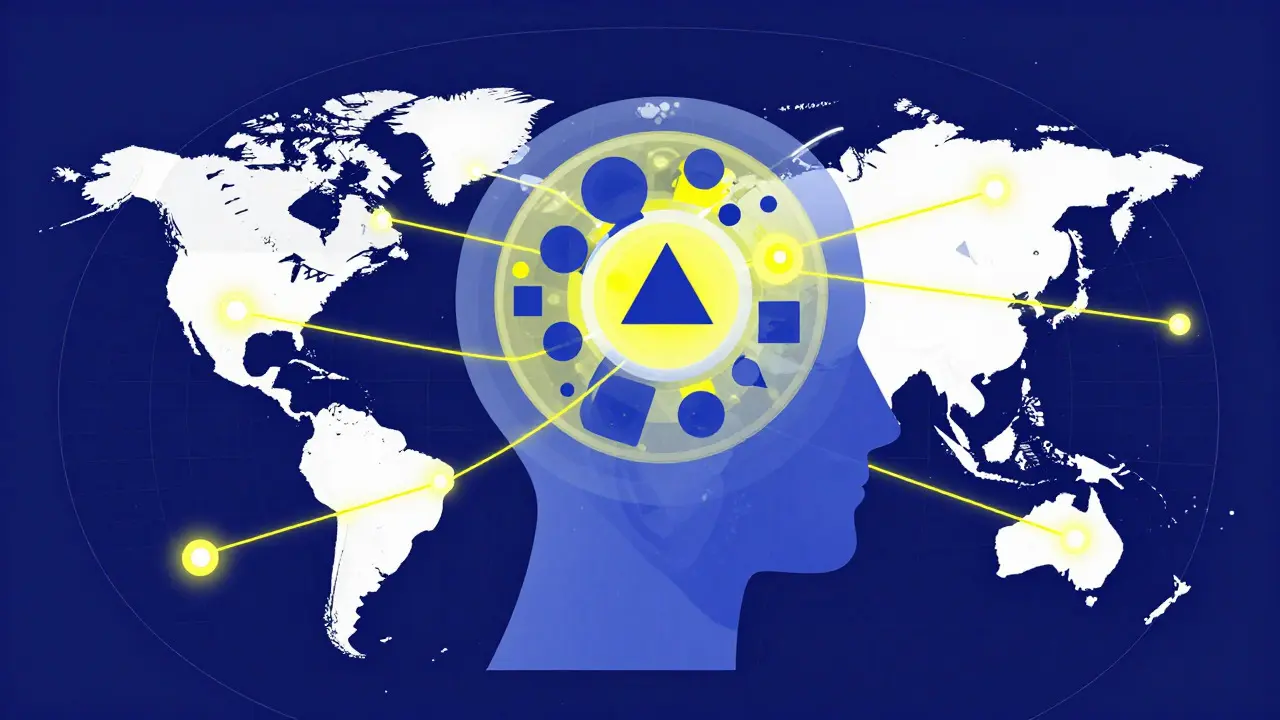
Implementing Self-Attention: The Math Behind the Magic
You don't need to derive the equations from scratch every time, but knowing how Scaled Dot-Product Attention works helps when you hit precision errors or scaling issues. The formula is simple:
Attention(Q, K, V) = softmax(QK^T / sqrt(d_k))V
Here, Q (Query), K (Key), and V (Value) are matrices derived from the input embeddings. The dot product between Query and Key measures similarity. We divide by the square root of the dimension ($d_k$) to prevent the dot products from growing too large, which would push the softmax function into regions with extremely small gradients. This scaling factor is crucial for stable training in deep networks.
Multi-head attention repeats this process multiple times with different learned linear projections. If you have 8 heads, the model computes 8 different attention patterns and concatenates them. This allows the model to capture diverse linguistic features-syntax, semantics, and coreference-in parallel subspaces.
Practical Engineering Challenges
Deploying transformers introduces unique constraints that differ significantly from traditional machine learning pipelines.
Memory Bandwidth and Inference Latency
During inference, especially for autoregressive generation, memory bandwidth becomes the bottleneck, not compute power. Loading billions of parameters from VRAM to the compute cores takes time. Techniques like quantization (reducing precision from FP32 to INT8 or FP16) and kernel optimization (using FlashAttention) are essential for real-time applications. FlashAttention reduces memory access overhead by recomputing intermediate values instead of storing them, drastically cutting memory usage.
Context Window Limits
Self-attention has quadratic complexity $O(n^2)$ relative to sequence length. Doubling the context window quadruples the computational cost. For engineers handling long documents, this is a hard limit. Solutions include sliding window attention, where the model only attends to a local neighborhood, or sparse attention mechanisms that selectively attend to key tokens. Recent models like Longformer or BigBird implement these optimizations to handle sequences exceeding 100,000 tokens.
Training Stability
Pre-training on massive datasets requires careful hyperparameter tuning. Learning rate warmup is standard practice; starting with a low learning rate and gradually increasing it helps the model stabilize in the early stages. Gradient clipping prevents exploding gradients, which are common in deep residual networks. Additionally, mixed-precision training using FP16 or BF16 formats accelerates training while maintaining accuracy, provided you use loss scaling to preserve gradient precision.
Fine-Tuning Strategies for Production
Few engineers train foundation models from scratch due to the astronomical costs. Instead, you fine-tune pre-trained weights. Two dominant methods exist today:
- Full Fine-Tuning: Updating all parameters. This yields the best performance but requires significant GPU memory and risks catastrophic forgetting if the new dataset is small or biased.
- Parameter-Efficient Fine-Tuning (PEFT): Methods like LoRA (Low-Rank Adaptation) freeze the pre-trained weights and inject trainable rank decomposition matrices into each layer. This reduces trainable parameters by up to 10,000x while achieving comparable performance. For most production deployments, LoRA is the default choice due to its efficiency and ease of swapping adapters for different tasks.
When implementing PEFT, ensure your evaluation metrics reflect the specific task. Accuracy alone is misleading for generative tasks. Use BLEU for translation, ROUGE for summarization, and perplexity for general language modeling quality. Always validate on a held-out test set that matches the distribution of your production data.
Future Directions and Optimization
The Transformer is not static. Researchers are actively addressing its limitations. Mixture of Experts (MoE) architectures activate only a subset of parameters for each token, allowing larger models to run faster and cheaper. Models like Mixtral use this approach to offer high capacity with low inference latency. Additionally, hybrid architectures combining Transformers with recurrent elements or state-space models (like Mamba) are emerging to reduce the quadratic attention cost further.
For engineers, staying current means monitoring developments in efficient attention mechanisms and modular model designs. The goal is clear: maintain the contextual power of self-attention while eliminating its computational inefficiencies. As hardware evolves and algorithms mature, the Transformer remains the central pillar of generative AI, demanding deep technical mastery from those who build upon it.
What is the difference between encoder-only and decoder-only transformers?
Encoder-only transformers (like BERT) process input bidirectionally, seeing the entire context at once, making them ideal for understanding tasks like classification. Decoder-only transformers (like GPT) use causal masking to predict the next token based only on previous inputs, making them suitable for generative tasks like text creation.
Why is positional encoding necessary in Transformers?
Since Transformers process all tokens in parallel, they lose inherent sequence order. Positional encodings add unique vectors to each token's embedding to indicate its position in the sequence, allowing the model to distinguish between "A loves B" and "B loves A."
How does multi-head attention improve model performance?
Multi-head attention allows the model to focus on different parts of the input sequence simultaneously across multiple representation subspaces. One head might capture grammatical relationships, while another captures semantic meaning, leading to richer and more robust representations.
What is LoRA and why is it useful for engineers?
LoRA (Low-Rank Adaptation) is a parameter-efficient fine-tuning technique that freezes the pre-trained model weights and trains small adapter modules. It significantly reduces memory requirements and computational cost while maintaining high performance, making it ideal for deploying customized models in resource-constrained environments.
Why do Transformers struggle with very long sequences?
The self-attention mechanism has quadratic computational complexity relative to sequence length. As the number of tokens increases, the memory and compute requirements grow exponentially. This limits the context window unless optimized techniques like sparse attention or sliding windows are used.
What role does the feed-forward network play in a Transformer block?
The feed-forward network applies non-linear transformations to the output of the attention mechanism. It processes each position independently, adding depth and complexity to the model's ability to learn intricate patterns and relationships within the data.
How does FlashAttention optimize Transformer inference?
FlashAttention reduces memory access overhead by tiling the computation and recomputing intermediate values on the fly rather than storing them in memory. This technique significantly lowers memory usage and speeds up both training and inference, especially for long sequences.
Can Transformers be used for non-text data?
Yes, Transformers are highly versatile. Vision Transformers (ViTs) split images into patches and process them similarly to text tokens. Audio models use Transformers to analyze spectrograms. The architecture's ability to capture dependencies makes it applicable to any sequential or grid-like data structure.