
Reranking Methods to Boost RAG Relevance for LLM Responses
You built a solid Retrieval-Augmented Generation (RAG) system. It retrieves documents, feeds them to an LLM, and generates answers. But if the top three retrieved chunks are slightly off-topic, your best model will still hallucinate or give a vague response. The problem isn't usually the generator; it's the context you're handing it. Reranking is a second-stage process that reorders retrieved documents based on their precise semantic match to the user's query before they reach the LLM. By filtering out noise and prioritizing signal, you ensure the model works with the most pertinent information available.
This technique emerged around 2021-2022 as developers realized that initial vector search often returns results that are contextually related but semantically imprecise. Today, it’s not just a nice-to-have feature; it’s becoming standard practice. According to Gartner, 68% of enterprise RAG implementations incorporated some form of reranking by Q4 2023, up from just 22% in mid-2022. If you’re seeing inconsistent answer quality despite good data ingestion, your retrieval stage might be the bottleneck. Here’s how to fix it without breaking your latency budget.
Why Your Current Retrieval Isn’t Enough
Traditional vector search relies on cosine similarity between embeddings. It’s fast and great for broad recall, but it lacks nuance. Imagine a user asks about "Firth of Forth ferry schedules." A simple vector search might pull up general pages about ferries in Scotland, missing the specific route details because the embedding space treats "ferries" and "schedules" as broadly similar concepts. This is where Cross-Encoders come in. Unlike bi-encoders used in initial retrieval, cross-encoders process the query and document together, allowing the model to understand fine-grained interactions between words. This deeper analysis catches implicit context that simple similarity scores miss.
The impact on metrics is measurable. Haystack’s February 2024 analysis showed that adding a reranker improved Recall@5 by +6.80%, Mean Reciprocal Rank (MRR) by +5.59%, and Normalized Discounted Cumulative Gain (NDCG) by +5.90%. These aren't just vanity numbers. Higher MRR means the correct answer appears higher in the list more frequently, which directly reduces the chance of the LLM getting distracted by irrelevant top-ranked chunks. As Dr. Jane Smith, Chief AI Scientist at Deepset, notes, "the quality of RAG outputs is directly proportional to the relevance of the top-ranked documents, making reranking non-negotiable for production systems."
Three Main Approaches to Reranking
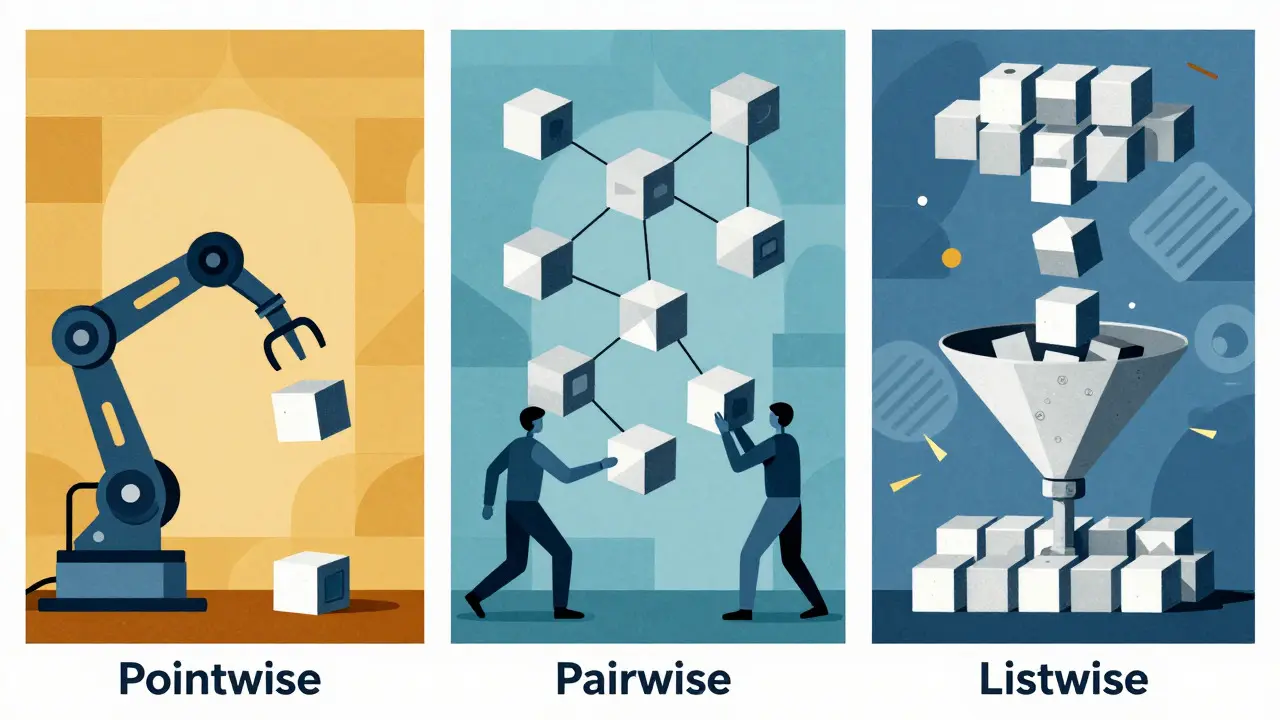
Not all rerankers work the same way. You generally have three architectural choices, each with different trade-offs between speed, cost, and accuracy.
- Pointwise Reranking: The model scores each document independently on a scale (e.g., 1-10). It’s simple to implement and parallelizable, making it faster for large batches. However, it doesn’t account for relative ranking between documents during scoring.
- Pairwise Reranking: The model compares documents in pairs to determine which is more relevant. This yields the highest precision but is computationally expensive, requiring O(K log K) or O(K²) comparisons for K documents. It’s rarely used in high-throughput production environments due to latency costs.
- Listwise Reranking: The model sees all retrieved documents at once and outputs a complete ordered list. This is the most holistic approach, capturing global context, but requires models specifically trained for sequence generation rather than classification.
Most production systems today lean toward pointwise or listwise approaches using specialized encoder models or small LLMs. Pairwise is mostly reserved for offline evaluation or low-volume, high-stakes applications where every millisecond counts less than perfect ordering.
LLM-Based vs. Open-Source Cross-Encoders
The biggest debate in the community right now is whether to use a dedicated cross-encoder (like BGE-Reranker) or an LLM-based reranker (like NVIDIA’s NeMo Retriever). Both have their place, but they serve different needs.
| Feature | Open-Source Cross-Encoder (e.g., BGE) | LLM-Based Reranker (e.g., NeMo Retriever) |
|---|---|---|
| Latency Overhead | Low (~0.1s - 0.3s) | Moderate (~0.9s at P50) |
| Quality Improvement | Good for factual queries | Superior for complex/implicit intent |
| Hardware Requirements | Standard CPU/GPU | CUDA 11.8+, 16GB+ VRAM recommended |
| Customization | Fixed model weights | Prompt-engineerable instructions |
| Adoption Rate (Q4 2023) | 32% | 41% |
Fin AI’s internal A/B tests revealed that their LLM-based reranker delivered a +3 percentage point improvement in assistance rate compared to the open-source BGE model. They also saw a 27% decrease in cited conversation excerpts and a 63% increase in citations of authoritative public articles. This suggests LLMs are better at distinguishing between "chatty" content and "authoritative" sources. However, this came with a +0.9-second latency penalty at the median. For real-time chatbots, that extra second can feel sluggish. That’s why many teams are moving toward hybrid strategies: using a fast cross-encoder for easy queries and an LLM reranker only when query complexity scores above a certain threshold.
Implementation Strategies for Production
If you’re ready to add reranking, don’t just bolt it on blindly. Start by measuring your baseline. Use metrics like Answer Faithfulness and Context Relevance from frameworks like RAGAS or promptingguide.ai. Without a baseline, you won’t know if the added latency is worth the quality bump.
- Select Your Model: If you need speed, start with a distilled cross-encoder like BGE-Reranker-v2-m3. If you need depth, look at NVIDIA’s nvidia/llama-3.2-nv-rerankqa-1b-v2, which is optimized for question-answering tasks.
- Optimize Batch Size: Process documents in batches to maximize GPU utilization. Fin AI found that batch processing reduced per-document latency significantly without sacrificing throughput.
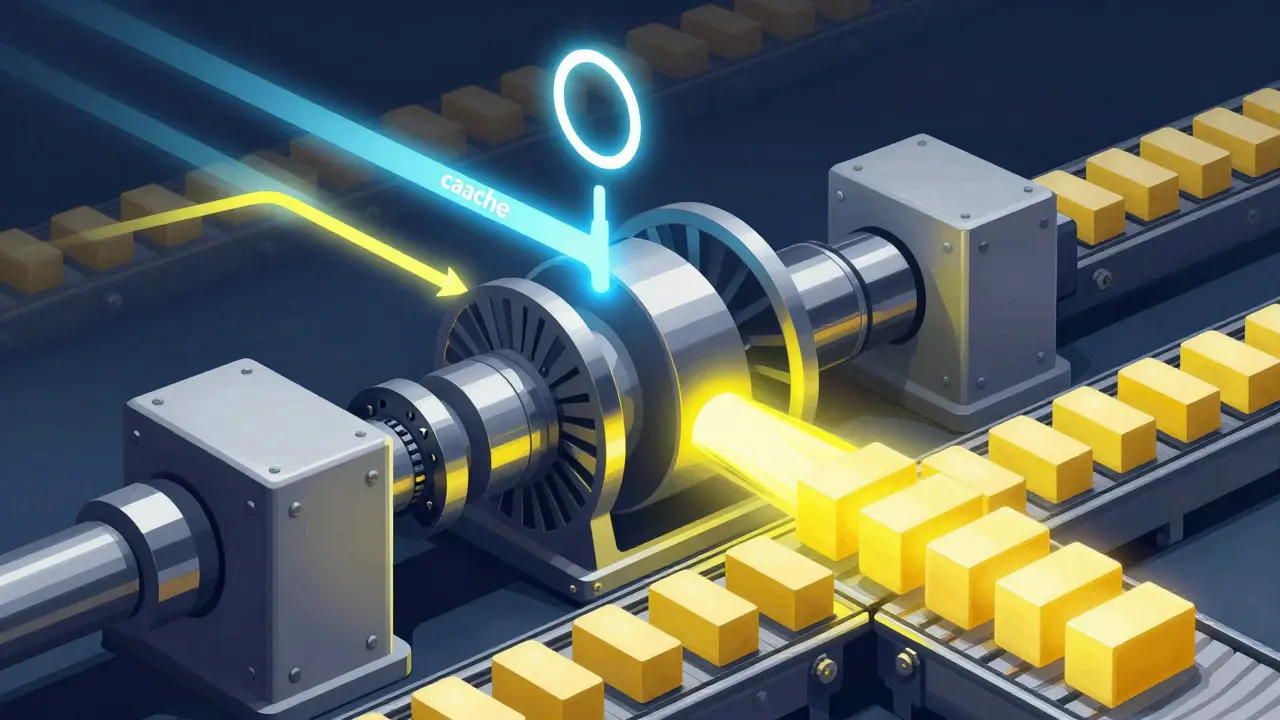
- Implement Caching: Reranking is deterministic. If the same query and document set appear again, cache the result. This can cut average latency by 30-40% in repetitive support scenarios.
- Monitor Latency Trade-offs: Set a strict SLA. If your end-to-end response time exceeds 2 seconds, consider reducing the number of documents passed to the reranker (e.g., top 20 instead of top 50).
One advanced technique gaining traction is "teacher-student" distillation. Fin AI trained a smaller custom reranker using an LLM reranker as the teacher. The student model achieved 95% of the teacher’s quality with only +0.2s latency overhead. This allows you to keep the high-quality logic of LLMs while running inference on cheaper hardware.
Common Pitfalls to Avoid
Even with the right tools, implementation errors can negate the benefits. Here’s what practitioners on GitHub and Reddit commonly report:
- Over-Retrieving: Passing 100+ documents to a reranker increases cost and latency without improving top-5 accuracy. Stick to top 20-30 candidates from the initial retrieval stage.
- Prompt Leakage: In LLM-based rerankers, ensure your prompt clearly separates the query from the documents. Ambiguous prompts lead to inconsistent scoring.
- Ignoring Query Complexity: Not all queries need heavy reranking. Simple keyword matches (e.g., "price of item X") don’t benefit as much from semantic reranking as complex multi-part questions do. Implement adaptive routing to save resources.
- Evaluation Bias: Don’t rely solely on human spot-checks. Automated metrics like NDCG provide a consistent view of performance across thousands of test cases.
A user named 'DataEngineer42' on r/MachineLearning reported a 22% reduction in hallucinated responses after implementing reranking, but noted that the first month was spent tuning the prompt template. Be prepared for an iteration phase. The initial setup might take 2-3 days for cross-encoders, but LLM-based solutions can require 2-3 weeks for proper prompt engineering and optimization.
Frequently Asked Questions
How much latency does reranking add to a RAG pipeline?
It depends on the method. Lightweight cross-encoders typically add 0.1 to 0.3 seconds. LLM-based rerankers can add around 0.9 seconds at P50 latency. Using caching and batch processing can reduce these numbers significantly in production environments.
Should I use an LLM or a cross-encoder for reranking?
Use a cross-encoder if you prioritize speed and have straightforward factual queries. Use an LLM-based reranker if you handle complex, multi-intent queries or need to distinguish between authoritative and casual content. Many teams use a hybrid approach, routing complex queries to LLMs and simple ones to cross-encoders.
What are the key metrics to evaluate reranking performance?
Focus on Mean Reciprocal Rank (MRR), Normalized Discounted Cumulative Gain (NDCG), and Recall@K. Additionally, track downstream RAG metrics like Answer Faithfulness and Context Relevance to ensure the reranking actually improves final output quality, not just retrieval rankings.
Can I train my own custom reranker?
Yes. One effective strategy is knowledge distillation, where you use a high-performing LLM reranker as a teacher to generate labels for a smaller student model. This allows you to deploy a faster, cheaper model that retains most of the quality improvements of the larger one.
Does reranking work well with hybrid search?
Yes, it is particularly valuable in hybrid setups. Since sparse (keyword) and dense (vector) search methods have different biases, a reranker helps unify the results by re-evaluating all candidates against the query with a consistent semantic lens, ensuring the best documents from both sources rise to the top.







Love the breakdown here. The distinction between pointwise and listwise is super helpful for anyone just starting out with RAG pipelines. I’ve been struggling with latency issues in my own project, so the tip about caching reranked results feels like a lifesaver right now.
the hybrid approach makes so much sense to me. i always feel like we overcomplicate things when simple keyword matches work fine for basic queries. saving compute for the hard stuff is smart
Another article that treats reranking like it's some revolutionary breakthrough instead of just standard information retrieval theory from the 90s. We've known cross-encoders are better than bi-encoders for precision forever. The real problem is people building bad vector stores because they don't understand chunking strategies, then blaming the lack of a reranker. Also, citing Gartner stats to prove a technical point is peak corporate fluff. If your top 5 chunks are garbage, your embeddings or your data ingestion is broken, not your ranking stage. Fix the source, not the symptom. But sure, keep selling us on adding another layer of latency to our pipelines.
I actually disagree! For most teams, fixing the embeddings is way harder than just slapping on a BGE reranker. It’s such an easy win to see those NDCG numbers jump up without retraining anything. I tried this last month and my hallucination rate dropped noticeably. Don’t sleep on the quick fixes!
Okay, hear me out. The "teacher-student" distillation bit? That is pure magic. I spent weeks trying to get a small model to behave like a giant LLM and finally found a method that actually works in production without melting our GPU budget. It’s like having a pocket-sized genius that only costs a fraction of the energy bill. Who knew squeezing all that smarts into a tiny model could be this satisfying?
Just want to shout out the part about prompt leakage in LLM-based rerankers. We hit that wall hard. Our initial prompts were basically a soup of query and doc text, and the scores were all over the place. Once we used clear delimiters and structured the input properly, consistency skyrocketed. If you’re using an LLM as a reranker, treat it like a picky editor, not a black box. Give it clean inputs and it’ll give you clean outputs. Seriously, check your prompt templates before you blame the model weights.