Biotech and Generative AI: Molecule Generation and Lab Notebooks
Imagine trying to find a single needle in a haystack that contains 10^60 possible drug-like molecules. That’s roughly the size of the chemical space researchers navigate when hunting for new medicines. Traditionally, this process was painfully slow and expensive, costing about $2.6 billion and taking 10-15 years per drug. But now, Generative AI is rewriting the rules. It doesn’t just search; it creates. By generating novel molecular structures with specific properties, AI is compressing timelines from decades to months. Yet, while the hype around molecule generation is loud, the quieter revolution happening in how we record and manage this data-specifically through Electronic Lab Notebooks (ELNs)-is where the real operational magic lies. This article breaks down how these two technologies are converging to reshape biotech.
The Chemical Space Problem and AI’s Creative Solution
Before diving into the tech, let’s look at why traditional methods fail. The sheer volume of potential drugs is staggering. Humans can only intuitively explore a tiny fraction of this space. Generative AI models, particularly those using diffusion architectures and transformers, treat chemistry like language translation or image generation. Instead of filtering existing libraries, they dream up new compounds from scratch. Early attempts used Variational Autoencoders (VAEs) and Generative Adversarial Networks (GANs), but since 2020, things have accelerated. Newer systems like PRODIGY (PROjected DIffusion for controlled Graph Generation), developed by Georgia Tech researchers, allow scientists to set strict constraints-like exact atom counts or bond types-and get valid results. This isn’t just faster; it’s more precise. While old methods might take hours to generate one candidate, modern AI systems do it in minutes, speeding up design cycles by up to 10 times.
Molecule Generation: From SMILES to Diffusion Models
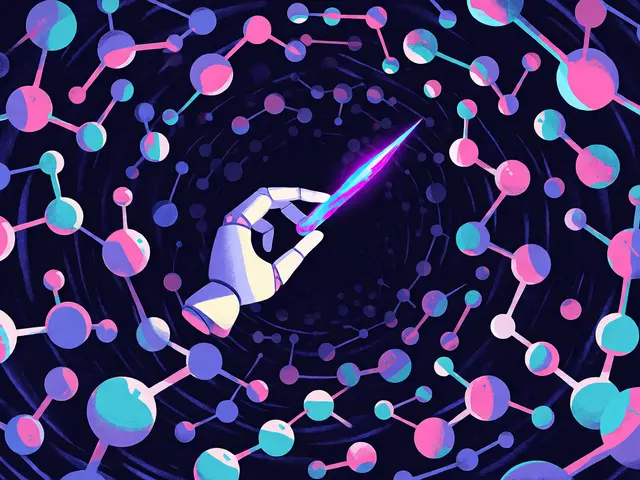
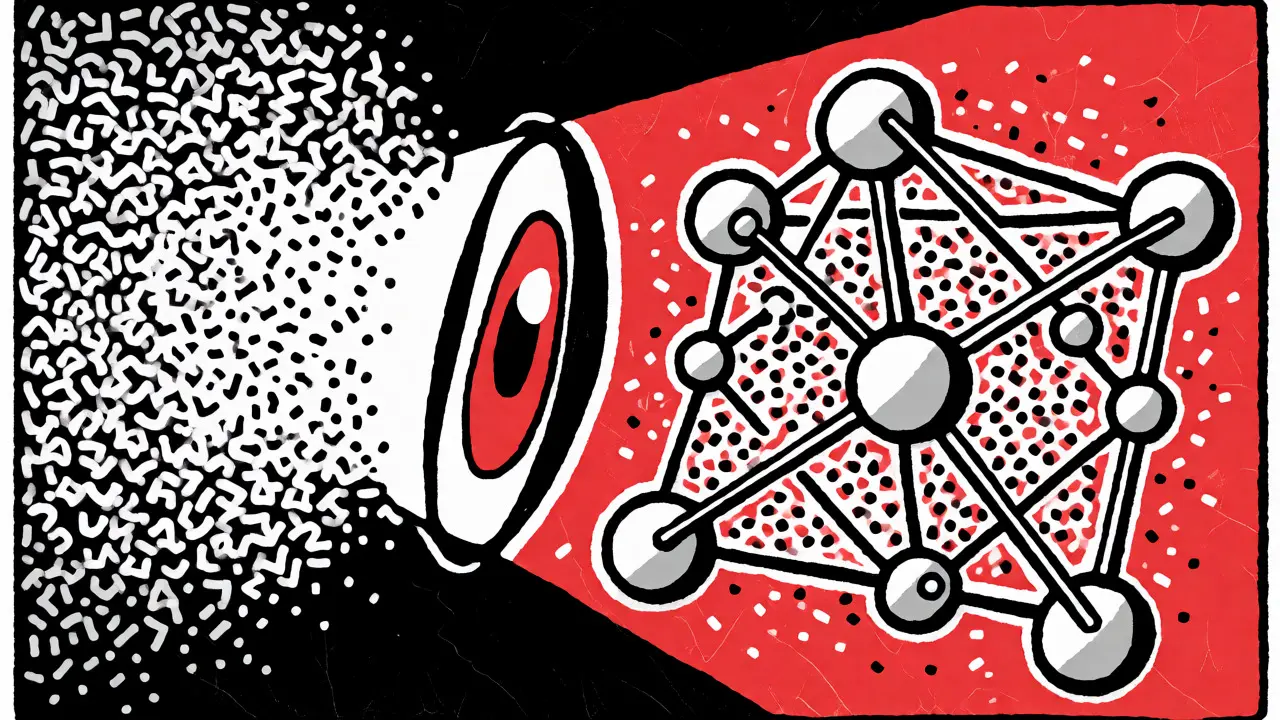
How does an AI actually "see" a molecule? Most models start with SMILES strings-a text-based representation of molecular structure. However, text can be tricky because small errors make a molecule invalid. That’s why graph-based approaches and diffusion models are gaining traction. Diffusion models, similar to those creating realistic images in tools like Midjourney, start with noise and gradually refine it into a structured molecule. According to a 2023 review in Briefings in Bioinformatics, these models achieve validity rates of over 90%, compared to 77% for older methods. They also score higher on novelty, meaning they create truly new structures rather than just tweaking known ones. But there’s a catch: these models struggle with large molecules exceeding 100 heavy atoms and often predict synthesizability poorly. Only about 30-40% of AI-generated molecules actually work in a real-world lab setting without significant tweaking.
| Approach | Validity Rate | Computational Cost | Best Use Case |
|---|---|---|---|
| SMILES-based RNNs | ~79% | Low | Rapid screening of simple compounds |
| Graph VAEs (e.g., JTVAE) | ~93% | Medium | Structurally complex but standard drugs |
| Diffusion Models (e.g., GCDM) | ~94.2% | High | Novel, highly constrained designs |
The Missing Link: Electronic Lab Notebooks (ELNs)
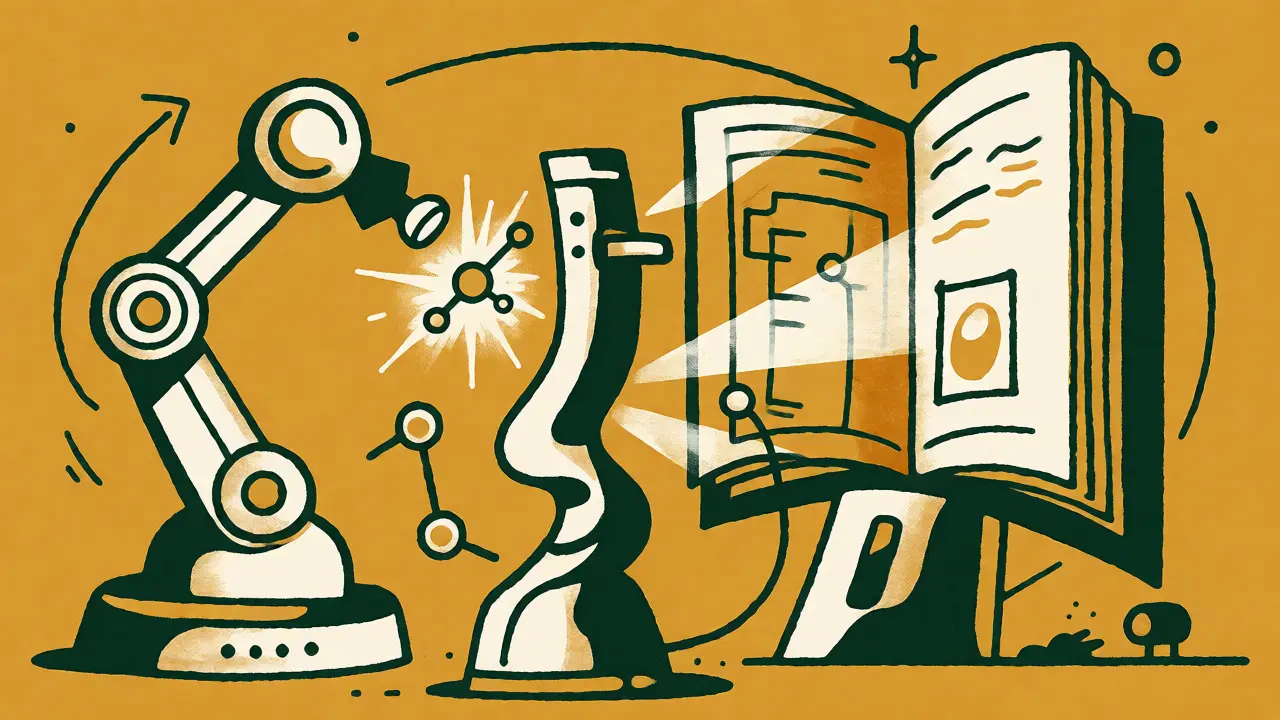
You can generate a thousand perfect-looking molecules in a day, but if you don’t track them properly, you’re lost. This is where Electronic Lab Notebooks (ELNs) come in. Unlike paper notebooks, ELNs are digital platforms that store experimental data, protocols, and results. Companies like Benchling (acquired by Thermo Fisher Scientific) and LabArchives dominate this space. Historically, ELNs were just digital filing cabinets. Now, they are becoming intelligent hubs. Imagine your ELN automatically pulling synthesis data from a robotic arm and feeding it back to the AI model that designed the molecule. This creates a closed loop. As of late 2024, only 15% of major ELN platforms offered native generative AI capabilities, but that number is climbing fast. Integration here is critical because 78% of pharma companies cite workflow integration as their biggest adoption barrier.
Closing the Loop: Design-Make-Test-Cycle
The real power emerges when molecule generation and ELNs talk to each other. This is called the Design-Make-Test-Cycle (DMTC). In a traditional setup, a chemist designs a molecule, sends it to a lab for synthesis, waits weeks for results, manually enters data into a notebook, and then decides what to do next. With AI-native labs, like Pfizer’s facility in Cambridge, MA, robots receive direct instructions from AI models. They synthesize the compound, test it, and upload results straight to the ELN. The AI then analyzes this new data to propose the next batch of molecules. Recursion Pharmaceuticals reported optimizing this cycle five times faster using such integrated systems. This reduces the time from idea to data from weeks to just 72 hours in some cases. It turns the lab into a self-learning machine.
Challenges and Reality Checks
Don’t believe the marketing fluff yet. There are significant hurdles. First, the "synthesis gap." AI might design a beautiful molecule, but if it’s too hard to make in a flask, it’s useless. Current models predict synthesizability with only 65-70% accuracy. Second, computational costs. Training advanced diffusion models requires massive hardware-often 4-8 NVIDIA A100 GPUs running for days. Third, regulatory scrutiny. The FDA has acknowledged AI-generated molecules but demands enhanced validation packages, adding 3-6 months to preclinical timelines. Finally, there’s the issue of diversity. Many AI models tend to generate similar-looking compounds, lacking the structural variety found in nature. Researchers must actively filter for diversity to avoid tunnel vision.
Market Trends and Future Outlook
The market reflects both excitement and caution. Valued at $1.34 billion in 2023, the generative AI drug discovery sector is projected to hit nearly $13 billion by 2030. Big players like Insilico Medicine and Recursion Pharmaceuticals are leading the charge. Insilico even reduced its target identification phase from 4.5 years to 18 months. However, success stories are still rare. Only three AI-designed molecules had entered clinical trials as of early 2025. The future likely belongs to hybrid systems that combine 3D spatial reasoning (which current 2D-focused models lack) with robust ELN integrations. Expect more partnerships between AI software providers and lab automation firms to bridge the digital-physical divide.
Why is generative AI better than traditional virtual screening?
Traditional virtual screening filters existing libraries of known molecules. Generative AI creates entirely new structures from scratch, allowing exploration of vast, uncharted chemical spaces that contain no prior data.
What is the main bottleneck in AI-driven drug discovery today?
The primary bottleneck is the "synthesis gap." While AI can design millions of candidates, predicting whether they can be physically synthesized in a lab remains difficult, with only 30-40% of generated molecules proving synthesizable without modification.
How do Electronic Lab Notebooks (ELNs) integrate with AI?
Modern ELNs act as data repositories that feed experimental results back to AI models. This creates a closed-loop system where AI designs a molecule, lab robots test it, and the ELN stores the data, which the AI then uses to improve the next generation of designs.
Are AI-generated molecules ready for clinical trials?
Yes, but cautiously. As of early 2025, only a handful of AI-designed molecules had entered clinical trials. Regulatory bodies like the FDA require extensive validation data, acknowledging AI's role but demanding rigorous proof of safety and efficacy.
Which AI architecture is currently best for molecule generation?
Diffusion models are currently considered state-of-the-art for high-validity and high-novelty molecule generation, outperforming older GANs and VAEs. Systems like PRODIGY allow for precise control over molecular constraints.