
Value Realization Roadmaps for Generative AI: 30-60-90 Day Milestones
You have the budget. You have the hype. You have a board that wants to see Generative AI results before the next fiscal quarter ends. But here is the hard truth: most AI projects die in the "pilot purgatory" because teams treat them like science experiments rather than business deployments. They spend months tweaking prompts and debating model choices without ever shipping code that touches real customers or saves real dollars.
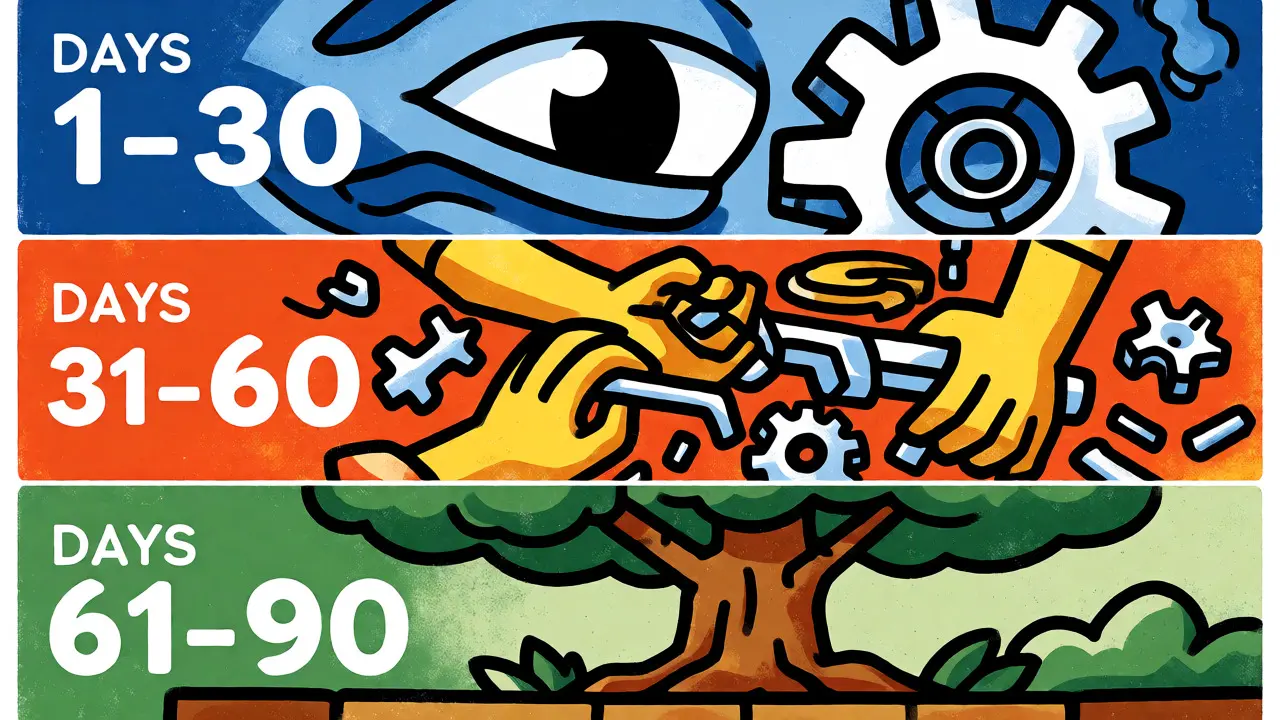
The fix isn't better models; it's better discipline. A Value Realization Roadmap is a time-bound framework that forces you to move from idea to impact in exactly 90 days. It breaks the journey into three distinct phases-Days 1-30, Days 31-60, and Days 61-90-each with non-negotiable deliverables. This approach stops scope creep, aligns stakeholders, and ensures you don't just build cool tech, but actually capture measurable business outcomes.
Why Speed Matters More Than Perfection
Think about how traditional software was built. You spent six months gathering requirements, another six building it, and hoped it worked when you launched. Generative AI doesn't work that way. The technology moves too fast, and the value is often found in iteration, not initial precision. If you wait for perfect data and perfect governance, you will never launch.
A 30-60-90 day structure imposes artificial urgency. It forces you to answer the scary questions early: Who owns this? What metric are we moving? How much does it cost to run? By compressing the timeline, you expose blockers immediately. If your data isn't ready by Day 30, you know it now, not six months later when the project is already over budget.
Phase 1 (Days 1-30): Diagnosis and Decision
The first month is not about coding. It is about clarity. Many leaders skip this phase, jumping straight into buying licenses or hiring vendors. That is a mistake. Without a signed-off scope, you are building a ship without a rudder.
Your primary goal here is to select one high-impact, low-risk use case. Don't try to transform the whole company at once. Pick a specific, painful workflow. Maybe it is summarizing customer support tickets, drafting legal contracts, or generating code snippets for developers. It needs to be repeatable and measurable.
| Deliverable | Description | Owner |
|---|---|---|
| Pilot Brief | A one-page document defining the problem, the proposed solution, and the success metric. | Product Owner |
| Data Audit | Confirmation that the necessary data exists, is accessible, and meets security standards. | Data Engineer |
| Governance Gate | Executive sponsor sign-off on the scope and risk tolerance. | Executive Sponsor |
By Day 30, you must have a go/no-go decision. If the executive sponsor hasn't signed off, kill the project or pivot. Do not let it drift into Month 2. This gate protects your resources.
Phase 2 (Days 31-60): Build and Learn
Now you build. But remember, you are building a pilot, not a product. The goal is an end-to-end workflow running on real data with real users. Keep the user group small-five to ten people who are willing to give brutal feedback.
This phase is where technical reality hits. You will discover that your data has gaps, that the latency is too high, or that the hallucination rate is unacceptable for your use case. That is good. You want these failures now, while they are cheap to fix.
Focus on integration, not isolation. Your AI tool shouldn't live in a separate chat window if the work happens in Salesforce or Slack. Embed it. Measure the baseline performance before you turn the AI on, so you can prove the lift later. Are agents handling tickets 20% faster? Is code review time down by 15 minutes per pull request? Track these numbers daily.
Phase 3 (Days 61-90): Validate and Scale
By Day 60, you should have a working prototype. Now, you decide if it deserves to become a production system. This is the hardest part of the roadmap because it requires honesty. If the pilot didn't hit the KPIs defined in Phase 1, do you scale it anyway?
In this final month, you shift focus from functionality to sustainability. Can you monitor this? Do you have alerts for when the model starts drifting? Have you calculated the ongoing cloud costs? A successful pilot that costs more to run than it saves is a failure.
The deliverable here is a scaling plan. This isn't just "roll it out to everyone." It is a detailed roadmap for the next 12 months. Which departments get access next? What training do they need? What new features are required to support broader adoption? Present this plan to the board with a clear ROI report.
Common Pitfalls to Avoid
Even with a structured roadmap, things go wrong. Here are the most common reasons 90-day plans fail:
- Scope Creep: Adding "just one more feature" during Phase 2. Stick to the original brief.
- Vague Metrics: Saying "improve efficiency" instead of "reduce ticket resolution time by 10%." Vague goals lead to vague results.
- Ignoring Change Management: Building a great tool that no one uses because employees were never trained or consulted.
- Security Blind Spots: Sending sensitive PII to a public API without checking compliance requirements first.

Tools and Frameworks That Help
You don't need to invent this process from scratch. Several frameworks have matured in the last two years. AWS’s Path-to-Value framework provides excellent guidance on lifecycle management, particularly if you are using services like Amazon Bedrock. Fujitsu’s AI Value Realization blueprint emphasizes the importance of assigning accountable owners early, which aligns perfectly with the Day 30 gate.
Consulting firms like BCG and McKinsey also offer strategic lenses, such as identifying top-down targets for efficiency, growth, and experience. Use their insights to help prioritize which use cases to pick for your 90-day sprint, but keep the execution simple.
Next Steps After Day 90
What happens after the 90 days? If you succeeded, you start the cycle again with a new use case. If you failed, you analyze why. Was the data bad? Was the use case wrong? Or was the team under-skilled?
Remember, the goal isn't just to finish one project. It is to build an organizational muscle for rapid AI experimentation. Once you have successfully run one 30-60-90 cycle, you can run two or three in parallel. That is how you move from being an AI consumer to an AI leader.
How many use cases should I target in the first 90 days?
Start with exactly one. Trying to manage multiple pilots simultaneously dilutes focus and resources. Master the single-use-case delivery pipeline first, then expand to two or three in subsequent cycles.
What if my data isn't ready by Day 30?
If critical data is missing or inaccessible, you have two choices: pause the project until data engineering catches up, or switch to a use case that relies on less complex data sources. Do not proceed with poor-quality data; it will yield poor results and waste your pilot budget.
Do I need a dedicated AI team for this roadmap?
Not necessarily a full-time dedicated team, but you do need a cross-functional squad. This typically includes a product owner, a data engineer, a developer, and a subject matter expert from the business unit. Assigning clear roles is crucial for accountability.
How do I measure ROI for generative AI pilots?
Define your baseline metrics before starting. Common metrics include time saved per task, error reduction rates, or increased throughput. Calculate the cost of the pilot (cloud fees, labor, tools) and compare it against the quantified savings or revenue generation over the 90-day period.
What happens if the pilot fails to meet KPIs?
Failure is a valid outcome. Analyze whether the issue was technical (model performance), operational (user adoption), or strategic (wrong use case). Document the lessons learned and either pivot the current project or sunset it entirely to free up resources for the next experiment.