Adapters vs Full Fine-Tuning for LLMs: Cost, Speed, and Quality Comparison
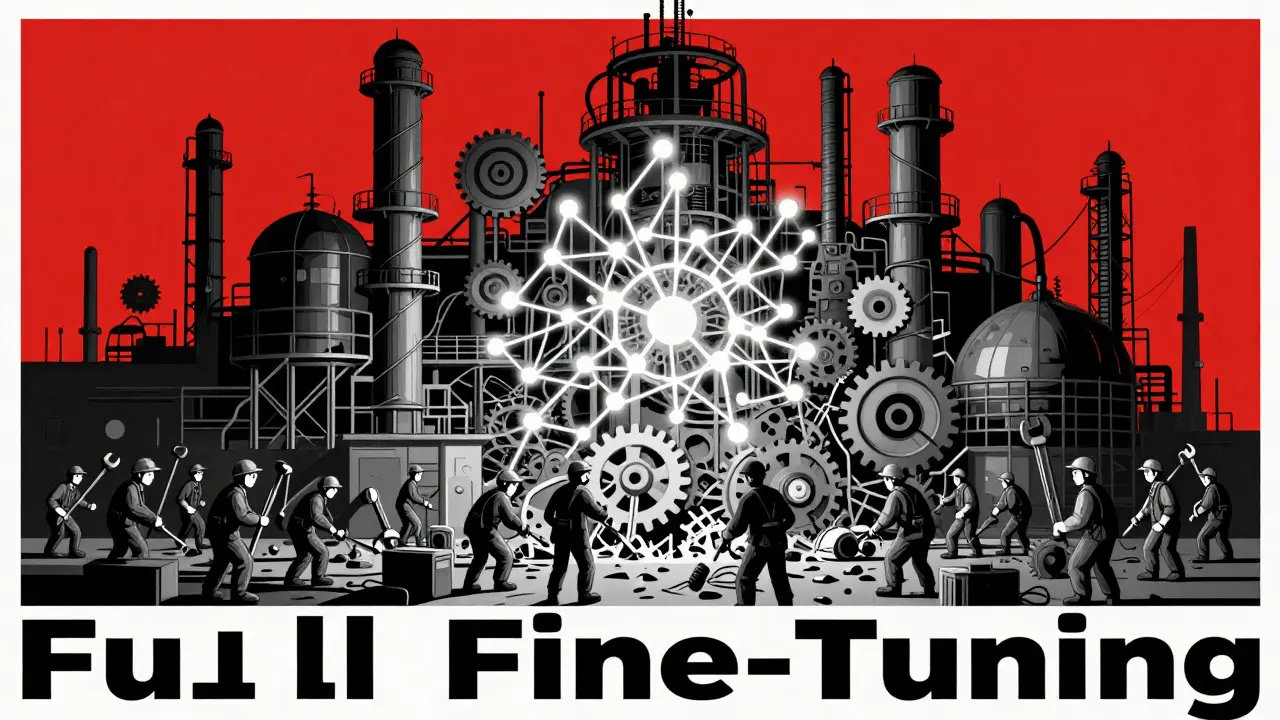
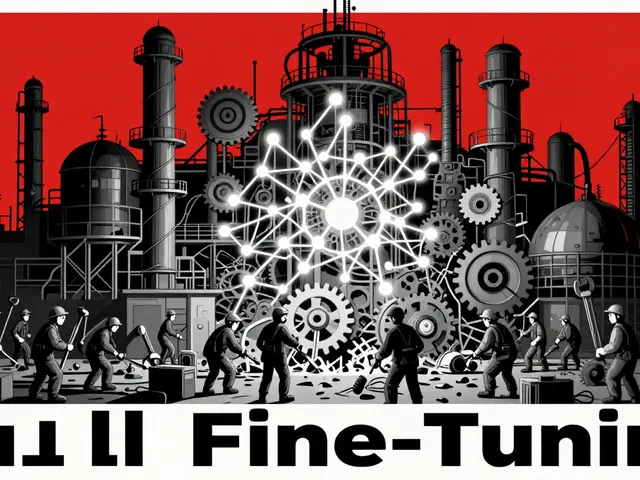
You’ve got a large language model. It’s smart, it’s capable, but it doesn’t know your specific business jargon or follow your exact formatting rules. You need to customize it. The old way was full fine-tuning, which means updating every single weight in the model. That approach is like hiring a team of engineers to rebuild an entire factory just to change the paint color. It works, but it’s expensive, slow, and risky. Enter adapters and other parameter-efficient fine-tuning (PEFT) methods. These techniques let you tweak the model’s behavior by changing only a tiny fraction of its parameters. The question isn’t whether you *can* do full fine-tuning anymore; it’s whether you *should*. Let’s break down the real-world differences in cost, speed, and quality so you can stop guessing and start building.
The Core Difference: Updating Everything vs. Adding Small Plugins
To understand why one method costs less than the other, you first have to look at what’s happening under the hood. A modern large language model (LLM) like Llama-3 or Mistral-7B contains billions of parameters. Think of these parameters as the neurons in a brain. When you perform full fine-tuning, you are forcing every single neuron to adjust its connections based on your new data. If you have a 7-billion-parameter model, you are calculating gradients and updating weights for all 7 billion numbers.
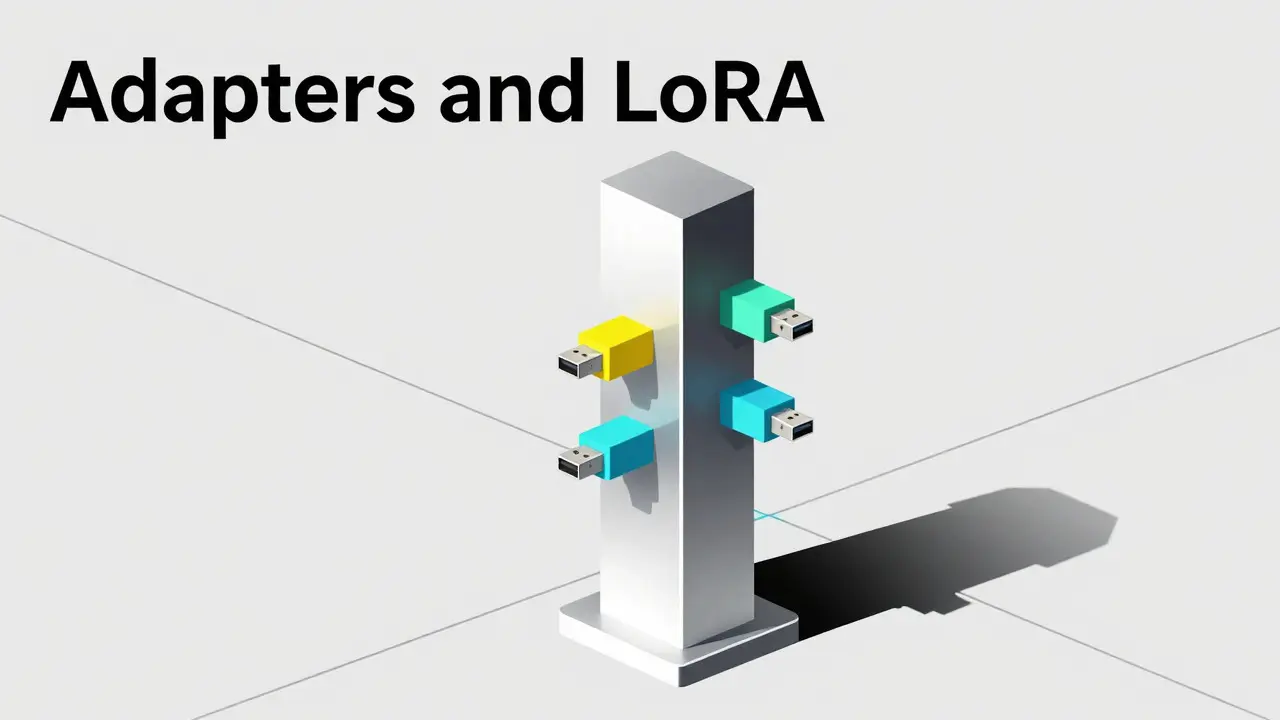
In contrast, Adapter modules and Low-Rank Adaptation (LoRA) take a different approach. They freeze the original model completely. Instead of touching the billions of existing weights, they inject small, trainable layers into the architecture. Imagine sticking a USB drive into a computer to add a specific skill, rather than rewiring the motherboard. With LoRA, you might only train 0.01% to 1% of the total parameters. With traditional adapters, you’re looking at a few million additional parameters-negligible compared to the billions already there. This fundamental architectural difference drives every other metric we care about: memory, time, money, and performance.
Cost Analysis: Why PEFT Saves Thousands of Dollars
Let’s talk about the bottom line. If you are running this on cloud infrastructure, the difference between full fine-tuning and parameter-efficient fine-tuning (PEFT) is not just noticeable; it’s staggering. Consider a scenario where you are fine-tuning a 7-billion-parameter model using AWS SageMaker with g5.2xlarge instances. These instances charge roughly $1.32 per hour. Because full fine-tuning requires more GPU memory and often fewer parallel tasks due to resource constraints, it takes longer to complete epochs. More hours equal more money.
Teams implementing LoRA or adapter-based tuning consistently report cost reductions of 50% to 70%. Here is why:
- Memory Efficiency: Full fine-tuning a 7B model can require over 28 GB of GPU VRAM just to hold the optimizer states and gradients. PEFT methods drop this requirement to roughly 10 GB or less. This allows you to use smaller, cheaper GPU instances or fit multiple training jobs on a single powerful server.
- Storage Savings: When you fully fine-tune a model, you must save a checkpoint that is nearly as large as the base model itself-several gigabytes. If you experiment with five different prompts or datasets, you now have 20+ GB of storage overhead. Adapter checkpoints are mere megabytes. You can store hundreds of variations without breaking the bank.
- Hardware Scalability: For self-hosted deployments, the gap widens further. Running a 70-billion-parameter model via full fine-tuning might demand servers costing over $3,200 per month in bare-metal leases. Using PEFT, you can often achieve similar results on hardware that costs a fraction of that, or even on consumer-grade GPUs if the model size permits.
For a startup or a mid-sized company, saving $950 a month on inference deployment plus thousands in training compute adds up quickly. It turns an AI project from a capital-intensive gamble into a manageable operational expense.
| Feature | Full Fine-Tuning | Adapters / LoRA (PEFT) |
|---|---|---|
| Trainable Parameters | 100% (All weights) | 0.01% - 1% |
| GPU Memory Required | High (e.g., 28GB+ for 7B models) | Low (e.g., ~10GB for 7B models) |
| Training Cost | High (Baseline) | 50-70% Lower |
| Checkpoint Size | Gigabytes (Full model copy) | Megabytes (Small adapter files) |
| Inference Speed | Same as Base Model | Nearly Identical (Negligible overhead) |
| Risk of Overfitting | Higher | Lower (Better generalization) |
Speed: Training Time and Inference Latency
Time is money, especially when you are waiting for a GPU cluster to finish a job. Because PEFT methods update far fewer parameters, the computational load per step is significantly lower. This translates directly to faster training times. You can run more experiments in less time. If full fine-tuning takes 10 hours to converge on a dataset, LoRA might get you to 95% of that performance in 2 hours. This agility is crucial for iteration. You want to test three different prompt strategies today, not next week.
But what about inference? Once the model is trained, does having adapters slow down the user experience? The short answer is no. Inference speed remains essentially unchanged across parameter-efficient methods and full fine-tuning. While adapters technically add a tiny layer to the forward pass, the computational overhead is insignificant for most applications, particularly those involving batch processing. Some advanced techniques, like IA³, actually have zero inference cost penalty because they simply scale existing operations without adding auxiliary parameters. For production deployments where response time impacts user retention, you don’t have to sacrifice speed to gain efficiency.
Quality: Does Less Mean Worse?
This is the biggest fear developers have: “If I’m only training 1% of the model, will it be stupid?” The data says otherwise. Research and extensive practical implementation show that parameter-efficient tuning achieves results remarkably close to full fine-tuning. In numerous benchmarks, models fine-tuned with LoRA or adapters reach 95% to 100% of the performance of fully fine-tuned models on identical tasks.
Why does this work? Large language models are already pre-trained on vast amounts of data. They already “know” how to write code, summarize text, or translate languages. You aren’t teaching them these skills from scratch; you are nudging them toward a specific style or domain. The base model retains its general capabilities. By freezing the core weights, you also reduce the risk of catastrophic forgetting. Full fine-tuning can sometimes cause a model to forget its general knowledge while learning a narrow task. Adapters tend to preserve the original model’s robustness better, leading to superior generalization in many scenarios, including zero-shot cross-lingual transfer.
There are exceptions, of course. If you are trying to teach a model a completely novel concept that doesn’t exist in its pre-training data, or if you are working with very small models (under 1 billion parameters), full fine-tuning might offer marginal gains. But for standard enterprise tasks-customer support bots, legal document analysis, medical summarization-PEFT is not just good enough; it’s often better because it avoids overfitting.
When Should You Still Use Full Fine-Tuning?
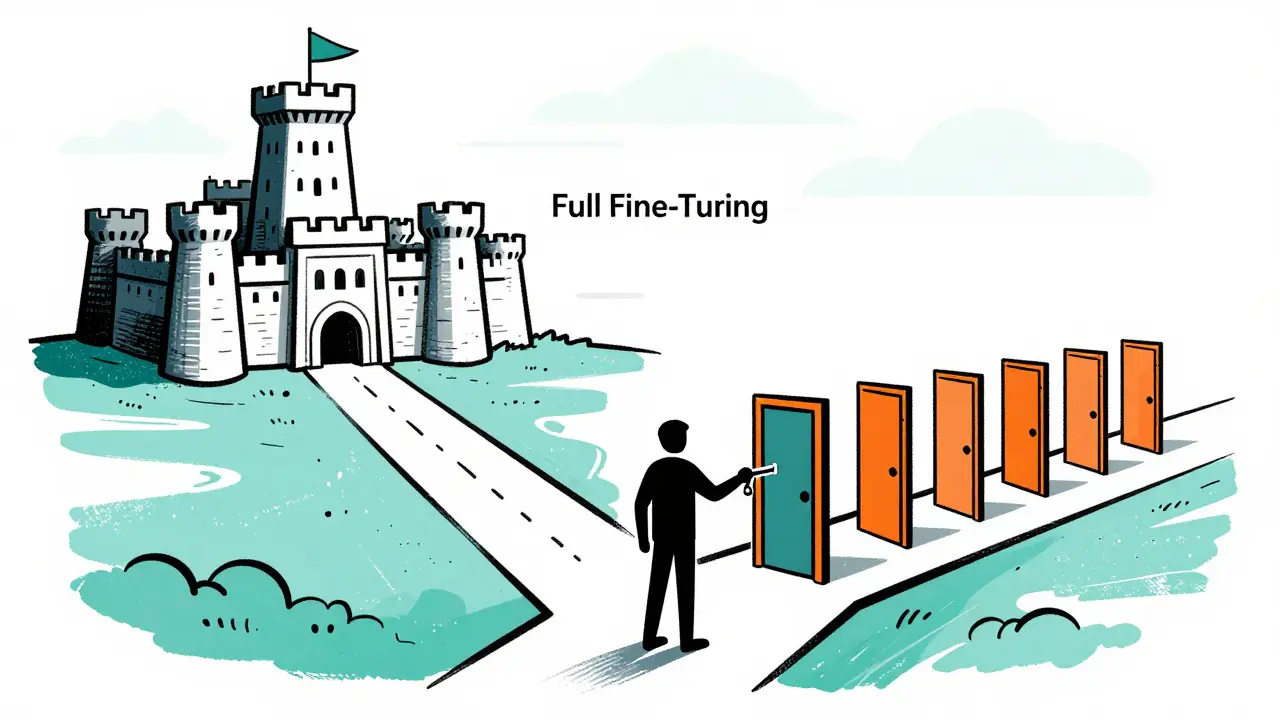
So, is full fine-tuning dead? Not entirely. There are specific edge cases where the heavy lifting is worth it. First, if you are working with a very small model that lacks sufficient capacity, updating all parameters might be necessary to embed complex patterns. Second, if you need maximum control over the model’s internal representations for research purposes, full fine-tuning gives you the deepest customization. Finally, some legacy systems or specific inference engines might not yet support efficient adapter merging, though this is becoming increasingly rare as frameworks like Hugging Face Transformers optimize for PEFT.
However, for 95% of organizations, the barrier to entry for full fine-tuning is too high. The compute demands, extended training times, and elevated risks of overfitting make it an impractical option unless you have substantial infrastructure investments. Unless you are a well-funded enterprise with a specialized use case that strictly requires comprehensive parameter updates, you are likely spending money unnecessarily.
Decision Framework: Which Path Is Right for You?
Choosing between these methods depends on your organizational maturity and specific goals. Here is a simple heuristic:
- Start with LoRA or Adapters: If you are in early stages, operating with limited resources, or need to deploy multiple specialized variants (e.g., one for sales, one for support), use PEFT. The ability to switch adapters dynamically without reloading the entire base model is a massive architectural advantage.
- Consider Retrieval-Augmented Generation (RAG): Before fine-tuning at all, ask if RAG solves your problem. If you just need the model to know facts about your company, injecting documents into the context window is cheaper and easier than any form of fine-tuning.
- Reserve Full Fine-Tuning for Niche Cases: Only choose full fine-tuning if you have benchmarked PEFT and found a measurable, critical performance gap that justifies the 3x-5x cost increase. Document this gap rigorously.
The technology has matured to the point where parameter-efficient fine-tuning is the default. It delivers comparable quality at dramatically reduced cost, with negligible impact on inference speed. By adopting adapters or LoRA, you democratize access to customized AI, allowing teams to iterate fast, fail cheaply, and scale efficiently. Don’t rebuild the factory when a plugin will do.
What is the main difference between LoRA and Adapters?
Both are parameter-efficient fine-tuning (PEFT) methods that freeze the base model. Adapters insert small neural network layers into the transformer blocks, while LoRA approximates weight updates using low-rank matrices. LoRA is generally preferred today because it is easier to implement, merges seamlessly with the base model for inference (zero latency overhead), and often achieves slightly better performance with fewer parameters.
Does using adapters slow down inference speed?
For most practical purposes, no. While adapters add a tiny computational step during the forward pass, the impact on latency is negligible, especially in batch processing. Techniques like LoRA can be merged with the base model weights after training, resulting in absolutely zero inference speed penalty compared to the original model.
How much cheaper is PEFT compared to full fine-tuning?
Organizations typically see cost reductions of 50% to 70%. This comes from reduced GPU memory requirements (allowing the use of cheaper instances), faster training times (fewer parameters to update), and significantly smaller storage needs for checkpoints (megabytes vs. gigabytes).
Can I use LoRA with any large language model?
Yes, LoRA is compatible with most modern transformer-based architectures, including Llama, Mistral, Falcon, and BLOOM. Libraries like Hugging Face PEFT provide easy-to-use interfaces to apply LoRA to almost any open-source model.
When should I choose full fine-tuning over adapters?
Choose full fine-tuning only if you are working with very small models (under 1B parameters), need to teach the model entirely new concepts not present in pre-training, or if rigorous benchmarking shows a critical performance gap that PEFT cannot bridge. For most enterprise applications, PEFT is the superior choice.






Yeah, the cost difference is just insane. We switched to LoRA last quarter and our cloud bill dropped like a stone.
I have been reading through this entire post, and I think it is absolutely brilliant, really! The analogy about the factory paint job is spot on, don't you think? It really helps visualize why we shouldn't be updating every single weight in the model, especially when you consider the sheer number of parameters involved in modern LLMs like Llama-3 or Mistral-7B, which are getting bigger and bigger every day, right? I mean, who has the time or the money to wait for full fine-tuning jobs to finish when you could just inject a small adapter layer instead? It is not just about saving money, although that is a huge factor, but it is also about speed and agility in development cycles, which are crucial for staying competitive in today's fast-paced tech landscape, wouldn't you agree?
omg yes!! stop doing full fine tuning unless u r google lol. lora is king fr fr. my team tried full ft once and cried for weeks over the gpu costs. never again.
You're missing the nuance here. While PEFT is great for most enterprise tasks, claiming it achieves 100% of the performance of full fine-tuning is hyperbolic. In low-resource languages or highly specialized domains with very little pre-training data overlap, full fine-tuning still offers marginal gains that can be critical for production accuracy. Also, merging LoRA weights isn't always seamless depending on your inference engine setup, so the 'zero latency overhead' claim needs caveats regarding deployment infrastructure.
I love how they explained the USB drive analogy! It makes so much sense now. Instead of rewiring the whole motherboard, you just plug in a new skill. That’s such a cool way to think about adapters. Makes me want to go tweak some models myself!
This is such a vital discussion for anyone building AI tools today! Let's empower ourselves by choosing the right tool for the job. If you're a startup, please listen up: do not burn your runway on full fine-tuning. Use RAG first, then try LoRA. Only if those fail should you even look at full fine-tuning. You've got this, and your budget will thank you!
The masses blindly follow the trend of efficiency without questioning the ontological implications of freezing the core consciousness of the model. By merely nudging the surface layers, we create a shallow mimicry of understanding, a hollow echo of true intelligence. Is the model truly learning, or are we merely dressing up its existing biases in new clothing? The elitist pursuit of cheap compute leads to a degradation of the soul of the machine, leaving us with efficient but empty vessels.
OMG I literally screamed when I read the part about storage savings! Imagine having to store gigabytes of checkpoints for every little experiment you run. It’s a nightmare! A total disaster! But with adapters, it’s just megabytes. Like, tiny! It’s a lifesaver! I feel so much better knowing I won’t run out of disk space ever again. This post changed my life!