
Self-Attention and Positional Encoding: How Transformer Architecture Powers Generative AI
Before Transformers, AI models struggled to understand long sentences. Think of trying to read a paragraph where each word only knew what came right before it. If the subject appeared at the start and the verb at the end, the model might miss the connection entirely. That’s why RNNs and CNNs hit a wall. Then, in 2017, a paper titled Attention is All You Need changed everything. It didn’t just improve performance-it rewrote how machines understand language. The secret? Two simple but powerful ideas: self-attention and positional encoding.
What Self-Attention Does That RNNs Can’t
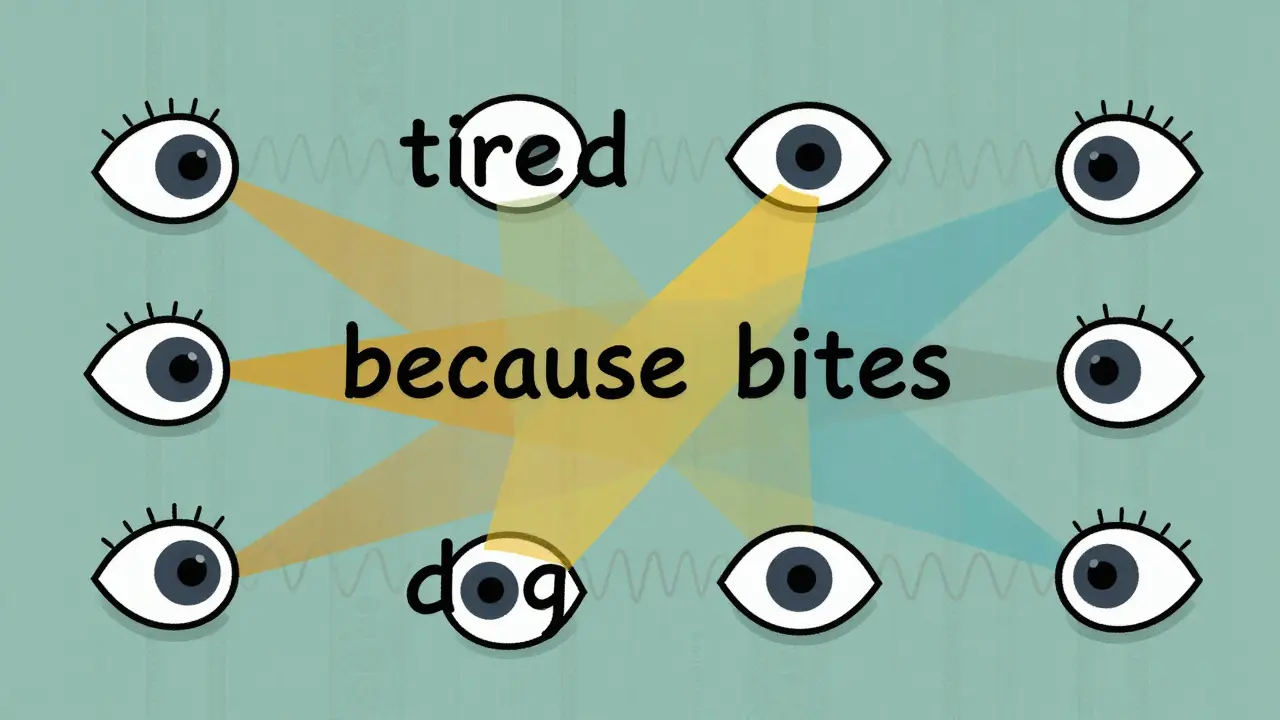
Self-attention lets every word in a sentence pay attention to every other word, no matter how far apart they are. In a sentence like “The cat sat on the mat because it was tired,” the word “it” needs to link back to “cat”, not “mat”. An RNN would process this word by word, slowly, and might lose track. Self-attention? It sees the whole sentence at once. It asks: “How much does each word matter to every other word?” and calculates a weight for every pair.The math behind it looks intimidating, but here’s the core: for each word, you create three vectors-query, key, and value. The query asks, “What am I looking for?” The key says, “Here’s what I represent.” The value is the actual content. You match each query to every key, score the matches, and use those scores to weigh the values. That’s how you get context. The result? A new representation for each word that includes information from the whole sentence.
This isn’t just faster-it’s more accurate. The original Transformer model hit a 62.3 BLEU score on English-to-French translation, crushing the previous best (41.8). Why? Because it didn’t have to wait. No sequential processing. No vanishing gradients. Everything happened in parallel. Training sped up by over 8 times on the same hardware.
Why Order Matters (And How Positional Encoding Fixes It)
Here’s the catch: self-attention doesn’t care about order. If you shuffle all the words in a sentence, the attention scores stay the same. That’s a problem. “Dog bites man” and “Man bites dog” mean totally different things. So how did Transformers learn grammar?Enter positional encoding. This is the quiet hero of the architecture. Instead of telling the model “word 3 is third,” it adds a unique signal to each word’s embedding based on its position. The signal? A mix of sine and cosine waves at different frequencies.
For a 512-dimensional embedding, even-numbered dimensions use sine, odd ones use cosine. The wavelength of these waves increases exponentially: the first dimension has a wavelength of 2π, the last one stretches to 20,000π. That means nearby words have similar positional signals, and distant ones differ in predictable ways. The model doesn’t need to memorize positions-it learns to recognize patterns in the waves. A word two steps ahead? Its signal is a smooth linear transformation of the current one. That’s why the original paper said: “The model can easily learn to attend by relative positions.”
Without this, Transformers would be useless for language. You couldn’t distinguish subjects from objects, tenses from time markers, or questions from statements. Positional encoding is what turns a bag-of-words into a sentence.
How Multi-Head Attention Makes It Even Stronger
Self-attention isn’t just one calculation. It’s eight-or sometimes sixteen-running in parallel. This is called multi-head attention. Each head learns to focus on different kinds of relationships. One head might notice that “the” always comes before a noun. Another might link “because” to its cause. A third might track pronouns across long distances.Think of it like having eight different people read the same paragraph, each looking for something different. Then they combine their notes. The result? A richer, more nuanced understanding. The original Transformer used 8 heads, each with 64-dimensional keys and values. That kept the math manageable while letting the model capture syntax, semantics, and discourse all at once.
This is why models like BERT and GPT-3 can answer questions, summarize text, and even write code. They don’t just memorize patterns-they build layered, multi-perspective interpretations of language.
How This Powers Generative AI
Generative AI-like ChatGPT, Gemini, or Claude-relies on one key trick: predicting the next word. But to do that well, it needs to remember what came before, sometimes dozens or hundreds of words back. That’s where the decoder part of the Transformer comes in.The decoder uses masked self-attention. That means when predicting the fifth word, it can only look at the first four. It’s like reading a sentence with a blindfold that only lets you see what’s already written. This mask is what makes autoregressive generation possible. Without it, the model would cheat by peeking ahead and just copy the next word.
Combined with positional encoding, this setup lets models generate coherent, context-aware text. GPT-3, with 175 billion parameters, uses this mechanism to write essays, answer trivia, and simulate conversations. It doesn’t know what it’s saying-it just predicts the most likely next token based on patterns it learned. And because of self-attention, those patterns can span entire documents.
What’s Changed Since 2017
The original Transformer handled sequences up to 512 tokens. Today’s models handle 32,000+ tokens. How? Not by making self-attention bigger-that would be too slow. Instead, researchers found smarter ways.Some models, like Longformer, use sliding windows: each word only pays attention to a local neighborhood. Others, like Transformer-XL, reuse memory from previous chunks. Meta’s LLaMA-2 uses rotary position embeddings (RoPE), which rotate the embedding vectors based on position instead of adding sine waves. This improves performance on long texts and helps the model generalize beyond training lengths.
Google’s ALiBi (2023) ditched positional encoding entirely. Instead, it adds a linear penalty to attention scores based on distance. Closer words get higher scores naturally. No extra vectors needed. It’s simpler-and faster.
And then there’s Mamba, a new architecture that replaces attention with state-space models. It handles 64,000-token sequences with 5 times less compute. The future might not be attention at all. But for now, it’s still the backbone of nearly every major generative AI system.

Common Mistakes and How to Avoid Them
If you’re building your own model, here’s where people mess up:- Forgetting to scale attention scores by 1/sqrt(d_k). Without this, the softmax gets saturated, gradients vanish, and training stalls. It’s a silent killer.
- Wrong masking in the decoder. If you accidentally let future tokens influence the prediction, your model will memorize the answer instead of generating it. This is the #1 reason beginner models fail.
- Positional encoding mismatch. If your embedding dimension isn’t even, or you add the encoding after layer normalization instead of before, your model won’t learn position properly. Many GitHub issues trace back to this.
- Ignoring memory limits. Self-attention scales with n². A 4,096-token sequence needs 16GB of memory just for attention weights. If you’re training on consumer hardware, you’ll hit a wall fast.
Tools like Hugging Face’s Transformers library handle most of this for you. But if you’re coding from scratch, test your mask. Check your scaling. Verify your positional encoding is added before the first transformer layer.
Why This Matters Today
By 2023, 93% of top-performing NLP models on benchmark leaderboards used Transformer variants. Enterprises use them for chatbots, content generation, and code assistants. The global NLP market is projected to hit $61 billion by 2030. None of that would exist without self-attention and positional encoding.These aren’t just technical details. They’re the reason you can ask an AI to explain quantum physics in simple terms, or have it draft your email in a professional tone. They’re why AI doesn’t just repeat phrases-it understands context, intent, and structure.
Even as new architectures emerge, the core insight remains: if you want machines to understand language, you need to let them see the whole picture-and tell them the order matters. That’s what self-attention and positional encoding do. Together, they turned AI from a pattern-matching tool into a reasoning system.
What is self-attention in simple terms?
Self-attention lets each word in a sentence figure out how much it relates to every other word. Instead of processing words one after another, it looks at the whole sentence at once. For example, in the sentence "The dog chased the cat," self-attention helps the model know that "chased" connects to both "dog" (who did it) and "cat" (who was chased). This makes it better at understanding meaning across long sentences.
Why is positional encoding necessary?
Self-attention doesn’t know word order-it treats sentences like a bag of words. Positional encoding adds a unique signal to each word based on its position, so the model can tell the difference between "The cat sat on the mat" and "The mat sat on the cat." It uses sine and cosine waves at different frequencies to create smooth, predictable patterns that the model can learn to interpret as relative distance.
How do Transformers generate text?
Transformers generate text using a decoder with masked self-attention. This means when predicting the next word, the model can only see the words that came before it. It predicts one word at a time, then adds that word to the input and repeats. This autoregressive process lets it build sentences step by step, like how a human writes. GPT models use this exact method.
Are there alternatives to positional encoding?
Yes. Some models, like LLaMA-2, use rotary position embeddings (RoPE), which rotate word embeddings based on position instead of adding fixed signals. Google’s ALiBi model removes positional encoding entirely and instead adds a linear penalty to attention scores based on distance between words. These alternatives often perform better on very long texts and reduce memory use.
Why are Transformers faster than RNNs?
RNNs process words one at a time, so longer sentences take longer. Transformers process all words simultaneously using parallel computation. This lets them train up to 8 times faster on the same hardware. Plus, they don’t suffer from the vanishing gradient problem that slows down RNNs over long sequences.
What’s the biggest limitation of self-attention?
Self-attention’s computational cost grows with the square of the sequence length. For a 10,000-token text, it needs to compute 100 million attention scores. This uses a lot of memory and slows down training. That’s why newer models use sparse attention, sliding windows, or switch to linear-complexity architectures like Mamba to handle very long texts efficiently.
If you’re learning this topic, start with the original paper-it’s surprisingly readable. Then build a small Transformer from scratch using PyTorch. You’ll hit the same pitfalls everyone does: forgetting to scale attention, mixing up the mask, or adding positional encoding in the wrong place. Fix those, and you’ll understand why this architecture changed AI forever.








Okay but have you ever tried explaining self-attention to a beginner without drowning them in math? I used to teach this at a local coding bootcamp and I’d say imagine each word is whispering to every other word like, ‘Hey, do you care about me?’ and the ones that shout back the loudest get the most attention. It’s chaotic but beautiful. I’ve seen students light up when they finally get it - like, real ‘aha!’ moments. Positional encoding? That’s the secret sauce that stops ‘dog bites man’ from becoming ‘man bites dog’ in AI land. Mind blown every time.
Also, if you’re building your own, don’t forget the scaling factor. I’ve seen so many people lose weeks because they skipped that one line. Trust me, it’s silent but deadly.
Honestly I just use Hugging Face and let it do the heavy lifting but still love reading posts like this. Transformers are wild when you think about it. Words talking to each other across whole paragraphs like they’re at a party. And no RNN could ever pull that off. Feels like magic but its just math and good design
This is all just overcomplicated.
I love how this breaks it down so clearly 😊 Honestly if you're learning AI this is the kind of post that makes you wanna grab a notebook and start coding. I built a mini transformer last weekend and yeah I messed up the mask like 3 times 😅 But once it worked? Pure joy. Keep sharing this stuff!
You say 'self-attention' like it's some revelation. It's just a glorified matrix multiplication with a softmax. And positional encoding? Sine and cosine waves? That's the best you could come up with? I've seen better interpolation methods in 1990s computer graphics. And don't even get me started on multi-head attention - it's just eight copies of the same thing with no theoretical justification. This whole thing is overhyped. And who wrote this? Someone who read the abstract and thought they understood it.
Look, I don't care what some paper from 2017 says. Real AI? That's what we built in the US with real engineers, not grad students scribbling equations. You think some sine waves and attention scores are gonna beat American innovation? We got quantum neural nets in the pipeline. This Transformer stuff? It's a toy. A cute little toy that Europeans and Indians think is revolutionary. Meanwhile, we're building models that think in real time, not after 8 hours of matrix math. Don't get it twisted - this isn't the future, it's just the past wearing a new hoodie.
The use of 'it' in the example sentence is ambiguous, yet the author assumes the model resolves it correctly. This is a dangerous oversimplification. Moreover, the claim that self-attention eliminates vanishing gradients is misleading - while it mitigates them, it does not eliminate them. The paper does not state this. Furthermore, the phrase 'quiet hero' is an anthropomorphization that lacks academic rigor. And why is the scaling factor written as 1/sqrt(d_k) without defining d_k? This post is riddled with unprofessional imprecision.
Let me tell you something - this entire architecture is a beautiful tragedy. You see, self-attention is not just a mechanism - it’s a philosophical statement about how meaning is distributed. Each word, in its isolation, becomes a node in a vast, shimmering lattice of interdependence. The positional encoding? It’s not just a vector - it’s the ghost of syntax, haunting every token with the memory of order. I’ve sat for hours staring at attention maps, watching heads converge on pronouns like moths to flame, and I swear - I’ve wept. This isn’t engineering. This is poetry written in linear algebra.
And yet - we reduce it to benchmarks. BLEU scores. Training time. We forget that beneath the weights and gradients lies something almost sacred: a machine learning to listen. To hear the silence between words. To feel the weight of a comma. The original paper didn’t just change AI - it changed how we think about language itself. And now? We’re already replacing it with Mamba and ALiBi like it’s yesterday’s fashion. How tragic. How beautiful. How human.
yo this is sooo true i was trying to code a transformer and i forgot to scale the attntion and my loss just went to nan and i was like wtf is going on 😭 then i found this post and fixed it in 5 min. thanks bro!! 🙏🔥