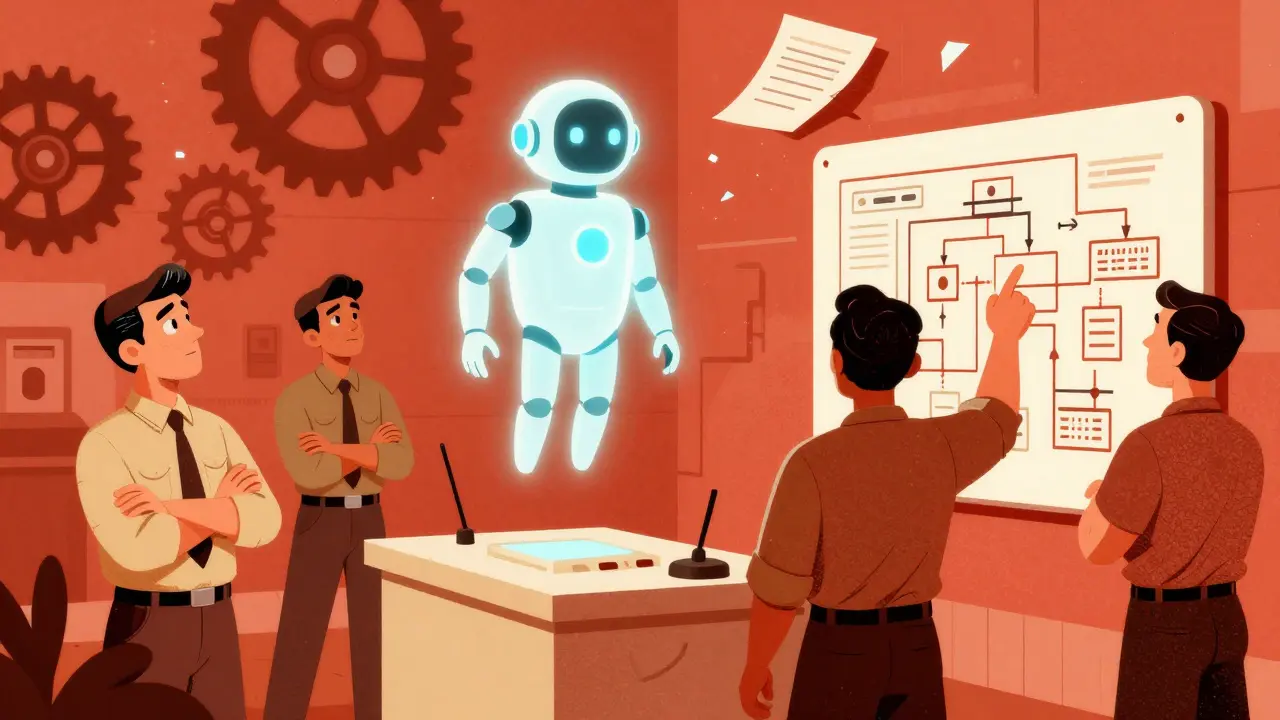
Change Management Costs in Generative AI Programs: Training and Process Redesign
Most companies think the biggest cost of bringing generative AI into their operations is buying the software or paying for cloud APIs. But the real expense? Change management. It’s not flashy. It doesn’t show up in a vendor’s demo. Yet it’s the difference between an AI project that saves money and one that drains it.
Why Change Management Costs More Than You Think
A 2024 analysis of 157 small and mid-sized businesses found that training and process redesign made up 15% to 25% of the first-year AI budget. That’s $8,000 to $20,000 right out of the gate. But here’s the kicker: over five years, 60% of total AI spending goes to maintenance, training, and scaling - not the initial setup. That means if you spend $100,000 in year one, you’ll likely spend $120,000 to $150,000 just keeping it running by year five. The reason? AI doesn’t work in a vacuum. It changes how people do their jobs. If you don’t prepare them, they resist. And resistance costs money. A manufacturing SME in Ohio spent $18,000 in month 14 just retraining staff because their initial rollout skipped proper change management. That’s money thrown away on fixing what could’ve been planned.Three Phases of AI Change Management - And Their Price Tags
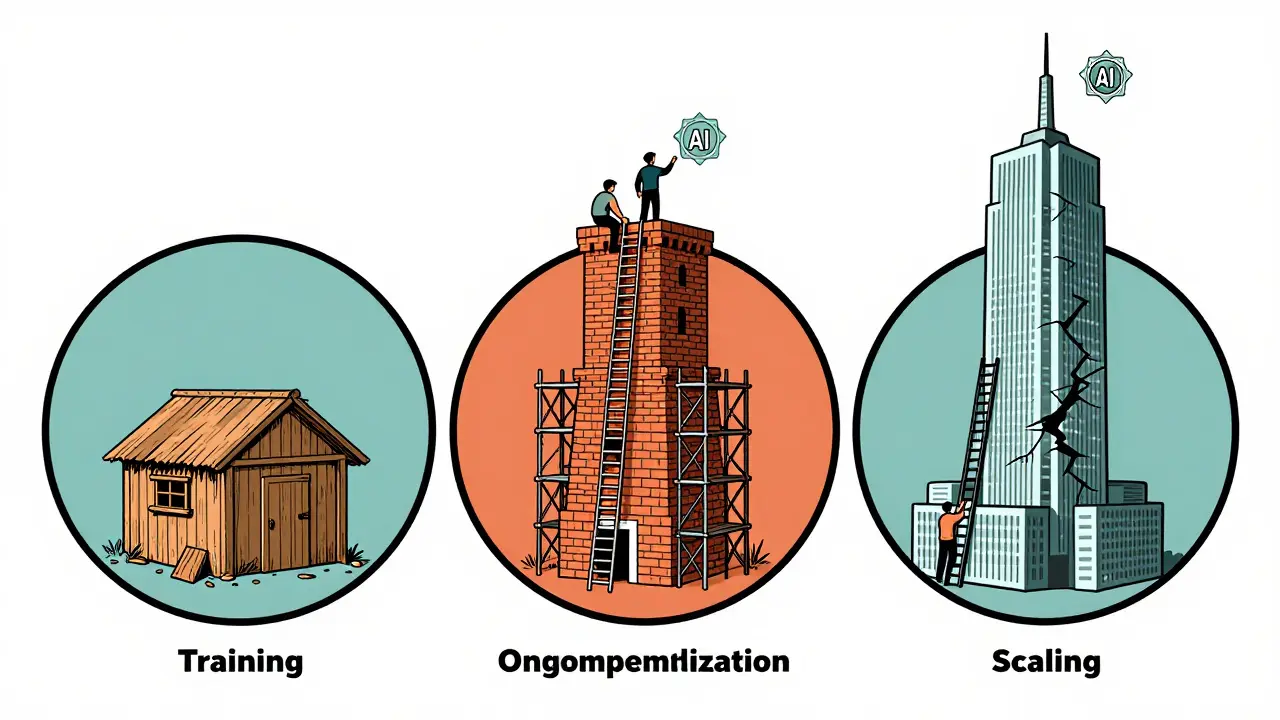
There’s no one-time fix. Change management happens in three stages, each with its own cost structure.- Initial Implementation (Months 1-6): This is where you train teams, map out new workflows, and get people comfortable. Costs range from $8,000 to $20,000 for small teams. Larger companies spend $15,000 to $35,000. You’re not just teaching people how to use a tool - you’re redesigning how work gets done. That means interviewing staff, spotting bottlenecks, and building new processes. One company found 37 hidden inefficiencies just by mapping out their current workflow before introducing AI.
- Ongoing Optimization (Year 2+): AI models drift. Rules change. People forget. That’s why you need quarterly refreshers and small workflow tweaks. Each key team member costs $3,000 to $8,000 a year in training and support. For a team of five, that’s $15,000 to $40,000 annually - just to keep things running smoothly.
- Scaling (Year 3+): When you roll out AI to other departments, the cost jumps. Adding AI to a new business unit? Expect $15,000 to $30,000 per unit. One logistics company saw their annual maintenance cost spike from $45,000 in year two to $74,000 in year three because they didn’t redesign processes early enough. Scaling without planning is like building a second floor on a cracked foundation.
Who Pays for This - And Who Gets Left Behind
Costs vary wildly by company size.- Startups (10-50 employees): Initial cost: $5,000-$15,000. Annual upkeep: $20,000-$100,000. They often rely on lean teams and off-the-shelf tools, but skip deep training. That’s risky. One startup lost $25,000 when their AI tool started giving wrong answers because no one knew how to validate outputs.
- Mid-sized (100-1,000 employees): Initial cost: $15,000-$35,000. Annual cost: $200,000-$800,000. This is where most companies get stuck. They invest in tech but not in people. Their biggest expense? Salaries for change managers and training coordinators.
- Enterprises (1,000+ employees): Initial cost: $50,000-$150,000. Annual cost: Over $1 million. They have dedicated AI teams, compliance officers, and internal training departments. But even they underestimate how much time it takes to get 1,000 people on board.
The Hidden Costs of Skipping Change Management
It’s easy to cut this part. It feels “soft.” But the damage shows up fast.- Staff resistance: 68% of implementations face pushback from people who’ve mastered legacy systems. They don’t trust the AI. Or they think it’ll make their job obsolete. The fix? Involve them early. Let them help design the new workflow. One hospital tried to force AI on nurses without consulting them. After eight months, they scrapped the whole $250,000 project.
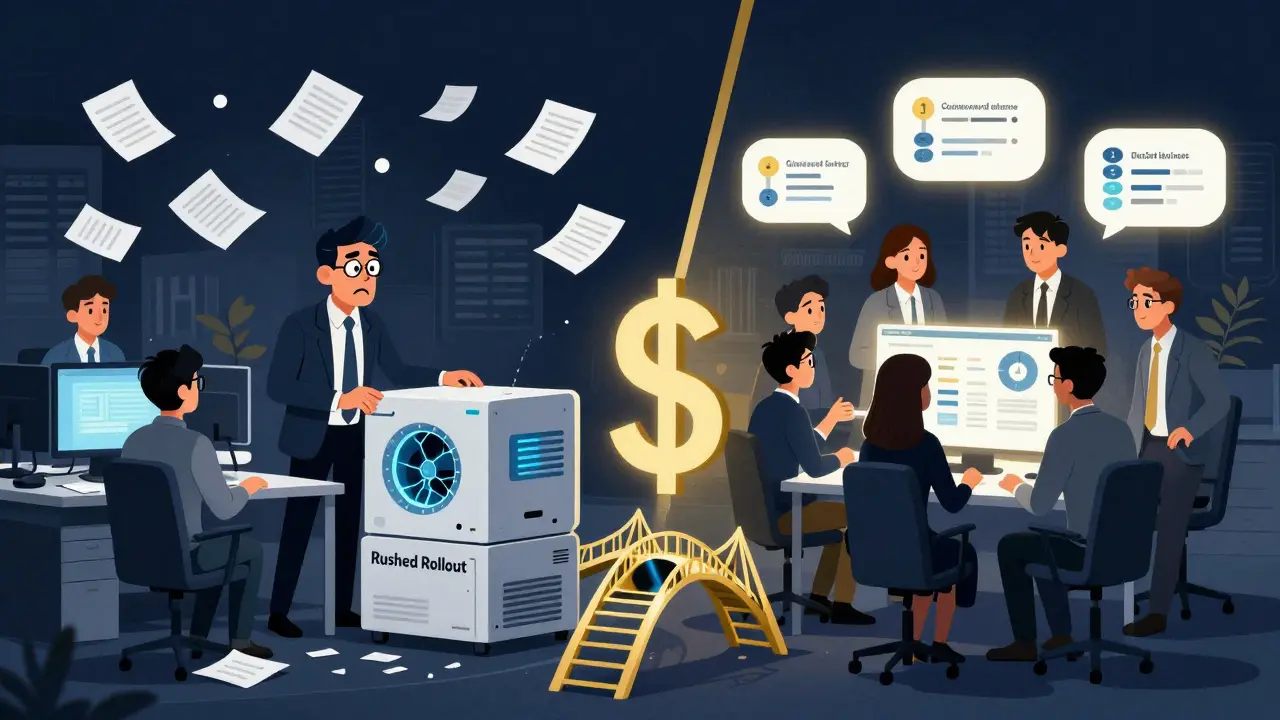
- Remediation costs: A rushed rollout means retraining later. Reddit users reported $15,000-$25,000 in unplanned costs just to fix poorly trained teams. One user wrote: “We spent $18k in month 14 just retraining staff because our initial change management was rushed.”
- Compliance risk: The EU AI Act now requires documented change management processes for high-risk systems. Skipping this isn’t just bad practice - it’s a legal risk. Compliance adds 10% to 15% to your budget, but skipping it could cost you fines.
What You Need to Get Started
You don’t need a big team. But you do need a plan.- Do a change readiness assessment: Cost: $2,000-$8,000. Ask: Who’s affected? Who will resist? What’s their biggest fear? Tools like Prosci ADKAR help map this out.
- Create role-specific training: Cost: $3,000-$10,000. Don’t use one-size-fits-all videos. A sales rep needs different training than a finance analyst. One company saved $12,000 by cutting generic training and building 4 tailored modules.
- Design the new workflow: Cost: $5,000-$15,000. Map out every step before you flip the switch. Where does AI take over? Where does a human still need to check? This step alone prevented a manufacturing client from wasting $40,000 on redundant approvals.
Tools That Make Change Management Less Painful
You don’t need to build everything from scratch.- Prosci ADKAR or Prosci 360: These platforms help track employee readiness, measure adoption, and flag resistance. Annual cost: $5,000-$25,000.
- ServiceNow or Jira: Integrate your AI project with your existing workflow tools. Integration costs $2,000-$10,000 per system.
- AI-powered change tools: New tools in 2026 use AI to predict who’s likely to resist - and suggest targeted messages before problems start. These can cut implementation costs by 25% to 35% by 2027.
The Future: Change Management Is Now Always-On
The old model treated change as a project with a start and end date. That’s dead. AI evolves. So must your team.- 82% of leading organizations now run “always-on” change management - continuous training, feedback loops, and process tweaks.
- The new ISO 30428 standard, released in January 2026, sets baseline requirements for AI change management. If you’re in Europe or work with EU clients, you’re already bound by this.
- By 2027, 70% of AI budgets will have a dedicated line item for change management. Right now, it’s only 45%.
What Happens If You Don’t Do This?
Gartner says 85% of AI projects fail to deliver value. Not because the tech doesn’t work. Because the people didn’t adopt it. You can buy the best generative AI model on the market. You can train it on perfect data. But if your team doesn’t trust it, doesn’t know how to use it, or keeps reverting to old ways - you’re wasting money. The companies that succeed treat change management like infrastructure. Not an add-on. Not a nice-to-have. A core part of the system. Just like security or compliance.Final Thought: It’s Not About AI - It’s About People
Generative AI isn’t replacing jobs. It’s changing them. And that’s hard. People fear the unknown. They worry they’ll be left behind. The best AI strategy isn’t the most advanced algorithm. It’s the one that brings people along. The data is clear: invest in change management, and your ROI jumps. Skip it, and you’re just spending money on tech that sits unused.How much should I budget for change management in my AI project?
Plan to spend 25% to 30% of your total AI budget on change management - training, process redesign, and ongoing support. For most small to mid-sized companies, that’s $15,000 to $35,000 upfront, plus $3,000 to $8,000 per key team member annually. Companies that spend less than 15% often end up paying more later in remediation and retraining.
Is change management only for large companies?
No. Even small teams need it. A startup with 20 employees might spend $5,000 to $15,000 on initial training and workflow mapping. Skipping it leads to costly mistakes - like retraining staff months later or losing trust in the tool. Size doesn’t matter. Readiness does.
What’s the biggest mistake companies make with AI change management?
Treating it like a one-time event. Many companies run a single training session and call it done. But AI changes. So do workflows. The best organizations treat change management as continuous - quarterly refreshers, feedback loops, and regular updates to training materials. That’s what keeps adoption high.
Can I outsource change management?
Yes - and many companies do. Firms like SmartDev offer full change management packages, including training design, workflow mapping, and adoption tracking. Outsourcing can cut costs by 40% to 60% compared to building an internal team from scratch. But make sure they offer role-specific content, not generic templates.
How do I know if my change management plan is working?
Track adoption rates. Companies with strong change management see 73% of staff using the AI tool regularly. Those without? Only 42%. Also, measure time saved per task, error rates, and how often people revert to old systems. If usage drops after the first month, your plan isn’t working.
Do I need certification in change management?
Not for everyone, but yes for your lead change manager. Prosci ADKAR or Kotter’s methodology certifications are the gold standard. They teach you how to assess resistance, design communication plans, and measure progress. For team leads, basic AI literacy and communication training is enough.


Change management isn't just a cost-it's a cultural recalibration. You're not deploying software; you're negotiating the surrender of deeply ingrained habits, the quiet dignity of expertise, the unspoken rituals of work. The AI doesn't care if you've been doing this for twenty years. But you do. And that emotional residue? That's the real ROI calculator. If you skip the mourning phase, you'll never reach the adaptation phase. It's not about training. It's about grief. And grief, like any process, demands time, space, and acknowledgment.
People are dumb. They think AI is magic. It's not. It's just math. But they panic when you ask them to do less typing. So you pay them to learn? That's not a cost. That's a subsidy for incompetence. Spend the money on better tools. Not on therapy for office workers who can't adapt.
lol at all these consultants selling change management packages. you spend 30k on training because you dont know how to write a simple guide. the tool works. people just need to use it. no one needs a 15 slide deck on workflow mapping. just show them the button. done. why is this so hard
Glenn, I get where you're coming from-but you're missing the human heartbeat here. This isn't about buttons. It's about trust. I've seen teams where someone spent 18 years mastering Excel macros, and now they're told, 'Just ask the bot.' No wonder they freeze. What if we flipped it? Instead of training people on AI, what if we trained AI on them? Let the tool learn their rhythm, their shortcuts, their quirks. Make it feel like an assistant, not an auditor. That's where real adoption happens. And yes, it costs more upfront-but it saves soul, not just dollars.
Also, Madeline? People aren't dumb. They're tired. And tired people don't respond to commands. They respond to respect.
Wilda nailed it. My cousin works at a hospital that rolled out AI scheduling. First month? 80% of nurses used the old paper board. Second month? They let the nurses help design the interface. Now it's the most loved tool in the unit. No training videos. No seminars. Just listening. Sometimes the cheapest fix is just asking what people actually need