Enterprise Generative AI Strategy: Vision, Roadmap, and Operating Principles for 2026
By mid-2026, the novelty of generative AI has worn off. If you are a CIO or business leader right now, you likely have dozens of chatbots running in your organization. The problem is that while over 80% of enterprises have deployed some form of generative AI, fewer than 35% can show their board a defensible return on investment. You aren't just building technology anymore; you are managing a complex operational risk and opportunity.
This guide cuts through the hype to provide a practical framework for moving from scattered pilots to a cohesive enterprise generative AI strategy. We will look at how to align these tools with real profit-and-loss drivers, build a technical architecture that scales without breaking the bank, and establish the operating principles needed to govern autonomous agents safely.
The Business-First Foundation: Aligning AI with P&L Drivers
The biggest mistake companies made in 2024 and 2025 was letting IT departments pick use cases based on what was technically cool rather than what was financially viable. In 2026, the rule is simple: if an AI initiative doesn't tie directly to a measurable financial outcome, it doesn't get funded. This means shifting the ownership of success metrics from IT engineers to business unit leaders.
You need to define your strategic intent clearly. Most successful organizations focus on one of four primary areas:
- Efficiency: Reducing operating costs through automation of routine tasks.
- Growth: Expanding revenue by personalizing customer experiences or accelerating product development.
- Resilience: Managing risk and ensuring business continuity through predictive analytics.
- Experience: Improving satisfaction scores for both customers and employees.
For example, instead of saying "we want to use AI for customer service," a mature strategy says, "we aim to reduce average handle time by 20% and improve first-contact resolution by 15%, saving $2 million annually." This clarity prevents the common pitfall where enterprises build impressive technical demos that never reach operational scale because they don't solve a painful enough problem.
The Five-Phase Enterprise AI Roadmap
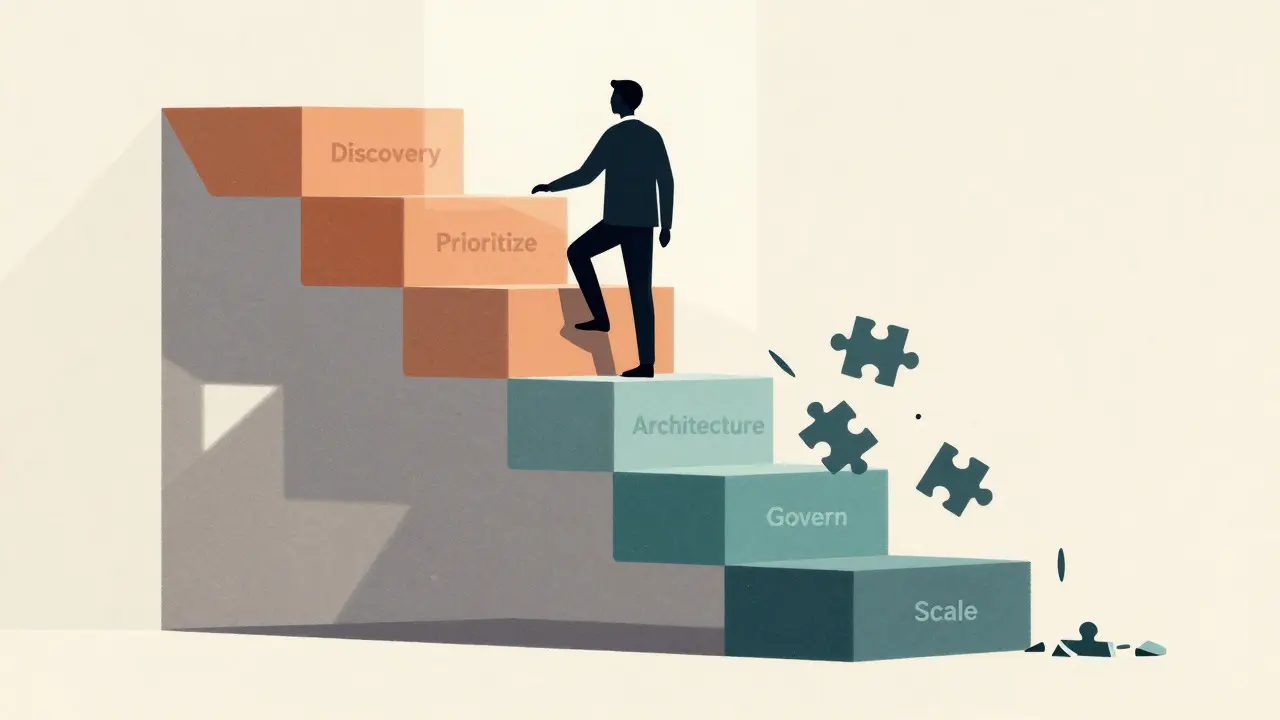
A coherent roadmap consolidates execution into five disciplined phases. This structure ensures you aren't just throwing code at a problem but are building a sustainable capability. Here is how the timeline typically breaks down over a 12-to-18-month horizon.
| Phase | Duration | Key Activities | Deliverables |
|---|---|---|---|
| Discovery & Alignment | Weeks 1-8 | Stakeholder interviews, data maturity assessment, pain point mapping | Strategic goals, success metrics, executive sponsorship model |
| Prioritize | Weeks 9-12 | Scoring use cases by value, feasibility, time-to-value, and change impact | Sequenced implementation roadmap, one-page business cases |
| Architecture & Design | Months 4-6 | Model selection (RAG vs. Fine-tuning), agentic orchestration design, security integration | Technical blueprint, cost governance framework, API integration plans |
| Govern & Monitor | Ongoing | Establishing ethics policies, bias detection, token cost tracking | Compliance frameworks, LLMOps monitoring dashboards |
| Scale & Improve | Months 7+ | Federated team deployment, continuous feedback loops, reskilling | Standardized operating model, sustained ROI reports |
In the Discovery phase, you examine key processes through three lenses: the volume and cost sitting in the process, how structured the data is, and how dependent the process is on human judgment. High-performing organizations achieve payback within 6 to 12 months by combining effective architecture with strict cost governance during this early stage.
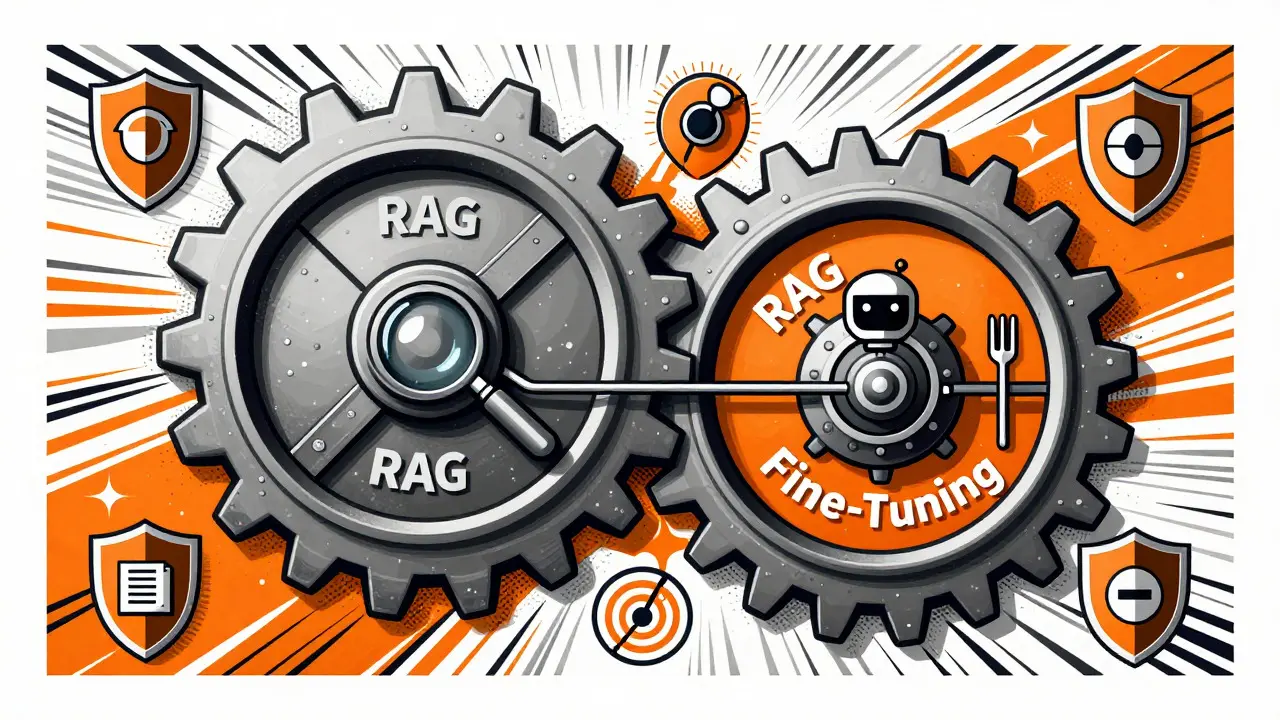
Architectural Choices: RAG, Fine-Tuning, and Agents
Not every use case requires the same technical approach. A mature enterprise generative AI strategy balances different methods based on risk and complexity. Understanding these distinctions is critical for controlling costs and maintaining accuracy.
Retrieval-Augmented Generation (RAG) is the standard for governed access to enterprise knowledge. It allows models to pull from your internal databases without hallucinating facts. This is ideal for HR policy queries or legal contract review where accuracy is paramount.
Fine-tuned or domain-specific models are reserved for regulated and specialized workflows where the base model lacks specific industry nuance. These are more expensive to maintain but offer higher precision for niche tasks.
Agentic Orchestration represents the shift in 2026. Unlike passive chatbots, agents can reason through tasks, call enterprise APIs, and execute supervised workflows across ERP and CRM systems. For instance, an agent might not just summarize a sales report but automatically update the CRM, schedule follow-ups, and alert managers if a deal is at risk. This requires robust isolation of prompts, data, and outputs across business units to prevent security breaches.
Governance and Risk Management in Production
Governance is no longer an afterthought; it is the gatekeeper of scale. As you move from pilots to production, the risks of bias, data leakage, and regulatory non-compliance increase exponentially. Your governance framework must incorporate policies for ethics, traceability, and ongoing compliance.
One of the most overlooked aspects of governance in 2026 is LLMOps cost governance. Token usage and inference spending can spiral out of control quickly if not monitored. CFO-ready programs track token costs, inference spend, and automation yield as strictly as they track traditional IT budgets. Without these controls, your AI strategy becomes a money pit rather than an investment.
Additionally, you need explainability and traceability. When an AI agent makes a decision that impacts a customer's credit score or an employee's promotion path, you must be able to audit why that decision was made. This requires logging every prompt, context retrieval, and output generation step.
The Operating Model: People and Culture
AI transformation is operational and cultural, not just technical. You cannot automate your way to success if your people don't know how to work with the new tools. Organizations typically establish an AI Center of Excellence (CoE) to coordinate enterprise-wide initiatives, but this CoE must operate in a federated model.
This means centralized governance for standards and security, combined with local innovation teams embedded in business units. These teams need to be reskilled for prompt engineering, model monitoring, and data stewardship. You also need to redefine responsibilities among data engineering, ML engineering, and business teams. Business owners must own the outcome metrics, while IT owns the platform reliability.
Change management is critical here. Identify capability gaps early and decide whether to hire externally or upskill internally. The goal is to create a repeatable, governed process that sustains ROI over time, rather than relying on a few star engineers to keep the lights on.
How long does it take to see ROI from an enterprise generative AI strategy?
High-performing organizations typically achieve payback within 6 to 12 months. This rapid return is possible when companies combine effective architectural choices like RAG with strict LLMOps cost governance and focus on high-impact use cases tied to clear P&L drivers.
What is the difference between RAG and fine-tuning in an enterprise context?
RAG (Retrieval-Augmented Generation) connects a model to your live data sources for accurate, up-to-date answers, making it ideal for knowledge retrieval. Fine-tuning involves training a model on specific datasets to learn patterns or styles, which is better for specialized, regulated workflows where base models lack domain expertise.
Why is LLMOps cost governance important in 2026?
Token usage and inference costs can scale unpredictably as AI adoption grows. Without LLMOps governance, enterprises risk uncontrolled spending. Tracking token costs and inference spend ensures that AI initiatives remain profitable and provides CFO-ready metrics for financial accountability.
How should businesses prioritize AI use cases?
Use cases should be scored across four dimensions: value potential (revenue/cost impact), feasibility (data availability/complexity), time to value (speed of pilot results), and change impact (workflow disruption). Focus on initiatives that deliver sustained operational or financial impact aligned with P&L drivers.
What role does the AI Center of Excellence (CoE) play?
The CoE coordinates enterprise-wide AI initiatives, establishes governance standards, and manages central resources. However, it should operate in a federated model, allowing local business teams to innovate while adhering to centralized security and compliance protocols.