
Prompting as Programming: How Natural Language Became the Interface for LLMs
Remember when writing code meant staring at a black screen and typing out rigid syntax? If you made one tiny mistake-a missing semicolon or a mismatched bracket-the whole thing crashed. That era is shifting fast. Today, more developers are treating Prompt Engineering as the practice of designing natural language queries to produce desired results from Large Language Models (LLMs) than traditional coding for certain tasks. It’s not just about asking questions anymore; it’s about structuring instructions so precisely that they function like software programs.
This shift didn’t happen overnight. Since the release of GPT-3 in June 2020, we’ve watched natural language evolve from a simple chat interface into a powerful development tool. By 2026, prompting has become a legitimate programming paradigm. You aren’t just talking to a machine; you’re directing its reasoning process. Let’s break down how this works, why it matters, and how you can master it without getting lost in the noise.
The Shift: From Syntax to Semantics
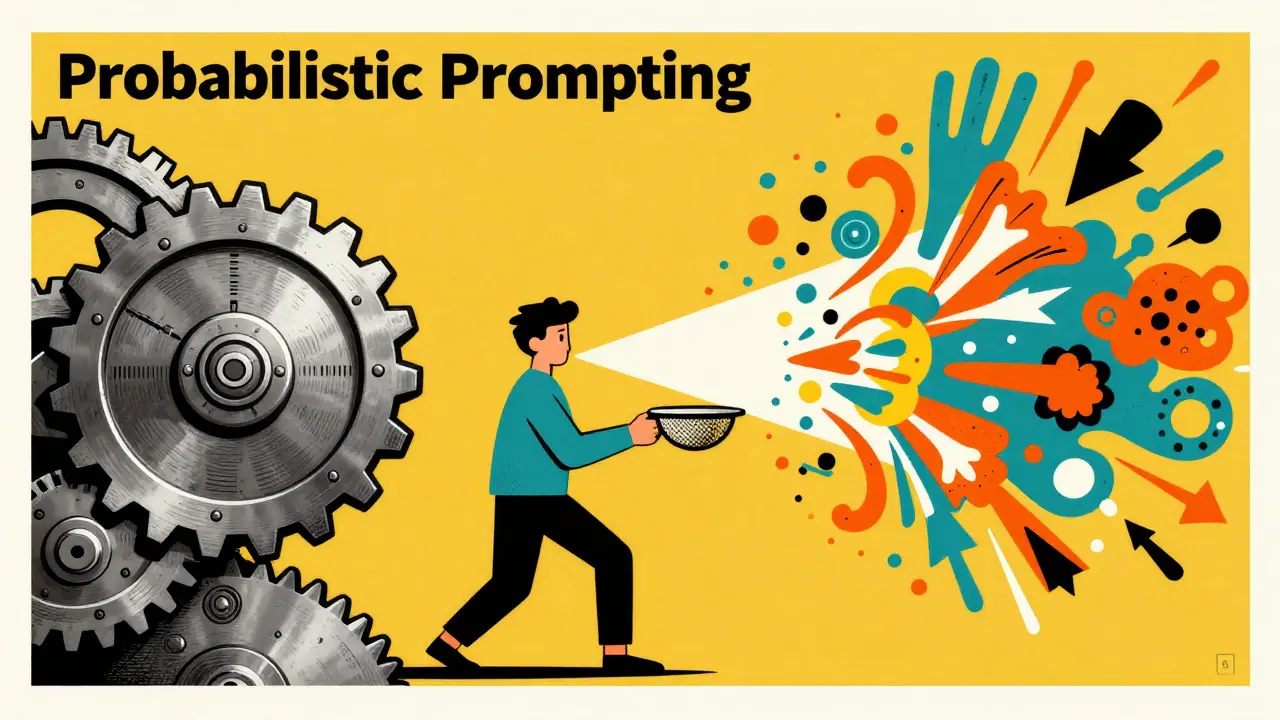
In traditional programming, you tell the computer exactly what to do step-by-step using logic gates and variables. In prompt engineering, you describe the outcome and provide context. This is a fundamental change in control flow. Instead of deterministic execution (where input A always equals output B), you’re dealing with probabilistic outcomes. The model predicts the next most likely token based on your instructions.
Why does this matter? Because it lowers the barrier to entry while raising the ceiling for complexity. Professor Greg Benson noted in a November 2024 Stack Overflow discussion that prompts can replace complex code implementations entirely. You don’t need to write a regex parser if you can ask an LLM to "extract all email addresses from this text." But here’s the catch: vague prompts lead to vague results. Clarity isn’t just nice-to-have; it’s the compiler.
Anatomy of a Prompt Program
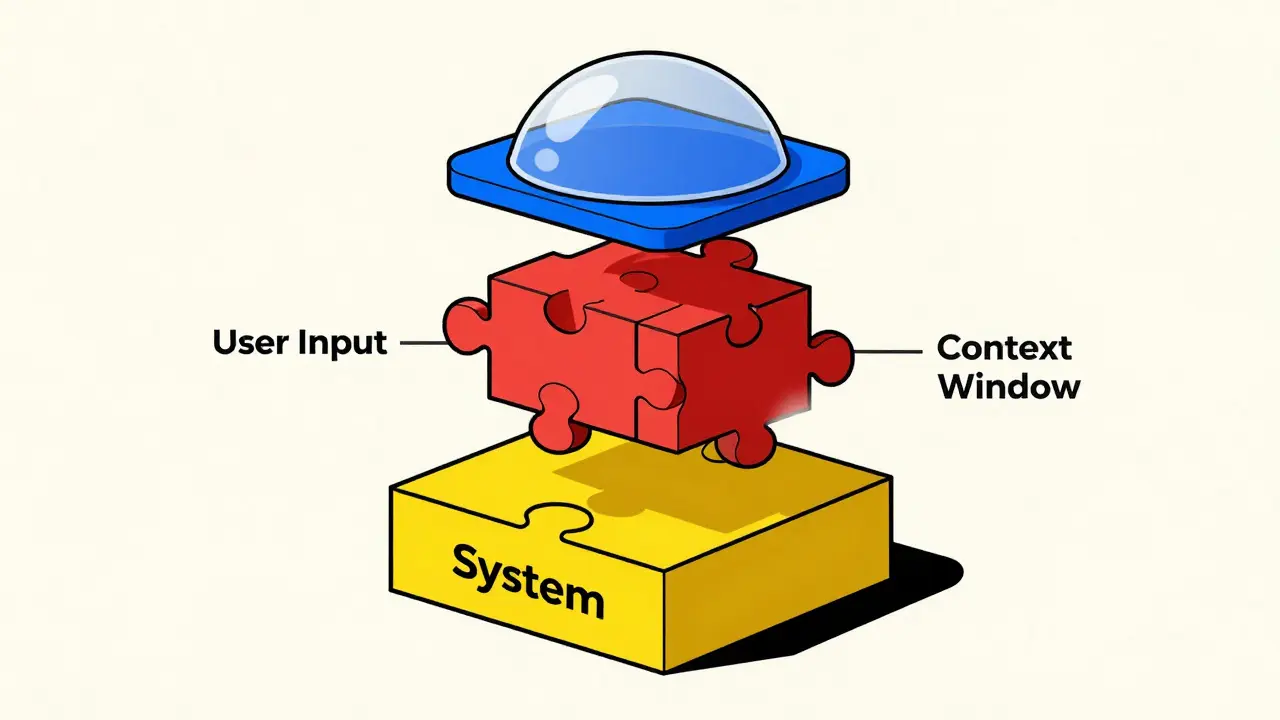
To treat prompting as programming, you need to understand its components. Think of a prompt not as a single sentence, but as a structured document with distinct layers:
- System Prompts: These are fixed instructions that define the task’s nature, expected inputs, and output format. They act like global variables or configuration files in traditional code. For example, "You are a senior Python developer who writes clean, documented code."
- User Prompts: The specific query or data you want processed. This is your function argument.
- Context Windows: The memory limit of the model. Depending on the version, this ranges from 4,096 tokens in early models to over 128,000 tokens in modern ones. Managing this window is crucial-too much irrelevant info dilutes the signal.
Effective prompts serve three critical functions: task definition (what to do), context provision (background info), and output shaping (how to present the result). If you miss any of these, your "program" will likely crash-or worse, hallucinate.
Core Techniques: Structuring Your Logic
You can’t just throw words at an LLM and expect production-ready code. You need techniques. Here are the most impactful ones used by professional developers in 2026:
- Chain of Thought (CoT): Ask the model to explain its reasoning before giving the final answer. This reduces errors significantly. For instance, instead of "What is the result?", try "Think step-by-step through the calculation, then provide the answer."
- Generated Knowledge: Split the task into two steps. First, ask the LLM to generate relevant facts or outlines. Second, use that output as context for the final generation. Martin Fowler highlighted this in his October 2023 analysis, noting it helps developers engage with LLMs as "junior partners."
- Instruction Prompting: Use clear, imperative verbs. Avoid ambiguity. Instead of "Maybe make this shorter," say "Summarize the following text to half its original length."
These techniques transform raw text into logical workflows. They give you control over the model’s internal processing, making the output more reliable and predictable.
Prompting vs. Traditional Coding: The Trade-offs
Is prompting replacing coding? Not entirely. It’s complementing it. Here’s how they compare:
| Feature | Traditional Programming | Prompt Engineering |
|---|---|---|
| Control | Deterministic (exact outputs) | Probabilistic (variable outputs) |
| Learning Curve | Steep (syntax, logic, tools) | Moderate (clarity, structure, iteration) |
| Speed | Slower initial setup | Rapid prototyping |
| Reliability | High (if tested) | Variable (depends on prompt quality) |
| Use Case | Core infrastructure, security-critical systems | Content generation, data extraction, ideation |
Traditional code is still king for mission-critical applications where precision is non-negotiable. But for tasks like drafting documentation, generating test cases, or brainstorming architectures, prompting is faster. The key is knowing which tool to use when.
Real-World Challenges: Why It’s Harder Than It Looks
Don’t be fooled by the hype. Prompt engineering has real pain points. One major issue is output variability. Two nearly identical prompts can yield different results. Hopsworks AI demonstrated this with examples like "Rewrite the text to make it half as long" versus "Summarize the text, making it half as long." The subtle difference changes the model’s approach entirely.
Another challenge is context window limits. If your prompt exceeds the model’s memory, it forgets earlier instructions. Early GPT variants had tight limits (4,096 tokens), but even modern models struggle with very long documents. You need to chunk data strategically.
Then there’s prompt injection. Just like SQL injection in databases, malicious users can trick LLMs into ignoring their system instructions. In 2025, 37% of security-focused GitHub repositories flagged this as a risk. You must sanitize inputs and use robust system prompts to set boundaries.
The Future: Standardization and Tools
We’re moving toward a more mature ecosystem. In January 2026, OpenAI released GPT-5 with enhanced system prompt capabilities, allowing explicit parameter definitions. Microsoft introduced "Prompt Contracts" in Azure AI, adding schema validation to ensure prompts meet specific structural requirements. These tools address the reliability concerns that have plagued the field.
Gartner predicts that by 2028, prompt engineering will evolve into a standardized discipline with formal syntax, testing frameworks, and debugging tools. We’re already seeing this with GitHub’s Prompt Debugger for Copilot, which allows developers to test and refine prompts iteratively. This isn’t just a trend; 87% of tech executives view it as a permanent part of their toolkit.
How to Get Started: Practical Steps
If you want to adopt prompting as programming, start small. Here’s a quick checklist:
- Define the Goal: What exactly do you want the LLM to do? Be specific.
- Set the Persona: Use a system prompt to assign a role (e.g., "Expert Data Analyst").
- Provide Examples: Show the model what good output looks like (few-shot prompting).
- Iterate: Don’t expect perfection on the first try. Refine your prompt based on the output.
- Version Control: Treat prompts like code. Save successful versions and track changes.
Mastering this takes 2-4 weeks of dedicated practice for experienced developers. Focus on clarity, structure, and iteration. You’ll find that your productivity skyrockets, especially for repetitive or creative tasks.
Is prompt engineering considered a form of programming?
Yes, increasingly so. While it lacks the strict syntax of traditional languages, prompt engineering involves structuring instructions, managing state (context), and defining logic flows (via Chain of Thought). Experts like those at ACM and SIGPLAN argue that prompts function as programs because they guide the LLM’s execution to compute specific results.
What is the biggest risk of using prompts instead of code?
The biggest risk is unpredictability. Unlike traditional code, which produces deterministic outputs, LLMs are probabilistic. Small changes in wording can lead to vastly different results. Additionally, prompt injection vulnerabilities pose security risks if inputs aren’t properly sanitized.
How long does it take to learn effective prompt engineering?
For experienced developers, mastering core techniques typically takes 2-4 weeks of dedicated practice. The learning curve focuses less on memorizing syntax and more on understanding how to structure context, constraints, and iterative refinement processes.
What is Chain of Thought prompting?
Chain of Thought (CoT) is a technique where you ask the LLM to explain its reasoning step-by-step before providing the final answer. This improves accuracy by forcing the model to "think" through complex problems logically, reducing hallucinations and errors.
Will prompt engineering replace traditional coding jobs?
Unlikely. While it accelerates development and handles routine tasks, traditional coding remains essential for building secure, scalable, and precise infrastructure. Prompt engineering is best viewed as a complementary skill that enhances developer productivity rather than a replacement.










It is fascinating to consider that we have moved from the rigid determinism of C++ to the probabilistic fluidity of natural language. The philosophical implication here is that code is no longer just a set of instructions for a machine, but a dialogue with an intelligence that interprets intent rather than just syntax. This shift suggests that clarity of thought is now more valuable than memorization of grammar. We are essentially teaching machines to think like us, which forces us to be more precise in our own thinking. It is a mirror held up to human cognition.
Oh my gosh! This is absolutely revolutionary!!! I cannot believe how fast this has happened!! It feels like we are living in the future right now!!! The way you described prompt engineering as programming is so spot on!! I tried it yesterday and it was amazing!! My productivity went through the roof!!! Thank you for sharing this!!
the distinction between syntax and semantics is often overstated. language itself is syntax. the meaning emerges from the structure. treating prompts as programs ignores the fundamental nature of communication which is inherently messy and contextual. we are not programming we are negotiating with a statistical model.
this article is full of nonsense written by people who dont understand real computing. prompt injection is a joke compared to actual security flaws in legacy systems. only amateurs care about this new toy. real engineers write deterministic code because they value precision over convenience. the fact that you think this is a paradigm shift shows how detached you are from serious development work. stop wasting time on these chatbots and learn actual programming.
lmao look at lisa acting all high and mighty again. she probably still thinks python is too slow for production. meanwhile im using llms to generate entire microservices in seconds. your elitist attitude is showing joe. maybe if you spent less time judging others and more time learning youd realize that adaptability is the new skill. also your spelling is terrible.
The concept of Chain of Thought is particularly intriguing when viewed through the lens of cognitive science. It mimics the human process of deliberation before action. By forcing the model to articulate its reasoning steps we are essentially externalizing the internal monologue of the AI. This creates a layer of transparency that traditional black-box algorithms lack. It raises questions about accountability and trust in automated decision making processes.
You are missing the point entirely. Prompt engineering is not just a tool it is a mindset shift. If you are still writing regex parsers manually you are obsolete. The industry moves fast and those who cling to old methods will be left behind. Embrace the change or get out of the way. Efficiency is king and this is the most efficient path forward. Stop complaining and start adapting.