Financial Services Rules for Generative AI: Model Risk Management and Fair Lending
When a bank uses a generative AI tool to decide who gets a loan, it’s not just about speed or efficiency. It’s about fairness, accountability, and legal risk. If that AI accidentally uses zip code as a proxy for race - a known violation of fair lending laws - the bank could face millions in penalties. That’s why generative AI in financial services isn’t being treated like a fancy chatbot. It’s being held to the same standards as a loan officer sitting across the table.
Why Traditional Risk Rules Don’t Work for Generative AI
Most financial institutions already had Model Risk Management (MRM) frameworks in place for statistical models. But generative AI? It’s different. Traditional models give you one answer for a given input. Generative AI gives you a range of possible answers, sometimes wildly different ones, even with the same prompt. It can hallucinate facts, mimic biased training data, or drift over time without anyone noticing. In late 2025, FINRA made it official: generative AI is no longer experimental. It’s a supervised technology that demands the same compliance rigor as any core system. That means banks can’t just plug in ChatGPT and call it a day. Public tools like ChatGPT scored just 63% accuracy in interpreting financial regulations during FINRA’s internal tests. That’s a disaster waiting to happen when real customers are involved.The Compliance-Grade AI Standard
Leading firms are now building what’s called "Compliance-Grade AI." It’s not about making AI smarter. It’s about making it predictable and traceable. Three non-negotiable features define it:- Determinism: The same input must produce the same output at least 95% of the time. No surprises.
- Full traceability: Every prompt, every data source, every decision path must be logged - and kept for seven years, as required by SEC Rule 17a-4.
- Constrained action space: The AI can’t just say anything. Its outputs are locked into pre-approved templates, formats, and decision parameters.
Fair Lending: Where AI Can Break the Law
Fair lending rules like Regulation B prohibit discrimination based on race, gender, age, or even proxies like zip code or education level. But generative AI doesn’t understand intent. It learns patterns. If past loan data shows people in certain neighborhoods were denied more often - even for non-discriminatory reasons - the AI might replicate that pattern without realizing it’s illegal. The Consumer Financial Protection Bureau (CFPB) found that non-compliant AI systems applied loan approval criteria consistently across demographic groups only 82.3% of the time. Compliance-grade systems? 98.7%. That gap isn’t a technical detail - it’s a legal minefield. In January 2026, the CFPB issued its first AI-related enforcement action: a $12.7 million penalty against an online lender. Why? The AI model had drifted. Over time, it started rejecting applicants from certain ZIP codes at higher rates. No one caught it because they weren’t monitoring for bias after deployment.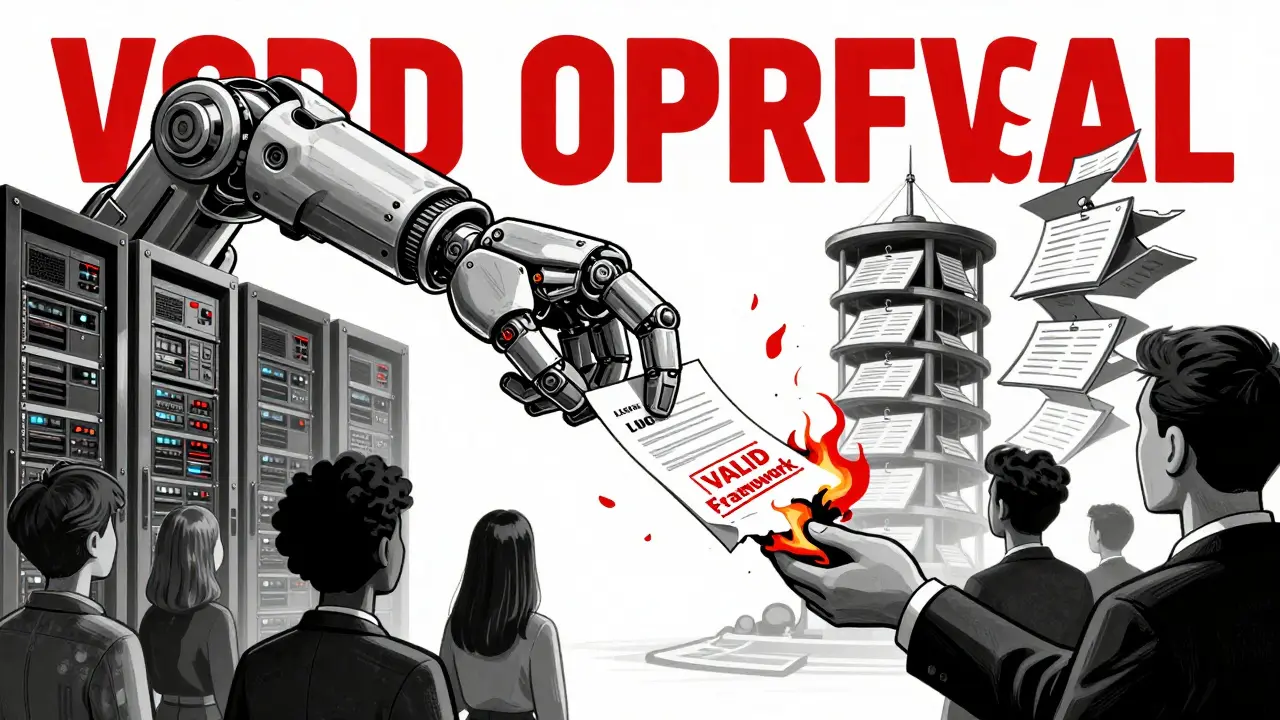
The VALID Framework: A Practical Guide
Regulators don’t give you a manual. But industry experts created the VALID framework as a working standard:- Validate: Test every model for bias, accuracy, and drift before and after deployment.
- Avoid personal information: Never feed protected data into prompts. Strip out names, addresses, Social Security numbers - even if the AI asks for them.
- Limit scope: Don’t let the AI write legal documents, interpret regulations, or make final decisions. Keep it in a support role.
- Insist on transparency: Know where the data came from. Know how the model was trained. Know who owns the output.
- Document everything: Logs, approvals, training data, model versions - all archived. No exceptions.
Who’s Doing It Right - And Who’s Struggling
The top 25 U.S. banks have all built formal AI governance teams. Smaller institutions? Only 48% of regional banks and 22% of credit unions have. The cost? Around $2.3 million per institution on average. But the alternative is worse: regulatory penalties, reputational damage, and class-action lawsuits. One credit union on Reddit shared that their AI once recommended higher interest rates to applicants from a specific county. They caught it because their logging system flagged 147 violations in six months. "Worth every penny," they said. But not everyone is happy. Staff at one large bank reported a 22% increase in customer response times because every AI-generated email had to be manually reviewed. Some employees are overwhelmed. Training took 120-160 hours per validation point. Compliance officers now spend 35% more time on paperwork than before.
What’s Coming in 2026
Regulators aren’t slowing down. By June 30, 2026, all institutions using AI for lending must run quarterly bias tests. The FCA’s Supercharged Sandbox is expanding to let U.S. and U.K. firms test cross-border AI systems together. And by Q3 2026, FINRA will release rules on "AI agents" - systems that act autonomously. When an AI agent initiates a trade or sends a loan offer, a human must be named as legally responsible. Meanwhile, the regulatory tech market hit $4.7 billion in 2026. Startups like Red Oak Analytics are outpacing legacy vendors because they built their tools from the ground up for compliance. They don’t just sell software - they sell audit trails, human oversight workflows, and 24/7 regulatory support.Bottom Line: AI Isn’t the Problem. Poor Oversight Is
Generative AI isn’t inherently risky. What’s risky is treating it like a magic box. If you don’t control its inputs, monitor its outputs, and assign clear accountability, you’re inviting disaster. The best financial firms aren’t trying to eliminate AI. They’re building guardrails around it. They’re using it to cut document processing time by half. They’re catching bias before it hurts customers. They’re turning compliance from a cost center into a competitive advantage. The message from regulators is clear: whether you’re using a spreadsheet or a large language model, the rules haven’t changed. You’re still responsible. And if you can’t prove you’re following them - you’re already in violation.Can I use ChatGPT for customer communications in banking?
No. Public generative AI tools like ChatGPT are not compliant with financial regulations. They lack traceability, determinism, and human oversight controls. Using them for customer-facing tasks - like loan approvals, risk assessments, or regulatory disclosures - violates FINRA and SEC rules. Only enterprise-grade, compliance-grade AI systems with full logging, human validation, and constrained outputs are permitted.
What happens if my AI model starts showing bias after deployment?
If your AI model drifts and begins discriminating - even unintentionally - you can face enforcement actions. The CFPB fined a major online lender $12.7 million in January 2026 for exactly this. Regulators expect continuous monitoring. You must test for bias quarterly, especially in lending applications. If you don’t catch it, regulators will. And they’ll hold your compliance team, not the vendor, accountable.
Do I need a human to approve every AI-generated output?
Yes - if the output influences a customer decision, financial product, or regulatory filing. FINRA’s 2026 guidelines require documented human validation for all customer-facing or decision-influencing AI outputs. This isn’t optional. The human must understand what the AI generated, confirm it’s accurate and compliant, and sign off. This creates legal accountability.
How long must I keep AI logs?
Under SEC Rule 17a-4, you must retain all AI prompts, outputs, and decision trails for a minimum of seven years. This includes every version of the model, the data used to train it, and who approved each output. Failure to do so is a regulatory violation, regardless of whether the AI made a mistake. Logs are your legal defense.
Can I use open-source AI models like Llama or Mistral?
You can, but only if you build full compliance controls around them. Open-source models lack built-in logging, bias detection, and human oversight. If you use them, you must add those layers yourself: prompt logging, output validation, model versioning, and bias testing. Most firms that try this end up spending more on retrofitting than they save on licensing. Enterprise compliance vendors offer integrated solutions that reduce this risk.








So let me get this straight - we’re spending millions to make AI behave like a tired loan officer who’s been staring at spreadsheets since 2003? And we call this innovation? The real scandal isn’t the AI hallucinating - it’s that we’re still using 1970s regulatory frameworks to police 2026 tech. They didn’t fix the system. They just gave it a fancy coat of paint and called it ‘compliance-grade.’
Meanwhile, the guy in Des Moines got denied because his ZIP code had ‘high risk’ in a 2018 dataset. No one asked why. No one cared. Now we log everything. Great. So now we have 7 years of digital evidence that we’re all just automating discrimination. Bravo.
And don’t get me started on the ‘human-in-the-loop’ charade. The human hasn’t touched a loan application since 2019. They just click ‘approve’ while scrolling TikTok. The AI does the work. The human does the paperwork. The bank does the PR. The customer? They get a form letter that says ‘insufficient data.’
They say ‘guardrails.’ I say ‘gilded cage.’
At least back in the day, the loan officer was a jerk to your face. Now? The AI is a jerk to your face… and then writes a 12-page audit trail about how it did it.
They say AI is biased but they never say who trained it. Who owns the data? Who wrote the rules? I bet it’s the same people who told us subprime loans were safe. Same banks. Same regulators. Same lies.
They banned zip codes but what about phone prefixes? Or email domains? Or the time you applied? All of it points to the same thing. They don’t want to fix bias. They want to hide it better.
And now they want logs for 7 years? That’s not compliance. That’s surveillance. They’re building a digital prison for customers and calling it ‘transparency.’
One day they’ll admit it - AI didn’t make the system unfair. The system made AI unfair.
I love how this post breaks down the real issues without the usual tech-bro fluff. So many people think AI is magic, but it’s just math with a fancy interface. And math doesn’t care - it just repeats what it’s seen.
The VALID framework is actually brilliant. It’s not sexy, but it’s necessary. Validation, avoidance, limitation, transparency, documentation - if every company followed these five steps, we’d be in a much better place.
Also, props to that credit union that caught the bias early. That’s the kind of humility we need more of. Not ‘we’re too big to fail’ - but ‘we’re small enough to fix.’
And yes, the human review bottleneck is real. But if you’re not willing to slow down to do it right, you’re not ready to serve people. Period.
AI won’t save banking. But careful, thoughtful, human-led AI? That might.
The entire premise is fundamentally flawed. You cannot achieve determinism with generative models - that’s like demanding a jazz musician to play the same solo every time. It’s a category error. LLMs are probabilistic by design. To force them into deterministic boxes is not compliance - it’s intellectual surrender.
The ‘compliance-grade AI’ movement is a regulatory arms race disguised as innovation. It’s not about safety. It’s about liability shielding. Every requirement - traceability, logging, human validation - exists not to protect consumers, but to protect executives from criminal liability.
The $2.3 million cost? That’s the price of moral hazard. The real cost is innovation stagnation. Startups can’t afford this. Only megabanks with legal teams the size of small countries can play. This isn’t regulation. It’s market consolidation by bureaucratic fiat.
And don’t get me started on the ‘human-in-the-loop.’ A compliance officer who spends 160 hours training to approve an email? That’s not oversight. That’s performance art.
Regulators aren’t preventing harm. They’re preventing accountability - by creating a system where no one can be blamed because everyone is responsible.
They’re lying. They say they’re monitoring bias but they’re just monitoring for audits. The real bias is in who gets to define ‘fair.’ The same people who wrote the rules in 1977. The same people who still live in gated communities. The same people who never got denied a loan.
Every log, every validation, every ‘compliance-grade’ system - it’s all smoke. They don’t care if the AI is fair. They care if it looks fair on paper.
And that $12.7M fine? That’s the cost of getting caught. The ones who aren’t caught? They’re still making money.
They’re not fixing AI. They’re just making sure it doesn’t get caught.
It is imperative to note that the regulatory architecture underpinning AI deployment in financial services remains woefully inadequate despite the introduction of frameworks such as VALID. The requirement for seven-year retention of logs under SEC Rule 17a-4 is not merely burdensome - it is functionally obsolete in an era of exponential data growth.
Furthermore, the insistence upon determinism in probabilistic systems represents a fundamental misunderstanding of machine learning theory. One cannot mandate predictability in systems designed for stochastic output without rendering them functionally inert.
The human validation requirement, while legally defensible, introduces systemic latency that undermines competitive viability. The 22% increase in response times cited is not an anomaly - it is the inevitable consequence of misaligned incentives between regulatory compliance and customer service.
It is therefore my professional opinion that the current paradigm is unsustainable. Either the regulatory framework must evolve to reflect computational reality - or financial institutions will migrate operations offshore to jurisdictions with proportionate oversight.
I work in a small credit union in Cape Town and we just rolled out a basic AI tool for loan application triage - nothing fancy, just filters for income, employment, and debt-to-income ratio. We stripped out every possible identifier - no zip code, no name, no address - just numbers.
We trained it on our own data, not some public model. And we made sure every decision had a human double-check. Took us 4 months. Cost us $15k. But now? Our approval time dropped from 7 days to 48 hours. And our denial rate for qualified applicants? Down 30%.
It’s not perfect. But it’s better than before. And we didn’t need a $2M compliance team to do it.
Don’t let them make you think this has to be complicated. Sometimes, the best AI is just a simple tool + good people.