How Analytics Teams Use Generative AI for Natural Language BI and Insight Narratives
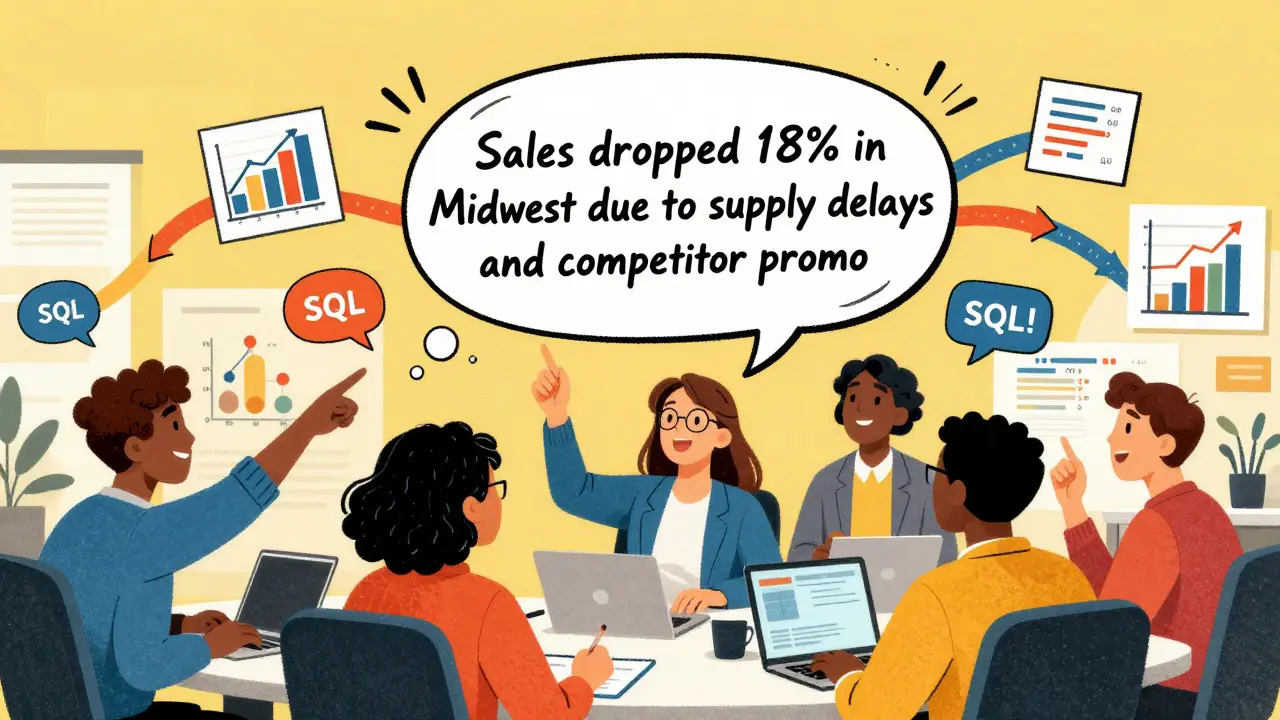
Imagine asking your data system, "Why did sales drop in the Midwest last quarter?" and getting back a clear, written explanation-complete with root causes, trends, and recommended actions-within seconds. No SQL queries. No pivot tables. No waiting for a data analyst. This isn’t science fiction. It’s what analytics teams are doing today with generative AI and natural language business intelligence (BI).
What Natural Language BI Actually Does
Natural Language BI lets anyone on the team talk to data like they’re talking to a colleague. Instead of typingSUM(sales) WHERE region = 'Midwest' AND date BETWEEN '2024-10-01' AND '2024-10-31', you just type your question in plain English. Behind the scenes, the system translates that into a database query, runs the analysis, and turns the results into a plain-language summary.
This isn’t just about convenience. It’s about speed. Before these tools, analysts spent 50 to 70% of their time cleaning data and writing reports. Now, with generative AI, that drops to under 10%. One retail analytics team in Chicago cut their weekly reporting time from 8 hours to 45 minutes. That’s not a small win-it’s a full-time role freed up for deeper work.
How Insight Narratives Turn Numbers into Decisions
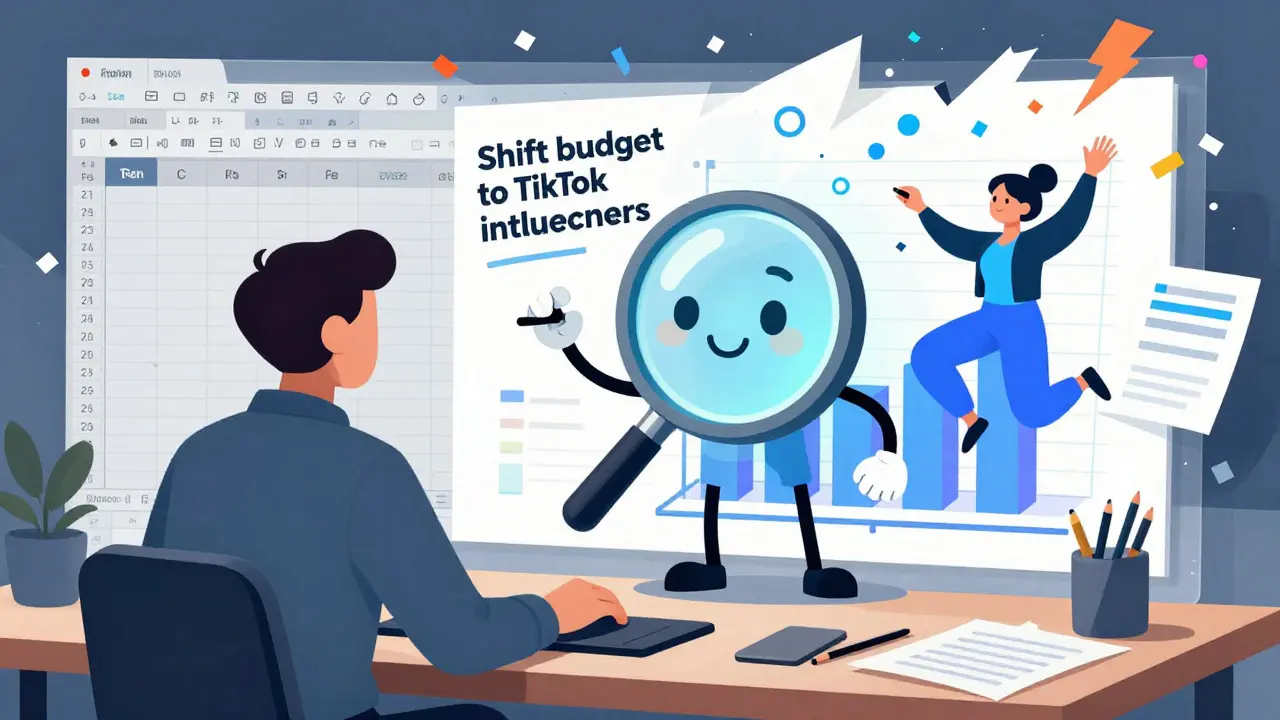
Numbers alone don’t drive action. Stories do. That’s where insight narratives come in.Take a finance team reviewing monthly P&Ls. Without AI, they’d stare at charts showing a 12% spike in customer acquisition costs. With insight narratives, the system says: "Customer acquisition costs rose 12% in November due to a new paid search campaign targeting Gen Z. While conversions increased by 8%, the cost per acquisition exceeded targets by 19%. Consider shifting budget to TikTok influencers, which delivered 32% lower CPA in Q3."
These aren’t generic templates. The best systems learn your company’s language. If your team calls profit margin "gross return," the AI uses that term. If your sales team refers to "high-value clients" as "Tier 1 accounts," the AI knows to match it. Systems that remember context-like past questions or department-specific jargon-see 42% higher user satisfaction, according to Nielsen Norman Group.
Who’s Leading the Pack?
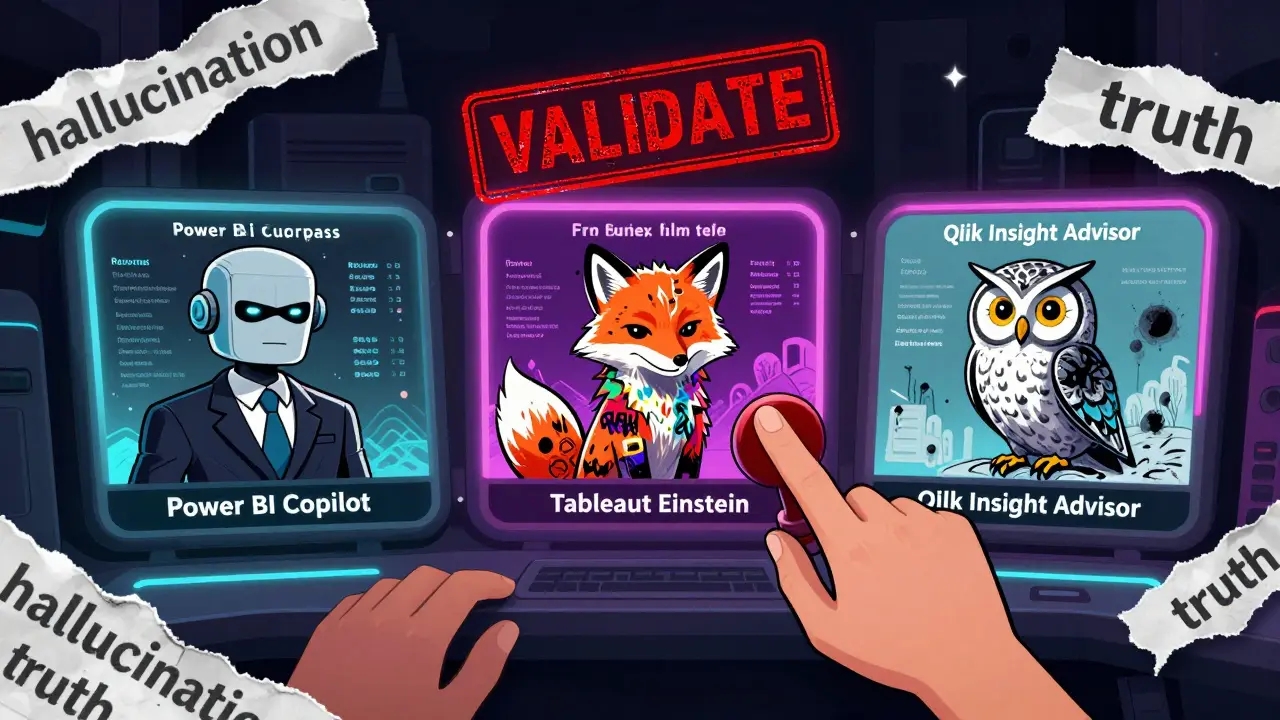
Not all natural language BI tools are the same. Three platforms dominate enterprise adoption:- Microsoft Power BI Copilot leads with 34% adoption among Fortune 500 companies. It works best if you’re already in the Microsoft ecosystem-Teams, Excel, Azure. But customization is limited.
- Tableau Einstein Copilot is strong in retail and e-commerce. It comes with pre-built retail templates and handles seasonal trends well, but its natural language accuracy is 15% lower than Power BI’s, per Dresner Advisory Services.
- Qlik Insight Advisor shines in storytelling. It crafts narratives that feel human, not robotic. But it needs more training data-about 30% more than the others-to get it right.
Specialized tools like Arria NLG hit 98% accuracy in generating regulatory reports for banks and insurers-but they don’t connect to dashboards. So they’re great for compliance teams, not for sales leaders checking weekly KPIs.
What You Need to Make This Work
Generative AI doesn’t work in a data swamp. If your data is messy, inconsistent, or siloed, the AI will give you garbage answers. Here’s what successful teams do:- Fix your metadata. Define what terms mean across departments. Is "revenue" gross or net? Is "active user" logged in once a month or five times?
- Connect your data sources. AI needs access to your warehouse or data lake. If you’re still using old Excel files or legacy systems without APIs, you’ll hit a wall. About 38% of companies struggle here.
- Train the AI on your business. Feed it past reports, approved summaries, and common questions. The more context it has, the less it hallucinates.
And yes, hallucinations happen. One finance team got a narrative claiming a 40% spike in returns due to "product defects," when the real cause was a shipping delay. The AI didn’t know the difference between "returns" and "damaged goods." That’s why validation is critical.
The New Skills Analytics Teams Need
Forget SQL. The new core skill is prompt engineering.It’s not about writing perfect sentences. It’s about asking the right questions. Instead of "Show me sales," you ask: "Compare Q4 2024 sales by product line and region, and explain why the top performer outperformed the rest by more than 25%."
Organizations are already requiring analytics staff to complete certified prompt engineering training. Sixty-eight percent now require it, according to Russell Reynolds Associates. Why? Because bad prompts lead to bad insights-and bad decisions.
Also, analysts are shifting from report builders to AI supervisors. One senior data scientist on Reddit said: "Copilot helped my team get answers in minutes, but now I spend 30% of my time checking its work." That’s not a failure-it’s evolution. You’re not being replaced. You’re being upgraded.
Where It Falls Short
Generative AI is powerful-but not magic. It’s best for descriptive analytics: what happened? and why? It’s not great at predicting the future. MIT found traditional data science methods are still 27% more accurate for forecasting models.Complex cross-dataset analysis also trips it up. If you’re comparing customer behavior across five systems with different IDs, accuracy drops to 78%. Human analysts still hit 92%.
And then there’s trust. A 2025 MIT Sloan Review study found 23% of executives accepted AI-generated insights without questioning them-even when the logic was flawed. That’s dangerous. AI doesn’t understand context the way a human does. It doesn’t know your company culture, your past mistakes, or your unspoken assumptions.
What’s Coming Next
The next wave is agentic AI. Microsoft announced at Convergence 2025 that its analytics agents will soon do more than answer questions-they’ll act. For example: if inventory levels drop below a threshold, the system doesn’t just say "Stock is low." It automatically triggers a purchase order, notifies the warehouse, and updates the finance forecast-all without human input.By 2026, Gartner predicts 35% of enterprise analytics will include image and video analysis. Imagine asking: "Why are returns up in the Southwest?" and the AI analyzing customer return photos to spot damaged packaging.
But adoption is still uneven. Only 27% of companies have rolled this out company-wide. Another 33% are using it in one department. Nearly half of leaders are still piloting it. That means if you wait, you’re falling behind.
Real Impact: ROI and Adoption
Every dollar spent on generative AI in analytics returns $4.80, according to AmplifAI’s 2025 analysis. That’s the highest ROI of any AI use case.The market is exploding-from $2.1 billion in 2024 to $8.7 billion by 2027. Finance and retail are leading adoption at 41% and 37% respectively. Why? Because they’re drowning in data and need faster decisions.
Organizations that adopt now are gaining a 66% productivity advantage, per Nielsen Norman Group. By 2026, MLQ.ai predicts the performance gap between AI-savvy teams and traditional ones will widen to 47%. That’s not a trend. That’s a divide.
Getting Started Without Overwhelm
You don’t need to rebuild your entire analytics stack. Start small:- Pick one team-maybe finance or marketing-that’s drowning in routine reports.
- Choose one tool: Power BI Copilot if you’re Microsoft-heavy; Tableau if you’re retail-focused.
- Define 3 key questions you want answered faster: "Why did churn go up?", "Which campaign delivered the best ROI?", "What’s the trend in customer complaints?"
- Train the AI with your past reports and terminology.
- Set up a weekly review: "Did the AI get it right? What did it miss?"
Within 4 to 6 weeks, you’ll see results. Within 3 months, your team will stop asking for reports-and start asking for insights.
Final Thought: Don’t Trust the AI. Trust the Process.
Generative AI won’t replace analysts. But analysts who use AI will replace those who don’t.The goal isn’t to automate insight. It’s to amplify human judgment. Use AI to handle the grunt work. Use your brain to ask the hard questions, challenge the assumptions, and make the final call.
Because in the end, data doesn’t make decisions. People do. And the best people are the ones who know how to use the tools-without letting the tools think for them.
Can non-technical staff use natural language BI without training?
Yes, but not perfectly. Business users can get basic answers within minutes of trying the tool. However, to get accurate, reliable insights, they need to learn how to ask better questions. Training takes about 14 hours of hands-on use-far less than the 80 hours needed for traditional BI tools. Without training, users often ask vague questions like "Show me sales," which leads to vague answers. With practice, they learn to ask: "Compare sales by region and product category last quarter, and explain the top 3 changes."
Do I need to clean my data before using generative AI?
Absolutely. Generative AI doesn’t fix bad data-it amplifies it. If your customer IDs are inconsistent, your sales figures are duplicated, or your region names vary between "Midwest" and "Mid-West," the AI will give you misleading answers. Successful teams spend the first 2-3 weeks cleaning metadata, defining business terms, and mapping data sources. Without this, even the best AI tool will produce unreliable narratives.
Is generative AI secure for sensitive business data?
It depends on the vendor and your controls. Leading platforms like Power BI Copilot and Tableau Einstein Copilot run on private cloud environments and don’t train models on your data. But you still need to enforce access rules, mask sensitive fields (like salaries or customer PII), and audit what questions are being asked. Sixty-two percent of enterprises are now building AI governance policies specifically for analytics teams to prevent leaks and compliance issues.
Can AI replace data analysts?
No-and that’s the point. AI takes over repetitive tasks: pulling reports, cleaning data, writing summaries. That frees analysts to focus on what humans do best: asking the right questions, interpreting context, challenging assumptions, and advising leadership. The role is changing, not disappearing. Analysts who learn to guide AI are becoming more valuable than ever.
What industries benefit most from natural language BI?
Finance and retail lead adoption. Finance teams use it to automate monthly P&L reviews and compliance reports. Retailers use it to track inventory, customer behavior, and campaign performance across hundreds of stores. But any team drowning in reports benefits: HR (turnover trends), supply chain (delivery delays), and marketing (campaign ROI). The common thread? High-volume data, frequent reporting needs, and non-technical decision-makers.
How accurate are AI-generated insights?
Accuracy varies. For simple questions on clean data, AI hits 90%+ accuracy. For complex cross-dataset analysis, it drops to 78%. Independent tests show natural language to SQL translation is 82-93% accurate. But the real risk isn’t math-it’s misinterpretation. AI can give you the right numbers with the wrong story. That’s why validation is key. Always ask: "Does this make sense? What’s missing?"





So now we pay $8.7B for a chatbot that can’t tell the difference between a shipping delay and a product defect? Brilliant. I’ll stick with my Excel sheets, thanks.
While I appreciate the technological advancement described herein, I must emphasize that the human element remains paramount. In my experience across African markets, data literacy is not merely a skill-it is a cultural imperative. Without foundational understanding, even the most sophisticated AI becomes a source of misinformation rather than insight.
Let’s not confuse automation with intelligence-AI generates narratives, yes, but narratives are not wisdom. Wisdom requires context, history, irony, and the quiet, unquantifiable weight of lived experience. The machine doesn’t know why your sales team hates the word ‘conversion’-but you do. And that? That’s the part that matters.
Also: who decided that ‘Tier 1 accounts’ was the right term? Was there a vote? A committee? A drunken Slack thread at 2 a.m.? The AI doesn’t care. It just mirrors. And mirrors lie.
And don’t get me started on ‘agentic AI.’ If a machine can trigger a purchase order without human review, who’s liable when it orders 10,000 paperclips because ‘inventory is low’? The machine? The CFO? The intern who typed ‘low’ instead of ‘lowish’?
Technology doesn’t evolve in a vacuum. It evolves in the mess of human inconsistency-and we’re pretending we can outsource judgment to a statistical parrot.
Stop pretending this is revolutionary. You still need to clean your data. You still need to train it. You still need to check its work. All you did was make the same old garbage-in-garbage-out process sound fancy with buzzwords. And now everyone’s paying $4.80 back for a glorified autocomplete. Pathetic.
I’ve seen this movie before. Remember when everyone swore BI tools would kill the analyst? Then we got 10x more reports. Now we’re gonna get 10x more AI-generated fluff that sounds smart but means nothing. Give me a break.
You think training the AI on your jargon fixes anything? Ha. You’re just teaching it to lie better. My team used this tool and it said 'revenue growth was driven by customer loyalty'-except we didn’t have a loyalty program. The AI hallucinated it from a typo in a 2021 email. And now the CFO believes in ghosts. Congrats.
I’ve seen teams struggle with this tech, but I’ve also seen them thrive-when leadership actually supports the change. The key isn’t the tool. It’s the culture. If you reward curiosity over compliance, if you encourage people to say ‘I don’t understand’ instead of nodding along, then AI becomes a partner. Not a crutch. Not a threat. A tool that lets us focus on what actually matters: asking better questions.
And yes-validation is non-negotiable. But so is trust. Build both.
It is imperative to recognize that the transition from manual analytics to AI-augmented decision-making constitutes not merely a technological shift, but an epistemological one. The epistemic authority once vested in the analyst-who interpreted data through the lens of domain expertise, institutional memory, and contextual nuance-is now, in part, delegated to algorithmic systems whose internal logic remains opaque even to their creators.
Furthermore, the assertion that 'analysts are being upgraded' risks semantic obfuscation; the role is being redefined, not elevated. The new competency of prompt engineering, while valuable, is fundamentally a linguistic interface skill, not a statistical or inferential one. One may master the syntax of inquiry without mastering the substance of analysis.
It is also noteworthy that the cited ROI figures derive from vendor-sponsored studies, and the sample bias inherent in enterprise adoption data must be critically interrogated. The 47% performance gap projected by MLQ.ai presumes uniform implementation quality, which, in practice, is demonstrably false.
Thus, while the potential is undeniable, the uncritical embrace of generative AI as a panacea for analytical inefficiency constitutes a form of technocratic hubris. The human mind remains the only instrument capable of discerning the difference between correlation and causation, between signal and noise, and between truth and plausible fiction.