
Financial Services Use Cases for Large Language Models in Risk and Compliance
Financial institutions aren’t just using Large Language Models (LLMs) to answer customer questions or draft emails. They’re deploying them to catch fraud before it happens, cut through mountains of regulatory paperwork, and make sure every decision leaves an audit trail. And it’s not science fiction - banks, insurers, and investment firms are already seeing real results. But getting this right isn’t about slapping an AI chatbot on your website. It’s about building systems that understand money, law, and risk - and doing it safely.
How LLMs Are Catching Fraud Before It Happens
Traditional fraud detection systems rely on rules: "If a transaction exceeds $5,000 and occurs at 3 a.m., flag it." That works for obvious cases, but fraudsters adapt fast. LLMs change the game by reading between the lines. They don’t just look at numbers - they analyze patterns in customer behavior, email exchanges, chat logs, and even social media posts linked to accounts. For example, a customer suddenly starts sending messages with unusual language - "I need to move this cash immediately" or "My uncle is sick, can you waive the fee?" - while also making small,试探性 transactions. A rule-based system might miss this. An LLM trained on decades of fraud cases recognizes the linguistic red flags and ties them to behavioral shifts. One U.S. regional bank reported a 22% drop in fraudulent account takeovers after integrating LLM-based behavioral analysis into its monitoring stack. These models also cross-reference transaction data with external sources: news about a company’s bankruptcy, a CEO’s arrest, or a surge in phishing attempts targeting a specific region. The result? A risk score that evolves in real time, not just when a transaction hits a threshold.Turning Legal Documents Into Actionable Insights
Compliance teams used to spend weeks sifting through contracts, regulatory filings, and internal audit reports. Now, LLMs do the heavy lifting. Multi-modal models can ingest PDFs, scanned forms, handwritten notes, and Word docs - then extract key clauses, summarize obligations, and flag inconsistencies. Take a loan agreement. An LLM doesn’t just find the interest rate. It checks whether the terms match current state regulations, compares the language to past agreements flagged for non-compliance, and highlights clauses that could expose the bank to liability. One major European bank cut document review time for new mortgage applications from 14 days to under 48 hours, while reducing compliance errors by 38%. This isn’t about replacing lawyers. It’s about giving them superpowers. Instead of reading 500 pages, a compliance officer gets a summary: "Clause 7.3 conflicts with SEC Rule 15c6-1. Recommendation: Amend to align with 2025 deadline." That’s time saved - and risk reduced.Keeping Up With Regulations That Never Stop Changing
Regulatory guidelines shift constantly. A new anti-money laundering rule in the EU. A revised KYC requirement in Singapore. A court decision in the U.S. that redefines "suspicious activity." Keeping up manually is impossible. LLMs now act as real-time regulatory scanners. They’re fed official sources - central bank bulletins, FINRA notices, SEC filings - and trained to understand legal language. When a new rule drops, the model doesn’t just store it. It cross-references it with internal policies, identifies gaps, and auto-generates update memos for compliance teams. One asset management firm in Boston automated its regulatory monitoring. Before, they had a team of three analysts reading 15+ sources daily. Now, an LLM does the initial scan, flags only the high-impact changes, and surfaces them with context: "This affects your client onboarding process in California. Here’s the exact wording you need to add to Form 421-B." The result? A 40% reduction in missed regulatory updates and zero penalties from missed deadlines in the last 18 months.
The Hidden Power of Data Synthesis
LLMs don’t just analyze existing data - they create it. In risk modeling, you often lack enough real-world examples. How do you test a new money laundering detection model when you’ve only seen 12 actual cases in the last year? That’s where synthetic data comes in. LLMs can generate thousands of realistic, anonymized transaction scenarios based on historical patterns. They simulate how fraudsters might behave under new conditions - say, after a cryptocurrency exchange shuts down. These synthetic datasets train models to spot anomalies that real data alone wouldn’t reveal. One insurance company used this to improve its fraud detection for medical claims. By generating synthetic claims with subtle red flags - mismatched dates, inconsistent provider codes, unusual billing codes - they trained their model to catch 63% more fraudulent submissions than before. It’s not magic. It’s math. And it’s legal - as long as the synthetic data is properly anonymized and doesn’t replicate real customer identities.Why FinLLMs Beat General-Purpose Models
You might think any big AI model - like GPT-4 or Gemini - would work fine for finance. But financial language is its own dialect. "EBITDA" isn’t just a word. It’s a metric with legal implications. "Margin call" isn’t a casual phrase - it triggers immediate action. General models often misinterpret context. A FinLLM, fine-tuned on SEC filings, earnings calls, and regulatory texts, understands that "liquidate" in a trading memo means something very different than in a customer support chat. A 2025 study comparing FinLLMs against general-purpose models found FinLLMs were 31% more accurate in classifying regulatory documents and 27% better at detecting subtle language cues in compliance violations. They also used 60% less computing power - a big deal for banks with strict cost controls. The best approach? Hybrid. Use a powerful general model to understand broad context, then layer in a FinLLM for precision. Combine that with Retrieval-Augmented Generation (RAG), where the model pulls from your bank’s internal policies, legal databases, and past audit findings. That way, answers aren’t just smart - they’re grounded in your specific rules.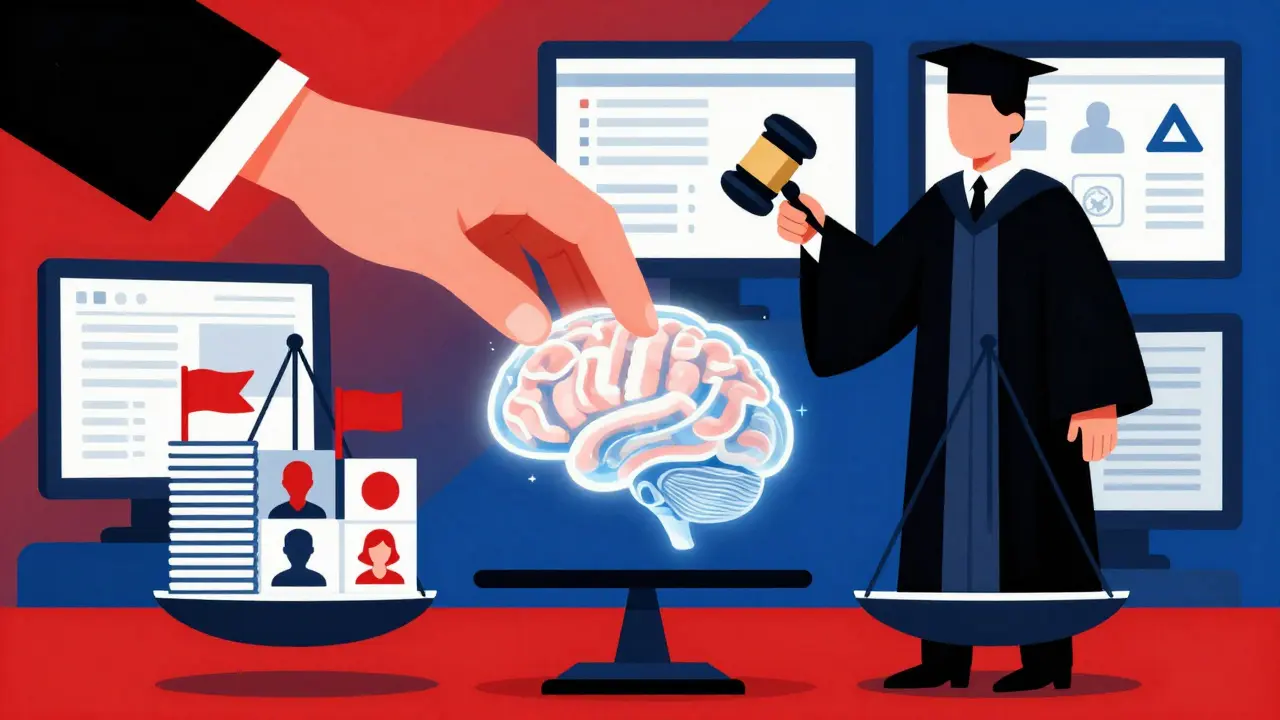
The Audit Trail Problem
Here’s the catch: regulators don’t care how smart your AI is. They care if you can explain why it made a decision. An LLM flagged a transaction as high-risk. Why? Because the customer’s email tone changed? Because they opened three accounts in three days? Because their IP address matched one used in a past fraud case? If you can’t answer that, you’re in trouble. That’s why explainability isn’t optional - it’s built into the architecture. Leading financial institutions now use LLMs that log every step: which documents were referenced, which data points triggered the alert, and how confidence scores were calculated. Some even generate plain-language summaries: "Flagged due to 3 unusual login attempts from a new device, combined with a 40% spike in outbound transfers to offshore accounts." This isn’t just for regulators. It’s for internal auditors, legal teams, and even customers who dispute a decision.What Happens When It Goes Wrong?
LLMs hallucinate. They make up facts. They misread contracts. They inherit biases from training data. A U.K. bank once used an LLM to automate loan eligibility checks. It rejected 12% of applicants from a specific zip code - not because of income, but because historical data showed higher defaults there. The model didn’t understand context. It just repeated patterns. That’s why every LLM deployment in finance needs three guardrails:- Human oversight - No decision that affects a customer’s account or triggers a regulatory report is final without a human review.
- Continuous monitoring - Track accuracy, bias drift, and performance decay. If the model’s error rate jumps by 5% in a month, pause and investigate.
- Secure data pipelines - Never feed live customer data into public LLMs. Use private, on-premise models or encrypted cloud environments with strict access controls.
Where This Is Headed in 2026
By the end of this year, expect to see:- Automated regulatory reporting - LLMs that compile quarterly filings from internal data and submit them directly to regulators.
- Real-time compliance dashboards - Live feeds showing which departments are at risk, what regulations are changing, and how your controls are performing.
- LLM-powered audit assistants - AI that walks auditors through past decisions, highlights anomalies, and suggests next steps.
Can LLMs replace compliance officers?
No. LLMs are tools, not replacements. They handle repetitive tasks like document review, data extraction, and alert generation - tasks that take hours for humans. But compliance officers still make final judgments, interpret gray areas, respond to regulators, and ensure ethical standards. The best teams now work side-by-side with AI, using it to be faster and more accurate - not to cut staff.
Are FinLLMs more secure than general LLMs?
Yes, in key ways. FinLLMs are typically trained on private, internal data and deployed in secure, air-gapped environments. They don’t rely on public internet sources, reducing exposure to data leaks. General LLMs like ChatGPT can accidentally memorize and reproduce sensitive information. FinLLMs avoid that by design - making them far safer for handling customer data, transaction histories, and regulatory documents.
How do I know if my LLM is biased?
Test it. Run simulations across demographic groups - age, gender, location, income level - and compare outcomes. If the model flags transactions from one zip code 3x more often than others with similar risk profiles, that’s bias. Use fairness metrics like demographic parity and equal opportunity difference. Many banks now run monthly bias audits using open-source tools like IBM’s AI Fairness 360. If you’re not doing this, you’re at risk of regulatory action.
Do I need a PhD to implement LLMs for compliance?
No. You need a clear goal, a good vendor or internal team, and strong governance. Start small: pick one high-friction task - like reviewing loan applications or categorizing customer complaints. Test a FinLLM on that. Measure results. If it saves time and reduces errors, scale it. Most successful implementations began with one team, one use case, and a pilot. You don’t need AI experts - you need compliance experts who understand what needs fixing.
What’s the biggest mistake banks make with LLMs?
Starting with the technology instead of the problem. Many banks buy an LLM because it’s trendy, then try to force it into compliance workflows. That fails. The right approach: find the task that’s slow, error-prone, and costly - then match the AI tool to it. Don’t ask, "What can AI do?" Ask, "What’s breaking in our compliance process?"








This is actually happening in real time. My cousin works at a regional bank and said their fraud team cut false positives by over 60% in six months. No more midnight alerts for 'unusual' $4,999 transfers. The AI just knows when something's off - even if the numbers look clean.
It’s not magic. It’s pattern recognition trained on real fraud, not hypotheticals.
We’re letting machines decide who gets loans now? Next thing you know, they’ll be auditing Congress. This isn’t innovation - it’s surrender. If you can’t explain why a human made a decision, you shouldn’t be in finance. You should be in IT.
Bro, FinLLMs are the real MVPs now. General LLMs? Nah. They don’t get that 'margin call' isn’t a yoga session. I’ve seen teams go from 14-day document reviews to under 48 hours. That’s not efficiency - that’s survival.
And synthetic data? Genius. You can’t train on 12 fraud cases. You need 10,000 fake-but-plausible ones. It’s like simulating a bank heist in a video game - except the stakes are real.
Just don’t let the model near your customer data. Air-gap everything. Trust me.
I want to commend the thoughtful structure of this piece. The emphasis on human oversight, explainability, and phased implementation reflects a mature understanding of AI integration. Too often, institutions rush into automation without addressing governance, which leads to regulatory exposure.
It is encouraging to see organizations prioritize risk mitigation over technological novelty. The hybrid model - general LLM for context, FinLLM for precision - is not merely optimal, it is necessary.
I appreciate how this breaks down the practical applications without overselling the tech. The audit trail point is critical - regulators don’t care how smart the model is if you can’t show your work. I’ve seen firms get fined because their AI said 'yes' and no one could explain why.
Also, the synthetic data angle is under-discussed. Generating realistic fraud scenarios isn’t just helpful - it’s essential when real cases are too rare to train on. That’s not cutting corners. That’s smart engineering.
The biggest mistake banks make is assuming the AI will fix broken processes. It won’t. It will amplify them. If your compliance team is drowning in paperwork because of outdated workflows, throwing an LLM at it won’t help - it’ll just make the mess louder.
Start with the problem. Not the tool. Fix the process first. Then let the AI handle the repetition. Otherwise, you’re just automating inefficiency - and that’s a liability waiting to happen.
I’ve been in compliance for 18 years. This is the first time I’ve seen tech actually reduce our workload without increasing risk. The real win? We’re not hiring more staff. We’re retraining them to do higher-value work - like interpreting gray-area cases and talking to regulators. The AI doesn’t replace us. It lets us be better.