
Integrating Consent Management Platforms into Vibe-Coded Websites
You just spent an hour talking to an AI agent, and suddenly you have a fully functioning, beautiful website. No matter if you used a natural language prompt or a visual builder, the site feels right-it has the exact "vibe" you wanted. But here is the cold shower: the moment you go live, you are legally responsible for how you handle user data. If you are targeting users in Europe or California, a pretty interface isn't enough. You need a way to manage cookies and data privacy without breaking the seamless flow of your AI-generated site.
What exactly is vibe coding?
Before we tackle the legal side, we need to define the environment. Vibe Coding is a modern development approach where applications are created using natural language prompts, AI copilots, and visual builders instead of traditional manual hand-coding. In this world, the "developer" acts more like a creative director. You describe the feeling and functionality you want, and tools like Cursor or other LLM-powered IDEs handle the actual syntax. It is the ultimate democratization of software creation, but it creates a unique challenge: when the AI writes the code, do you actually know where the data is leaking?
The role of a Consent Management Platform
When you add a third-party analytics tool or a payment gateway to your site, you are usually dropping cookies into your visitor's browser. That is where a Consent Management Platform (or CMP) comes in. A CMP is a specialized tool designed to manage user consent for cookies and data collection, ensuring the site complies with privacy laws like GDPR (General Data Protection Regulation) in the EU and CCPA (California Consumer Privacy Act) in the US.
Without a CMP, you are basically guessing if your site is legal. A CMP automates the boring stuff: it scans your site for cookies, creates a banner that actually meets legal standards, and keeps a log of who said "yes" and who said "no." For a vibe-coded site, the goal is to integrate this without spending three days reading documentation.
Integration patterns for AI-generated sites
Since vibe-coded sites aren't usually built with a rigid, multi-layered architecture from the start, the integration pattern is typically script-based embedding. You aren't building a custom consent API; you are plugging in a managed service.
Take Cookiebot as a primary example. This CMP uses a lightweight script that needs to be the very first thing that loads on your page. Why? Because if your Google Analytics script loads before the Cookiebot script, you've already collected data without consent, and you've technically broken the law.
Here is the typical workflow for a vibe-coder:
- The Setup: You sign up for the CMP and let it scan your domain to find all the "hidden" cookies your AI might have implemented through third-party libraries.
- The Prompt: Instead of hunting through files, you tell your AI copilot: "I have this Cookiebot script. Please embed it into the head section of every page on my site so it loads before any other scripts."
- The Deployment: You push the changes. Because vibe coding relies on rapid iteration, you can immediately check the live site to see if the banner appears at the bottom.
- The Tuning: You decide between auto-blocking (where the CMP automatically stops cookies until consent is given) or manual blocking (where you tell the AI to wrap specific scripts in a conditional statement).
| Method | Effort | Control | Best For |
|---|---|---|---|
| Script Embedding | Very Low | Medium | Rapidly deployed AI sites |
| AI-Wrapped Logic | Medium | High | Custom healthcare or FinTech apps |
| Visual Builder Plugin | Low | Low | No-code vibe sites |

The hidden dangers of "just prompting it"
It sounds easy to just tell an AI to "make it compliant," but that is a dangerous game. AI doesn't actually know the current legal requirements of the EU AI Act or specific state laws in the US. It only knows how to place a script where you tell it to.
One major pitfall is script ordering. If your AI places the CMP script at the bottom of the HTML body, it's useless. The browser will have already executed the tracking pixels at the top of the page. You must explicitly instruct the AI to place the script in the <head> tag.
Another issue is scan accuracy. Many vibe-coders rely on the CMP's auto-scan. While helpful, these scans can sometimes miss cookies set by complex JavaScript functions that the AI generated on the fly. If you're building something that handles sensitive data-like a health tracker or a financial tool-you cannot rely on a simple banner. You need a full audit of your data storage and model training pipelines to ensure you aren't leaking user info into a public LLM training set.
Balancing the "Vibe" with the Law
The biggest fear for anyone vibe-coding is that a giant, ugly cookie banner will ruin the aesthetic of their site. Fortunately, modern CMPs allow for heavy customization. You can prompt your AI to write CSS that styles the banner to match your site's color palette, typography, and spacing.
But remember, the law requires that "Reject All" be as easy to find as "Accept All." If you hide the reject button inside a sub-menu to keep the vibe "clean," you are inviting a regulatory fine. The trend in 2026 is Privacy-by-Design, where consent is woven into the user experience rather than slapped on as an afterthought.
Future-proofing your AI site
As we move further into the era of AI-driven software, the line between the frontend and the backend is blurring. Your site might not even be a static set of pages; it might be a dynamic interface that changes based on the user's mood. In this scenario, a static cookie banner is insufficient.
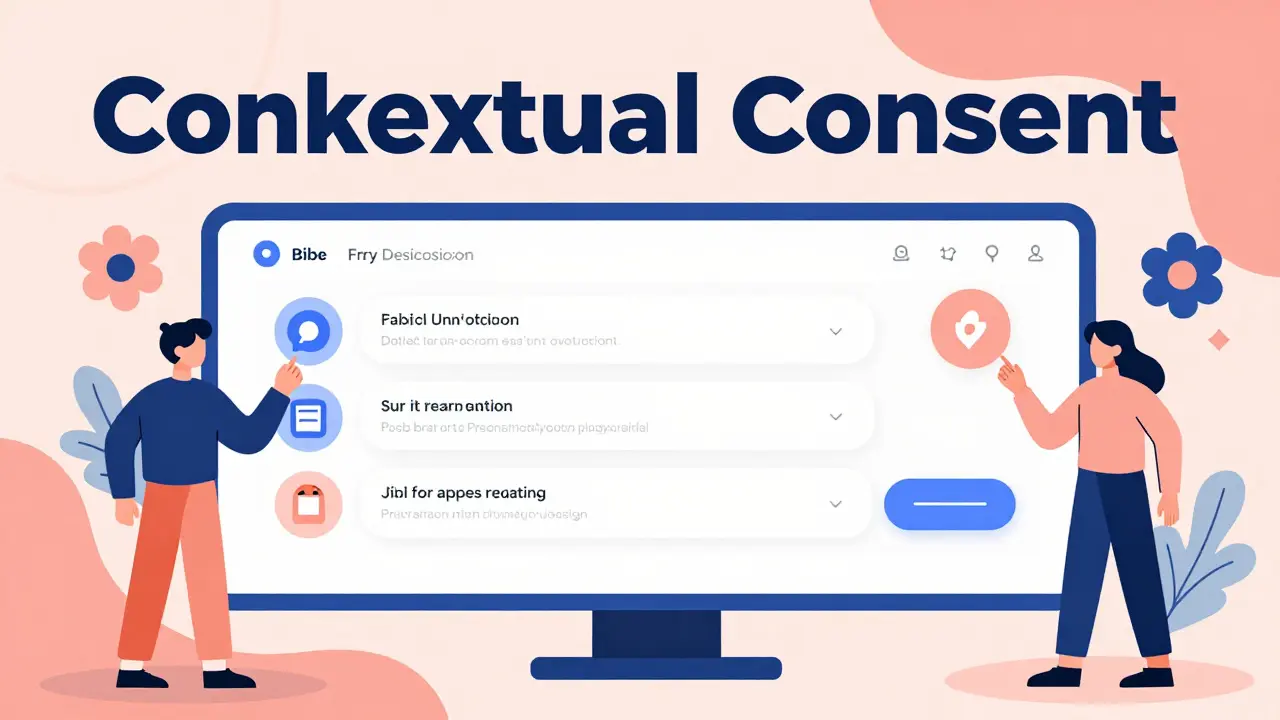
We are seeing a shift toward Contextual Consent. Instead of one big popup at the start, the site asks for permission the moment a specific feature is used. For example, the site doesn't ask for location data upon landing; it asks when the user clicks "Find a store near me." This keeps the vibe high and the compliance tight.
Can I just ask my AI to make the site GDPR compliant?
No. An AI can write the code for a banner, but it cannot provide legal certification or actually manage the consent logs required for an audit. You need a dedicated Consent Management Platform (CMP) to store the legal proof of consent.
Does Cookiebot work with vibe-coded tools like Cursor?
Yes. Since Cursor and similar tools edit standard HTML/JS files, you can simply provide the CMP's script and instruct the AI to place it in the head section of your project.
What is the difference between auto-blocking and manual blocking?
Auto-blocking uses the CMP's intelligence to stop known cookies from loading until the user clicks "okay." Manual blocking requires you to wrap your scripts in specific code that only triggers after consent is granted. Auto-blocking is much easier for vibe-coders.
Will a CMP slow down my AI-generated site?
Most modern CMP scripts are asynchronous, meaning they don't stop the rest of the page from loading. However, because they must load first to be effective, they can add a few milliseconds to the initial page load.
Do I need a CMP if I don't use cookies?
If you are truly not collecting any personal data, using tracking pixels, or using third-party scripts (like Google Fonts or Analytics), you might not need a full CMP. However, most vibe-coded sites use at least one external library, making a CMP a safe bet.
Next Steps for Vibe-Coders
If you've just launched a site, don't leave your privacy to chance. First, run a manual scan of your site using a tool like Cookiebot to see what's actually running in the background. If you find tracking scripts you didn't explicitly ask for, your AI may have added them as part of a template.
For those building complex apps, move beyond the basic script. Start documenting your data flows-where does user info go? Does it hit an API? Is it stored in a database? When you can map the data, you can tell your AI to implement a more robust, granular consent system that protects both you and your users.







This is absolutely electric stuff! 🚀 The way we can just vibe out a whole site and then snap it into legal compliance with a few prompts is just mind-blowing. Keep pushing the boundaries, everyone! Let's turn these digital dreams into rock-solid realities!
Wake up people! You think a "CMP" is for your safety? It is just another layer of surveillance. These tools are designed to make us feel safe while the AI actually maps your entire biological signature through your browser. It is all a game to control the masses and the "vibe" is just a distraction from the digital prison they are building around us!
I really enjoyed the flow of this piece! Just a tiny note, though-I noticed a couple of spots where the punctuation felt a bit off in the table descriptions, but the overall energy is fantastic. I'm definitely going to try integrating a CMP into my next project!
It is profoundly disappointing that many modern developers prioritize the so-called "vibe" of a website over the fundamental ethical obligation to protect user privacy. One must realize that the mere act of employing an AI to generate code without a thorough understanding of the underlying data flows is not merely an efficiency gain, but rather a dereliction of professional duty. True craftsmanship in the digital age requires a rigorous adherence to legal standards and a moral commitment to transparency, rather than relying on the automated shortcuts provided by a script-based embedding system which, while convenient, often fails to address the nuanced requirements of the GDPR in a comprehensive manner. We must hold ourselves to a higher standard if we wish to maintain any semblance of integrity in the software engineering industry.
Totally agree with the point about script ordering! It is such a game-changer when you realize the AI doesn't just "know" the law. But hey, that's the beauty of it-we get to be the captains of the ship! Let's keep learning and building awesome things together!
Very usefull info. I think we shuld also consider how this affects users from diffrent culturs who might not trust these banners as much. Its important to keep things respectfull and clear for everyone regardless of where they are from. Thnx for sharing!
So true about the aesthetics! 🌸 I always worry that the legal stuff will ruin the mood of my pages, but the idea of CSS styling for the banner is a lifesaver! ✨💖
makes sense.
I can see how stressful it is to worry about fines while just trying to be creative. It's nice to have a simple way to handle it.
I'm with you on the contextual consent part. It's a much more natural way to handle things. For those starting out, just take it slow and double-check your head tags like the post suggests. It's a common mistake but an easy fix.