How to Build a Domain-Aware LLM: The Right Pretraining Corpus Composition
Most people think training a powerful language model is all about data size. More text = better model. But that’s not how it works anymore. If you stack together every scrap of web text, books, and code you can find, you’ll end up with a model that’s decent at everything and terrible at anything specific. The real breakthrough isn’t in training longer-it’s in what you train on. This is where pretraining corpus composition becomes critical.
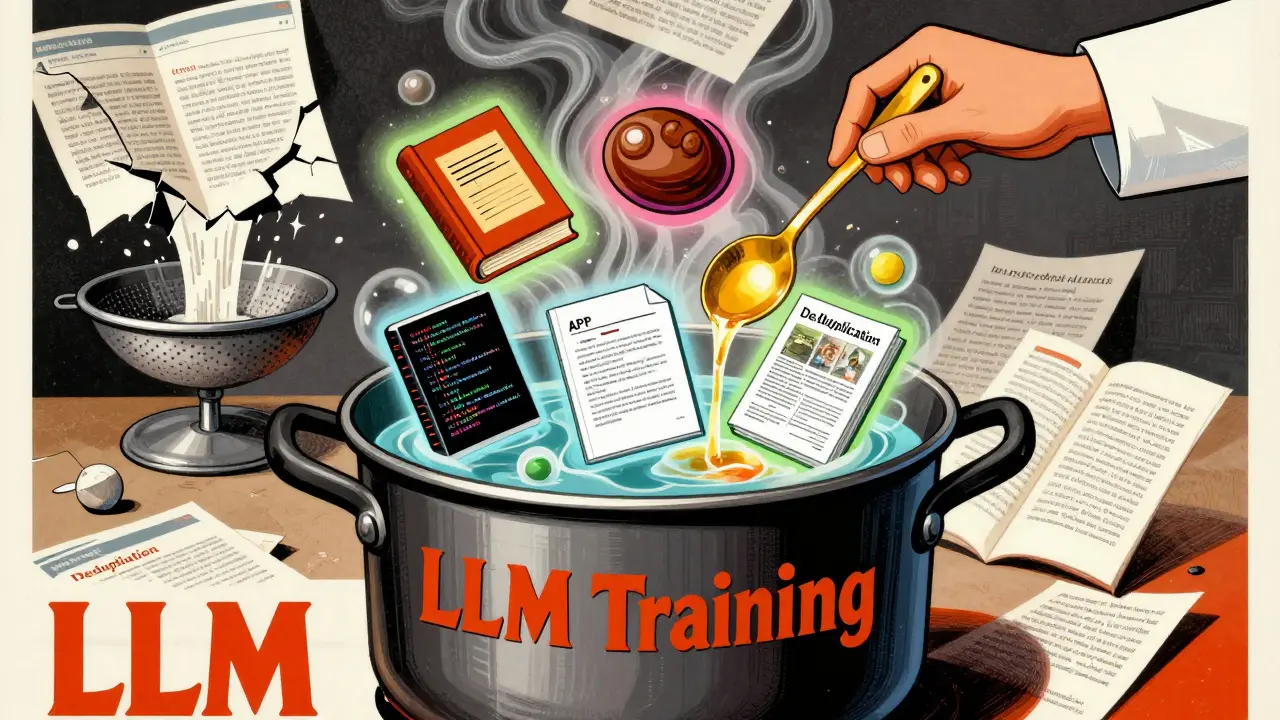
Think of it like cooking. You wouldn’t make a gourmet French dish by dumping every ingredient in your pantry into one pot. You pick the right herbs, balance the flavors, and remove the ones that clash. The same goes for training large language models. The goal isn’t just to feed the model as much text as possible. It’s to feed it the right kind of text, in the right proportions, so it becomes sharp in one area without forgetting how to talk normally.
Why General Data Doesn’t Cut It Anymore
Early models like GPT-3 and BERT were trained on huge, messy datasets-mostly web pages, Wikipedia, and public books. These models learned to answer general questions, write essays, and even joke around. But when you asked them to read a legal contract, diagnose a rare disease, or debug a Python script in a specific framework? They struggled. Why? Because those tasks need specialized knowledge, not just broad vocabulary.
Studies from 2024 show that general-purpose models achieve only 67.2% accuracy on scientific reasoning tasks, even after fine-tuning. Meanwhile, models trained on carefully composed domain-specific corpora hit over 85% on the same tasks. The difference? It’s not the number of parameters. It’s the data.
For example, a model trained only on general web text learns to mimic popular phrases-but it doesn’t learn how to reason. It sees “quantum entanglement” a thousand times in pop science articles and thinks it understands it. But if you give it actual peer-reviewed physics papers, it starts to grasp the structure, terminology, and logic behind the concept. That’s the power of targeted data.
The Five Core Data Categories That Matter
Researchers have identified five major types of data that make up a high-performing domain-aware corpus. Not all are created equal. Some boost reasoning. Others fix hallucinations. Some even reduce bias.
- Books - Especially nonfiction. These show a 0.82 correlation with factual knowledge and 0.76 with reasoning. They’re dense, well-structured, and edited. A single textbook can teach more than a million web pages.
- Scientific Papers - Peer-reviewed articles in medicine, law, engineering. These teach precision. A model trained on PubMed abstracts learns to cite sources, recognize uncertainty, and avoid overstatement.
- Code - Not just GitHub repos, but code with documentation, comments, and issue threads. Code makes up 5-15% of optimal technical corpora and improves programming skills by over 30%. It teaches logic, structure, and debugging.
- Algorithm Documentation - This one’s surprising. Technical manuals, API docs, and protocol specs. Even though they make up less than 0.5% of most corpora, they improve mathematical reasoning by 14.2 percentage points. Why? Because they’re precise. No fluff. Just rules.
- General Knowledge Text - Wikipedia, encyclopedias, curated question-answer pairs. These aren’t optional. They prevent domain models from forgetting how to answer simple questions. Without them, your legal AI can’t explain what a “contract” is.
Here’s the catch: mixing these wrong can hurt performance. Too much legal text? The model starts rejecting questions about cats. Too much web text? It starts making up facts. The trick is balance.
The Magic Numbers: Ratios That Actually Work
There’s no one-size-fits-all ratio. But research from ACL 2025 and the February 2024 arXiv study gives us solid starting points.
For a multilingual model focused on Chinese and English markets, a 1:4 ratio of Chinese to English text works best. Go beyond that-say, 30% Chinese-and English proficiency drops sharply. The model starts confusing grammar rules.
For a medical domain model, the sweet spot is 70% medical literature (papers, clinical notes, drug databases) and 30% general knowledge. That’s what the Harvard Medical AI team used to cut hallucinations from 22% to 8%. Too much medical data? The model becomes overconfident. It starts diagnosing rare conditions that don’t exist.
For legal AI, a 75:25 split of legal documents to general text delivered 92% accuracy on contract analysis-beating GPT-4 by 17 points. But here’s the twist: the legal documents had to be cleaned. Not just deduplicated. Context-filtered. A contract signed in 1998 might use outdated terms. A 2023 court ruling might cite a precedent that was later overturned. Quality matters more than quantity.
Preprocessing: The Hidden 30% of Training
You can’t just dump raw data into a model. You have to clean it. And not just a little.
Three levels of deduplication are now standard:
- Document-level - Remove exact copies of entire pages.
- Sentence-level - Kill duplicate paragraphs across documents.
- Token-level - Remove overlapping phrases, even if they’re reworded.
This isn’t just about saving space. It’s about accuracy. According to NeurIPS 2024, this three-step cleaning improved factual knowledge benchmarks by 2.3% to 5.7%. Why? Because models over-index on repeated misinformation. If a fake news article gets copied 12 times across 100 websites, the model thinks it’s truth. Deduplication stops that.
Then there’s quality filtering. Tools trained to spot high-quality text (like those from Ritwik Raha’s 2024 guide) can identify clean, authoritative content with 92.4% accuracy. They look for:
- Grammar consistency
- Source credibility
- Depth of explanation
- Avoidance of clickbait phrases
And tokenization? That’s not just splitting words. It’s matching the model’s architecture. A model with a 50,000-token vocabulary needs different preprocessing than one with 128,000. Get this wrong, and you’re wasting 15-20% of your data.
What Happens When You Get It Wrong
Real-world failures are brutal.
A legal tech startup trained a model on 100% legal documents. It became a genius at interpreting contracts. But when a user asked, “What’s a tort?” it gave a 200-word definition full of jargon-then refused to explain it in plain English. They had to go back and add 20% general text to teach it how to translate expertise into usability.
Another team trained a finance chatbot on 90% financial reports. It nailed stock analysis. But when users asked about weather delays or travel insurance, it crashed. They added 10% general knowledge data and saw general conversation quality jump from 48% to 81% accuracy.
And then there’s bias. Dr. Timnit Gebru’s warning is real: domain models can amplify existing biases. A legal model trained on old court rulings might reproduce gendered language 22% more than a general model. Why? Because those rulings reflect outdated social norms. Without deliberate correction, the model learns to echo them.

What’s Next: Dynamic Corpus Composition
The next leap isn’t just building a corpus once. It’s changing it during training.
Meta’s December 2024 prototype adjusts data proportions on the fly. If the model’s math reasoning starts to slip, it automatically boosts algorithm documentation. If hallucinations rise, it increases general knowledge text. This isn’t science fiction-it’s being tested in production.
By 2026, Gartner predicts 68% of enterprise LLMs will use this approach instead of fine-tuning general models. Why? Because fine-tuning is expensive. It needs hours of retraining. Corpus composition? You build it once, train once, and deploy smarter.
And cost savings? Real. A domain-aware model trained on 98.5 billion tokens can outperform a general model trained on 2 trillion tokens-while using 60% less compute during inference. That’s not just smarter. It’s cheaper.
Final Rule: Quality Over Quantity
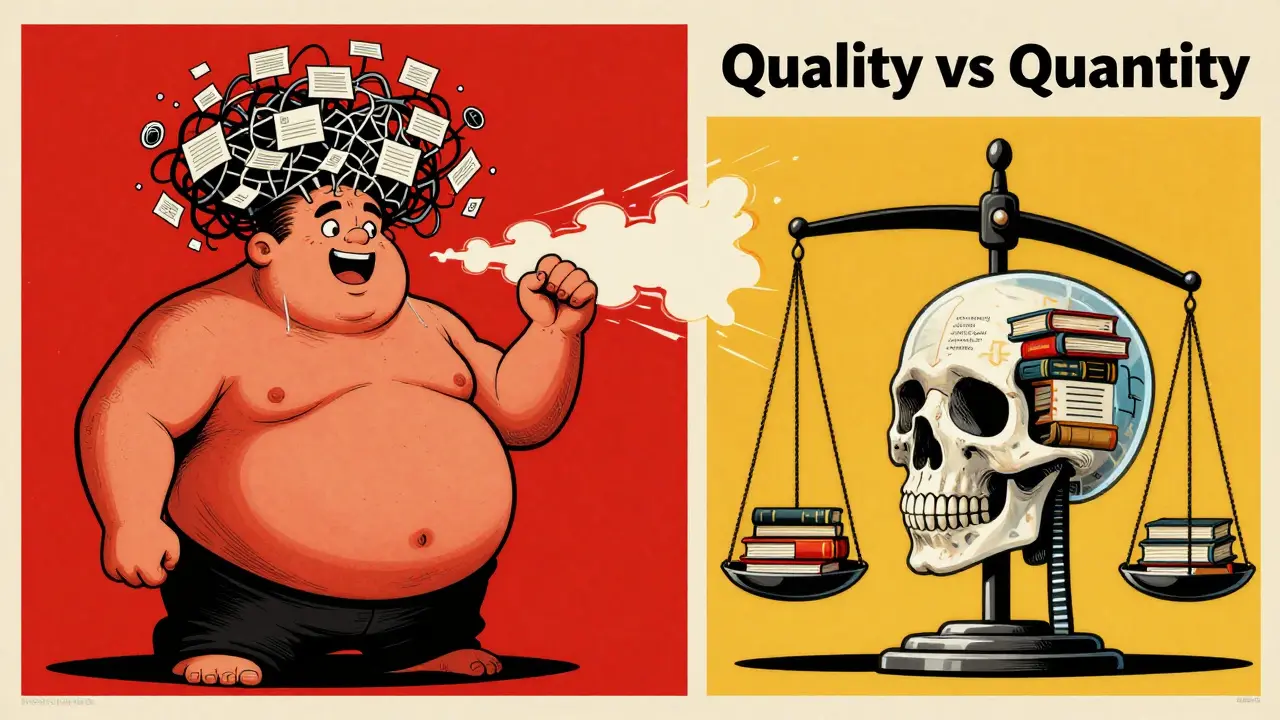
There’s a myth that bigger is better. It’s not. A 2-trillion-token corpus of messy web text is worse than a 100-billion-token corpus of clean, curated, balanced data.
Start with these three rules:
- Define your domain first - What tasks will the model actually do? Don’t guess. Map them.
- Choose data by function - Not by source. Books for reasoning. Code for logic. Docs for precision.
- Test with ablation - Train three versions: one with 100% domain data, one with 70/30, one with 50/50. Measure performance on real tasks. Don’t assume.
The future of AI isn’t in bigger models. It’s in smarter data. The best LLMs aren’t the ones that saw the most text. They’re the ones that saw the right text.
What’s the minimum corpus size for a domain-aware LLM?
There’s no fixed number, but research shows effective specialization starts around 10-100 billion tokens. For example, a legal domain model trained on 50 billion tokens of clean legal documents plus 20% general text outperformed GPT-4 on contract analysis. Smaller corpora (under 5 billion) rarely achieve strong specialization without overfitting.
Can I just fine-tune a general model instead of building a custom corpus?
You can, but it’s less efficient. Fine-tuning a general model like Llama 3 on a small domain dataset often improves performance by only 5-10%. A domain-aware model trained from scratch on a curated corpus improves performance by 18-25% while using 60% less compute during inference. The trade-off is upfront data work-but long-term savings are real.
How do I avoid overfitting my model to one domain?
Always include 15-30% general knowledge text. This keeps the model grounded in basic language skills. Without it, models become brittle. A medical model might refuse to answer “What’s a fever?” because it’s trained only on rare disease papers. Adding general text reduces hallucinations and improves usability.
Is synthetic data useful for corpus composition?
Yes, but carefully. ACL 2025 showed synthetic data boosted scientific reasoning by 26.4 percentage points when used to generate explanations of complex concepts. But synthetic data must be grounded in real sources. Fake papers written by the model alone introduce hallucinations. Best practice: use real documents to generate paraphrased, expanded, or simplified versions.
Do I need legal experts to build a legal domain corpus?
Absolutely. Data curation isn’t just technical-it’s domain-specific. For legal, medical, or financial models, 30-40% of your team should be domain experts. They know which documents are authoritative, which are outdated, and which contain hidden biases. A data scientist can clean text. A lawyer knows what the text means-and whether it’s safe to use.








Bro, I trained a legal AI on 100% court docs and it started refusing to explain what a 'contract' was. Like, wtf? I had to go back and inject 25% Wikipedia just so it wouldn’t sound like a robot that read too many statutes. This post nails it - quality > quantity. No more dumping every scrap of text into the blender.
Finally, someone says it plainly: preprocessing isn’t a footnote - it’s the foundation. I’ve seen teams waste months fine-tuning models when their corpus was riddled with duplicate paragraphs and outdated legal jargon. Deduplication at the token level alone improved our medical model’s accuracy by 4.1%. And yes - grammar consistency matters. If your data has inconsistent capitalization or missing Oxford commas, your model learns to mimic that chaos. Clean data isn’t boring. It’s professional.
Stop pretending fine-tuning is a shortcut. You think you’re saving time? Nah. You’re just delaying the inevitable. I built a finance bot with 90% financial reports and it crashed when someone asked about ‘tax season.’ Had to add 15% general text just so it wouldn’t act like a Wall Street bot that forgot how to talk to humans. This isn’t theory - it’s what happens when you ignore the 30% hidden work. Do the prep. Or don’t bother.
Imagine your LLM as a chef who only ever cooked with Michelin-star recipes - no salt, no pepper, no garlic. It’s brilliant… but it can’t make toast. That’s what happens when you go all-in on domain data. The magic isn’t in the ingredients alone - it’s in the seasoning. General knowledge text? That’s the pinch of salt. Code? The fresh herbs. Docs? The slow-simmered broth. And if you skip the tasting? Your model becomes a genius who can’t say ‘hi’ without sounding like a Wikipedia page. I love this breakdown. So. Damn. Right.
So true 💯 And hey - if you're building a domain model, don’t forget to include *people* in the loop. Not just data scientists. Lawyers, doctors, engineers - they’re the ones who know what’s *actually* important in their field. I’ve seen teams train models on 100B tokens and still miss the point because they didn’t ask a single practitioner. Domain expertise isn’t a bonus - it’s the secret sauce. And yes, synthetic data can help… but only if it’s grounded in real-world context. Otherwise, you’re just teaching your AI to lie elegantly 🤖📚