Vibe Coding vs Traditional Programming: Key Differences Every Developer Needs to Know
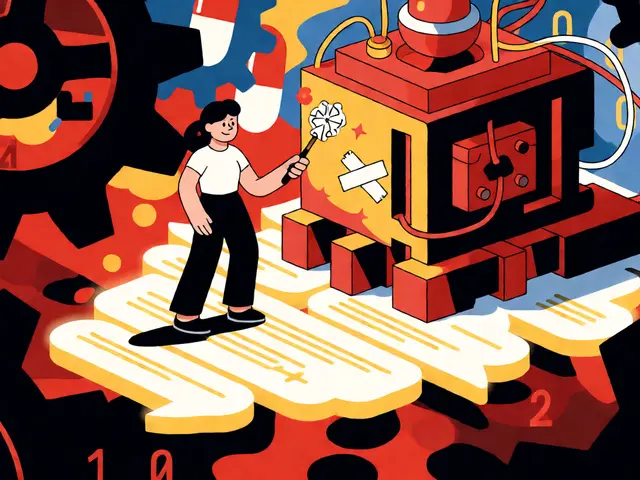
Imagine building a working web app in 20 minutes-not by writing line after line of code, but by typing a simple sentence like, "Create a login page with Google auth and a dashboard that shows user activity." That’s vibe coding. It’s not magic. It’s AI listening, interpreting, and generating real code. Meanwhile, traditional programming still means opening an IDE, setting up a project, importing libraries, writing functions, debugging syntax errors, and praying your imports don’t break. Both methods build software. But they operate on completely different wavelengths.
What Is Vibe Coding, Really?
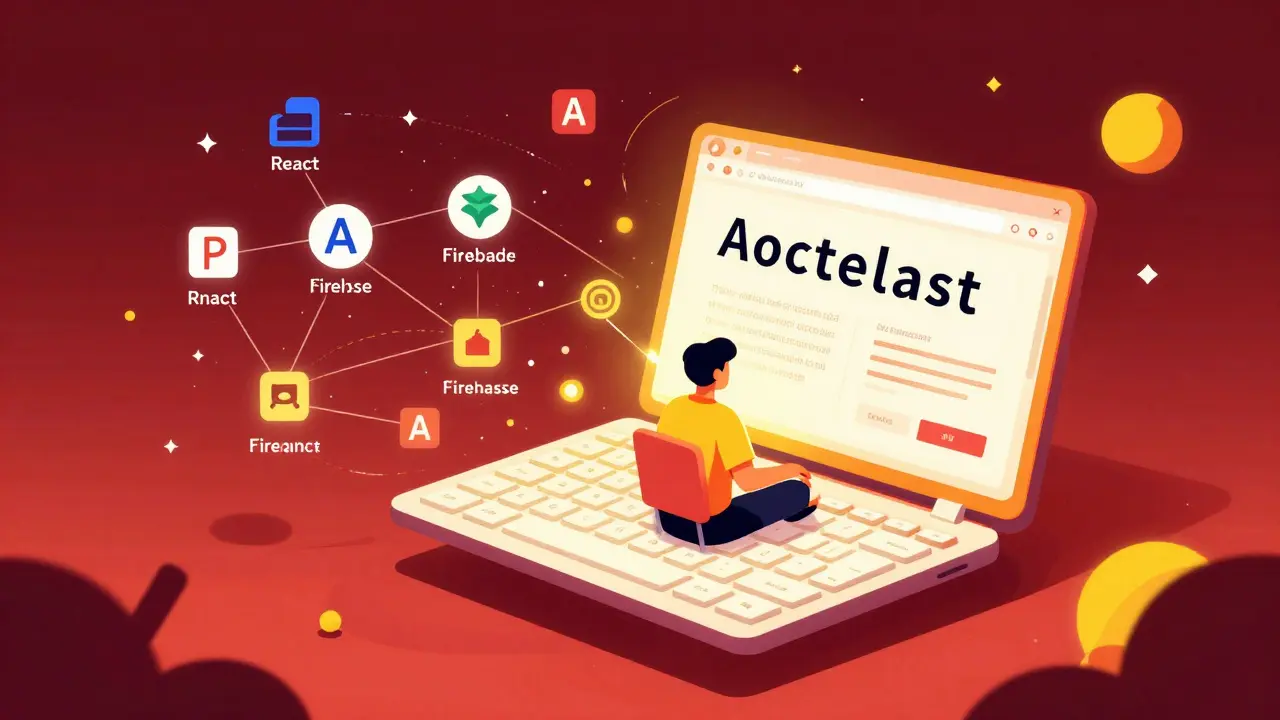
Vibe coding isn’t just another no-code tool. It’s not dragging sliders or clicking buttons in a template. It’s using natural language to describe what you want, and letting AI generate the actual code behind it. Tools like GitHub Copilot, Cursor, or Replit AI don’t just suggest snippets-they build entire components. You say, "Make a React form that validates email and submits to Firebase," and within seconds, you get working code. No need to remember how to import useState, or write a custom validation hook. The AI does it. You focus on the problem: "I need users to sign up."
This approach flips the old model. Instead of starting with syntax, you start with intent. You’re not thinking in JavaScript or Python-you’re thinking in outcomes. Who uses this? Founders with no coding background. Designers building prototypes. Product teams testing ideas before hiring engineers. Even experienced devs use it to skip boilerplate. One developer told me they cut their initial MVP setup from three days to four hours. That’s the power of vibe coding: removing friction so you can move faster.
How Traditional Programming Still Rules the Backend
Traditional programming is what you learned in school: write code, compile it, test it, debug it, deploy it. You pick a framework-React, Django, .NET-and build everything from scratch. Every variable, every loop, every API call is written by hand. It’s slow. It’s precise. It’s controlled.
Why does it still exist? Because control matters. When you’re building a banking app, a healthcare system, or a payment processor, you can’t afford to let AI guess what "secure authentication" means. You need to know exactly how the encryption works, where the tokens are stored, and how the session timeout is handled. Traditional programming gives you that. You own every byte. You can audit every line. You can trace an error back to a forgotten semicolon or a race condition in threading.
It’s also the only way to scale. If your app hits a million users, you need optimized database queries, efficient caching, and fine-tuned server configs. AI can’t yet handle that level of optimization on its own. You still need engineers who understand memory allocation, concurrency, and network latency. Traditional coding isn’t dead-it’s the foundation.
Speed: Hours vs. Weeks
Let’s compare timelines. You want to build a simple task manager with drag-and-drop, user roles, and cloud sync.
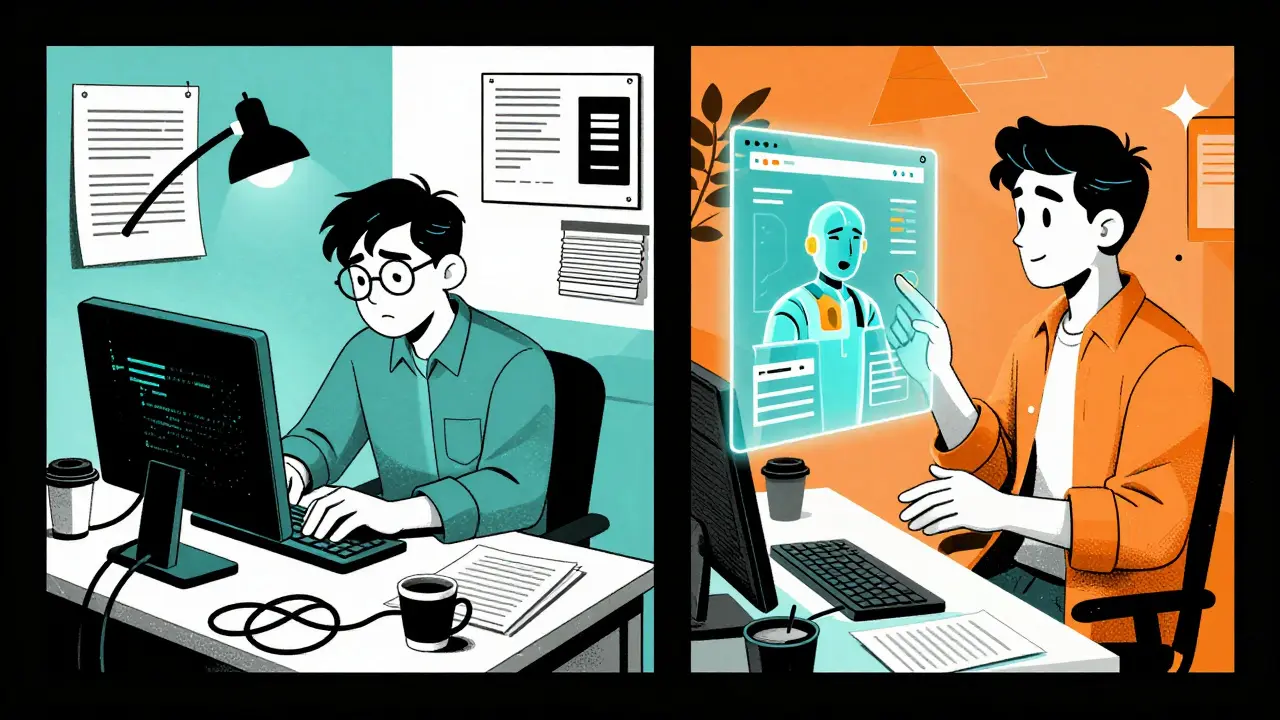
- Vibe coding: You type the prompt. AI generates the frontend in React, the backend in Node.js, the database schema in PostgreSQL, and even writes the deployment script for Vercel. You click deploy. Done in 90 minutes.
- Traditional programming: You set up the project structure. Install dependencies. Configure routing. Write the auth middleware. Build the API endpoints. Connect to the database. Write unit tests. Set up CI/CD. Deploy. That’s 7-10 days if you’re fast.
That’s not a small difference. That’s a game-changer for startups. For early-stage teams, speed is survival. Vibe coding lets you test ideas before you’ve hired a single developer. You don’t need to wait for a dev team to get on board. You can prove demand before spending a dime.
Flexibility: Total Control vs. Tool Boundaries
Vibe coding feels powerful until you hit a wall. What if you need a custom animation that the AI doesn’t recognize? What if you want to integrate with a niche API that isn’t in its training data? Suddenly, you’re stuck. You can’t just edit the AI’s code like you would your own-you might break the connection between your prompt and the generated output.
Traditional programming has no such limits. You can modify anything. You can write your own library. You can override a framework’s default behavior. You can dive into assembly if you need to. The only limit is your knowledge. That’s why companies like Netflix, Amazon, and Stripe still rely on hand-written code for their core systems. They need that freedom.
But here’s the twist: vibe coding tools are getting better. Many now let you edit the generated code, tweak it, and even teach the AI how you like to write. It’s not a black box anymore-it’s a collaborator. Still, you’re working within its boundaries. Traditional coding? You’re the architect.
Learning Curve: Anyone Can Start. But Only Experts Can Scale.
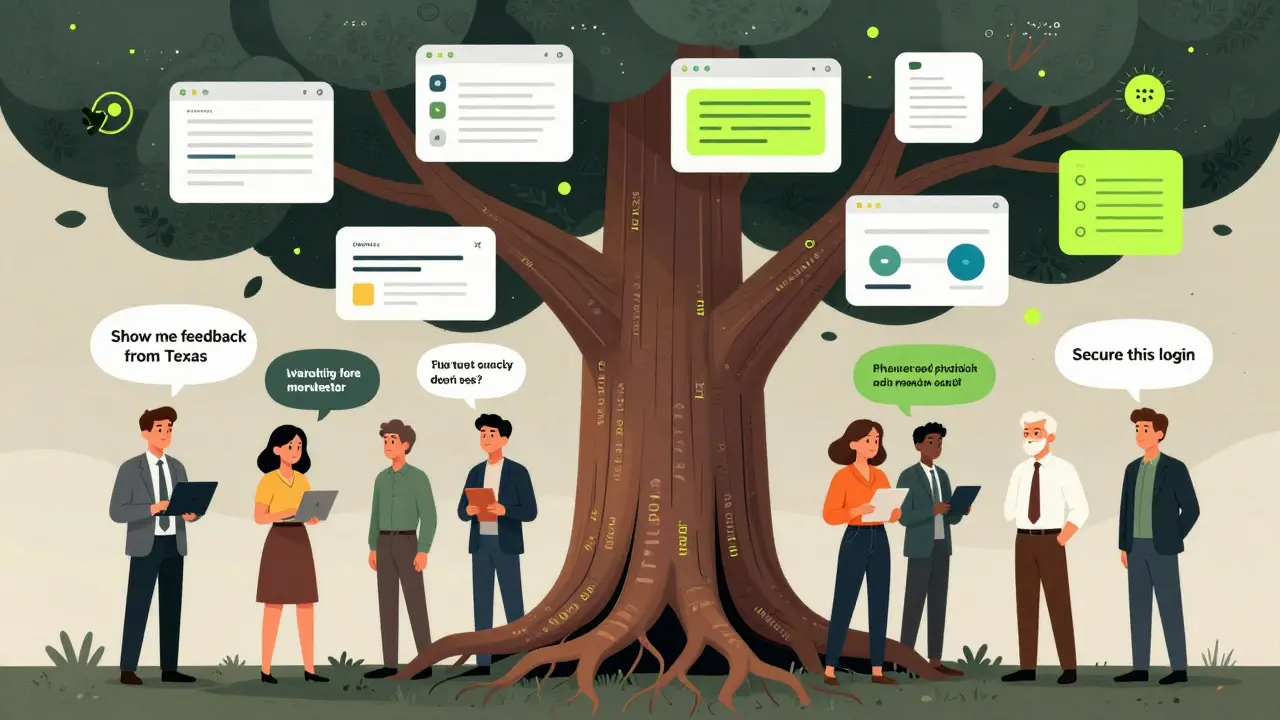
Vibe coding lowers the barrier to entry like nothing before it. A marketing manager in Chicago built a customer feedback tool using just voice prompts on her phone. She didn’t know what a JSON object was. She didn’t need to. She said, "Show me feedback from users in Texas," and the AI pulled it from her Google Sheet and made a dashboard. That’s the future: people solving problems without knowing how to code.
Traditional programming? You need months of study. Variables, loops, functions, scope, async, promises, modules, dependency management, build tools, package managers, environment variables-you can’t skip any of it. You need to understand how the machine works before you can tell it what to do.
But here’s the catch: vibe coding doesn’t eliminate the need for technical understanding. It just changes what you need to know. Instead of memorizing syntax, you need to know how to describe problems clearly. You need to understand data flow. You need to recognize when AI-generated code is doing something sketchy. A bad prompt leads to bad code. And bad code can leak data, crash apps, or create security holes.
Code Quality and Maintenance: AI Can’t Replace Code Reviews
AI-generated code isn’t clean. It’s messy. It’s repetitive. It uses outdated patterns. It imports 12 libraries when you only need one. It doesn’t follow your team’s style guide. It doesn’t document itself.
That’s why vibe coding teams still need senior engineers. Not to write code-but to review it. To refactor it. To enforce consistency. To catch bugs the AI missed. One team I spoke to found that 60% of their AI-generated code needed heavy cleanup before deployment. The AI saved them time on the first draft, but didn’t save them from testing.
Traditional code, when written well, is predictable. It follows patterns. It’s documented. It’s reviewed. It’s maintainable. But it takes time. Vibe coding speeds up the draft. Traditional coding ensures the final product lasts.
When to Use Which?
Here’s the simple rule:
- Use vibe coding when: You’re prototyping. You’re validating an idea. You’re a non-developer building something personal. You need to move fast. You’re building a small tool, a landing page, or a simple internal app.
- Use traditional programming when: You’re building for production. You need security, scalability, compliance, or long-term maintainability. You’re working on a core product. You’re in finance, healthcare, or infrastructure.
Most successful teams use both. They let AI handle the boring stuff: login pages, form validations, API wrappers. Then they hand off the core logic to experienced devs who build the engine. It’s not an either-or choice. It’s a stack.
The Real Shift: From Code to Communication
The biggest change vibe coding brings isn’t technical-it’s cultural. The hardest part of building software has always been figuring out what to build. Not writing the code. Figuring out the problem.
Vibe coding forces you to articulate your goals clearly. If you can’t explain it in plain language, the AI can’t help you. Suddenly, product managers, designers, and customers are part of the development process. You’re not just writing code-you’re having conversations.
That’s why the best developers today aren’t the ones who know the most syntax. They’re the ones who ask the best questions. Who understand users. Who can translate chaos into clear prompts.
Traditional programming taught us to think like machines. Vibe coding is teaching us to think like humans.
Is vibe coding just another no-code tool?
No. No-code tools lock you into templates. Vibe coding generates real, editable code using AI. You’re not stuck with pre-built components-you can modify the output, add custom logic, and even teach the AI your preferred patterns. It’s code generation, not drag-and-drop.
Do I still need to learn programming if I use vibe coding?
You don’t need to write code, but you need to understand how software works. You need to know what data is, how APIs connect, how security works, and how to spot when AI gives you something dangerous. Vibe coding shifts the skill from syntax to communication and critical thinking.
Can vibe coding replace software engineers?
No. It changes their role. Engineers now focus on architecture, security, scalability, and reviewing AI output. They’re less like typists and more like editors, strategists, and quality gatekeepers. The job isn’t disappearing-it’s evolving.
Is AI-generated code secure?
Not automatically. AI doesn’t know your security policies. It might generate code with hardcoded keys, vulnerable dependencies, or unvalidated inputs. Always review it. Use static analysis tools. Never deploy AI code without testing. Treat it like a first draft-not a final product.
What’s the best way to start with vibe coding?
Start small. Use GitHub Copilot or Cursor to generate a simple script: a calculator, a to-do list, or a data scraper. Then edit the code. Break it. Fix it. Understand why it worked. Once you’re comfortable, try building a full page from a prompt. Don’t skip the editing step-that’s where you learn.





This vibe coding stuff is a joke. I've seen AI generate code that breaks in production because it used deprecated libraries and hardcoded API keys. You think you're saving time? You're just kicking the can down the road. Real engineers don't get paid to babysit AI outputs. We get paid to fix the messes it leaves behind. And yeah, I'm calling it out - this isn't innovation, it's laziness dressed up as efficiency.
The real shift, isn't it? Not from code to... well, whatever this is - but from mastery of syntax to mastery of intent. We've always been translating human needs into machine logic; now, the machine is just... listening more attentively. But does that make us less skilled? Or merely reorient our skills? I find myself asking: if the AI writes the function, who is the artist? The one who speaks the desire - or the one who, later, refines it into something enduring?
Vibe coding? More like vibe lying. AI generates code that looks fine until you run it and realize it's using bcrypt for password hashing but with a 2015 library version that's got a known exploit. You think you're being fast? You're just being dumb. Real devs don't need AI to write a login form. They write it once, reuse it, and move on. Stop pretending this is progress - it's just tech bros avoiding learning fundamentals.
I mean sure, vibe coding is cool if you're building a personal blog. But if you're actually trying to ship something that doesn't implode under load, you still need someone who knows what a stack trace is. AI doesn't care if your endpoint is vulnerable to SSRF. It just wants to make your prompt look good. So congrats, you got a working prototype. Now go fix the 14 security holes it left behind.
Oh wow, so now we're calling AI-generated spaghetti 'vibe coding'? That's cute. You're not a developer, you're a prompt engineer. And let's be real - you're one bad update away from your whole app being owned by a botnet. Meanwhile, real engineers are still out here writing secure code, reading RFCs, and actually understanding the systems they build. Vibe coding? More like 'vibe getting fired'.
I love this breakdown. The truth is, vibe coding isn't replacing engineers - it's empowering them. I used to spend 3 days setting up boilerplate. Now I spend that time thinking about user flows, edge cases, and scalability. The AI handles the grunt work. I handle the thinking. And honestly? That’s the kind of work that actually matters. This isn't about replacing skill - it's about elevating it.
The evolution of software development is not a binary transition from traditional programming to AI-assisted composition; rather, it is a symbiotic integration wherein the human operator transitions from a syntactic artisan to a strategic arbiter of intent, fidelity, and systemic integrity. The machine executes; the mind discerns. This paradigm shift necessitates not obsolescence, but rather a redefinition of expertise - one grounded in epistemological rigor, not mere procedural fluency.
If you need AI to write a login page, maybe you shouldn't be a dev. This isn't progress. It's just people who never learned to code pretending they're innovators. I've seen teams hire 'prompt engineers' and then spend 3 weeks debugging AI-generated nonsense. You don't need vibe coding. You need to learn JavaScript.