Vibe Coding Glossary: Essential Terms for AI-Assisted Development
Remember when writing code meant typing every single character yourself? That era is fading fast. A new way of building software has taken over, and it doesn't involve staring at syntax errors for hours. It involves talking to an AI. This approach, known as vibe coding, is a conversational, AI-first methodology where developers describe their intent in natural language and let the model generate the code, is changing how we work. You don't just write code; you curate it. You guide the machine. But to do that well, you need to speak its language-or at least understand the jargon surrounding it.
If you've heard the term "vibe coding" tossed around on tech Twitter or in your Slack channels but aren't sure what it actually entails, you're not alone. The concept exploded after Andrej Karpathy, former Director of AI at Tesla, tweeted about his workflow in September 2023. He described shifting from manual coding to "talking to the AI, accepting everything it gives me, and keeping going." Since then, the industry has adopted this mindset rapidly. According to GitHub's 2024 State of the Octoverse report, 68% of developers now use AI coding assistants weekly. For many, vibe coding isn't just a trend; it's the primary way they build applications. To navigate this shift without losing your mind (or your security), you need a solid grasp of the essential terms that define this new reality.
The Core Concept: What Is Vibe Coding?
At its heart, vibe coding is about flow. It relies on Large Language Models (LLMs) are artificial intelligence systems trained on vast amounts of text data to understand and generate human-like language, including code. These models, often built on transformer architectures with billions of parameters, act as your pair programmer. Instead of manually constructing loops and functions, you describe what you want in plain English. The AI writes the code. You run it. If it breaks, you tell the AI what went wrong, and it fixes it. You iterate by conversation.
This method differs sharply from traditional coding. In the old days, you needed to memorize syntax and library methods. Now, your value shifts from implementation skill to problem framing. Dr. Sarah Guo, General Partner at Conviction Partners, calls this a shift from "craftsmanship to curation." You are no longer the bricklayer; you are the architect. The goal is speed and clarity. Studies show vibe coding can accelerate development cycles by 40-60% for routine tasks. However, it requires a specific mindset. You must trust the AI enough to move fast, but remain skeptical enough to catch errors. This balance is the essence of the "vibe."">
Key Terminology You Need to Know
To succeed in this environment, you need to understand the vocabulary. Here are the critical terms that shape the vibe coding landscape:
- Prompt Engineering: This is the art of crafting instructions for the AI. It’s not just asking "write a login page." It’s providing context, constraints, and desired formats. Dr. Monica Dinculescu from Google notes that successful vibe coders spend 40% of their time crafting precise prompts. It’s technical writing, not just coding.
- Context Window: Every LLM has a limit to how much information it can process at once. This is measured in tokens. Current models range from 4,000 to 128,000 tokens. Understanding this limit is crucial. If your project is too large, the AI will forget earlier instructions. You need to manage what context you feed it.
- First-Pass Functionality: This refers to code that works correctly on the first try without major edits. Modern vibe coding implementations achieve 60-75% first-pass functionality for well-defined tasks. The higher this number, the less time you spend debugging.
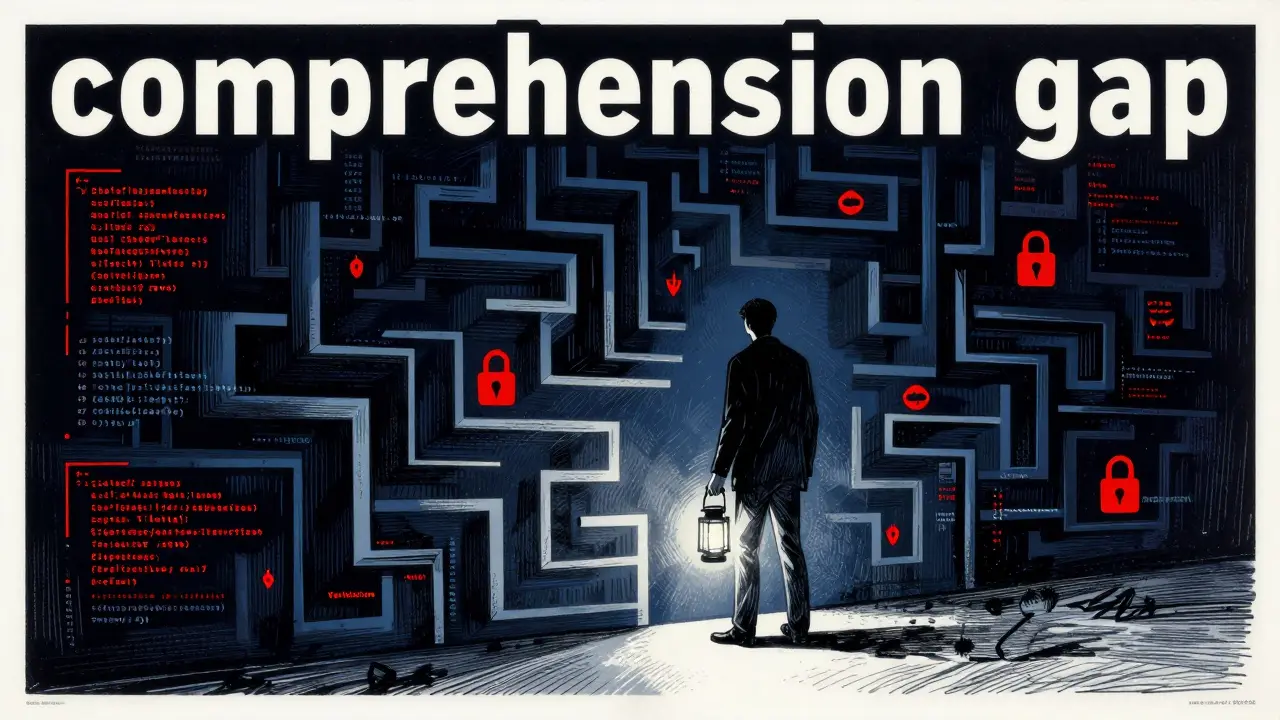
- Comprehension Gap: A dangerous phenomenon where developers deploy code they don’t fully understand. Martin Fowler of ThoughtWorks warns that vibe coders may only understand 35-50% of the code they ship. This creates hidden technical debt and security risks.
- S.C.A.F.F. Methodology: A prompting framework standing for Situation, Constraints, Actions, Format, and Foundations. Using this structure reduces prompt iterations by 37%, making your interactions with the AI more efficient.
Tools of the Trade
You can’t vibe code without the right tools. The market is crowded, but a few players dominate. GitHub Copilot is an AI-powered code completion tool developed by GitHub and OpenAI that suggests entire lines or blocks of code as you type remains the industry standard for many, costing $10 per user per month as of January 2025. It integrates seamlessly into existing editors like VS Code. Then there’s Cursor is an AI-native code editor designed specifically for vibe coding workflows, allowing users to chat directly with their codebase. Cursor Pro costs $20 per month and offers a more dedicated vibe coding experience. For enterprise teams concerned about governance, frameworks like the Vibe Coding Framework provides enterprise-grade governance features for AI-assisted development, including verification protocols and compliance checks charge around $50 per user per month. These tools support major languages like JavaScript, Python, and TypeScript with high accuracy rates.
| Tool | Price (Monthly) | Best For | Key Feature |
|---|---|---|---|
| GitHub Copilot | $10 | Generalists | Seamless IDE Integration |
| Cursor | $20 | Dedicated Vibe Coders | Chat-Based Workflow |
| Vibe Coding Framework | $50 | Enterprise Teams | Governance & Security |
The Risks: Security and Comprehension
Vibe coding sounds magical, but it comes with serious pitfalls. The biggest issue is the comprehension gap. When you accept AI-generated code without understanding it, you create a black box. If that code fails in production, you won’t know why. SonarSource’s 2025 report revealed that vibe-coded outputs contain 2.3x more security flaws than manually written code. Input validation and authentication flows are particularly vulnerable. Hackers exploit these weaknesses because the AI might miss edge cases that a human would catch.
Another risk is knowledge erosion. Some developers report forgetting basic syntax because they rely so heavily on the AI. Reddit users have complained about becoming dependent on prompts, losing their ability to debug independently. This dependency can be dangerous if the AI service goes down or produces hallucinated code. Always verify critical components. Use the C.L.E.A.R. Review Framework mentioned in recent guidelines to ensure your code meets safety standards. Don’t just copy-paste; read, test, and question.
When to Use Vibe Coding (And When Not To)
Vibe coding isn’t a silver bullet. It excels in specific areas but struggles in others. According to the IEEE 2025 AI Coding Benchmark, vibe coding achieves an 87% success rate in UI development and 79% in API integrations. Data processing pipelines also see a 76% success rate. These are repetitive, pattern-based tasks where the AI shines. It speeds up CRUD applications by 5.7x compared to traditional methods.
However, avoid using it for complex algorithm development. It underperforms by 22-35% in tasks requiring deep mathematical understanding. Real-time systems and cryptographic implementations are also risky, with success rates dropping to 42% and 38% respectively. For these critical systems, stick to traditional coding or agentic coding, which uses autonomous agents for multi-step workflows but requires more setup. Use vibe coding for prototyping and routine features, but keep humans in the loop for security-critical logic.
Getting Started: Your First Steps
If you’re ready to try vibe coding, start small. Install an AI assistant like GitHub Copilot or Cursor. Spend 17-22 hours learning the ropes, as suggested by JetBrains' 2025 Developer Efficacy Study. Focus on prompt engineering. Practice the S.C.A.F.F. methodology. Describe the situation, list constraints, specify actions, define the format, and establish foundations. This structured approach will save you time and reduce errors.
Integrate these tools into your CI/CD pipeline early. Many teams struggle with integration, but setting it up correctly ensures consistent quality. Remember, the goal is augmentation, not replacement. Keep your skills sharp. Read the code the AI generates. Understand the libraries it uses. By balancing AI assistance with human oversight, you’ll harness the power of vibe coding while avoiding its traps. The future of development is conversational. Are you ready to talk?
Is vibe coding safe for production environments?
Vibe coding can be used in production, but with caution. Research shows AI-generated code contains more security flaws than manual code. You must implement rigorous verification protocols, such as the C.L.E.A.R. Review Framework, and manually review critical components like authentication and input validation before deployment.
What is the difference between vibe coding and agentic coding?
Vibe coding is a conversational approach where you guide the AI step-by-step through natural language. Agentic coding uses autonomous AI agents that plan and execute multi-step workflows independently. Agentic coding is better for complex systems but requires more setup time and infrastructure.
Do I still need to know how to code if I use vibe coding?
Yes. While you write less syntax, you need strong problem-framing skills. You must understand the code the AI generates to debug issues, ensure security, and maintain the application. Relying solely on AI without coding knowledge leads to the "comprehension gap" and increased technical debt.
Which programming languages work best with vibe coding?
JavaScript, Python, and TypeScript show the highest accuracy rates (95-98%) according to Mendix's 2024 Language Support Matrix. These languages have extensive training data available to LLMs, making them ideal for AI-assisted development. Other languages are supported but may have lower first-pass functionality.
How much does vibe coding cost?
Costs vary by tool. GitHub Copilot costs $10/user/month, Cursor Pro is $20/month, and enterprise frameworks like the Vibe Coding Framework charge around $50/user/month. These prices cover access to the AI models and associated features as of early 2025.