LLM Portfolio Management: Balancing APIs, Open-Source, and Custom Models
You’ve probably seen the headlines. Everyone is rushing to plug a Large Language Model (LLM) into their business processes. But here’s the uncomfortable truth most vendors won’t tell you: sticking with just one type of model-whether it’s a shiny new API or a free open-source download-is a fast track to wasted budget and compliance nightmares. By early 2026, data from Gartner shows that successful enterprises aren’t betting on a single horse. They’re managing a LLM Portfolio. This isn’t just about picking the smartest AI; it’s about balancing three distinct types of models: commercial APIs, open-source foundations, and custom-built solutions.
If you’re still treating your AI strategy as a simple "buy" button, you’re likely overpaying by 38-62% in operational costs while risking regulatory fines. The shift from pilot projects to production-grade systems has forced a change in how we think about AI infrastructure. It’s no longer about which model has the highest benchmark score. It’s about which model fits the specific job, budget, and risk profile of each task. Let’s break down how to build a resilient portfolio that actually delivers ROI.
Why Single-Model Strategies Are Failing
Remember when every company tried to use one giant model for everything? That era is over. Andrew Ng, founder of DeepLearning.AI, warned in his January 2026 TED Talk that companies clinging to single-model strategies faced 30% higher operational costs and significant compliance risks. His team’s analysis revealed that 63% of these companies failed to achieve a return on investment within 18 months. Why? Because different tasks have wildly different needs.
Think of it like transportation. You wouldn’t use a semi-truck to deliver a pizza, nor would you take a bicycle to haul freight across the country. Similarly, using an expensive, general-purpose API for high-volume, low-complexity tasks burns cash. Conversely, relying on a generic open-source model for highly regulated financial underwriting can lead to hallucinations that legal teams hate. The solution is a tiered approach.
Leading organizations now categorize their deployments into three tiers:
- Tier 1 (Mission-Critical): Requires maximum control and domain-specific accuracy. These are usually custom models.
- Tier 2 (Regulated/Specific): Needs good performance but with some customization. These are often fine-tuned open-source models.
- Tier 3 (General Tasks): High volume, lower stakes. These rely on commercial APIs.
This structure allows you to match the cost and complexity of the model to the value of the output. If a task doesn’t generate revenue directly, why pay premium API rates for it?
The Three Pillars of Your LLM Portfolio
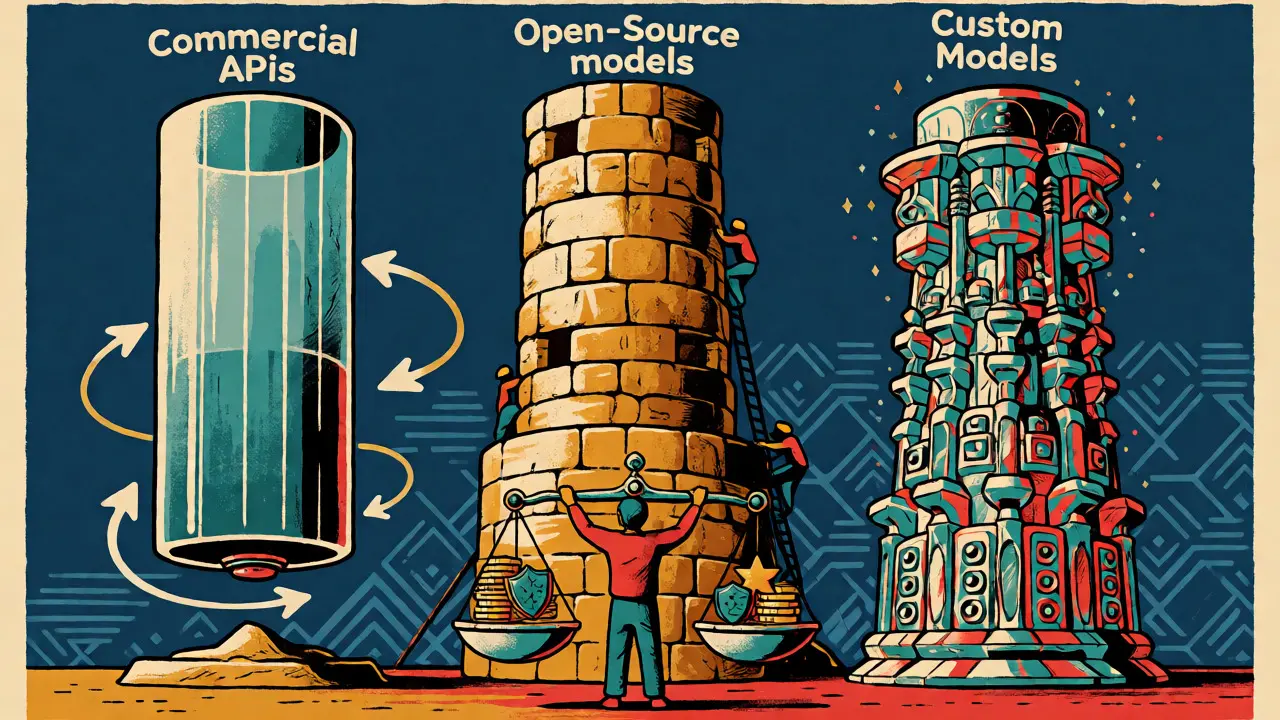
To manage this balance, you need to understand the trade-offs inherent in each model type. Each has its strengths, weaknesses, and hidden costs.
Commercial APIs: The Convenience Tax
Models like GPT-5, Gemini 3, and Claude 4 offer incredible ease of use. You don’t manage servers; you just send requests. As of January 2026, GPT-5 achieves 82.1% on MMLU-Pro benchmarks at roughly $0.015 per 1,000 tokens. For many, this is the path of least resistance.
But there’s a catch. Privacy is a major hurdle. 78% of enterprises report compliance issues when sending sensitive data through third-party APIs. Furthermore, customization is limited. According to Forrester, only 37% of complex business logic can be effectively incorporated into prompt-based API interactions without extensive engineering workarounds. Use APIs for customer service chatbots (where speed matters more than deep domain nuance) or content generation drafts. Avoid them for proprietary research where data leakage is a dealbreaker.
Open-Source Models: Control vs. Complexity
Open-source families like Llama 4, Falcon 2, and Mistral 8x22B give you full ownership of your data. You can deploy them on-premise or in private cloud environments, ensuring 94% of enterprises can implement strict data governance.
The savings look attractive on paper. Deploying Llama 4 70B might cost around $28,500 monthly in infrastructure compared to $18,200 for equivalent GPT-5 API usage. However, this ignores the human cost. Open-source models require 40% more engineering resources for maintenance, updates, and tuning. If your team lacks ML engineers, the "free" model becomes the most expensive option due to hidden technical debt. Emily Bender, an AI researcher, warns that over-reliance on unvetted open-source models creates "hidden technical debt," a concern validated by 38% of enterprises reporting significant rework after initial deployments.
Custom Models: The Precision Play
When generic models fail, you build your own. Custom models, fine-tuned on your proprietary data, offer the highest domain accuracy-often 18.7% higher than generic APIs on specialized tasks. They are essential for industries like healthcare triage or financial underwriting, where a small error margin can mean huge losses.
But building them is pricey. MIT’s 2026 LLM Cost Study pegs the average development cost at $417,000 per model, with development cycles lasting 6-9 months. This isn’t for every use case. Reserve custom models for high-value applications where accuracy directly impacts revenue or risk mitigation.
Comparing Costs and Performance
How do you decide which model goes where? It comes down to metrics. SAP’s 2026 Enterprise AI Maturity Report suggests tracking 12 key metrics, but four stand out for decision-making: accuracy, latency, cost per token, and compliance risk.
| Metric | Commercial API (e.g., GPT-5) | Open-Source (e.g., Llama 4) | Custom Fine-Tuned |
|---|---|---|---|
| Avg. Cost per 1k Tokens | $0.015 | $0.0085 (Infra + Ops) | $0.018 (Amortized Dev) |
| Domain Accuracy Gain | Baseline | -5% to +2% (Varies) | +18.7% |
| Data Privacy Risk | High (Third-party processing) | Low (Self-hosted) | Very Low (Isolated) |
| Engineering Effort | Low | High (Maintenance heavy) | Very High (Dev cycle) |
| Best For | General Chat, Drafting | Bulk Processing, Internal Search | Critical Analysis, Regulated Data |
Notice the cost inversion. While APIs seem cheap per token, the lack of control often leads to inefficient prompting and retries, driving up actual spend. Open-source looks cheaper per unit but requires a dedicated team. Custom models have a high upfront cost but amortize well if the application scales and the accuracy gain prevents costly errors.
Implementing a Governance Framework
You can’t just pick models and hope for the best. You need governance. Arputham Rajkumar, a Gartner Distinguished Analyst, emphasizes that mature enterprises implement 14-17 specific controls for model selection, evaluation, and retirement. Without this, you end up with "model sprawl"-a chaotic mess of unused or poorly performing models eating up budget.
Start with a structured taxonomy. Every model in your portfolio should be tagged with its purpose, owner, and cost center. Implement a standardized evaluation framework. Don’t just look at accuracy scores. Measure latency (aim for under 2.3 seconds for user-facing apps) and compliance risk scores (keep below 15 on a 100-point scale).
Integration is another critical piece. 92% of enterprises now use Retrieval-Augmented Generation (RAG) architectures to ground models in real-time data. This reduces hallucinations and keeps models relevant without constant retraining. Ensure your RAG pipeline works seamlessly across all three model types. A common pitfall is assuming RAG works identically for a hosted API and a self-hosted Llama 4 instance. It doesn’t. Vector database compatibility and chunking strategies may need adjustment for each.
Real-World Implementation Steps
So, how do you move from theory to practice? Follow this six-phase approach, refined by Lumenalta’s 2026 adoption framework:
- Assessment (2-4 weeks): Identify high-value use cases. Look for repetitive language tasks that consume at least 15% of departmental effort. Ignore the "cool factor"; focus on pain points.
- Piloting (4-8 weeks per use case): Run small tests. Collect 300-500 high-quality exemplars with clear inputs and outputs. This dataset will become your ground truth for evaluation.
- Evaluation: Go beyond basic accuracy. Use custom evaluators that check for tone, safety, and factual consistency. 89% of successful deployments use these sophisticated metrics.
- Data Preparation: Clean your data. Use "data clean rooms" to join consented sources while keeping raw identifiers out of prompts. This protects privacy during training and inference.
- Deployment & Monitoring: Launch with observability tools. Track drift. Models degrade over time as data changes. Continuous evaluation frameworks can reduce model drift by 47%.
- Retirement: Kill what doesn’t work. If a model isn’t delivering ROI after six months, retire it. Don’t let legacy models linger in your infrastructure.
Team composition matters too. You typically need one architect, two to three ML engineers, and one domain specialist per major implementation. Don’t underestimate the domain expert. An engineer who doesn’t understand the nuances of insurance claims or medical coding will build a technically sound but practically useless model.

Common Pitfalls to Avoid
Even with a plan, things go wrong. Here are the most frequent mistakes I see in 2026:
- Underestimating Integration Complexity: 63% of negative reviews cite integration challenges. Connecting a new LLM to legacy CRM or ERP systems is rarely plug-and-play. Budget time for middleware development.
- Poor Documentation: Hugging Face’s enterprise documentation scored only 3.2/5 in recent reviews due to insufficient real-world examples. Always test a model’s ecosystem before committing. LangChain, for instance, scores higher (4.5/5) for clarity.
- Ignoring Security Fragmentation: 68% of enterprises report inconsistent security practices across model types. Ensure your encryption keys, access controls, and logging standards are uniform whether you’re using an API or a local server.
- Skipping the Center of Excellence: Early adopters who established Centers of Excellence saw 43% faster deployment cycles. Siloed teams reinvent the wheel. Share knowledge, prompts, and evaluation scripts across departments.
Also, beware of "open-source hype." Just because a model is free to download doesn’t mean it’s free to run. The infrastructure costs for high-throughput open-source deployments can surprise CFOs. Always calculate Total Cost of Ownership (TCO), including engineering hours, not just GPU rental fees.
The Future of LLM Portfolios
The landscape is shifting rapidly. We’re moving toward standardized model interchange formats, expected by Q3 2026, which will make switching between providers easier. AI-powered portfolio management assistants are already being piloted by forward-thinking firms, helping automate the decision of which model to route a query to.
Gartner predicts that LLM portfolio management will hit the "Plateau of Productivity" by late 2026. This means the technology is no longer experimental-it’s a standard business function. Companies that treat it as such will thrive. Those that treat it as a one-off IT project will struggle with rising costs and compliance risks.
Your next step? Audit your current AI usage. How many models are you running? Do you know their individual costs and performance metrics? If not, start there. Build your taxonomy, define your tiers, and begin testing alternatives. The goal isn’t to have the most advanced AI. It’s to have the right AI for every job.
What is the main benefit of an LLM portfolio approach?
The primary benefit is optimizing the balance between cost, control, and performance. By mixing APIs, open-source, and custom models, enterprises can reduce operational costs by 38-62% while maintaining high accuracy for critical tasks and ensuring data compliance for sensitive information.
Are open-source LLMs always cheaper than APIs?
Not necessarily. While infrastructure costs per token can be lower, open-source models require significantly more engineering resources for maintenance, tuning, and hosting. For smaller teams without dedicated ML engineers, the total cost of ownership often exceeds that of managed APIs.
When should a company invest in custom models?
Invest in custom models for mission-critical applications where domain-specific accuracy is paramount and data privacy is non-negotiable. Examples include financial underwriting, healthcare diagnostics, and proprietary research analysis. The high development cost ($400k+) is justified only when the accuracy gains directly impact revenue or risk mitigation.
What is the biggest risk of using multiple LLMs?
Model fragmentation and inconsistent security practices. Without proper governance, companies can lose track of which model is used for what, leading to duplicated efforts and potential data leaks. Establishing a Center of Excellence and standardized evaluation frameworks helps mitigate these risks.
How does RAG fit into LLM portfolio management?
Retrieval-Augmented Generation (RAG) is a critical architecture used across all model types to ground responses in real-time data. It reduces hallucinations and keeps models relevant without constant retraining. However, RAG pipelines must be tailored to each model type, as vector database compatibility and chunking strategies vary between APIs and self-hosted open-source models.