Vibe Coding Adoption Metrics and Industry Statistics That Matter
By 2025, vibe coding isn’t just a buzzword-it’s reshaping how software gets built. If you’re a developer, manager, or founder, you’ve probably seen it: a teammate typing a simple English sentence like "build a login form with password reset," and suddenly, 200 lines of working code appear. It’s fast. It’s impressive. But is it safe? Is it sustainable? And more importantly-how many people are actually using it, and what’s really happening behind the scenes?
Who’s Using Vibe Coding, and How Much?
The numbers don’t lie. According to Stack Overflow’s 2025 Developer Survey of over 90,000 respondents, 84% of developers are either using AI coding tools or planning to start within the next six months. That’s up from 70% just two years ago. This isn’t a niche experiment anymore. It’s mainstream adoption. Platforms like GitHub Copilot, Cursor, Replit, and Loveable are no longer side projects-they’re central to daily workflows. GitHub Copilot alone has over 3 million paid users, with enterprise subscriptions growing 30% quarter-over-quarter in Q2 2025. Replit, which serves more than 30 million users globally, reports that 63% of its users interact with its AI tools daily. Even startups that used to write every line manually are now letting AI handle the boilerplate. Y Combinator’s W25 cohort found that 25% of their codebases were mostly generated by AI tools. But adoption isn’t uniform. North America leads with 55% of global usage, driven by the U.S. and Canada’s 4.5 million+ developers. Europe follows at 30%, while Asia-Pacific lags slightly at 15%, mostly due to slower enterprise tech adoption and stricter data regulations. Within companies, adoption is split: tech giants like Meta are targeting 50% AI-generated code by 2026, while Visa and Amazon report around 30%. Smaller firms? They’re experimenting fast, but few have rolled it out company-wide.What Are Developers Actually Doing With It?
Most people aren’t using vibe coding to write their entire app. That’s a myth. The real use case is faster prototyping and repetitive task automation. Bubble.io’s 2025 survey found that 61.2% of users say the biggest benefit is rapid UI prototyping. A frontend dev might generate a dashboard layout in seconds. A backend engineer might auto-create API routes for a new microservice. A product manager might use Loveable to sketch out a basic admin panel without touching code. The time savings are real. Roots Analysis found that routine coding tasks-like setting up database connections, writing unit tests, or formatting JSON-take 35-55% less time with AI tools. For teams shipping weekly releases, that’s a game-changer. GitHub’s own data shows enterprise customers are delivering features 55% faster. But here’s the catch: that speed comes at a cost. When AI generates code, developers spend 20-30% more time debugging it. Reddit user u/CodeWizard42 summed it up: "Cursor cut my prototyping time by 70%, but I still spend 40% more time debugging the AI-generated sections." Why? Because AI doesn’t understand context the way a human does. It predicts patterns, not logic. It’s great at copying what it’s seen-but terrible at reasoning through edge cases.The Security Problem Nobody’s Talking About
This is where things get dangerous. MktClarity’s Q3 2025 analysis found that 40-45% of AI-generated code contains security vulnerabilities. That’s not a small risk. That’s a systemic threat. The IEEE’s 2025 Security Assessment revealed that 62% of AI-generated SaaS platforms lacked proper rate limiting on authentication endpoints. In plain terms: AI code often forgets to stop brute-force login attacks. One security engineer on Hacker News documented a case where AI-generated code in a fintech app bypassed authentication entirely. It took three weeks to fix. GitHub Copilot’s September 2025 update reduced vulnerability rates by 15% with new scanning tools, but it’s still not enough. Enterprise security teams at Fortune 500 companies have banned Copilot outright at 12% of firms, citing data leakage risks. Cursor’s local execution model helps with privacy, but it doesn’t fix flawed logic. Loveable’s no-code interface hides the code entirely-making audits impossible. And Replit? Cloud-based, so every line of code flows through a third-party server. The truth? Most companies are using AI code in non-critical systems. Only 9% of developers deploy AI-generated code as the majority of their production applications. The rest use it for internal tools, documentation, or early prototypes. Mission-critical systems? Still handwritten. And for good reason.
Platform Showdown: Who’s Winning and Why
Not all vibe coding tools are created equal. Here’s how the top four stack up as of December 2025:| Platform | Market Share | Key Strength | Key Weakness | Pricing (per user/month) |
|---|---|---|---|---|
| GitHub Copilot | 45% enterprise | Deep IDE integration, 35+ languages | Data privacy concerns, hallucinations | $10 (individual), $19 (enterprise) |
| Cursor | 35% startups | Local execution, faster feedback | High RAM/CPU use, not for old machines | $20 |
| Replit | 25% education | Collaborative cloud, great for learners | Cloud dependency, security hesitancy | Free-$12 |
| Loveable | 15% no-code | UI generation, low-code for founders | Hard to customize, steep learning curve | $20 (business tier) |
What Skills Do You Need Now?
If you’re still thinking you just need to know Python or JavaScript, you’re behind. Vibe coding has changed the skill requirements. You now need:- Prompt engineering for code-not just "build a login," but "build a secure login with JWT, rate limiting, and bcrypt hashing in Node.js, using Express and MongoDB."
- AI code auditing-the ability to spot when AI hallucinated a function, missed a validation, or forgot error handling.
- Understanding of model limitations-knowing when to trust the AI and when to write it yourself.
Where Is This All Going?
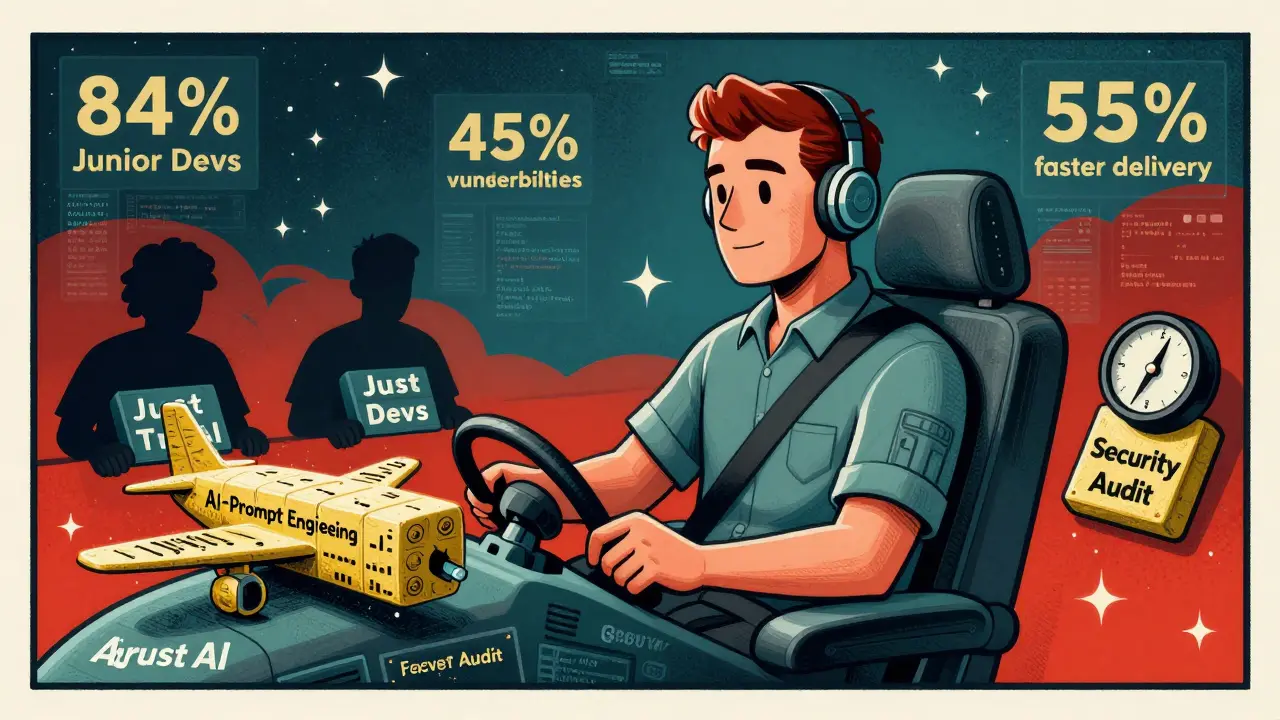
The market size projections tell a story of extremes. MktClarity predicts $65 billion by 2030. Roots Analysis says $325 billion by 2040. That’s a 5x difference. Why? Because nobody agrees on how far this will go. Gartner’s 2025 Hype Cycle puts vibe coding at the "Peak of Inflated Expectations." That means we’re past the hype phase, but the real value hasn’t kicked in yet. Full mainstream adoption? Not until 2028-2030. The big question: Will AI replace developers? No. But it will replace developers who don’t adapt. MIT’s Dr. Sarah Chen warns that junior devs are becoming dependent on AI, losing foundational skills. "They think they’re coding," she says, "but they’re just editing AI’s guesses." The future belongs to those who use AI as a co-pilot-not a driver. Teams that audit AI output, enforce security checks, and train their people in prompt engineering will thrive. Teams that blindly accept AI code? They’ll be the ones cleaning up the mess in 2027.Final Reality Check
Vibe coding isn’t magic. It’s a tool. A powerful one. But like any tool, it’s only as good as the person using it. If you’re using it to:- Generate UI components in minutes? Perfect.
- Write unit tests for legacy code? Great.
- Build a prototype for a pitch deck? Absolutely.
- Deploy authentication systems without review? Dangerous.
- Replace your senior devs because "AI does it faster"? Foolish.
- Ignore security scans because "it’s just a small feature"? Risky.