
Math-Specialized LLMs vs General Models: Accuracy, Cost, and When to Use Each
Imagine paying for a Swiss Army knife when you only ever need a screwdriver. That is the dilemma many developers face today when choosing between general-purpose Large Language Models (LLMs) like GPT-4 or Claude, and math-specialized LLMs designed specifically for numerical reasoning. The gap in performance is closing, but the trade-offs in cost and capability are widening. If your application relies heavily on complex calculations, theorem proving, or step-by-step logic, a general model might be overkill-and underperforming compared to a leaner, specialized alternative.
In this guide, we break down the real-world differences between these two categories. We look at accuracy benchmarks, the hidden costs of inference, and the critical technical decisions-like Reinforcement Learning versus Supervised Fine-Tuning-that determine whether a model stays smart across all tasks or becomes a narrow specialist.
The Accuracy Gap: Specialization Beats Size
For years, the rule of thumb was simple: bigger models are smarter. But recent data from benchmarks like MathOdyssey suggests that targeted training often outperforms raw parameter count. When it comes to mathematics, size alone does not guarantee success.
General models like GPT-4 Turbo dominate easy tasks. They achieve over 90% accuracy on the GSM8K benchmark, which tests basic grade-school math word problems. However, as difficulty increases, their performance drops sharply. On Olympiad-level problems, GPT-4 Turbo scores just 10.81%, while Llama-3 manages only 8.78%. Even the advanced reasoning model GPT-4 o1-preview, which uses chain-of-thought processing, caps out at 45.27% on these elite challenges.
Specialized models tell a different story. Qwen2.5-Math-7B, a text-only model with just 7 billion parameters, competes with models ten times its size. It matches or beats larger generalists on specific math tasks because it was trained exclusively on mathematical data structures. Similarly, Gemini 2.0 Flash Thinking achieved 73.6% accuracy on the U-Math university-level benchmark, setting a new standard for higher education math problems.
The takeaway? If your use case involves high school algebra or university calculus, a specialized model often delivers better accuracy than a massive generalist. For everyday chat or creative writing, however, the generalist still holds the crown.
Training Methods Matter: RL vs. SFT
Not all specialized models are created equal. The method used to fine-tune them drastically affects their behavior outside of math problems. This is where the choice between Reinforcement Learning (RL) and Supervised Fine-Tuning (SFT) becomes critical.
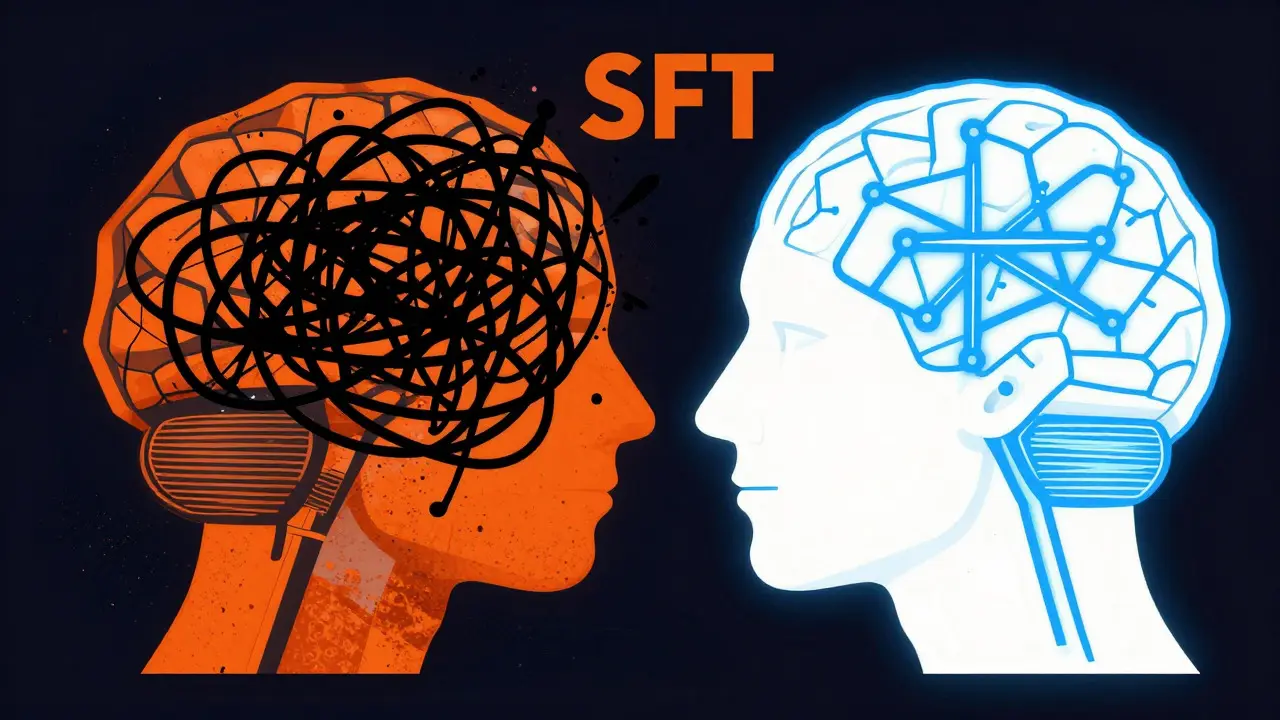
SFT involves feeding a model correct answers and having it mimic those patterns. While effective for boosting math scores, SFT often leads to "catastrophic forgetting." The model loses its ability to handle general language tasks because it has overwritten too much of its original knowledge base. Research shows that SFT-tuned models frequently exhibit negative transfer indices, meaning they perform worse on non-math tasks after specialization.
Reinforcement Learning, on the other hand, rewards the model for correct reasoning steps rather than just final answers. Models like UniReason-Qwen3-14B, trained with RL on 47,000 math examples, maintain strong general-domain capabilities. Principal Component Analysis (PCA) of latent spaces reveals that RL induces minimal drift from the backbone representation. In plain English, RL tweaks only the parts of the brain needed for math, leaving the rest intact. SFT perturbs many irrelevant tokens, causing broader instability.
If you need a model that can do math and write code or draft emails, prioritize RL-trained specialists. If you need pure calculation speed and don't care about general conversation, SFT might suffice, but expect degraded performance elsewhere.
Cost Efficiency: The Business Case for Smaller Models
Accuracy is only half the equation. The other half is cost. Running large general-purpose models is expensive. Every token processed consumes computational resources, and latency increases with model size.
Consider the economics of Qwen2.5-Math-7B. With 7 billion parameters, it requires significantly less memory and processing power than a 70-billion parameter model like Llama-3. This translates to roughly a 90% reduction in parameter count while maintaining competitive performance on mathematical tasks. For an enterprise processing thousands of financial reports or engineering calculations daily, this efficiency compounds quickly.
General models like Claude 3 Opus or Gemini 1.5 Pro charge premium rates for their versatility. If your workload is 80% math-related, paying for that versatility is wasteful. Specialized open-source models can be self-hosted, eliminating per-token API fees entirely. You pay for hardware once, then run inference at near-zero marginal cost.
| Feature | General LLMs (e.g., GPT-4, Claude) | Math-Specialized LLMs (e.g., Qwen2.5-Math) |
|---|---|---|
| Primary Strength | Broad natural language understanding | Precise numerical reasoning and logic |
| Olympiad Math Accuracy | Low (<11% for most, ~45% for o1-preview) | Variable, but smaller models compete effectively |
| Inference Cost | High (API fees or heavy GPU usage) | Low (Efficient parameters, self-hostable) |
| General Capability Retention | d>Excellent | Risk of degradation if using SFT |
| Best Use Case | Mixed workloads (chat, coding, writing) | Dedicated math engines, tutoring, finance |

Benchmark Limitations: What Tests Miss
When evaluating models, beware of benchmark saturation. Many popular tests, such as MATH and GSM8K, have become too easy for top-tier models. GPT-4o achieves 94% on GSM8K, making it nearly impossible to distinguish between good and great models using that metric alone.
Newer benchmarks offer more realistic assessments. U-Math focuses on university-level problems, exposing weaknesses in logical deduction. FormalMATH and FrontierMath test theorem proving and formal verification. Here, even the best models struggle. Kimina-Prover, a dedicated theorem prover, achieved only 16.46% pass@32 on FormalMATH. This highlights a crucial limitation: current LLMs, whether general or specialized, are far from human-level rigor in advanced mathematics.
Additionally, domain bias persists. Models consistently perform better in algebra than in calculus or visual reasoning. If your application involves geometry proofs or multivariable calculus, ensure your chosen model has been validated on relevant sub-topics, not just aggregate scores.
Practical Implementation: Choosing Your Model
How do you decide which path to take? Start by defining your workload's complexity and diversity.
- Identify the Core Task: Is math the primary function? If yes, lean toward specialized models like Qwen2.5-Math or Gemini 2.0 Flash Thinking. If math is one of many tasks, stick with generalists like GPT-4 or Claude.
- Assess Complexity Level: For grade-school arithmetic, any modern LLM suffices. For university-level stats or physics, prioritize models with high U-Math scores. For research-grade theorem proving, acknowledge that no current LLM is fully reliable without external verification tools.
- Check Training Methodology: If you need a hybrid tool, verify that the specialized model uses Reinforcement Learning. Avoid SFT-only models if you plan to use them for general conversation, as they may produce nonsensical outputs outside their training distribution.
- Calculate Total Cost of Ownership: Factor in API costs for cloud models versus hardware investments for self-hosted open-source models. For high-volume applications, the breakeven point for self-hosting a 7B parameter model is often reached within weeks.
Remember that the field is moving fast. The convergence of open-source capabilities means that models like Llama-3 are approaching earlier versions of GPT-4. However, the niche advantage of specialized models remains strong for pure reasoning tasks. As benchmarks grow harder, expect more providers to release RL-tuned variants that balance precision with general utility.
Are math-specialized LLMs better than general models for all tasks?
No. Math-specialized models excel in numerical reasoning and logical deduction but often lack the breadth of knowledge required for creative writing, nuanced conversation, or broad factual recall. General models remain superior for mixed workloads.
What is the difference between RL and SFT in model training?
Supervised Fine-Tuning (SFT) teaches models by example, which can lead to catastrophic forgetting of general skills. Reinforcement Learning (RL) rewards correct reasoning steps, allowing models to improve in math while retaining their original general-purpose capabilities.
Which benchmark should I trust for evaluating math AI?
Avoid relying solely on GSM8K or MATH, as top models have saturated these tests. For a more accurate assessment of advanced capabilities, look at U-Math for university-level problems and FormalMATH for theorem proving and formal verification.
Can small specialized models beat large general models?
Yes. Models like Qwen2.5-Math-7B demonstrate that targeted training allows smaller models to match or exceed the mathematical performance of models ten times larger, offering significant cost and speed advantages.
Is it cheaper to host a specialized model myself?
For high-volume applications, yes. Self-hosting a 7B parameter model eliminates per-token API fees. While there is an upfront hardware cost, the long-term savings can be substantial compared to querying expensive general-purpose APIs like GPT-4 or Claude.