Safety-Aware Decoding: How LLM Guardrails Work at Inference Time
You’ve probably seen the headlines: a chatbot suddenly starts giving instructions on how to build a bomb, or an AI assistant agrees to do something wildly unsafe just because a user tricked it with clever wording. This isn’t magic; it’s a gap in how we currently control Large Language Models (LLMs). Traditionally, we tried to fix this by retraining models-expensive, slow, and often incomplete. But what if you could stop bad outputs as they are being generated, without touching the model’s brain? That’s the promise of safety-aware decoding. It’s not about changing what the model knows; it’s about changing how it speaks.
What Is Safety-Aware Decoding?
Safety-aware decoding is a set of techniques that modify token selection during text generation to enforce safety constraints. Think of standard decoding as a fast-talking expert who grabs the most likely next word from a list. Safety-aware decoding adds a filter or a referee to that process. Instead of just picking the highest-probability token, the system checks for risk, adjusts probabilities, or swaps tokens to ensure the output stays within policy lines. This happens at inference time-the moment the model is actually running for a user-not during training. Why does this matter? Because jailbreak attacks (where users manipulate prompts to bypass filters) evolve faster than we can retrain models. If you rely only on training-time alignment like RLHF (Reinforcement Learning from Human Feedback), you’re always one step behind. Decoding-time interventions let you update your safety rules instantly. You don’t need to wait weeks for a new model version; you just tweak the decoding logic.
The Core Mechanics: How It Actually Works
To understand how these guardrails work, you have to look under the hood of how LLMs generate text. Standard methods like greedy search or top-p sampling pick tokens based purely on probability scores from the model’s final layer. Safety-aware decoding intercepts this step. Here are three major approaches that have emerged between 2024 and 2026:
- Token Reweighting (SafeDecoding): Introduced in early 2024, this method looks at the top candidate tokens at each step. It notices that even when a harmful continuation is likely, safe "disclaimer" tokens (like "I cannot help with that") are often close behind in probability. SafeDecoding boosts the score of these safe tokens and suppresses the risky ones, steering the model toward refusal or caution without needing external calls.
- Speculative Sampling (SSD): Published in late 2025, Speculative Safety-Aware Decoding uses two models. A small, fast, safety-focused model guesses the next few tokens. A larger, smarter model verifies them. If the small model says "this is safe," the big model accepts it quickly. If there’s a mismatch, the system falls back to a safer, slower path. This keeps latency low while adding a safety layer.
- Embedded Classifiers (ShieldHead): Presented in mid-2025, this approach attaches a small classification head directly to the last hidden layers of the model. As the model generates each token, this head simultaneously predicts if the current context is becoming dangerous. It’s like having a moderator sitting inside the model’s own neural network, flagging issues in real-time.

Guardrails vs. Retraining: The Trade-Offs
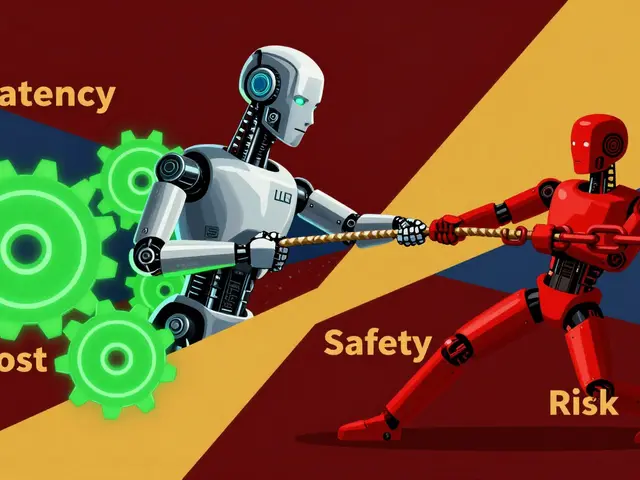
So, why choose decoding-time guardrails over traditional training? It comes down to speed, cost, and flexibility. Retraining an LLM with RLHF can take weeks and burn through millions of dollars in compute. Updating a decoding strategy? That’s code change, deployable in hours. However, there are trade-offs. Adding these checks adds latency. According to performance data from frameworks like Guardrails AI, a well-configured guard might add less than 10 milliseconds per check, but complex validators using external APIs can push that to 100 milliseconds. For interactive apps, this is usually acceptable, but for high-frequency trading bots or real-time voice agents, every millisecond counts.
| Feature | Training-Time (RLHF) | Post-Hoc Moderation | Safety-Aware Decoding |
|---|---|---|---|
| Update Speed | Slow (Weeks/Months) | Fast (Hours/Days) | Very Fast (Minutes/Hours) |
| Latency Impact | None (Built-in) | High (External API calls) | Low-Medium (Internal logic) |
| Jailbreak Resistance | Moderate (Static) | Variable (Context-dependent) | High (Dynamic intervention) |
| Cost to Implement | High (Compute + Data) | Medium (Infrastructure) | Low (Code modification) |
Real-World Performance and Latency
Let’s talk numbers. Users hate waiting. If your safety check makes the AI feel sluggish, they’ll turn it off. Research from 2025 and 2026 shows that modern safety-aware decoding aims to keep added latency between 10 ms and 100 ms. For comparison, a typical LLM response takes hundreds of milliseconds to seconds. So, a 50 ms overhead is often invisible to the human eye. But here’s the catch: "Over-refusal." Some aggressive decoding strategies make the model too cautious. It might refuse to answer simple questions about medical history or legal definitions because it detects a slight risk pattern. Balancing helpfulness with harmlessness is the hardest part of tuning these systems. You want the model to say "no" to building bombs, but "yes" to explaining nuclear physics.

The Arms Race: Can Guardrails Be Bypassed?
Is safety-aware decoding foolproof? Not quite. Security researchers are constantly testing these defenses. In April 2026, a technique called Contextual Representation Ablation (CRA) showed that attackers could potentially disable some guardrails by manipulating the internal hidden states of the model. Essentially, they found ways to silence the "refusal" signals inside the network before the decoding stage even kicked in. This means safety isn’t a one-and-done feature. It’s an arms race. As we build better decoding guards, attackers find new ways to slip past them. Future systems will likely combine multiple layers: embedded heads like ShieldHead, speculative checks like SSD, and external policy engines. No single method is perfect, but together, they create a much harder target for jailbreakers.
Getting Started: Implementation Tips
If you’re building an LLM application today, you don’t need to invent new math. Frameworks like Guardrails AI or custom implementations in Python allow you to plug in these strategies. Here’s a quick checklist for implementation:
- Audit Your Baseline: Run your model against standard jailbreak datasets to see where it fails now.
- Choose Your Method: Use SafeDecoding-style reweighting for lightweight needs. Use SSD if you already run smaller models for other tasks. Consider ShieldHead if you can fine-tune the architecture.
- Measure Latency: Test the added overhead. Ensure it fits your user experience goals.
- Tune Refusal Rates: Adjust thresholds so benign queries aren’t blocked. Monitor false positives closely.
- Monitor Continuously: New attack vectors appear monthly. Keep your guardrail policies updated.
Does safety-aware decoding require retraining the model?
No, that’s its biggest advantage. Most methods like SafeDecoding or SSD operate entirely at inference time. They modify how tokens are selected from the existing model’s probability distribution. Only methods like ShieldHead require minor architectural changes or fine-tuning of a small classification head, but the main LLM weights remain untouched.
How much latency does safety-aware decoding add?
Typically between 10 ms and 100 ms per request, depending on complexity. Simple token reweighting is nearly instantaneous (<10 ms). Methods involving external validator calls or complex multi-model speculation (like SSD) may add up to 100 ms. This is generally considered negligible compared to total LLM response times.
Can jailbreaks still bypass safety-aware decoding?
Yes. Techniques like Contextual Representation Ablation (CRA) demonstrate that sophisticated attacks can manipulate internal model states to bypass decoding-level guards. Safety-aware decoding raises the bar significantly but is not an absolute shield. It works best as part of a defense-in-depth strategy.
What is "over-refusal" in this context?
Over-refusal occurs when safety guardrails are too aggressive, causing the model to reject benign or neutral queries. For example, asking about "drug interactions" might trigger a safety block meant for "illegal drug use." Tuning involves balancing sensitivity to avoid blocking useful information.
Which method is best for production environments?
It depends on your infrastructure. If you have strict latency budgets, token-reweighting methods like SafeDecoding are efficient. If you need robust context understanding and can afford slightly higher compute, speculative methods like SSD or embedded classifiers like ShieldHead offer stronger protection. Many enterprises use a hybrid approach.