Monitoring Loss and Perplexity: Reading Signals During LLM Training
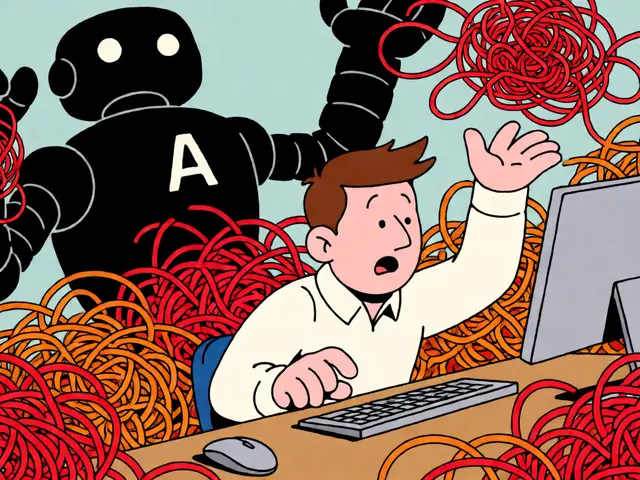
You’re three days into a massive Large Language Model training run. Your GPU cluster is humming, the cost meter is ticking up by the minute, and you’re staring at a dashboard that looks like a heart monitor. The line goes down. Good. Then it wobbles. Is it noise? Is it overfitting? Or did your learning rate just nuke the gradient flow?
This is the daily reality of ML engineering. You aren’t just writing code; you’re interpreting telemetry from a black box. Two metrics dominate this landscape: cross-entropy loss and perplexity. They are mathematically linked, yet they tell different stories. One drives the optimizer; the other helps you understand what the model actually knows. If you can’t read these signals, you’re flying blind.
The Math Behind the Magic
Let’s strip away the jargon. At its core, an LLM is trying to predict the next token in a sequence. It outputs a probability distribution over its entire vocabulary. If the model thinks the next word is "cat" with 90% confidence, and the actual next word is "cat," it’s happy. If it gives "cat" only 1% probability, it’s surprised.
Cross-entropy loss is the raw penalty for that surprise. It measures the average negative log-likelihood per token. In PyTorch implementations, which use natural logarithms, this value is measured in nats. It’s the number the optimizer minimizes directly. But raw loss numbers are abstract. A loss of 3.5 doesn’t intuitively mean much to a human brain.
That’s where perplexity comes in. It’s simply the exponential of the cross-entropy loss ($e^{loss}$). Think of it as the effective size of the model’s uncertainty. If a model has a perplexity of 20, it behaves as if it has 20 equally likely choices for each token. A perplexity of 1 means perfect prediction (zero uncertainty). A perplexity of 100 means the model is guessing among 100 options.
Why does this matter? Because perplexity is interpretable. When OpenAI released GPT-3, they didn’t just say "we reduced loss." They highlighted dramatic drops in perplexity compared to GPT-2, signaling a superior grasp of language patterns. It’s the difference between saying "the error score went down" and saying "the model’s confusion dropped by half."
Reading the Dashboard: What Normal Looks Like
When you start a fresh training run, expect high perplexity. For a random initialization on a standard dataset like Penn Treebank, you might see values in the thousands. As training progresses, this should drop rapidly. State-of-the-art models like GPT-3 or Claude 3 typically achieve perplexity scores between 20 and 25 on standard benchmarks. If you’re seeing 100+ after significant training steps, something is wrong.
But context is king. Perplexity is dataset-dependent. A model achieving 20 perplexity on clean, curated books might hit 50 or higher on messy web text. Never compare perplexity across different datasets without normalization. Also, remember that tokenizers affect these numbers. Different tokenization strategies split words differently, changing the sequence length and the difficulty of prediction. Hugging Face’s documentation explicitly warns that perplexity values aren’t comparable across different tokenizers.
Here’s a quick heuristic for reading your curves:
- Sharp Initial Drop: This is normal. The model is learning basic syntax and frequent tokens.
- Steady Decline: The model is capturing deeper semantic structures.
- Plateau: The model has learned all it can from the current data or hyperparameters. Check your learning rate schedule.
- Sudden Spikes: Often caused by batch normalization issues, bad data batches, or gradient explosions. If it recovers quickly, it’s noise. If it persists, check your data pipeline.
- Increase After Decrease: Classic sign of overfitting. The model is memorizing training data but failing to generalize to validation sets.
Common Pitfalls and False Signals
Many engineers fall into the trap of thinking lower perplexity always equals better performance. It doesn’t. Perplexity measures how well the model predicts the next token in the training distribution. It doesn’t measure reasoning, factuality, or helpfulness. You can have a model with low perplexity that produces grammatically correct but semantically nonsense sentences.
A Reddit user recently shared a horror story: their validation perplexity plateaued at 25.3 while training accuracy kept climbing. They panicked, thinking the model was broken. It turned out their learning rate schedule was too aggressive late in training, causing instability. Once they adjusted the decay, validation perplexity dropped further. The lesson? Don’t react to single points. Look at trends over hundreds of steps.
Another common mistake is ignoring the gap between training and validation perplexity. If training perplexity is 18 and validation is 45, you have severe overfitting. If both are 45, your model is underfitting-it hasn’t learned enough. The goal is to close that gap while keeping both values low.
| Metric | Definition | Interpretation | Best Use Case |
|---|---|---|---|
| Cross-Entropy Loss | Average negative log-likelihood per token | Raw optimization target; harder to interpret intuitively | Optimizer feedback loop |
| Perplexity | Exponentiated average negative log-likelihood ($e^{loss}$) | Effective number of choices; intuitive scale | Diagnostics and reporting |
| Validation Loss | Loss computed on held-out data | Generalization capability | Detecting overfitting |
| Task-Specific Scores | ROUGE, BLEU, Human Eval | Quality of generated output for specific tasks | Final model selection |

Practical Implementation Tips
Monitoring these metrics adds minimal overhead-less than 2% computational cost according to AWS SageMaker benchmarks. So, why do people skip it? Usually because they don’t know when to evaluate.
Evaluating every step is wasteful. Evaluating once an hour is too slow to catch issues. The sweet spot? Every 500 to 1,000 training steps. This balances signal frequency with compute cost. Most modern frameworks like Hugging Face Transformers support this out of the box.
One tricky aspect is handling variable sequence lengths. If you calculate perplexity per sequence, longer sequences will skew results. Always calculate per-token perplexity. This normalizes for length and gives you a consistent metric regardless of batch composition.
Also, watch out for Out-of-Vocabulary (OOV) tokens. While most modern subword tokenizers handle this well, rare tokens can cause spikes in loss if not handled correctly. Ensure your special tokens (like `
Beyond Perplexity: The Future of Diagnostics
Is perplexity going away? No. But it’s becoming one piece of a larger puzzle. Recent research shows that perplexity filtering for data selection can sometimes pick grammatically correct but shallow text. Newer techniques, like Ask-LLM scoring, show no correlation with perplexity in some cases, suggesting we need multi-dimensional evaluation.
Meta has announced "Contextual Perplexity," scheduled for broader adoption around 2026, which aims to incorporate semantic coherence. Meanwhile, tools like Google’s Perplexity Explorer help visualize where the model struggles within a sequence, not just overall averages.
For now, though, mastering loss and perplexity remains essential. They are the heartbeat of your training run. Learn to listen to them. When the curve dips smoothly, relax. When it flatlines, investigate. When it spikes, act fast. Your model’s success depends on your ability to read these subtle signals before they become expensive failures.
What is a good perplexity score for an LLM?
There is no universal "good" score because perplexity is highly dependent on the dataset and tokenizer. However, for standard benchmarks like Penn Treebank, state-of-the-art models typically achieve scores between 20 and 25. On more complex, diverse web corpora, scores of 30-50 might be considered strong. Always compare against baselines trained on the same data.
Why is my validation perplexity higher than training perplexity?
This is expected and healthy. Validation data is unseen by the model, so it naturally performs worse. A small gap indicates good generalization. A large gap suggests overfitting, meaning the model is memorizing training data rather than learning general patterns. Adjust regularization or early stopping if the gap becomes excessive.
Can I compare perplexity across different models?
Only if they use the exact same tokenizer and are evaluated on the exact same dataset. Different tokenizers break text into different units, making direct comparison invalid. Even with the same tokenizer, minor differences in preprocessing can affect scores. Always document your evaluation setup rigorously.
Does lower perplexity mean better generation quality?
Not necessarily. Low perplexity means the model predicts the next token accurately based on training distribution. It doesn't guarantee factual accuracy, logical reasoning, or stylistic appropriateness. A model can have low perplexity but produce repetitive or nonsensical long-form text. Use task-specific metrics like ROUGE or human evaluation for final quality checks.
How often should I calculate perplexity during training?
Every 500 to 1,000 steps is a common recommendation. Calculating it every step wastes compute resources since the change is negligible. Calculating it too infrequently delays detection of issues like divergence or overfitting. Modern frameworks allow you to configure this easily via callback handlers.