Residual Connections and Layer Normalization in Large Language Models: Why They Keep Training Stable
Imagine building a 100-layer neural network where every layer tries to improve on the last-but halfway through, the signal dies. Gradients vanish. The model stops learning. This was the nightmare before residual connections and layer normalization became standard in large language models (LLMs). Today, you can’t train a model like GPT-4 or Llama 3 without them. They’re not optional upgrades. They’re the reason deep transformers even work.
What residual connections actually do
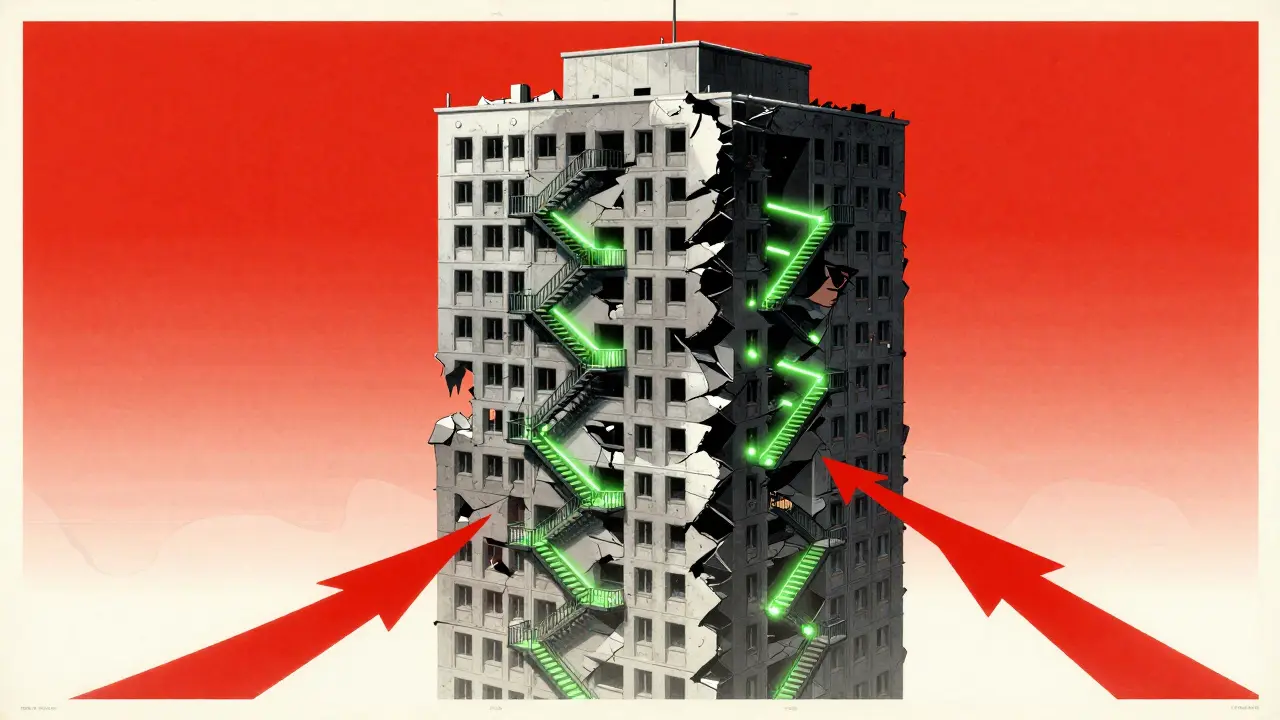
Residual connections are simple in theory: add the input of a layer directly to its output. Mathematically, it’s y = F(x) + x. That’s it. No fancy math. No magic. Just addition. But here’s why it matters: in deep networks, gradients shrink as they flow backward during training. By layer 10 or 15, they’re so weak the model can’t update its early layers. Residual connections fix that by giving gradients a shortcut. Instead of forcing the gradient to pass through every single transformation, it can just flow straight back through the added input. Think of it like a detour around a traffic jam. In the original Transformer paper from 2017, the authors tested removing residual connections-and the model collapsed. Training became unstable after just 4 layers. Without them, you’re stuck with shallow models. With them, you can stack 128 layers and still train effectively. GPT-2 used residual connections twice per transformer block: once after attention, once after the MLP. BERT used them once per block. Both worked. The key isn’t how many you add-it’s that you add them at all.Layer normalization: the quiet stabilizer
While residual connections fix gradient flow, layer normalization fixes activation chaos. In early deep learning, batch normalization was the go-to tool. But it required fixed-size batches and didn’t work well with variable-length sequences-exactly what language models deal with. Enter layer normalization, introduced in 2016. Instead of normalizing across the batch, it normalizes across the features for each sample. The formula looks intimidating: y = γ * (x − mean) / sqrt(var + ε) + β. But what it does is simple: it makes sure each layer’s outputs have a consistent mean and variance. No more wild spikes in activation values. No more layers getting overwhelmed by inputs that are too big or too small. In practice, this means the model doesn’t have to constantly relearn how to handle incoming data. It trains faster. It’s less sensitive to initialization. And it’s far more predictable. Without layer normalization, even a 6-layer transformer would struggle. With it, models with 24, 48, or 96 layers become feasible. That’s not a small win. That’s the difference between a prototype and a product.Post-LN vs. Pre-LN: the architectural showdown
There are two main ways to combine residual connections and layer normalization: Post-LN and Pre-LN. Post-LN (original Transformer style): Output = LayerNorm(x + SubLayer(x)) Pre-LN (now more common in deep models): Output = x + SubLayer(LayerNorm(x)) At first glance, they look almost identical. But the order changes everything. Post-LN keeps gradients strong in the deeper layers, which helps those layers extract complex features. But in shallow layers, gradients vanish. In Wang et al.’s 2020 study, the gradient norm in layer 1 dropped to 0.0002 in a 16-layer Post-LN model-almost zero. The model couldn’t learn from early layers. Pre-LN fixes that. By normalizing before the sublayer, it keeps input distributions stable from the start. Gradients stay strong all the way back. But here’s the catch: Pre-LN makes adjacent layers too similar. Cosine similarity between layers hit 0.87 in some tests. That means layer 5 is learning almost the same thing as layer 6. You’re wasting depth. So which one should you use?- For models under 12 layers? Post-LN still works fine. BERT used it successfully with 24 layers.
- For models over 12 layers? Pre-LN is the default. GPT-2, Llama, and most modern models use it.
- For models over 30 layers? You need more than just Pre-LN.

The B2T breakthrough: when even Pre-LN isn’t enough
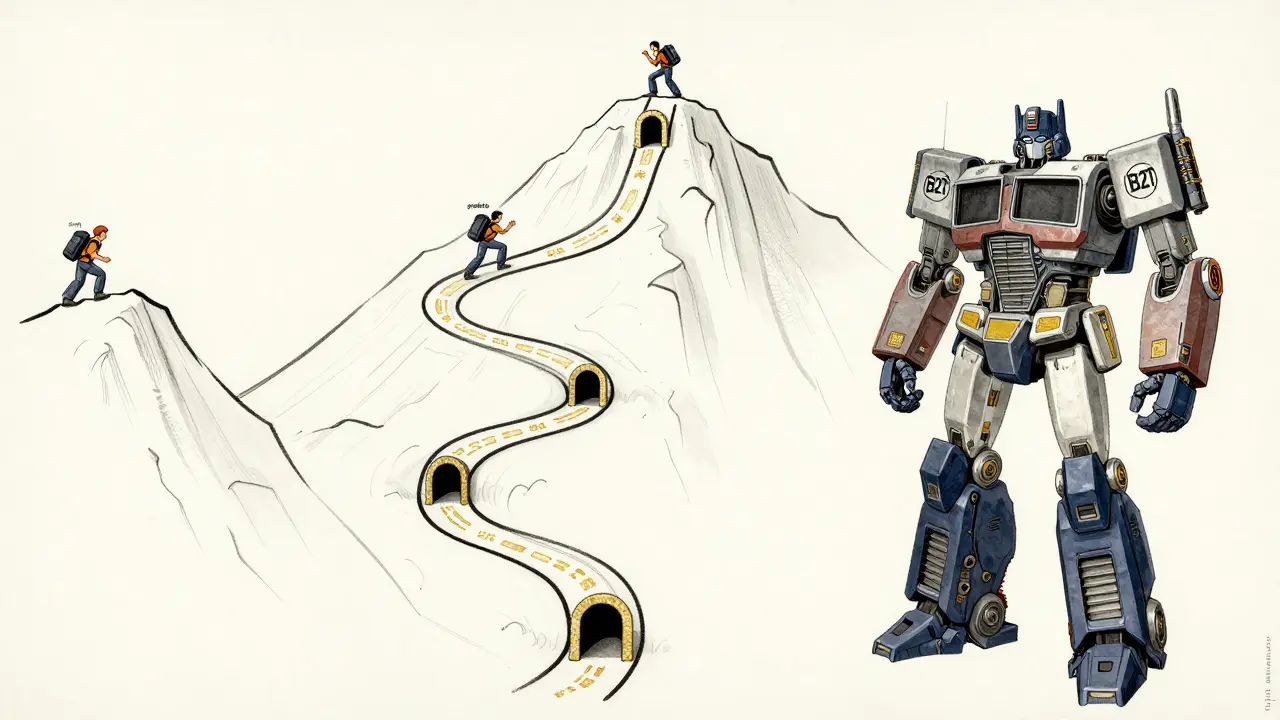
In 2020, Wang et al. introduced a tweak called Bottom-to-Top (B2T). It’s a clever hybrid. It keeps the stability of Pre-LN but adds an extra residual path that skips layer normalization entirely-except at the very end. This means gradients get a direct route from input to output, avoiding the normalization bottleneck. In tests with 16 layers, B2T scored 29.1 BLEU on translation, beating Pre-LN’s 28.3 and Post-LN’s failure to converge. Meta’s Llama 3 (2024) reportedly uses a version of B2T to train 128-layer models. That’s not an accident. It’s a response to a real problem: as models get deeper, even small inefficiencies compound. B2T isn’t in every library yet. But if you’re building a model with 50+ layers, you should be looking at it.Real-world impact: from research to billions
These two techniques didn’t just improve models. They changed the industry. Before residual connections and layer normalization, the deepest NLP models had around 8-12 layers. BERT (2018) broke that with 24. GPT-3 (2020) hit 96. GPT-4 variants now exceed 100. That growth curve? It’s almost entirely thanks to these architectural fixes. Enterprise adoption followed fast. By 2023, 78% of Fortune 500 companies used transformer-based models. Finance and healthcare led the way-not because they’re more tech-savvy, but because they needed deep models to understand complex documents, contracts, and medical records. The global market for transformer-based AI hit $15.7 billion in 2023. That’s not hype. That’s revenue. And it’s built on top of residual connections and layer normalization.Common mistakes and how to avoid them
Even with all the research, people still mess this up. Mistake 1: Using the same learning rate for Pre-LN and Post-LNPre-LN needs higher learning rates-20-30% higher. Hugging Face maintainers have seen this error in dozens of GitHub issues. If your model isn’t learning, check your LR. Mistake 2: Forgetting to scale residual connections
In deep networks (20+ layers), the residual path can dominate. The solution? Scale the residual branch by 1/sqrt(2) per connection. It keeps the signal balanced. Mistake 3: Ignoring layer collapse
Pre-LN can cause layers to learn identical representations. If your 48-layer model trains for weeks but performs like a 10-layer one, this is likely why. Switch to B2T or reduce depth. Mistake 4: Using wrong epsilon values
Layer normalization uses ε to avoid division by zero. Too high (like 1e-3) and you lose precision. Too low (like 1e-15) and you get NaNs. Stick to 1e-5 to 1e-12. PyTorch’s default (1e-5) is safe for most cases.
What’s next? The future of normalization
Residual connections aren’t going anywhere. They’re too simple, too effective. But layer normalization? That’s changing. Google’s Adaptive Layer Normalization (AdaLN), announced in 2023, adjusts normalization parameters based on input content. Early results show a 1.8% improvement across NLP benchmarks. That’s huge. Experts predict fixed normalization will be replaced by context-aware versions within five years. But even then, the core idea-stabilizing activations-will remain. The bigger threat? Not better normalization. But better training methods. Yann LeCun has argued that residual connections are a band-aid for flawed optimization. Energy-based models or other architectures might one day make them obsolete. But today? They’re still the foundation.Practical advice: what to do now
If you’re building or fine-tuning an LLM:- Use residual connections-always.
- For models under 12 layers: Post-LN is fine.
- For models over 12 layers: Use Pre-LN.
- For models over 30 layers: Try B2T or similar variants.
- Increase learning rate by 25% if switching from Post-LN to Pre-LN.
- Scale residual branches by 1/sqrt(2) per layer in deep networks.
- Use ε = 1e-5 unless you’re working with mixed precision.
Why this matters beyond the code
Residual connections and layer normalization aren’t just technical tricks. They’re a lesson in simplicity. Sometimes, the biggest breakthroughs aren’t about adding complexity. They’re about adding a single line of code that lets the network breathe. We didn’t need bigger models to solve language. We needed better ways to train them. And that’s what these two ideas gave us: the ability to build deeper, smarter, more stable models without reinventing the wheel. The next time you hear about a new LLM breaking records, don’t just cheer for the size. Ask: did they use residual connections? Did they use layer normalization? And did they get the order right? Because the real innovation isn’t in the parameters. It’s in the path the gradients take.Why do residual connections prevent vanishing gradients?
Residual connections create a direct path for gradients to flow backward without being multiplied through every weight layer. In a standard deep network, gradients shrink exponentially as they pass through each layer. With a residual connection, the gradient can flow straight from the output back to the input via the addition operation, preserving much of its original strength. This is why models with 100+ layers can still train effectively-gradients don’t vanish before reaching the early layers.
Is layer normalization the same as batch normalization?
No. Batch normalization normalizes across the batch dimension, meaning it uses statistics from all samples in a mini-batch. This doesn’t work well for variable-length sequences or small batch sizes. Layer normalization normalizes across the feature dimension for each individual sample, making it ideal for transformers and language models where input lengths vary and batch sizes are often limited by memory.
Which is better: Pre-LN or Post-LN?
There’s no universal answer. Pre-LN is better for deep models (12+ layers) because it stabilizes training and prevents gradient vanishing. Post-LN can perform better in shallow models and preserves gradient diversity across layers, making higher layers more distinct. However, Post-LN often fails to converge beyond 12 layers. For most modern applications, Pre-LN is the safer default.
Can I train a transformer without layer normalization?
Technically yes, but not reliably. Without layer normalization, activation distributions become unstable, especially in deeper layers. This causes training to diverge, oscillate, or stall. Even models with only 6 layers show poor convergence without it. Layer normalization is now considered essential-not optional-for any transformer-based architecture.
Why do some models use two residual connections per transformer block?
Each transformer block has two main sublayers: self-attention and the feed-forward network (MLP). Each of these sublayers benefits from its own residual connection. This ensures that both the attention mechanism and the MLP can be trained deeply without losing gradient signal. GPT-2 and later models use this design to support deeper architectures without collapse.
What is layer collapse, and how do I avoid it?
Layer collapse happens when multiple layers in a deep network learn nearly identical representations, effectively reducing the model’s depth. This is common in Pre-LN architectures with more than 24 layers. To avoid it, use B2T-style connections, reduce model depth, or add small random perturbations during training. Monitoring cosine similarity between adjacent layers can help detect it early.
Do I need to change anything when fine-tuning a pre-trained model?
Usually not. The residual connections and layer normalization are already baked into the pre-trained weights. Your job is to preserve them. Don’t remove or modify them during fine-tuning. The only thing you might adjust is the learning rate-especially if you’re switching from a Post-LN to a Pre-LN model. But the architecture itself should stay untouched.
How much GPU memory do these techniques require?
Residual connections and layer normalization themselves add negligible memory overhead-they’re just addition and normalization operations. The memory cost comes from the model depth they enable. A 6-layer transformer needs ~4GB; a 12-layer model needs ~8GB; and a 100-layer model like GPT-4 can require 80GB+ of GPU memory. The techniques don’t increase memory usage-they just make it possible to use much larger models efficiently.










so like... u just add x to F(x) and boom magic? lol i thought ai was supposed to be hard
Pre-LN is the only way to go past 12 layers-Post-LN is a relic from the days when we thought 24 layers was ‘deep.’ The gradient collapse in shallow layers is catastrophic. And don’t get me started on how B2T bypasses the normalization bottleneck entirely-this isn’t engineering, it’s architecture warfare.
Wait-so you’re telling me that after all these years of overcomplicating neural nets, the answer was just… ADDING A LINE OF CODE? And people paid billions for this? I mean, I’m not mad, but I AM disappointed. Also-epsilon at 1e-5? Are you kidding me? That’s not even a real number. Use 1e-8. Always. And if you’re using PyTorch’s default without questioning it, you’re not a researcher-you’re a copy-paster. And yes, I’m calling you out.
How quaint. You treat residual connections like some divine revelation, as if no one before 2015 understood the gradient problem. Have you ever read about skip connections in early CNNs? Or the work from 1999 on highway networks? This isn’t innovation-it’s rediscovery dressed in transformer glitter. And layer normalization? Please. It’s just batch norm’s poor cousin that got lucky because RNNs were too messy to handle. The real breakthrough isn’t in the math-it’s in the marketing.
These techniques are why we can even dream of models that understand context, not just predict words. It’s not magic-it’s persistence. Every layer breathing because someone thought to let the signal through. Keep building. Keep training. The future isn’t in bigger models-it’s in smarter paths.
What if the real question isn’t how to stabilize gradients-but why we need gradients at all? What if learning isn’t about backpropagation, but about emergence? Residual connections feel like a bandage on a wound that shouldn’t exist. Maybe the problem isn’t the depth-it’s the assumption that every layer must learn something new. What if we’re forcing evolution where spontaneity should reign? The math works. But does it mean we’re on the right path-or just the easiest one?
Ugh. I read this whole thing. Honestly? If your model doesn’t train without these tricks, maybe you’re just bad at tuning. Or maybe your data’s trash. Stop blaming architecture for your lack of creativity. I’ve trained 80-layer models on a laptop with just dropout and a good optimizer. These ‘essential’ fixes? More like crutches for lazy engineers.