Domain-Driven Design with Vibe Coding: How Bounded Contexts and Ubiquitous Language Prevent AI Architecture Failures
Most teams using AI to write code think they’re saving time. They’re wrong. They’re just delaying the mess.
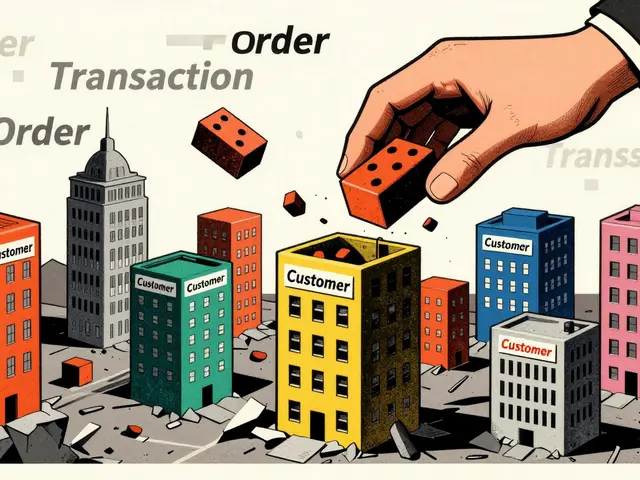
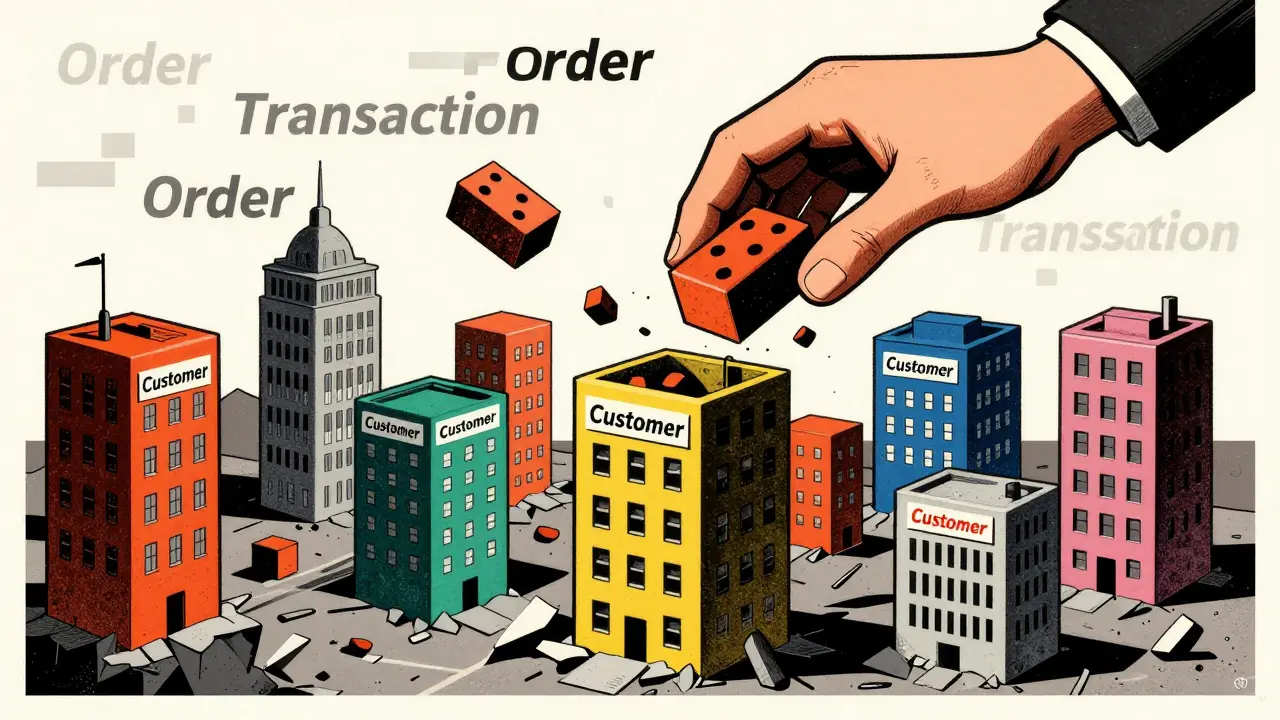
By late 2025, 67% of vibe coding projects-where developers use natural language prompts to generate code with AI-had collapsed under their own weight. Not because the AI failed. But because no one defined where one part of the system ended and another began. No one agreed on what a "Customer" actually meant across different parts of the app. And suddenly, you had 17 different versions of "Customer" in the same codebase. All generated by the same AI. All conflicting. All expensive to fix.
This isn’t a bug. It’s a design failure. And the fix isn’t better AI. It’s better Domain-Driven Design.
Why Vibe Coding Alone Doesn’t Work
Vibe coding, as Andrej Karpathy described it in early 2025, is "give in to the vibes." You describe what you want in plain language. The AI writes the code. You test it. You tweak the prompt. Repeat. It’s fast. It’s fun. It feels like magic.
But magic doesn’t scale.
Teams using vibe coding without structure can spin up a working prototype in under two hours. That’s impressive. But by the three-month mark, those same teams have 37% more technical debt than teams using traditional coding. Why? Because the AI doesn’t remember context. It doesn’t understand boundaries. It doesn’t care if "Order" in one file means something different than "Order" in another.
Google Cloud’s 2025 survey found that vibe coding works great for creation-but fails at maintenance. That’s the creation-maintenance divide. And it’s wide. Without structure, your codebase becomes a patchwork of AI-generated fragments that no one can reason about. Not even the person who wrote the original prompts.
What Bounded Contexts Actually Do
Domain-Driven Design (DDD) has a tool for this exact problem: Bounded Contexts.
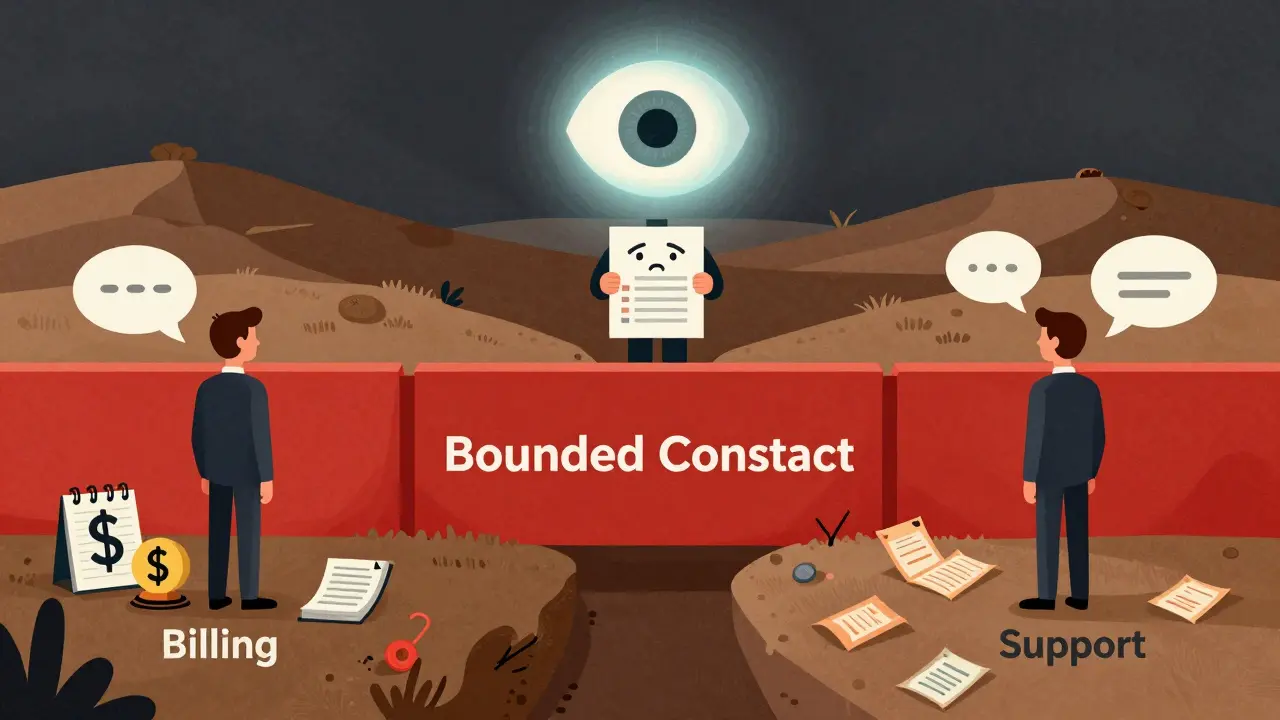
A Bounded Context is a clear, named boundary around a specific part of your system where a particular model applies. Think of it like zoning laws for your code. In one context, "Customer" means someone who buys products. In another context, "Customer" means someone who calls support. They’re different people with different data. And they shouldn’t share code.
In vibe coding, you don’t just say: "Write me a customer service module." You say: "Generate a Bounded Context called 'SupportTicketing' with these rules: Customer = user who opens a ticket. Ticket status can be Open, In Progress, Resolved. Only the SupportAgent role can update status. Do not reference any payment or inventory data. This context must not import models from the Billing context."
That’s not a prompt. That’s a contract.
Instinctools’ 2025 enterprise survey found that teams who defined 3-5 Bounded Contexts before starting vibe coding saw 63% fewer model inconsistencies. Why? Because the AI now has guardrails. It knows what it can and can’t touch. It knows what terms mean in this context. It doesn’t guess. It follows instructions.
Without Bounded Contexts, AI will happily merge your billing logic with your inventory logic. It won’t see the problem. It just sees a prompt: "Make a system that handles orders and customers." And boom-you get a mess.
Ubiquitous Language: The Shared Dictionary
Every Bounded Context needs a language. Not just code comments. A Ubiquitous Language.
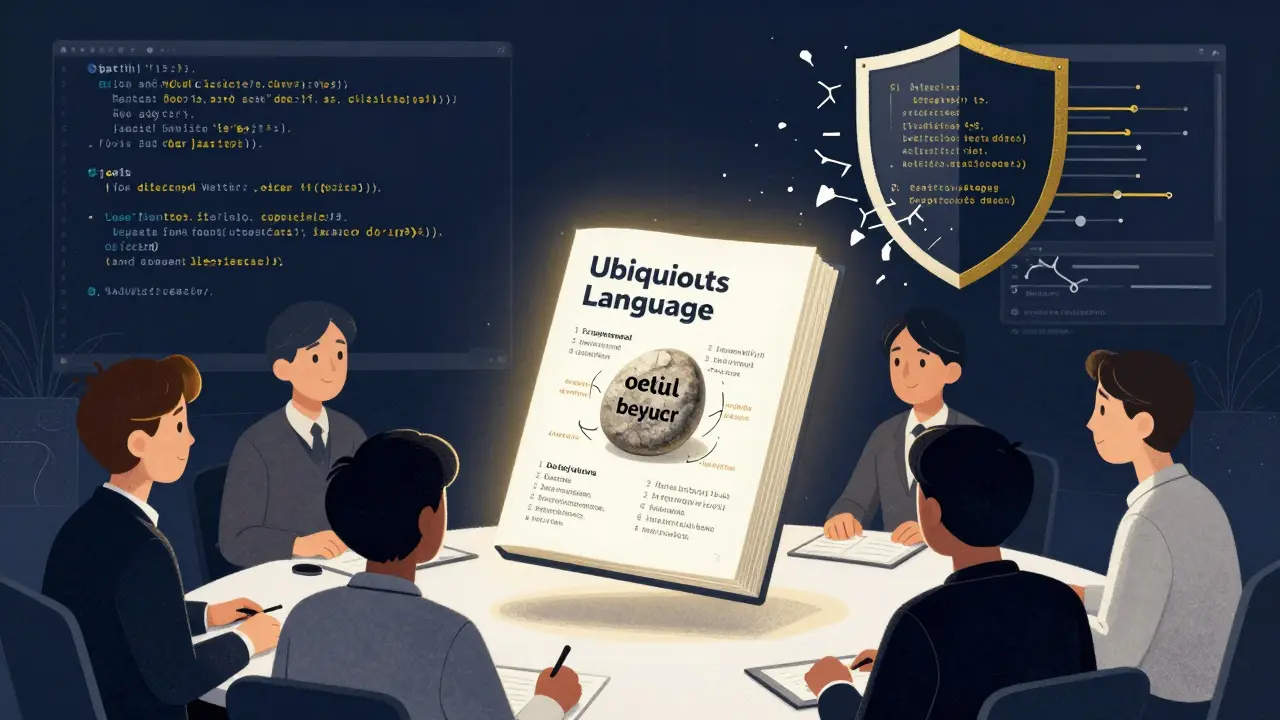
This is the exact same vocabulary used by developers, product managers, and domain experts. No jargon. No synonyms. No "customer," "user," and "client" used interchangeably. One term. One meaning. Everywhere.
One healthcare startup in Asheville used this approach in late 2025. They sat down with nurses, billing clerks, and doctors. They wrote down every term used in daily work: "Admission," "Discharge," "Referral," "Order." They defined each one. Then they turned those definitions into a living glossary. Every AI prompt started with: "In the 'PatientFlow' Bounded Context, 'Admission' means the moment a patient is registered in the system, not when they arrive at the ER."
The result? A 45% drop in domain misunderstandings. Non-technical staff could review AI-generated code and say, "That’s not what we mean by 'Discharge.'" And they were right.
Compare that to a fintech startup that skipped the Ubiquitous Language. Their AI kept generating code where "Transaction" meant one thing in Payments and another in Reporting. They spent two days untangling it. The fix? They had to rename 147 variables and rewrite 38 tests.
Ubiquitous Language isn’t optional. It’s the anchor. Without it, your AI doesn’t just generate bad code. It generates confusing code. And confusion is the silent killer of long-term projects.
How to Start Using DDD with Vibe Coding
You don’t need to rewrite your whole system. Start small.
- Pick one small domain. Not "the whole app." Pick one feature: "User Onboarding," "Email Notifications," or "Product Returns."
- Define the Bounded Context. Write down: What’s inside? What’s outside? What can it talk to? What can’t it touch? Use a simple diagram if it helps.
- Build the Ubiquitous Language. List every key term. Define it in plain English. Get non-technical stakeholders to approve it.
- Create a prompt template. Every time you use AI, start with this:
- Context Name: [Name]
- Boundary: [What’s included, what’s excluded]
- Key Terms: [Term] = [Definition]
- Integration Points: [Which other contexts does this connect to?]
- Generate, test, validate. Run the AI. Check if the code matches your definitions. If it doesn’t, fix the prompt-not the code.
That’s it. You’re not replacing DDD. You’re using AI to accelerate it.
Teams that do this see domain modeling drop from 6-8 weeks to 2.1 days. And technical debt? 52% lower than vibe coding without DDD.
The Hidden Risk: Context Drift
The biggest danger isn’t starting wrong. It’s drifting over time.
Context drift happens when small changes accumulate. A developer adds a field to a model. Another team reuses it. The AI starts generating code that crosses boundaries. No one notices. Until you’re debugging a bug that shouldn’t exist.
Instinctools found that 63% of projects with initial DDD structure still suffered context drift within six months. Why? Because no one checked.
Solution? Automated context validation. Some teams now use scripts that scan every new commit. If code in the "Billing" context references a "Customer" from the "Support" context, the CI pipeline blocks it. The error message? "Context violation: Billing cannot access Support.Customer. See context-definition.md."
It’s not fancy. But it works.
GitHub’s top DDD-Vibe-Coding-Starter template (over 1,200 stars) includes a context-definition.md file for every context. It’s not documentation. It’s a contract. And the AI is trained to respect it.
What the Experts Are Saying
Eric Evans, the creator of Domain-Driven Design, put it bluntly in a July 2025 interview: "AI will happily create inconsistent models across what should be separate domains. The core of DDD has always been about shared understanding. AI makes this more critical than ever."
Martin Fowler agrees. He warned that vibe coding risks creating a generation of developers who can prompt but can’t debug. But he also said: "When combined with DDD principles, it could finally make domain modeling accessible to non-technical stakeholders."
Google Cloud’s Rajiv Misra says the most successful vibe coding teams define their contexts before they write a single line of code. Not after. Not during. Before.
And for good reason: AI doesn’t think like a human. It doesn’t know what "important" means. It doesn’t care about consistency. It just follows the prompt. If your prompt is vague, the output will be chaotic.
What’s Next? The Tools Are Catching Up
The market is responding. Google’s AI Studio will release automatic bounded context detection in December 2025. It analyzes your prompts and suggests context boundaries before code is generated.
GitHub Copilot is building "DDD-aware prompting" for Q1 2026. It will enforce Ubiquitous Language consistency across generations. If you use "Customer" in one prompt and "Client" in the next, it will flag the inconsistency.
And tools like ContextAI, launched in May 2025, are built from the ground up for this. They don’t just generate code. They help you map contexts, define language, and validate boundaries.
But here’s the truth: No tool will fix bad thinking. If you don’t understand your domain, no AI will help. If you don’t define your boundaries, no prompt template will save you.
Domain-Driven Design isn’t about architecture diagrams. It’s about clarity. About shared meaning. About making sure everyone-developers, product teams, even customers-agrees on what the system does.
Vibe coding gives you speed. DDD gives you stability. Together, they give you something rare: software that scales, changes, and lasts.
Don’t let AI write your architecture. Guide it. Define it. Own it.