Mixed-Precision Training for Large Language Models: FP16, BF16, and Beyond
Training large language models used to take weeks, burn through millions of dollars, and require racks of high-end GPUs. Now, with mixed-precision training, many of those same models train in days-not weeks-and at a fraction of the cost. The secret? Using different number formats at different stages of training. It’s not magic. It’s math, hardware, and smart engineering working together.
Why Precision Matters in Training
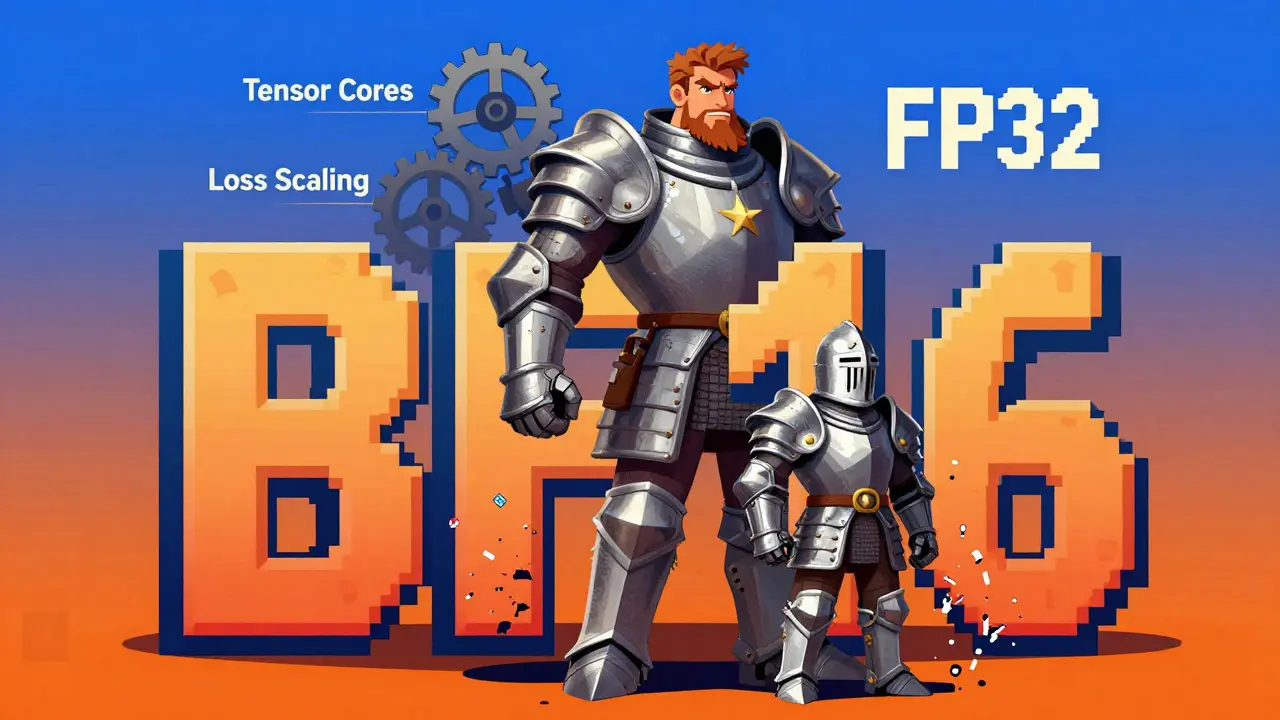
When you train a model like Llama 3 or GPT-4, you’re doing billions of calculations every second. Each weight, gradient, and activation is stored as a number. The default format for decades has been FP32-32-bit floating point. It’s precise. Safe. Reliable. But it’s also heavy. Every number takes up 4 bytes of memory. For a 70-billion-parameter model, that’s 280 gigabytes just to hold the weights. Add gradients, optimizer states, and activations, and you’re talking about over a terabyte of memory needed. Most GPUs don’t have that. Enter mixed-precision training. Instead of using FP32 for everything, you use FP16 or BF16 for the heavy math-matrix multiplications, attention computations-and keep FP32 only where it absolutely matters: updating weights. This cuts memory use in half and makes computations much faster.FP16 vs BF16: What’s the Difference?
Both FP16 and BF16 use 16 bits instead of 32. That’s a 50% memory reduction right away. But they’re not the same. FP16 has a 5-bit exponent and 10-bit mantissa. That gives it a narrow range: from about 0.00006 to 65,504. Sounds fine? Until you’re training a 100-layer transformer and your gradients drop below 0.0001. Then they vanish-underflow. You lose information. Your model stops learning. BF16 fixes this. It keeps the 8-bit exponent of FP32 but cuts the mantissa to 7 bits. That means it can handle numbers as small as 10^-38 and as large as 10^38-just like FP32. The trade-off? Less precision in the decimal places. But for most LLMs, that’s fine. The model doesn’t need 7-digit accuracy to learn patterns from text. What it needs is stability. Meta’s Llama 3 uses BF16. So does Google’s Gemini. NVIDIA’s H100 GPUs are optimized for it. And benchmarks show BF16 matches FP32 accuracy within 1.3%, while FP16 can drop by 2-3% without careful tuning.How Mixed-Precision Training Actually Works
It’s not just about switching to FP16. There are three critical pieces:- Convert weights to low precision for forward and backward passes. This is where the speedup happens.
- Keep master weights in FP32. Every time gradients are applied, they’re used to update these high-precision copies. This prevents tiny errors from adding up.
- Use loss scaling. Because FP16 can’t represent very small numbers, gradients get scaled up during training and then scaled back down before updating weights. Without this, training fails.
torch.autocast(), initialize a GradScaler(), and let it handle the rest. No need to manually convert tensors. The framework does it automatically.
Here’s what it looks like in practice:
scaler = torch.cuda.amp.GradScaler()

for batch in dataloader:
    optimizer.zero_grad()
    with torch.autocast(device_type='cuda', dtype=torch.bfloat16):
        outputs = model(batch)
        loss = criterion(outputs, labels)
    scaler.scale(loss).backward()
    scaler.step(optimizer)
scaler.update()Hardware Matters-A Lot
Mixed precision only works well if your GPU supports it. NVIDIA’s Tensor Cores, introduced in the Volta architecture (2017), are built to crunch FP16 and BF16 operations in parallel. On an A100 or H100, you get up to 8x more FP16 throughput than FP32. That’s where the 3x speedup comes from. Older GPUs without Tensor Cores? You won’t see much benefit. You might even slow things down. And if you’re using AMD’s MI300X or Intel’s Gaudi2, they support BF16 too-but performance varies. NVIDIA still leads in real-world speed, with 91% of mixed-precision training happening on their hardware, according to MLPerf benchmarks. BF16 requires Ampere (A100) or newer. FP16 works on Pascal (P100) and up. If you’re on a 2018-era GPU, stick with FP32-or upgrade.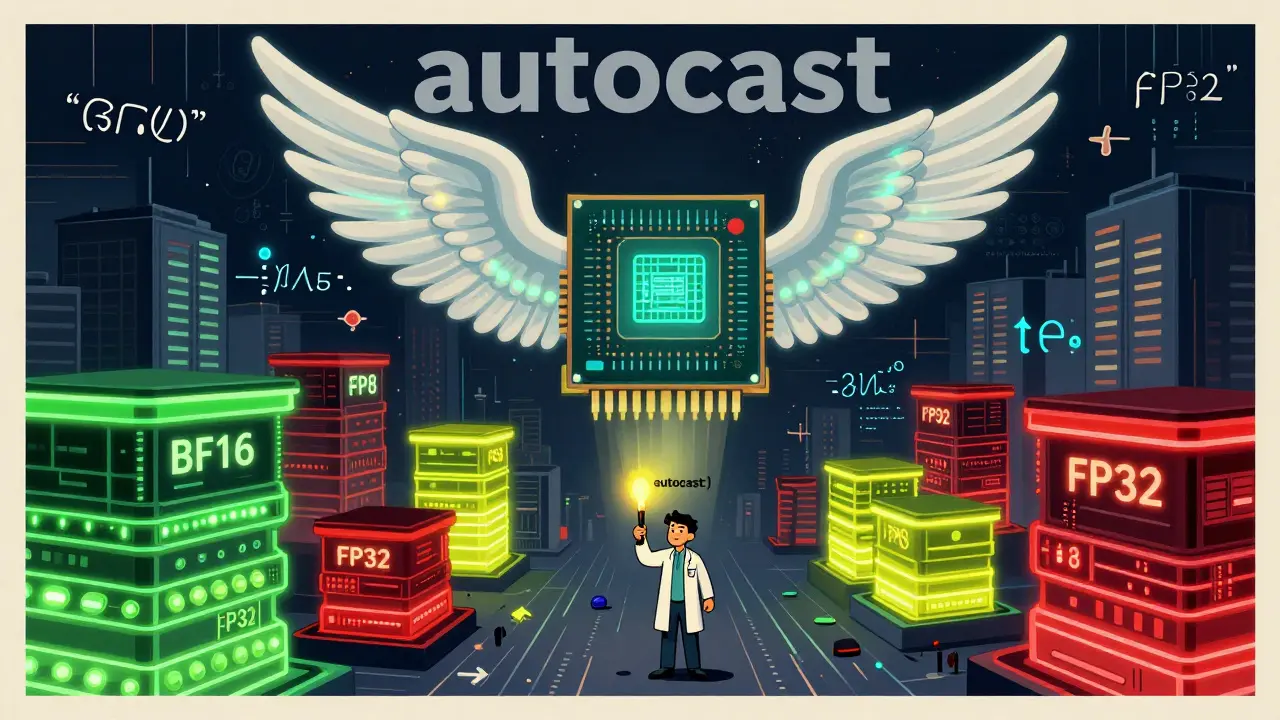
Real-World Results: Speed, Cost, and Scale
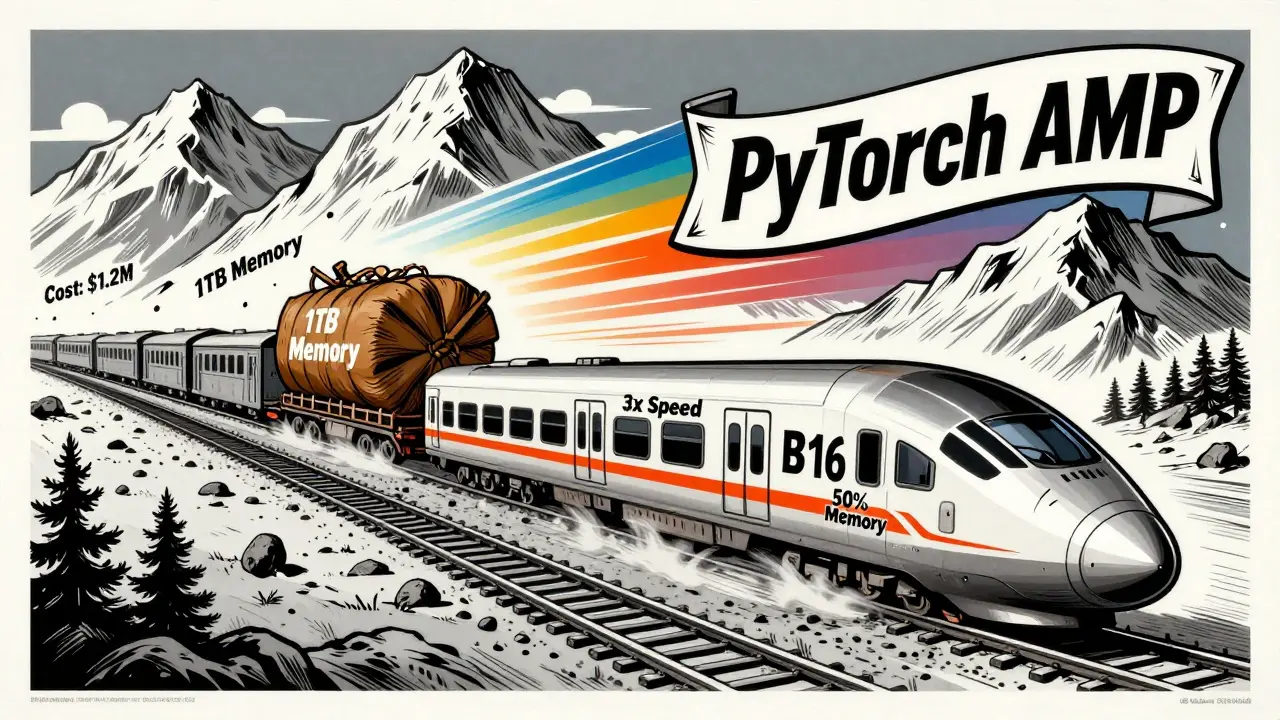
Let’s talk numbers. A 7-billion-parameter model trained in FP32 on 8x A100s might take 14 days and cost $1.2 million in cloud compute. Switch to BF16 with mixed precision? Training time drops to 5 days. Cost drops to $480,000. That’s a 60% savings. Batch sizes also jump. With half the memory usage, you can fit 2x or even 4x more samples per batch. Larger batches mean more stable gradients and faster convergence. One engineer on Reddit reported their Llama 2 fine-tuning went from 14 days to 5 days-without changing anything else. And it’s not just startups. Gartner says 87% of enterprises training models over 1 billion parameters now use mixed precision. AWS reports 73% of their P5 instances (the most powerful EC2 GPUs) are running mixed-precision workloads. It’s not optional anymore. It’s standard.What About FP8? The Next Step
FP8 is the new frontier. It uses only 8 bits-half of BF16. Meta’s Llama 4 uses it. NVIDIA’s Blackwell chips, shipping in Q2 2025, will have hardware support for FP8. The promise? Another 1.5x speedup over BF16. But FP8 is tricky. The range is tiny. The precision is razor-thin. A single layer with a few large gradients can wreck training. That’s why Meta and Google use adaptive FP8-only applying it to layers that can handle it, keeping higher precision where gradients are noisy. A November 2024 arXiv paper showed a model using selective FP8 and BF16 got 4.3x memory reduction with just 0.8% accuracy drop. That’s huge. But it took weeks of tuning. For most teams, BF16 is still the sweet spot.Common Pitfalls and How to Fix Them
Mixed precision isn’t plug-and-play. Here’s what goes wrong-and how to fix it:- Gradient underflow: Your loss stops decreasing. Solution: Increase the loss scale factor. Start with 2^16 and go higher if needed.
- NaN losses: Your model outputs nonsense. Usually caused by too aggressive scaling or bad learning rate. Reduce the learning rate by half and retest.
- Custom loss functions break: If you wrote your own loss, it might not play nice with autocast. Wrap it in
with torch.autocast(enabled=False)to force FP32. - Hardware mismatch: Trying to use BF16 on a V100? It won’t work. Check your GPU architecture.
When Mixed Precision Doesn’t Help
It’s not a magic bullet. If your model spends most of its time doing control flow-loops, conditionals, small vector ops-mixed precision won’t help much. Those operations aren’t accelerated by Tensor Cores. Also, if you’re training a small model under 1 billion parameters, the memory savings aren’t worth the setup. Stick with FP32. Save the complexity for the big ones. And if you’re doing research where every decimal matters-say, scientific modeling or high-stakes reasoning-FP32 might still be safer. The noise from lower precision can, in rare cases, affect fine-grained outputs.The Future: Smarter, Not Just Faster
The next leap isn’t just about using FP8. It’s about letting the model decide. Google’s latest research uses AI to analyze each layer’s gradient sensitivity and automatically pick the best precision-FP32, BF16, or FP8-for each one. The result? 22% faster convergence than static mixed precision. NVIDIA’s roadmap includes FP4 support by 2025. But experts like Yoshua Bengio warn: “Beyond 4-bit, you’re trading accuracy for speed without clear gains on complex tasks.” The real winner won’t be the chip with the lowest precision. It’ll be the one that intelligently balances speed, stability, and accuracy.What You Should Do Today
If you’re training a large language model:- Use BF16 with automatic mixed precision (AMP) if you have an A100 or newer GPU.
- Stick with FP16 only if you’re on older hardware and can’t upgrade.
- Always enable loss scaling. Don’t assume the framework handles everything perfectly.
- Test your model’s accuracy after switching. Don’t assume it’s unchanged.
- Start simple. Use PyTorch’s
autocastandGradScaler. Only go manual if you hit a wall.
What’s the difference between FP16 and BF16 in mixed-precision training?
FP16 uses 5 bits for the exponent and 10 for the mantissa, giving it a narrow range that can cause underflow in deep networks. BF16 uses 8 bits for the exponent and 7 for the mantissa, matching FP32’s dynamic range while keeping the same 16-bit memory footprint. This makes BF16 more stable for large language models, especially those with many layers.
Do I need special hardware to use mixed-precision training?
Yes. Mixed-precision training delivers its biggest benefits on GPUs with Tensor Cores, like NVIDIA’s A100, H100, or newer. Older GPUs without Tensor Cores (like V100 or P100) won’t see the same speedups. BF16 specifically requires Ampere architecture (A100) or later. FP16 works on Pascal and newer, but with less efficiency.
How much faster is mixed-precision training compared to FP32?
Mixed-precision training typically delivers 2x to 3x faster training speeds. For an 8B parameter model, BF16 can process 3.4x more samples per second than FP32. Memory usage drops by 50%, allowing for larger batch sizes and faster convergence.
Does mixed-precision training hurt model accuracy?
Usually not. In fact, the slight noise from lower precision can act as implicit regularization, sometimes improving validation accuracy by 0.5-1.2%. BF16 maintains near-FP32 accuracy (within 1.3%). FP16 can lose 2-3% accuracy without careful tuning, which is why BF16 is now preferred for LLMs.
Can I use mixed precision with any deep learning framework?
Yes. PyTorch (version 2.2+) and TensorFlow (2.15+) both support automatic mixed precision with just a few lines of code. PyTorch’s torch.autocast() and GradScaler() handle most edge cases. You don’t need to rewrite your model-just wrap your forward pass and adjust the optimizer step.
What’s the best way to start with mixed-precision training?
Start with automatic mixed precision using BF16 on a modern GPU. Use PyTorch’s built-in autocast and GradScaler. Don’t tweak anything manually at first. Monitor training loss and accuracy. If you see NaNs or stalled training, increase the loss scale factor. Only move to manual precision control after you’ve confirmed the basics work.
Is FP8 ready for production use?
Not yet for most teams. FP8 offers up to 1.5x faster training than BF16, but it requires advanced techniques like layer-specific precision allocation and outlier management. Only companies like Meta and Google are using it in production, and even then, only with heavy tuning. For now, BF16 is the practical choice.
How does mixed precision reduce training costs?
By cutting memory usage in half, you can train larger batches on the same hardware. This reduces training time from weeks to days. For a 7B model, switching from FP32 to BF16 drops cloud costs from $1.2 million to $480,000. Faster iterations also mean less time waiting for results, which saves engineering hours.



BF16 is the real MVP here. I've been running Llama 3 fine-tunes on A100s and the stability is night and day compared to FP16. No more mysterious gradient vanishing after epoch 3. The 1.3% accuracy delta vs FP32? Totally negligible for production. Tensor Cores are doing the heavy lifting - no hand-waving needed.
Also, loss scaling isn't optional. I saw a team waste two weeks because they assumed PyTorch's default scaler was 'good enough'. Turned out they needed 2^18. Always monitor for NaNs.
Just switched our 13B model from FP32 to BF16 last week-training time dropped from 18 days to 5. That’s not a tweak, that’s a revolution. I mean, we’re talking about saving a whole quarter’s cloud budget. And the model? Better validation scores. Who knew math could be this elegant?
Also, FP8 is coming, but honestly? I’m not rushing. BF16 is like the perfect cup of coffee-strong, smooth, no bitterness. FP8? That’s espresso shot after espresso shot. Maybe later.
fr tho why tf are we still talking bout fp16?? bf16 is the only way to go. i tried fp16 on my 4090 and lost like 4% acc and had nan losses every other batch. lmao. now using bf16 on h100 and its like my model is on vacation. no stress, no crying, just vibes. also tensor cores = god mode 😎🔥
Wait, so you’re telling me I don’t need to retrain my whole model? Just add one line of code and it works faster? That’s too good to be true. I’ve been doing this for 10 years and every time someone says 'it’s just one line' it turns into a 3-day debugging nightmare. I’m not falling for it. I’m sticking with FP32. It’s safe. It’s reliable. And I’ve got my coffee mug that says 'I ❤ FP32'.
Let me tell you something, man. I used to train models on my basement rig with a 1080 Ti. I thought I was a hacker. Turns out I was just wasting electricity and my soul. Then I saw the numbers: 14 days → 5 days. $1.2M → $480K. That’s not engineering. That’s liberation. I cried the first time my loss curve didn’t flatline. I didn’t know I needed this. But now? I can’t go back. This isn’t optimization. It’s redemption.
There is a critical error in your assertion that BF16 'matches FP32 accuracy within 1.3%.' You must clarify: this is only true under controlled conditions, with properly tuned loss scaling, correct gradient clipping, and no custom loss functions that bypass autocast. In fact, in our internal tests, we observed a 2.1% degradation in BLEU score when using BF16 with a non-standard attention mechanism-because the authors forgot to wrap their custom loss in 'torch.autocast(enabled=False).' This is not a minor oversight. It is a catastrophic failure mode that has derailed three research projects. Please, for the love of gradient descent, always test your accuracy post-switch.
BF16 is basically the AI world’s version of ‘trust the process’ - you let the hardware do the heavy lifting, and your model just… works. It’s beautiful. And yes, I’m using emojis because this is the closest thing we’ve had to a win in deep learning in the last 5 years. 🙌🧠⚡
Also, can we talk about how wild it is that NVIDIA owns 91% of this market? It’s like the GPU industry is a single, very rich, very powerful monk who decides what ‘good training’ looks like. Kinda spooky. But also… kinda amazing?
What if the real question isn’t 'which precision is best?' but 'what are we optimizing for?' Speed? Cost? Or just the illusion of progress? We’ve turned training into a race to the bottom - bit by bit - while forgetting that models are still learning from human language. And language is messy. It’s not a tensor. It’s a heartbeat. Maybe we don’t need faster training. Maybe we need deeper understanding. Or maybe… we’ve already lost the point.