Personalized Learning Paths: How LLMs Transform Education and Tutoring
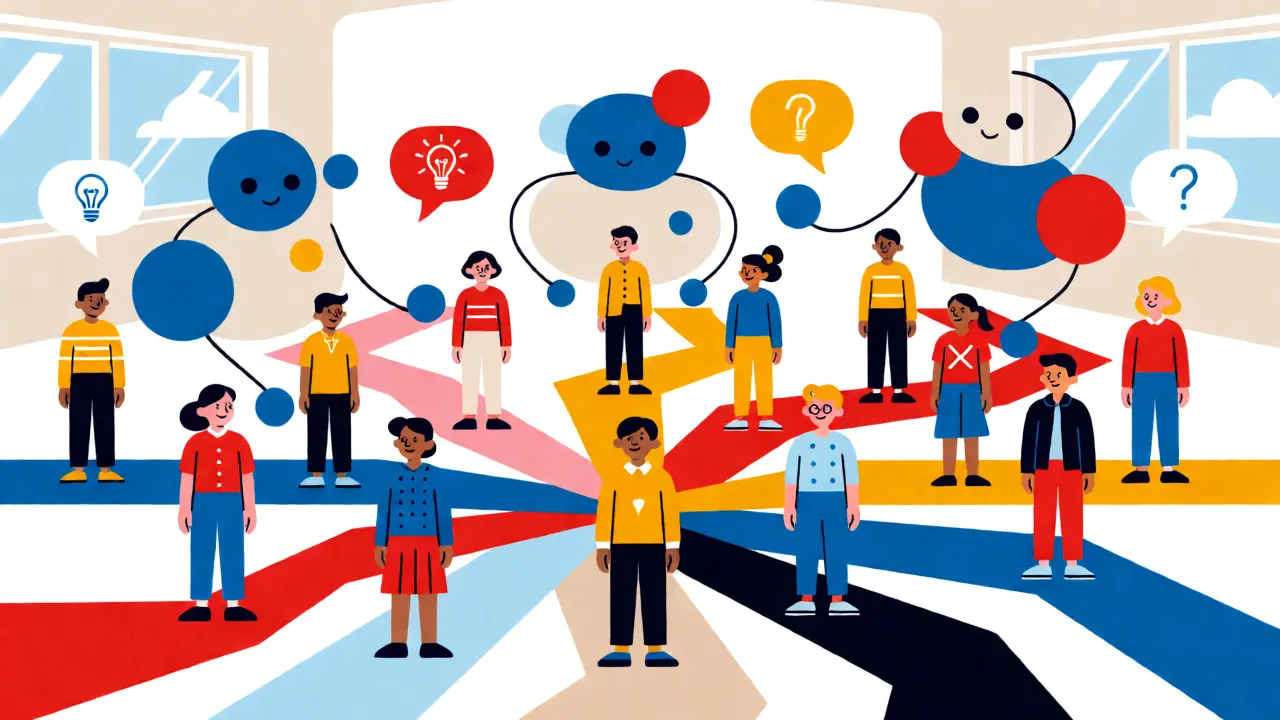
Imagine a classroom of 30 students. In a traditional setting, one teacher tries to address 30 different knowledge gaps, learning styles, and paces simultaneously. It’s mathematically impossible to give everyone the individual attention they need. But what if every student had a tutor available 24/7? That’s not science fiction anymore; it’s the reality being built today with Large Language Models (LLMs). These AI systems are moving beyond simple chatbots to create truly personalized learning paths that adapt in real-time to each learner’s needs.
The shift is already happening. According to a U.S. Department of Education report from October 2025, approximately 42% of K-12 schools in the United States have adopted some form of AI-assisted learning tool. This isn't just about replacing textbooks with screens. It's about solving the age-old problem of differentiated instruction. Tools like SchoolAI and NeuroBot TA are proving that you can scale personalization without scaling teacher burnout. If you’re an educator, parent, or ed-tech enthusiast, understanding how these models work-and where they fail-is crucial for navigating the next decade of education.
What Are Personalized Learning Paths?
Before we talk about the tech, let’s define the goal. A personalized learning path is a customized sequence of educational activities tailored to an individual student’s proficiency level, interests, and pace. Unlike a linear curriculum where everyone moves at the same speed, a personalized path adjusts dynamically. If a student struggles with quadratic equations, the system doesn’t just repeat the lesson; it identifies *why* they are struggling-maybe it’s a gap in factoring skills from two years ago-and backtracks to fix that specific foundation.
Traditional adaptive platforms like DreamBox or Khan Academy do this well for structured subjects like math. They use rule-based algorithms to map progress. However, they often lack conversational flexibility. You can’t ask them, "Why does this matter in real life?" or "Can you explain this using a soccer analogy?" LLMs bridge this gap by combining adaptive logic with natural language understanding, allowing for a dialogue rather than just a quiz.
How LLMs Power Adaptive Tutoring
At their core, LLMs are advanced AI systems trained on massive text datasets that predict and generate human-like text. In education, they function by analyzing student interactions to identify knowledge gaps. When a student answers a question incorrectly, the model doesn’t just mark it wrong. It analyzes the error pattern. Did the student misunderstand the concept, or did they make a calculation slip? Based on this analysis, the LLM generates new content or hints tailored to that specific misconception.
One of the biggest technical hurdles in early AI tutoring was "hallucination"-the tendency for models to invent facts. Recent implementations have tackled this using Retrieval-Augmented Generation (RAG). For instance, a study from Dartmouth’s Geisel School of Medicine published in November 2025 showed that using RAG architecture reduced hallucination rates from 91% down to 12-18%. This means the AI retrieves accurate information from trusted educational databases before generating its response, making it far more reliable for factual recall tasks.
| Metric | LLM-Based Tutoring | Traditional Human Tutoring | Standard Classroom Instruction |
|---|---|---|---|
| Scalability | High (supports hundreds simultaneously) | Low (1-on-1 or small groups) | Medium (limited by teacher capacity) |
| Emotional Cue Detection | Low (43% accuracy) | High (89% accuracy) | Medium (depends on teacher skill) |
| Factual Recall Accuracy | 85-95% (with RAG) | 90-98% | Variable |
| Cost per Student | Very Low | High | Low |
| Availability | 24/7 | Limited by schedule | School hours only |
Real-World Impact: Successes and Failures
Does it actually work? The data suggests yes, but with caveats. Professor Thomas Thesen of Dartmouth demonstrated that his course, supported by the NeuroBot TA platform, could provide individualized support to 190 medical students simultaneously. This level of attention is impossible with human tutors alone. Furthermore, a Gates Foundation study cited in late 2025 found that students in LLM-powered environments were 1.5 times more likely to be engaged and motivated compared to traditional settings.
However, engagement isn’t everything. There is a significant trade-off in emotional intelligence. A January 2026 study in the Journal of Educational Psychology revealed that while human tutors correctly identified student frustration 89% of the time, LLM-based systems managed only 43%. Students reported feeling frustrated when the AI gave plausible-sounding but incorrect answers to complex questions. One medical student noted that asking about rare neurological conditions resulted in wasted study time due to subtle inaccuracies. This highlights a critical rule: LLMs are excellent for practice and reinforcement, but they still require human oversight for nuanced understanding.
Implementation Challenges and Teacher Workload
Adopting these tools isn’t as simple as downloading an app. Teachers report mixed experiences. On one hand, 65% of special education teachers believe AI makes materials more accessible for students with disabilities. For example, text simplification features allow dyslexic students to engage with grade-level content, which one Denver Public Schools teacher described as "transformative." On the other hand, managing over-reliance is a major concern. 71% of teachers in the Gates Foundation study worried that students might use AI to bypass critical thinking rather than enhance it.
To mitigate this, successful implementations follow a phased approach. First, teachers use AI for administrative tasks like drafting emails, saving 2-3 hours weekly. Next, they use it for content differentiation-creating multiple versions of a reading passage at different difficulty levels. Finally, they introduce direct student tutoring. This gradual rollout helps educators build trust in the system and learn how to verify outputs effectively. As Katie Ellis from SchoolAI notes, "Large language models predict text patterns... but lack proper comprehension, making human oversight essential."
The Future: From Answer-Givers to Question-Askers
The next frontier for educational LLMs is shifting from providing answers to guiding discovery. Current models often solve problems for students. Future iterations aim to ask Socratic questions, prompting students to derive solutions themselves. Research priorities now include multimodal integration-combining text, visual, and audio inputs-and long-term student modeling that tracks progress across months or years.
We are also seeing a push toward bias mitigation. Dr. Susan Chen from MIT warned that bias in training data can disadvantage diverse learners, noting a 23% lower accuracy rate for non-native English speakers in standardized testing scenarios. Addressing this requires ongoing evaluation and diverse training sets. With the global AI in education market projected to hit $41.7 billion by 2028, these refinements will determine whether LLMs become standard infrastructure or remain a niche tool.
Are LLMs better than human tutors?
It depends on the goal. LLMs excel at scalability, availability (24/7), and low-cost personalized feedback for factual recall and practice. Human tutors are superior in emotional support, identifying nuanced frustration, and teaching complex social-emotional skills. The best outcomes often come from a hybrid model where AI handles routine practice and humans handle mentorship and complex conceptual guidance.
How do I prevent students from cheating with AI?
Focus on process over product. Instead of grading final answers, grade the interaction history with the AI. Ask students to submit screenshots of their prompts and the AI's responses. Additionally, use AI as a "guide" rather than an "answer key" by configuring tools to offer hints instead of full solutions. Encourage students to critique AI outputs, turning potential cheating into a critical thinking exercise.
What are the privacy risks of using LLMs in schools?
Student data privacy is a top concern, cited by 89% of researchers. Risks include data breaches and the use of student interactions for model training. To mitigate this, choose platforms compliant with FERPA and COPPA regulations. Look for services that offer end-to-end encryption and strict data anonymization practices, ensuring that student identities are not linked to their learning data in third-party servers.
Can LLMs teach subjects like art or physical education?
Currently, LLMs struggle with subjects requiring hands-on experimentation or complex physical feedback. While they can explain art history or biomechanics concepts accurately, they cannot assess the stroke of a paintbrush or the form of a tennis serve. Multimodal AI is improving this, but human instructors remain essential for practical application and creative coaching in these fields.
Do LLMs help students with disabilities?
Yes, significantly. Special education teachers report high satisfaction with AI tools for accessibility. Features like text-to-speech, speech-to-text, and automatic text simplification help students with dyslexia, ADHD, and other learning differences engage with grade-level content. 82% of special education teachers surveyed reported that AI tools helped them meet Universal Design for Learning principles by providing multiple representation formats.





Oh, please. Spare me the utopian nonsense about "personalized paths" when half these models are just hallucinating facts with a smile.
You cite that Dartmouth study reducing hallucinations to 12-18%? That is still a catastrophic failure rate for education! Imagine telling a medical student that a rare condition doesn't exist because the AI got bored of looking it up. We are replacing competent human teachers with expensive autocomplete scripts that have no soul, no intuition, and absolutely no idea what frustration looks like until they've already wasted twenty minutes of your life.
The table clearly shows emotional cue detection at 43%. Forty-three percent! That means more than half the time, the machine thinks you're fine while you're actually ready to throw your laptop out the window. It's not transformation; it's negligence packaged as innovation. Teachers aren't burning out because they don't have enough apps; they're burning out because administration keeps buying shiny toys instead of hiring staff. This isn't the future of education; it's the end of critical thinking, dressed up in a slick interface that charges us subscription fees for mediocrity.
I think the hybrid model mentioned in the FAQ is the only realistic way this works. If you try to go full AI, you lose the nuance, but if you ignore it entirely, you miss the efficiency gains for admin tasks. The scalability stats are impressive on paper, but I'd want to see how it handles students who need actual empathy rather than just data points.
It’s really interesting to see how the phased approach mentioned by Katie Ellis aligns with what we’re seeing in districts that actually succeed, because, honestly, throwing tools at teachers without training is just asking for disaster, and the fact that 65% of special ed teachers find it transformative for accessibility is huge, especially for dyslexic students who can finally engage with grade-level content without drowning in jargon, which is, in my opinion, the biggest win here, even if the emotional detection is lagging behind.
The point about bias mitigation is crucial too, because if non-native speakers are getting lower accuracy rates, then we’re just automating inequality unless we fix the training sets, and that $41 billion market projection feels both exciting and terrifying depending on whether we prioritize pedagogy or profit margins, which is always the question with ed-tech.
YES!! Finally someone gets it! The text simplification feature is literally a game changer for kids with ADHD who get overwhelmed by dense paragraphs, its like magic for their focus levels!
But ugh, the cheating concern is real though, gotta make sure they use it as a guide not an answer key, otherwise they just copy paste and learn nothing, which defeats the whole purpose! Also privacy is scary, hope schools stick to FERPA compliant stuff so our kids data isnt sold to advertisers!
I appreciate the balanced view, but I feel we should be cautious about letting LLMs handle the initial diagnosis of learning gaps. A human teacher can often spot a motivational issue disguised as a knowledge gap, whereas an algorithm might just drill math problems forever. Let's keep the AI as a support tool, not the primary diagnostician.