Chinchilla Scaling Laws: The Compute-Optimal Ratio for LLM Training
You’ve probably heard the old rule of thumb in AI development: bigger is better. For years, the industry chased parameter counts like dragonflies, assuming that if you just made the model larger, it would inevitably get smarter. But what if I told you that some of the most expensive models ever trained were actually undercooked? That’s the uncomfortable truth revealed by Chinchilla Scaling Laws. Introduced by DeepMind researchers in 2022, these laws flipped the script on how we allocate computational resources, proving that data volume matters just as much as model size.
If you’re building or fine-tuning large language models (LLMs), understanding this shift isn’t optional-it’s essential for saving money and boosting performance. This article breaks down the math behind the Chinchilla point, explains why previous giants like GPT-3 were inefficient, and gives you a practical checklist for determining the right size for your next model.
The Core Discovery: Why Data Matters More Than You Think
Before Chinchilla, the dominant wisdom came from Kaplan et al., who suggested that increasing model parameters yielded faster improvements in loss than increasing dataset size. Consequently, companies built massive models but trained them on relatively small datasets. DeepMind’s team challenged this by training over 400 transformer architectures, ranging from 70 million to 16 billion parameters, across various data sizes. Their conclusion was stark: for a fixed compute budget, model size (N) and training tokens (T) should scale equally.
This led to the famous "Chinchilla Ratio." The research established that the optimal relationship is approximately 20 tokens per parameter. If you have 1 billion parameters, you need roughly 20 billion tokens. If you have 10 billion parameters, you need 200 billion tokens. Ignoring this balance means you are either wasting compute on a model too big to learn effectively from its data, or starving a smaller model of the information it needs to generalize.
The Math Behind the Magic
Don’t let the algebra scare you off; the logic is surprisingly intuitive. The total computational cost (FLOPs) of training a transformer model is approximated by the formula C ≈ 6NT, where N is the number of parameters and T is the number of training tokens. To minimize the loss function given a fixed budget C, you must find the sweet spot between N and T.
DeepMind found that the loss function scales with power laws relative to both parameters and data. When they fitted their empirical data, the exponents for both parameters and data ended up being nearly identical (around 0.5). This symmetry implies that doubling your compute budget should result in doubling both your model size and your data size simultaneously. Any deviation-like keeping the model size constant while only adding more data, or vice versa-results in suboptimal performance.
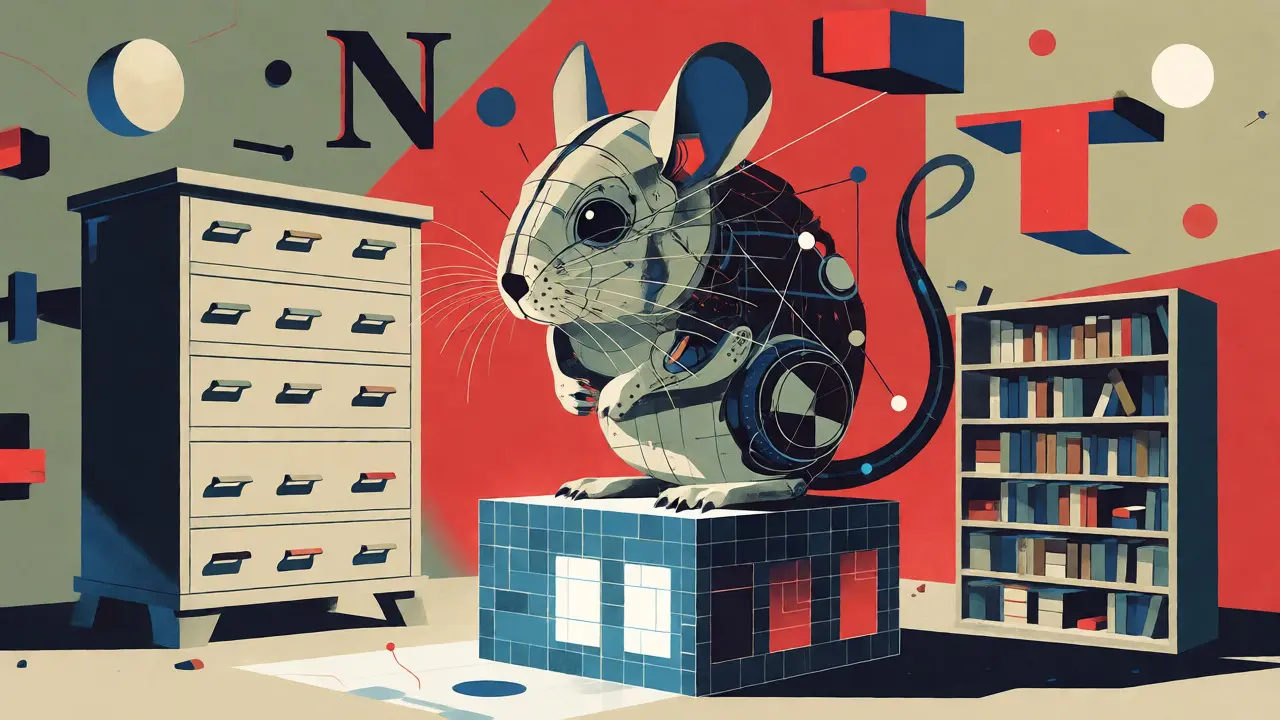
Think of each parameter as a slot in a filing cabinet. If you have 1 billion slots but only enough paper (tokens) to fill half of them, you’ve wasted space. Conversely, if you have 10 billion slots but only enough paper to fill each one halfway, you’ve built a huge cabinet that’s mostly empty. The Chinchilla ratio ensures every slot is filled efficiently.
Case Study: Chinchilla vs. Gopher
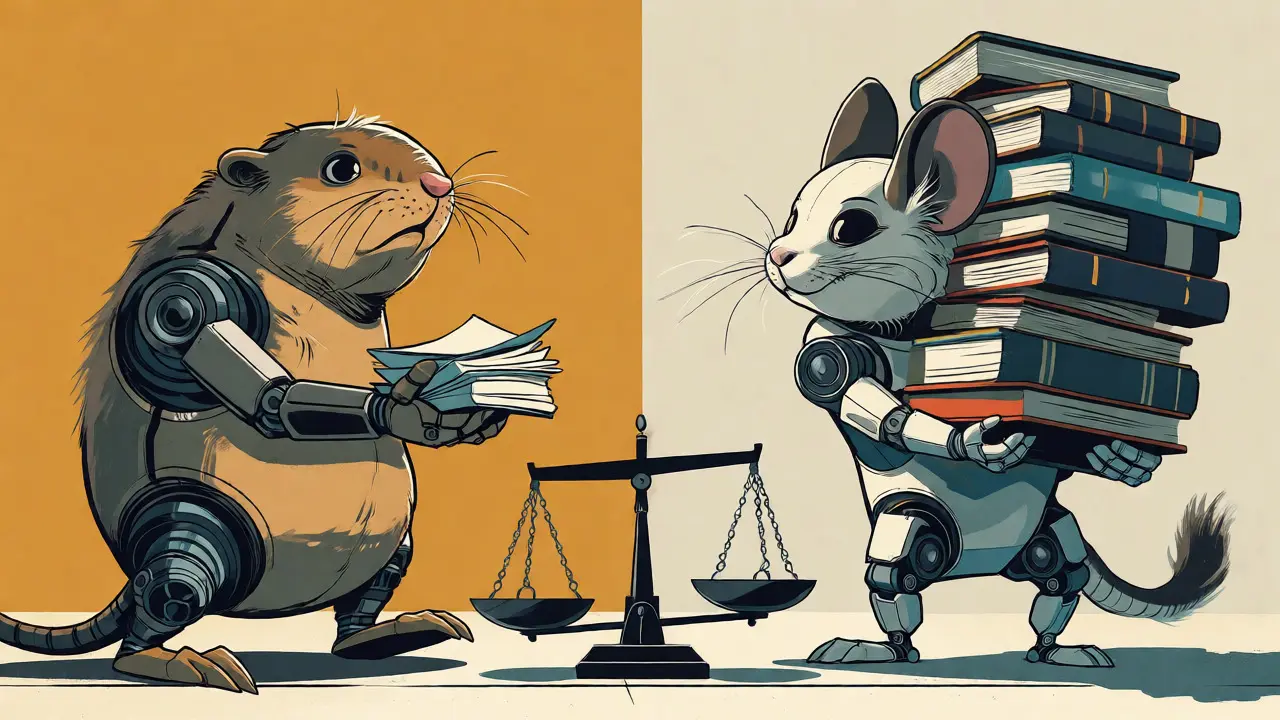
To prove their theory, DeepMind didn’t just run simulations; they built a model. They compared their new model, Chinchilla, against Gopher, a state-of-the-art model at the time. Both had access to similar compute budgets, but their allocations differed drastically:
- Gopher: ~280 billion parameters, trained on fewer tokens.
- Chinchilla: ~70 billion parameters, trained on four times more data.
The results were undeniable. Despite having less than a quarter of the parameters, Chinchilla outperformed Gopher on average by over 7% on benchmarks like MMLU. It achieved an accuracy of 67.5%, setting a new standard. Crucially, because Chinchilla was smaller, it was also cheaper and faster to use during inference. This demonstrated that efficiency isn’t just about training costs; it impacts the entire lifecycle of the model.
Limits and Nuances: Is 20:1 Always Right?
While the 20:1 ratio is a powerful heuristic, it’s not a universal law of physics. Real-world applications introduce variables that DeepMind’s controlled experiments smoothed out. Here’s where the limits kick in:
| Factor | Impact on Ratio | Practical Adjustment |
|---|---|---|
| Data Quality | High-quality, deduplicated data may require fewer tokens per parameter (closer to 15:1). | Curate aggressively; don't just dump raw web scrapes. |
| Architecture Efficiency | Newer architectures (e.g., MoE, Flash Attention) change effective capacity. | Re-evaluate ratios when switching base architectures. |
| Inference Costs | Smaller models are cheaper to serve long-term. | Intentionally deviate to smaller N/higher T to save on serving costs. |
| Downstream Tasks | Specialized tasks might benefit from different pretraining balances. | Tune based on validation loss of specific target tasks. |
Recent replications, such as those by Cerebras-GPT, confirmed the general trend across a wide range of model sizes (111M to 13B parameters). However, they also noted that the exact ratio can drift between 15:1 and 25:1 depending on the diversity of the dataset. If your data is highly redundant (lots of duplicate news articles, for example), you might need more tokens to see the same learning signal. If your data is dense and high-quality (curated textbooks, code), you might get away with fewer.

How to Apply This to Your Next Project
So, how do you use this without needing a PhD in statistics? Follow this simple workflow before you spin up your GPUs:
- Determine your Budget: Calculate your available FLOPs. If you know your GPU count and hours, multiply by the peak FLOPS of your hardware.
- Estimate Model Size: Decide on a reasonable parameter count based on your memory constraints. Remember, smaller is often better for deployment.
- Calculate Required Tokens: Multiply your parameter count by 20. This is your target token count.
- Audit Your Dataset: Do you have enough unique tokens? If you planned for 1 billion parameters but only have 10 billion tokens, your model is too big. Either shrink the model or gather more data.
- Iterate: Train a small proxy model first. Plot the loss curve. If it flattens out quickly, you might be data-limited. If it continues to drop steeply, you might be able to afford a larger model.
One critical pitfall to avoid: confusing pretraining optimality with post-training optimality. Chinchilla laws apply primarily to the pretraining phase. Once you start fine-tuning for specific tasks (like coding or medical advice), the rules change. You might want a larger model with less task-specific data, or a smaller model with extensive augmentation. Don’t rigidly apply the 20:1 rule to your fine-tuning pipeline without testing.
The Future of Scaling: Beyond Static Ratios
As we move into 2026, the conversation has evolved. We aren’t just looking at static ratios anymore. Researchers are investigating dynamic scaling strategies that adjust the data mix in real-time. For instance, curriculum learning-where the model starts with easy data and progresses to hard examples-can alter the effective value of each token. Some studies suggest that mixing diverse domains (code, literature, scientific papers) yields higher returns per token than homogeneous datasets.
Furthermore, the rise of Mixture-of-Experts (MoE) models complicates the picture. In an MoE architecture, not all parameters are active for every token. Does the 20:1 ratio apply to total parameters or active parameters? Early evidence suggests it applies closer to active parameters, but this remains an area of active debate. Keep an eye on emerging benchmarks that separate "total capacity" from "effective capacity."
Ultimately, Chinchilla taught us humility. We spent billions training models that were fundamentally inefficient. By respecting the balance between knowledge storage (parameters) and knowledge input (data), we can build smarter systems that cost less to train and serve. The era of "just make it bigger" is over; the era of "make it balanced" is here.
What is the Chinchilla scaling law?
The Chinchilla scaling law is a set of guidelines discovered by DeepMind in 2022 stating that for optimal performance under a fixed compute budget, the number of model parameters and the number of training tokens should scale equally. This typically translates to a ratio of approximately 20 training tokens for every model parameter.
Why was GPT-3 considered suboptimal according to Chinchilla?
GPT-3 had 175 billion parameters but was trained on significantly fewer tokens than required by the Chinchilla ratio. According to the laws, it should have been trained on roughly 3.5 trillion tokens to be compute-optimal. Instead, it was likely trained on around 300 billion tokens, meaning it was "under-trained" relative to its size, leaving potential performance gains unrealized.
Is the 20:1 ratio always correct?
No, 20:1 is a strong heuristic, not a strict physical law. The optimal ratio can vary between 15:1 and 25:1 depending on data quality, architecture type, and specific downstream goals. High-quality, dense data may require fewer tokens, while noisy, redundant data may require more.
Does Chinchilla scaling apply to fine-tuning?
Primarily, no. Chinchilla scaling laws are derived from pretraining dynamics. Fine-tuning involves different optimization landscapes and usually requires far fewer tokens. Applying the 20:1 rule strictly to fine-tuning would result in excessively long training times for marginal gains.
How does Chinchilla affect inference costs?
By favoring smaller models trained on more data, Chinchilla reduces inference costs. Smaller models require less memory and fewer FLOPs per generated token. Therefore, a Chinchilla-optimal model is not only cheaper to train but also cheaper and faster to deploy in production environments.