
Post-Generation Verification Loops: How Automated Fact Checks Are Making LLMs Reliable
Large language models spit out answers fast. Too fast. And too often, they’re wrong - not because they’re broken, but because they’re guessing. You ask for a code snippet, a medical summary, or a legal clause, and the model gives you something that sounds right but isn’t. That’s not a bug. It’s the default behavior. What if you could make these models check their own work before they finish? That’s where post-generation verification loops come in.
What Exactly Is a Verification Loop?
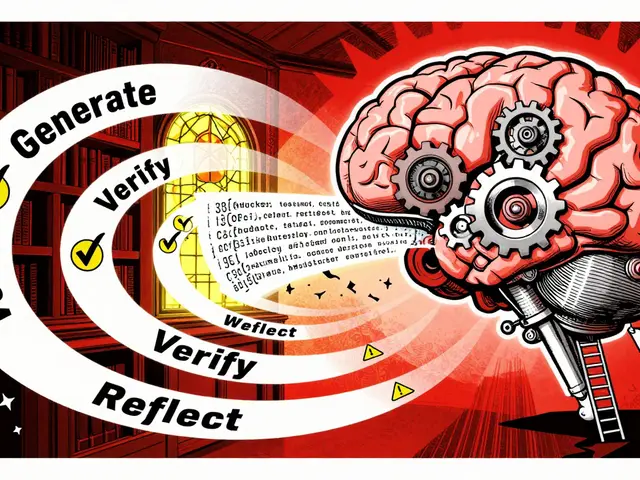
A verification loop isn’t magic. It’s a repeatable system: generate → verify → reflect → repeat. Think of it like a writer who drafts a paragraph, then reads it aloud to catch errors, asks a colleague for feedback, and revises before sending it. LLMs don’t do this naturally. Verification loops force them to. The process has three clear steps. First, the model generates an output - say, a piece of code or a factual claim. Then, automated tools check it. These aren’t simple spell checks. They’re rigorous tests: Does the code compile? Does the claim match trusted sources? Does the logic hold under formal rules? If it fails, the model doesn’t just try again randomly. It reflects. It reviews why it failed, recalls past mistakes, and adjusts its next attempt. This loop runs until the output passes all checks - or gives up after a set number of tries. Stanford’s Clover framework tested this on 150 textbook code examples. Without verification, 87% of LLM-generated code had functional errors. With the loop? That dropped to under 10%. That’s not a small improvement. That’s the difference between a prototype and something you can ship.How Verification Actually Works (No Jargon)
Verification doesn’t rely on one trick. It uses multiple tools working together. For code, it might use Z3, a theorem prover that mathematically proves whether a loop condition will always hold true. For text, it might compare claims against trusted databases like PubMed or official government publications. For images, it checks whether the generated object matches physical laws - like whether a car has four wheels or if shadows line up correctly. One popular method, called consistency checking, looks for contradictions. If the code says a variable is an integer, but the comments call it a string, the system flags it. If the model claims the capital of Brazil is Rio de Janeiro, but verified sources say Brasília, it’s corrected. Clover uses six different consistency checks between code, comments, and documentation. Each one is a filter. One filter catches syntax errors. Another catches logic mismatches. Together, they’re far more reliable than any single check. The reflection phase is what makes loops smarter over time. Instead of just retrying, the model analyzes its own failure. Did it misunderstand the prompt? Did it forget a rule from a past fix? The Emergent Mind team built a system that stores past feedback in a memory cache. Next time the model sees a similar problem, it remembers what went wrong before. This isn’t just learning. It’s cumulative reasoning.Where It’s Working - and Where It’s Not
Verification loops shine in technical domains. In hardware design, companies using the Prompt. Verify. Repeat. method saw signal-name accuracy jump from 58% to 93% - meaning their chip designs stopped having mismatched labels that caused costly manufacturing errors. In finance, banks use loops to verify risk calculations. In software, teams using Clover cut specification-related bugs by 82% after three weeks of setup. But here’s the catch: it doesn’t work well for general knowledge. Try verifying a claim like “Is coffee good for your heart?” The loop can check medical databases, but what if the sources conflict? What if one study says yes, another says no? The model doesn’t understand nuance - it just picks the most frequent answer. A 2023 paper showed these loops only got 31% accuracy on non-technical factual claims. That’s worse than a random guess. Even in code, the system has limits. When given a broken loop invariant and a counterexample, LLMs fixed it only 16% of the time - even when told exactly what was wrong. That’s not because the loop failed. It’s because the model doesn’t have the reasoning depth to fix deep logic errors. It can spot a missing semicolon. It can’t redesign an algorithm.
The Hidden Costs
You can’t just flip a switch and get a verification loop. Setting one up takes time. Developers report spending 8 to 12 hours just learning how to use Dafny or Z3 before writing a single line of verification code. The LLMLOOP framework, designed for Java, fails in 23.7% of cases because it can’t parse non-standard code. Setup with EDA tools for hardware verification can take over 11 hours. Then there’s speed. Each loop iteration adds 8.7 seconds per cycle. Five cycles? That’s 43.5 seconds for one code fix. Single-pass generation takes 2 seconds. So you’re trading speed for safety. For a developer iterating on a prototype? That’s a dealbreaker. For a self-driving car’s control system? Worth every millisecond. And the compute cost? Three to four times more than regular generation. That means higher cloud bills. Most small teams can’t afford it. That’s why adoption is still limited to big tech, finance, and semiconductor companies - places where a single error costs millions.Who’s Using This - And Who Should Be
Right now, the heaviest users are in three areas: semiconductor design (43% of deployments), financial systems (28%), and autonomous vehicles (19%). Why? Because these fields have strict safety rules. A wrong signal in a chip? A miscalculated risk? A misread sensor? All can kill people. The EU AI Act now requires formal verification loops for safety-critical AI code - and that’s just the start. GitHub reports that 18.7% of public repos using LLMs for code now include verification loops. That’s up from 4.2% in 2024. It’s growing fast - but only in the right places. If you’re a startup building a chatbot for customer service? You probably don’t need this. Your users will forgive a wrong answer. But if you’re building a tool that writes medical reports, legal contracts, or nuclear plant control code? You’re already behind if you’re not using loops.
What’s Next
The next leap isn’t just better loops - it’s baked-in verification. Meta AI’s December 2025 report revealed a new architecture called the Verification-Integrated Transformer. Instead of generating first, then checking, the model verifies as it writes. Each token it generates is scored against safety rules in real time. Early tests show this cuts verification steps by over half. Another breakthrough came in January 2025, when Guo et al. introduced outcome-based reward models for image generation. Instead of just checking if an image looks realistic, the system now judges whether it matches the user’s intent - like whether a medical illustration correctly shows tumor boundaries. This turned aesthetic quality scores up by 38.7%. Clover’s latest update (November 2025) fixed its biggest weakness: Dafny syntax. Earlier versions could only generate correct annotations 61% of the time. Now, with automated translation, that’s up to 84%. That’s the kind of progress that turns niche tools into standard practice.Should You Use It?
Ask yourself: What happens if this output is wrong? If the answer is “nothing serious” - like a blog post or social media caption - skip it. The cost outweighs the benefit. If the answer is “someone could get hurt, lose money, or face legal trouble” - then you have no choice. Verification loops aren’t optional anymore in safety-critical fields. They’re the new baseline. You don’t need to build one from scratch. GitHub Copilot Enterprise now includes built-in loops. Clover and LLMLOOP are open source. Emergent Mind’s documentation covers 17 verification strategies. The tools are here. The data proves they work. The only question left is: are you ready to stop trusting guesses?Do verification loops guarantee that LLM outputs are always correct?
No. Verification loops significantly reduce errors, but they don’t eliminate them. LLMs still struggle with deep logical reasoning - for example, fixing complex algorithmic flaws even when given perfect feedback. Success rates for invariant repair hover around 16%, meaning most serious bugs still require human intervention. Loops make outputs far more reliable, but they’re not a substitute for human oversight in high-stakes scenarios.
Can verification loops be used for fact-checking general knowledge, like history or science?
They’re weak here. Verification loops work best with structured, rule-based systems like code or hardware specs. For open-ended facts - like “Did Napoleon win the Battle of Waterloo?” - the system can cross-check databases, but it can’t resolve conflicting sources or interpret ambiguity. Studies show accuracy drops to 31% on non-technical claims. Human judgment is still needed to weigh evidence, interpret context, and spot bias.
How much more computational power do verification loops require?
Each full iteration cycle uses about 3.2 times more compute than a single-generation pass. A five-cycle loop can add 8-10 seconds per task and increase cloud costs by 4-5x. That’s manageable for enterprise systems with dedicated AI infrastructure, but prohibitive for small teams or consumer apps. Efficiency gains from techniques like iRank (which cuts verification steps by 64%) help, but the overhead remains a major barrier to widespread use.
What tools are needed to set up a verification loop?
It depends on the domain. For code: Z3 theorem prover, Dafny for specification, PMD for static analysis, and a retrieval system like RepoGenReflex. For text: trusted knowledge bases (e.g., PubMed, official government datasets), natural language inference models, and reward models. For images: physics-based validators and aesthetic scoring systems. Frameworks like Clover and LLMLOOP bundle these tools, but setup still requires 8-12 hours of learning for non-experts.
Is this just for developers, or can non-technical teams use it too?
Currently, it’s mostly for technical teams. Setting up loops requires understanding formal verification tools, code analysis, and prompt engineering. But tools like GitHub Copilot Enterprise are starting to hide the complexity behind simple UIs. In the next two years, we’ll see verification loops built into platforms for legal document review, medical reporting, and financial compliance - allowing non-coders to benefit without touching a line of code.
Are there any legal requirements to use verification loops?
Yes, in some cases. The EU AI Act’s February 2025 guidance requires formal verification through closed-loop processes for safety-critical AI systems - including those used in healthcare, transportation, and public infrastructure. In the U.S., industries like aviation and finance are moving toward similar standards. If your AI system affects human safety or legal rights, you’re likely already expected to use verification loops - whether you realize it or not.


lol this whole verification loop thing is just band-aiding a broken system. LLMs are glorified autocomplete engines, and you’re telling me we’re gonna fix their hallucinations by making them re-read their own garbage? The 16% success rate on invariant repair says it all. They don’t reason-they pattern-match. And now we’re paying 4x more compute to make them guess better? Give me a break.
ok but like… i just want my chatbot to tell me if pizza is good for hangovers, not write a 500-line formal proof for it 😅 why are we making everything so complicated? i’m not building a rocket, i’m asking for recipe suggestions.
I think the real win here isn’t about perfection-it’s about predictability. Even if the loop only catches 70% of errors, at least you know the output isn’t random anymore. In high-stakes environments, that’s huge. The cost is real, sure, but so is the cost of a single uncaught bug in a medical or aviation system. Maybe it’s not for everyone, but for the right use cases? It’s not optional anymore.
Oh wow. So we’re now paying $400/hour in cloud fees so an LLM can ‘reflect’ on why it wrote ‘Brasília is the capital’ instead of ‘Rio’? And you call this ‘progress’? This isn’t AI-it’s AI with a therapy session. The fact that this is being sold as a ‘solution’ is the real scam. Next they’ll charge us extra for the LLM to apologize after it gets it wrong.
Let me break this down plainly: verification loops aren’t about making LLMs perfect-they’re about making them *trustworthy enough* for critical tasks. If you’re writing a legal contract, a medical summary, or firmware for a pacemaker, you don’t want ‘probably right.’ You want ‘verified right.’ The 8-12 hour setup is a one-time cost. The cost of a single error? That’s ongoing. Start with GitHub Copilot Enterprise’s built-in loop. Don’t build from scratch. Use what’s already working.
Man, this is the future and we’re still arguing over whether to turn it on? Verification loops are like seatbelts for AI-you don’t need them when you’re just cruising around town, but when you’re doing 120mph on a highway with 200 lives onboard? You better buckle up. The fact that we’re even debating this is wild. We’re not talking about typos-we’re talking about lives, lawsuits, and legacy code that kills. If you’re not using this, you’re not being responsible. You’re just lazy.
They’re lying. This isn’t about safety-it’s about control. Big Tech wants you to think verification loops make AI safe so you stop asking questions. But what if the ‘trusted sources’ they’re checking against are rigged? What if PubMed, government databases, even Z3 are all fed manipulated data? This loop isn’t fixing errors-it’s locking you into a system that decides what’s ‘true.’ Wake up. They’re not building tools. They’re building cages.
Just a quick note: the part about Dafny syntax being fixed to 84% accuracy? Huge. I spent three days last month trying to get Clover to parse a simple loop invariant and it kept failing on semicolons. This is the kind of quiet progress that actually matters. Stop yelling about costs-focus on how much time this saves devs who aren’t PhDs in formal methods. We’re getting there.