RoPE vs ALiBi: Modern Positional Encodings for LLMs
Ever wondered why your large language model starts hallucinating or losing coherence when you feed it a document longer than what it saw during training? It’s not just about memory size; it’s about how the model understands where words sit relative to each other. For years, we relied on simple absolute position embeddings, but they hit a hard ceiling. Enter Rotary Position Embeddings (RoPE) and Attention with Linear Biases (ALiBi). These aren't just tweaks; they are fundamental shifts in how transformers handle sequence order, enabling the long-context capabilities we see in models like Llama and Falcon today.
The Problem with Absolute Positions
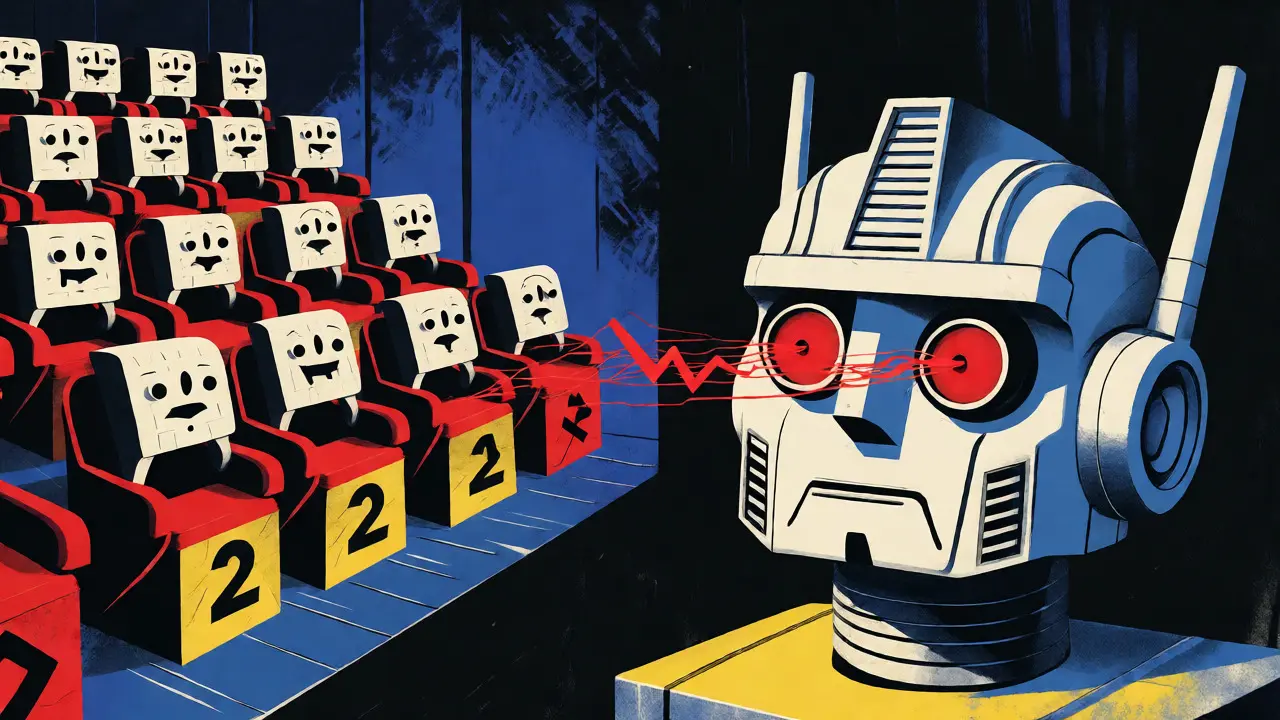
Standard transformers are permutation invariant. If you shuffle the words in a sentence without telling the model the original order, it sees them as identical inputs. To fix this, early architectures added positional encodings directly to word embeddings. Think of it as tagging each word with its seat number in a theater. The problem? This approach mixes semantic meaning with positional data. When you try to extend the context window beyond what was seen in training, these absolute tags break down. The model has never seen "seat number 5000" if it only trained up to "seat number 2048," leading to erratic attention patterns. Both RoPE and ALiBi solve this by decoupling position from content, handling distance logic inside the attention mechanism itself.
How Rotary Position Embeddings Work
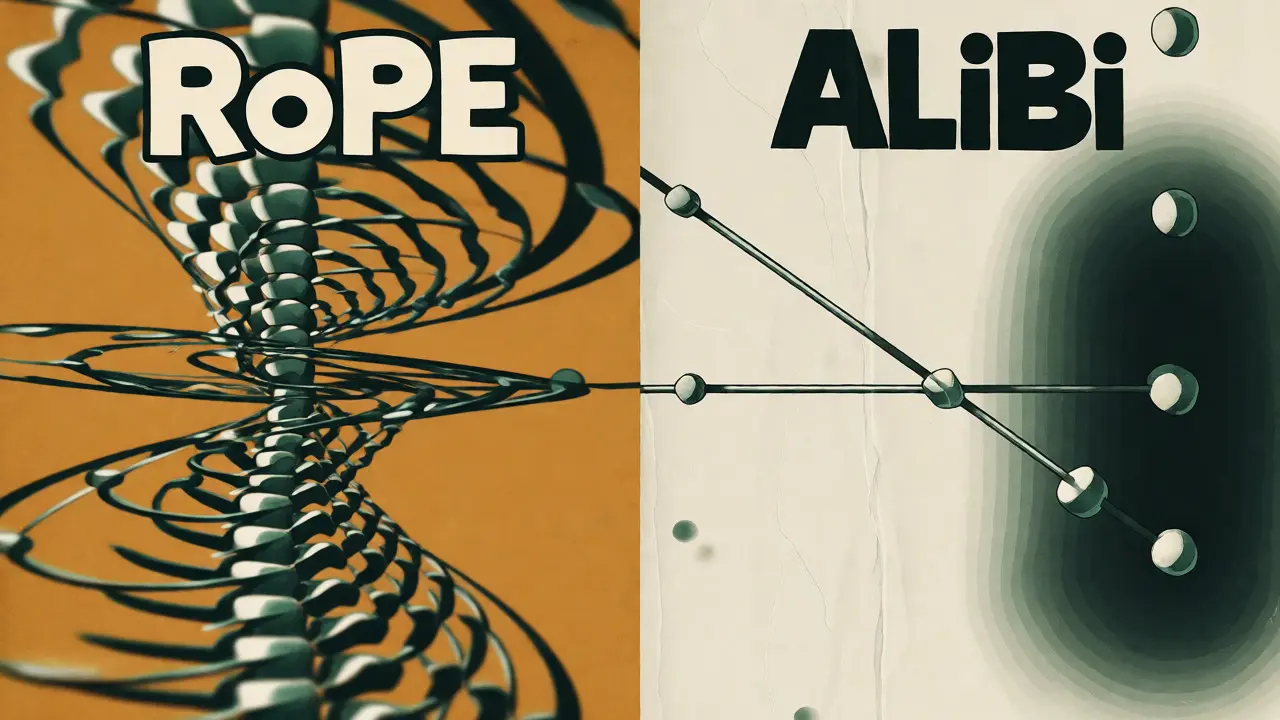
RoPE is currently the industry standard for open-source LLMs. Instead of adding a position vector to the token embedding, RoPE rotates the query and key vectors based on their position. Imagine every token's representation as a point in space. As the position increases, you rotate that point around the origin by an angle proportional to its index. When the attention mechanism calculates the dot product between two tokens, the result depends only on the difference in their angles-essentially, their relative distance. This mathematical elegance means RoPE naturally captures relative positions without needing extra learnable parameters. It scales beautifully because rotation properties hold true regardless of how far apart two points are, provided the frequency bands are tuned correctly.

ALiBi: Simplicity Through Linear Bias
ALiBi takes a different, arguably simpler route. It removes positional embeddings entirely from the input layer. Instead, it adds a penalty to the attention scores based on the linear distance between the query and key tokens. If two words are far apart, the attention score gets subtracted by a value proportional to that distance. This introduces an inductive bias towards locality-the idea that nearby tokens are more relevant than distant ones. Unlike RoPE’s trigonometric rotations, ALiBi uses straightforward arithmetic. It requires zero additional parameters and no lookup tables, making it incredibly efficient to implement and compute.
| Feature | RoPE | ALiBi |
|---|---|---|
| Core Mechanism | Rotation matrices applied to Q/K | Linear bias added to Attention Scores |
| Parameter Count | Zero (fixed frequencies) | Zero (fixed slopes) |
| Extrapolation Strength | Moderate (requires scaling tricks) | High (inherent linear decay) |
| Computational Cost | Slightly higher due to trig ops | Lower due to simple addition |
| Notable Adopters | Llama, Falcon, Mistral | GPT-NeoX, BLOOM |
Extrapolation: Handling Longer Contexts
This is where the rubber meets the road. Most users want to process documents much longer than the model's training window. ALiBi shines here. Because its penalty grows linearly with distance, the model learns a robust pattern of ignoring very distant tokens. You can push ALiBi models to context lengths 10x or even 20x larger than training with minimal performance drop. RoPE struggles more with pure extrapolation. Since it relies on specific frequency bands, extending the sequence length can cause aliasing issues where high-frequency components wrap around unpredictably. However, techniques like Dynamic NTK Scaling have largely patched this hole for RoPE, allowing modern implementations to stretch contexts effectively by adjusting the base frequency during inference.
Implementation and Adoption
If you're building a new model today, RoPE is likely the safer bet. It integrates seamlessly into existing Flash Attention kernels and has become the de facto standard for general-purpose language modeling. Its ability to preserve relative position information makes it versatile for tasks requiring precise local structure understanding. ALiBi, while slightly less common in the latest frontier models, remains a favorite for scenarios where computational efficiency and extreme extrapolation are critical. It’s also easier to debug because the attention penalties are explicit numbers rather than abstract rotational angles.
Which One Should You Choose?
Don't view this as a winner-takes-all battle. RoPE offers better theoretical guarantees for relative position encoding and fits well into hybrid architectures combining attention with recurrent layers. ALiBi offers brute-force simplicity and superior raw extrapolation capability out of the box. If you are fine-tuning a model for massive document analysis where speed is paramount, test ALiBi variants. For general chatbots and code generation where nuanced relative understanding matters, stick with RoPE. The field is moving toward hybrids, but knowing the distinct strengths of each helps you troubleshoot when your long-context results start drifting.
Why do LLMs fail at long contexts with old positional embeddings?
Old absolute embeddings assign unique vectors to specific positions. If a model trains on sequences up to 2048 tokens, it has no learned representation for position 5000. When fed longer inputs, the model encounters unseen position vectors, causing attention mechanisms to behave erratically and lose track of dependencies.
Does RoPE require more computation than ALiBi?
Slightly, yes. RoPE involves sine and cosine calculations for rotation, which are computationally heavier than the simple addition used in ALiBi. However, with optimized kernels like Flash Attention, this difference is often negligible compared to the overall cost of matrix multiplications in large models.
Can I switch from RoPE to ALiBi in a pre-trained model?
Not easily. The weights are trained assuming a specific positional encoding scheme. Switching usually requires retraining or significant fine-tuning because the attention heads have learned to interpret signals under the previous geometric or linear assumptions.
What is Dynamic NTK Scaling?
It is a technique used to improve RoPE's extrapolation. By dynamically adjusting the base frequency of the rotation matrices during inference, it prevents high-frequency aliasing, allowing RoPE-based models to handle context lengths significantly longer than those seen during training.
Is ALiBi still used in state-of-the-art models?
Yes, though less dominantly than RoPE. Models like GPT-NeoX use it. It remains popular in research settings focused on extreme length generalization and in systems where minimizing parameter count and computational overhead is the primary constraint.