
Source Selection Policies for RAG: Balancing Relevance and Diversity
Imagine asking your company’s AI assistant about a specific compliance regulation. It gives you one clear answer, citing the most popular document in your database. Sounds efficient, right? But what if that document is outdated, or worse, misses a critical exception mentioned in a less-cited but highly relevant internal memo? This is the classic trap of traditional Retrieval-Augmented Generation (RAG) systems. They prioritize relevance above all else, often creating an echo chamber where the same few documents are retrieved over and over, blinding the model to diverse perspectives.
We’re living through a shift in how we build these systems. As of late 2025, the industry has moved past simple "top-k" retrieval. The new standard involves sophisticated source selection policies that balance relevance with diversity. According to Chitika’s 2025 industry benchmark report, while 78% of enterprises still use basic relevance-only approaches, those who have adopted balanced systems see accuracy improvements of 23-37%. In high-stakes fields like healthcare and law, this isn’t just a nice-to-have feature; it’s a safety requirement.
The Problem with Single-Source Retrieval
Most early RAG implementations relied heavily on cosine similarity. If a query matches a document vector closely, that document gets pulled into the context window. The problem? The top five results often say the exact same thing in slightly different words. Gartner’s 2025 analysis found that 63% of current implementations suffer from 40-60% content redundancy in their top results.
This redundancy creates blind spots. Consider a legal researcher looking for precedent cases. A relevance-only system might return ten cases from the majority jurisdiction because they share common keywords. But what if the winning argument relies on a minority jurisdiction’s interpretation? A single-source approach misses this entirely. Dr. Sarah Chen, Chief AI Scientist at Innovatiana, noted in her October 2025 IEEE interview that static retrieval reinforces biases by over-prioritizing frequently accessed data. In medical research, this can be dangerous. Alternative perspectives are often buried in less-cited studies, yet they hold the key to diagnosing rare conditions.
How Maximum Marginal Relevance (MMR) Works
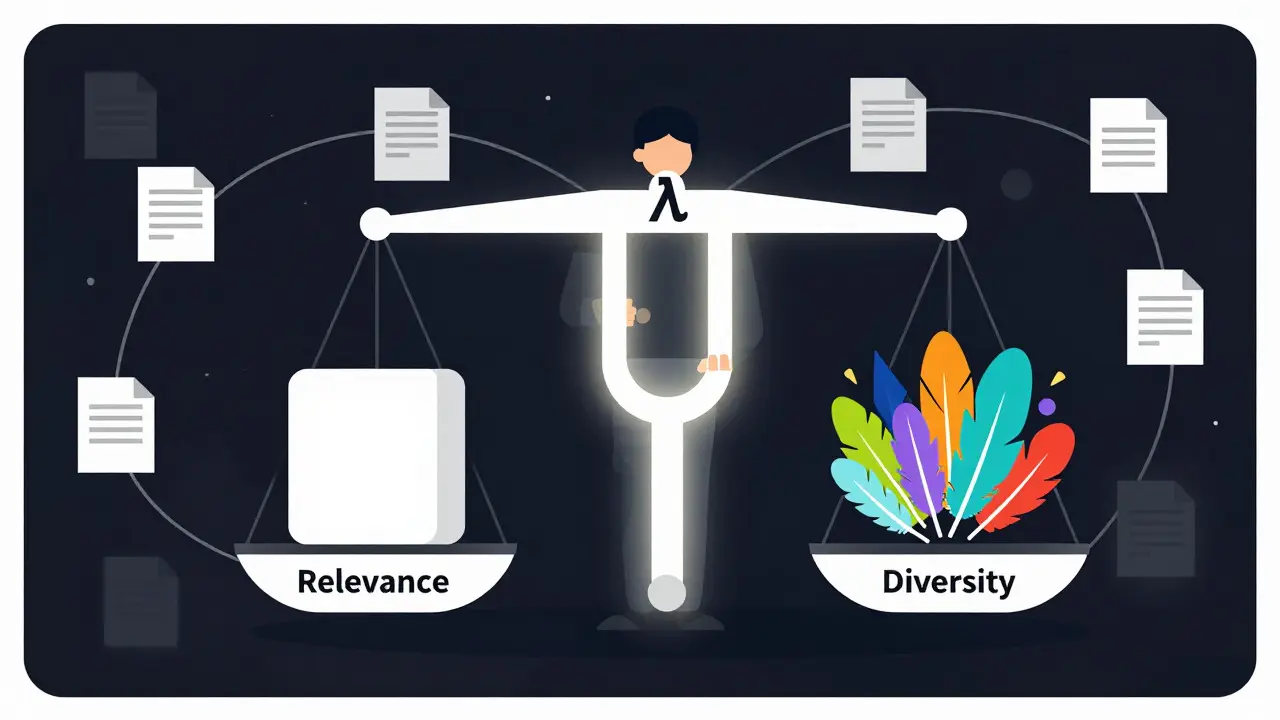
To fix this, engineers turned to Maximum Marginal Relevance (MMR), a technique adapted for RAG by Microsoft Research in 2022. Think of MMR as a smart filter that asks two questions simultaneously: "Is this document relevant to the user's question?" and "Does this document add new information compared to what I’ve already selected?"
MMR uses a mathematical formula with a lambda parameter (λ) to control the balance. This parameter typically sits between 0.4 and 0.7.
- High Lambda (0.7+): Prioritizes relevance. Good for factual queries where precision is paramount.
- Low Lambda (0.4-0.5): Prioritizes diversity. Useful for exploratory searches or creative tasks.
The ACM’s 2024 study showed that properly calibrated MMR increased distinct single-word coverage from 52% to 62%. That might sound small, but in the context of complex reasoning, those extra unique concepts are often the difference between a correct answer and a hallucination. By penalizing redundancy, MMR forces the system to look beyond the obvious hits.
Balancing Act: Technical Trade-offs
Nothing comes for free. Adding diversity calculations increases computational load. Farthest Point Sampling (FPS), another geometric optimization technique referenced in arXiv 2025 paper 2502.09017, achieves similar goals to MMR but requires 30-40% more processing power. Multi-objective optimization approaches, which treat relevance and diversity as competing goals using Pareto efficiency principles, demand even more resources-up to 3.7x more processing power than basic retrieval.
However, users seem willing to pay this latency tax. Amit Kothari’s 2025 research demonstrated that 78% of professionals prefer slightly slower responses (adding 200-400ms) if they come with transparent attribution of multiple sources. Azure AI Search’s January 2025 update achieved an average response time of 920ms while maintaining 87% relevance and 79% diversity metrics. For enterprise applications operating within 800-1200ms latency constraints, this is acceptable.
| Strategy | Semantic Accuracy | Content Redundancy | Avg. Latency Impact |
|---|---|---|---|
| Single-Source (Cosine Similarity) | 91% | 40-60% | Baseline |
| MMR-Enhanced Balanced | 90% | 15-25% | +200-400ms |
| Farthest Point Sampling (FPS) | ~90% | <15% | +30-40% Compute |
Implementation Challenges and Real-World Friction
Knowing the theory is easy; implementing it is hard. MindStudio’s 2025 survey of 153 organizations revealed that the learning curve for balanced source selection averages 8-12 weeks for experienced teams. The biggest hurdles aren’t the algorithms themselves, but the integration mess.
Gartner identified authentication, permissions management, and handling disparate data formats as the top three barriers, responsible for 68% of failed implementations. When you pull from three different sources-a vector database, a SQL backend, and a proprietary API-you need federated authentication and robust conflict resolution protocols. What happens when Source A says the deadline is Friday, and Source B says it’s Monday?
Successful implementations, according to Kothari’s case studies, don’t try to auto-resolve these conflicts. Instead, 73% of them show both perspectives with transparent attribution. This transparency builds trust. On Reddit’s r/MachineLearning forum, a healthcare administrator shared that seeing three different studies with slightly different recommendations for rare cancers made them feel "equipped to make better decisions" rather than confused. Users value the nuance.
Expert Consensus and Best Practices
There is no one-size-fits-all lambda setting. The IEEE’s 2025 RAG Best Practices Guide recommends starting with λ = 0.55-0.65 for general enterprise applications. However, domain-specific adjustments are crucial:
- Healthcare: Higher relevance weighting (λ = 0.60-0.70). Dr. Elena Rodriguez of Stanford AI Lab warned that over-emphasizing diversity in emergency medicine can introduce distracting, marginally relevant information. Safety first.
- Creative/Exploratory Tasks: Higher diversity weighting (λ = 0.45-0.55). Here, you want unexpected connections and novel ideas.
- Financial Forecasting: Dr. Marcus Reynolds at MIT showed that balanced systems reduced bias in financial predictions by 37%. A moderate balance prevents herd mentality in data interpretation.
Dr. Reynolds’ work in Nature Machine Intelligence (March 2025) highlights that diversity isn’t just about variety; it’s about reducing systemic bias. Static models often amplify the biases present in their training data. By forcing the retrieval engine to consider underrepresented sources, you mitigate this risk.

Future Trends: Adaptive and Causal Reasoning
The technology is moving fast. We are seeing a shift from static parameters to adaptive mechanisms. Google’s Gemini Enterprise 2.5 (Q1 2026 release) features dynamic thresholding that adjusts relevance scores in real-time based on user feedback. If a user consistently clicks away from diverse results, the system learns to tighten the relevance filter.
Microsoft’s January 2026 Azure AI Search update introduced adaptive lambda adjustment based on query type. Preliminary testing shows an 18% improvement in user satisfaction. Meanwhile, Anthropic’s 2026 roadmap includes "causal diversity scoring," which prioritizes sources offering different causal explanations for phenomena. This moves beyond keyword overlap into true logical diversity.
Regulatory pressure is also driving adoption. The EU’s 2025 AI Act requires transparent source attribution for high-risk applications. Balanced source selection policies naturally provide this transparency, making them not just technically superior, but legally safer. IDC projects the RAG market will reach $14.7 billion by 2027, with balanced source selection growing at 41.2% annually.
Getting Started: A Practical Checklist
If you’re ready to move beyond basic retrieval, start small. Don’t boil the ocean. Follow these steps to implement a balanced policy without breaking your existing infrastructure:
- Audit Your Current Redundancy: Run a sample of 100 queries through your current system. Calculate the semantic overlap between the top 3 results. If it’s above 50%, you have a problem.
- Start with Two Sources: Integrate MMR between your primary vector store and one secondary source (e.g., a knowledge base or recent chat logs). Nail the integration and attribution before adding more.
- Set Conservative Defaults: Begin with λ = 0.6. Monitor user feedback and error rates. Adjust up for precision-heavy tasks, down for exploration.
- Implement Transparent Attribution: Show users where each piece of information came from. Use UI cues to distinguish between high-relevance and high-diversity sources.
- Handle Conflicts Explicitly: Build logic to detect contradictory information. Display both sides rather than guessing which is right.
By balancing relevance and diversity, you transform your RAG system from a simple search tool into a nuanced decision-support engine. It’s harder to build, yes. But as the data shows, the payoff in accuracy, trust, and reduced bias is worth every millisecond of added latency.
What is the ideal lambda parameter for MMR in enterprise RAG systems?
The IEEE’s 2025 guidelines recommend a lambda (λ) between 0.55 and 0.65 for general enterprise use. For healthcare or safety-critical applications, increase it to 0.60-0.70 to prioritize relevance. For creative or exploratory tasks, lower it to 0.45-0.55 to encourage diverse ideas.
How much does implementing balanced source selection increase latency?
Balanced systems typically add 200-400ms to response times. While this seems significant, studies show that 78% of users accept this delay if the output includes transparent attribution of multiple sources and higher overall accuracy.
Why do traditional cosine similarity retrievals fail in complex domains?
Cosine similarity prioritizes lexical and semantic overlap, leading to high redundancy (40-60% in top results). This creates blind spots where critical but less-common information is ignored, causing errors in fields like law or medicine where nuance matters.
What are the biggest challenges in deploying MMR-based RAG systems?
The top barriers are integration complexity, specifically managing authentication across disparate systems, handling different data formats, and resolving conflicts between sources. These issues account for 68% of failed implementations according to Gartner.
How does diversity in source selection reduce AI bias?
By forcing the system to retrieve from underrepresented or less-frequently accessed sources, diversity counters the echo chamber effect. MIT research showed this approach reduced bias in financial forecasting by 37% by preventing the model from relying solely on dominant narratives.









Look, I’ve been wrestling with this exact issue in our legal tech stack for the past six months and let me tell you, the industry is moving way too slow on this. We switched from a basic cosine similarity setup to an MMR-based pipeline last quarter and the difference in client satisfaction was night and day. It’s not just about getting the right answer; it’s about not missing the nuance that lives in those obscure internal memos nobody reads. The redundancy problem is real, folks. You think you’re saving compute by pulling the top five hits, but you’re actually burning money on hallucinations later when the model misses a critical exception clause because it never saw the minority jurisdiction case. Stop treating retrieval like a static lookup table and start treating it like a dynamic reasoning process. Your users are smarter than your current architecture gives them credit for.
oh my gosh this is such a huge topic!! i love how they broke down the lambda parameter stuff 🤓 its wild to think that weve been ignoring diversity in search results for so long without realizing it was basically creating an echo chamber for AI. like imagine if every time you asked a question you only heard one side of the story because the algorithm decided it was the most popular opinion? scary right?? 😱 i feel like this applies to social media algorithms too honestly. we need more balance everywhere! also did anyone else notice the part about healthcare being a safety requirement? that made me shiver a little bit. cant wait to see how this evolves in the next year or two 🚀
It's all hype. Most enterprises don't care about diversity. They care about speed and cost. If you add 400ms latency to every query, your churn rate will skyrocket before you even finish tuning your lambda parameter. The benchmarks cited here are cherry-picked academic scenarios, not messy production environments. Keep dreaming.
@Art HND typical cynic. You’re confusing consumer-grade chatbots with enterprise decision support systems. In high-stakes fields like law or medicine, a 400ms delay is negligible compared to the cost of a malpractice suit or a failed compliance audit. You want fast? Go back to keyword search. But if you want accuracy that doesn’t lie to you, you pay the latency tax. It’s basic risk management, something your comment clearly lacks.
I totally agree with Dave here. I work in healthcare IT and we literally had a near-miss last year where the RAG system pulled an outdated guideline because it was the most cited document in our vector DB. The newer, less-cited memo had the correction but got buried because it didn't have the same keyword density as the old standard. Switching to MMR saved us. It’s not just nice to have, it’s critical. Also, the typo-prone nature of some of these comments makes me wonder if people are actually reading the technical details or just skimming for buzzwords lol. Just saying. 😉
This article presents a compelling argument, yet it fails to address the fundamental architectural limitations of current vector databases. While Maximum Marginal Relevance (MMR) is a step forward, it is merely a band-aid on a deeper systemic issue: the inability of embedding models to truly capture semantic nuance across diverse domains. Furthermore, the claim that 78% of enterprises use basic relevance-only approaches suggests a staggering level of incompetence within the C-suite of major corporations. One must ask: who is responsible for this oversight? Is it the engineers, or the executives who prioritize short-term gains over long-term reliability? The data presented is intriguing, but the narrative feels slightly sensationalized. Nevertheless, the call for balanced source selection is undeniably correct. We must demand better from our technology providers.
i think the real issue is that we keep trying to solve a human problem with math. diversity isnt just about statistical variance in vectors its about perspective. mmr helps sure but does it really understand context? probably not. still useful though
great points everyone. i think alex hit the nail on the head there. its not just math its about understanding what the user actually needs. i started using a hybrid approach recently mixing mmm with some semantic clustering and it works wonders. keeps things fast but also broad. highly recommend giving it a try if you havent already. no need to overcomplicate it just tweak the parameters and see what sticks. good luck with your projects!
It is quite fascinating to observe how the discourse has shifted towards acknowledging the necessity of diversity in information retrieval. As professionals, we often become so entrenched in optimizing for single metrics that we lose sight of the holistic user experience. The comparison between Single-Source retrieval and MMR-enhanced systems is particularly illuminating. It reminds me of the importance of interdisciplinary collaboration in our daily work. When we bring together different perspectives, much like the diverse documents retrieved by a balanced RAG system, we arrive at more robust and resilient solutions. Let us continue to advocate for these nuanced approaches in our respective organizations. Thank you for sharing this insightful analysis.